How to Get an AI Tutor: A Practical Guide

If you have been wondering how to get an AI tutor, you are not alone. Interest has surged across schools, universities, and professional programs. Artificial intelligence is no longer a fringe experiment in education. It has become a practical tool that students and lifelong learners use every day.

AI tutoring platforms now operate at scale. Universities integrate them into courses. Schools deploy them across districts. Professionals use them to build new skills outside traditional classrooms. The appeal is simple. You gain access anytime. You learn at your own pace. You receive instant feedback instead of waiting hours or days.

Some systems can even generate full courses in seconds, tailored to your goals. That efficiency is powerful, but it also requires thoughtful setup. In this blog, you will explore how to choose the right platform, configure it properly, personalize your learning journey, and use safeguards responsibly.


What Is the First Step to Getting an AI Tutor?

Before you download an app or create an account, pause. The first step in learning how to get an ai tutor is not technical. It is strategic. You need clarity.

Start by defining your goal. Are you trying to master algebra, prepare for a history test, complete a coding project, or build new skills for professional growth? AI tutors can generate personalized learning paths in seconds, but they rely on your input. Vague goals produce vague results.

Next, identify your subject range. Math and science often benefit from structured problem solving. Humanities and social studies require deeper discussion and context. Coding demands practice and iteration. The tool adapts, but only if you define the terrain.

You should also clarify your level. A K-12 student preparing for exams needs different support than a university learner or a professional in workforce training.

Finally, decide if you want quick homework help or a full structured course. Many AI systems can create complete learning programs instantly, but some free plans limit access.

Essential steps to follow before getting an AI tutor are:

  • Define Your Subject: Math, science, coding, history, social studies, or professional skills.
  • Set Your Leve: K-12, university, lifelong learning, workforce training.
  • Clarify Your Objective: Homework help, test prep, mastering concepts, building new skills.


Where Can You Find an AI Tutor Platform?
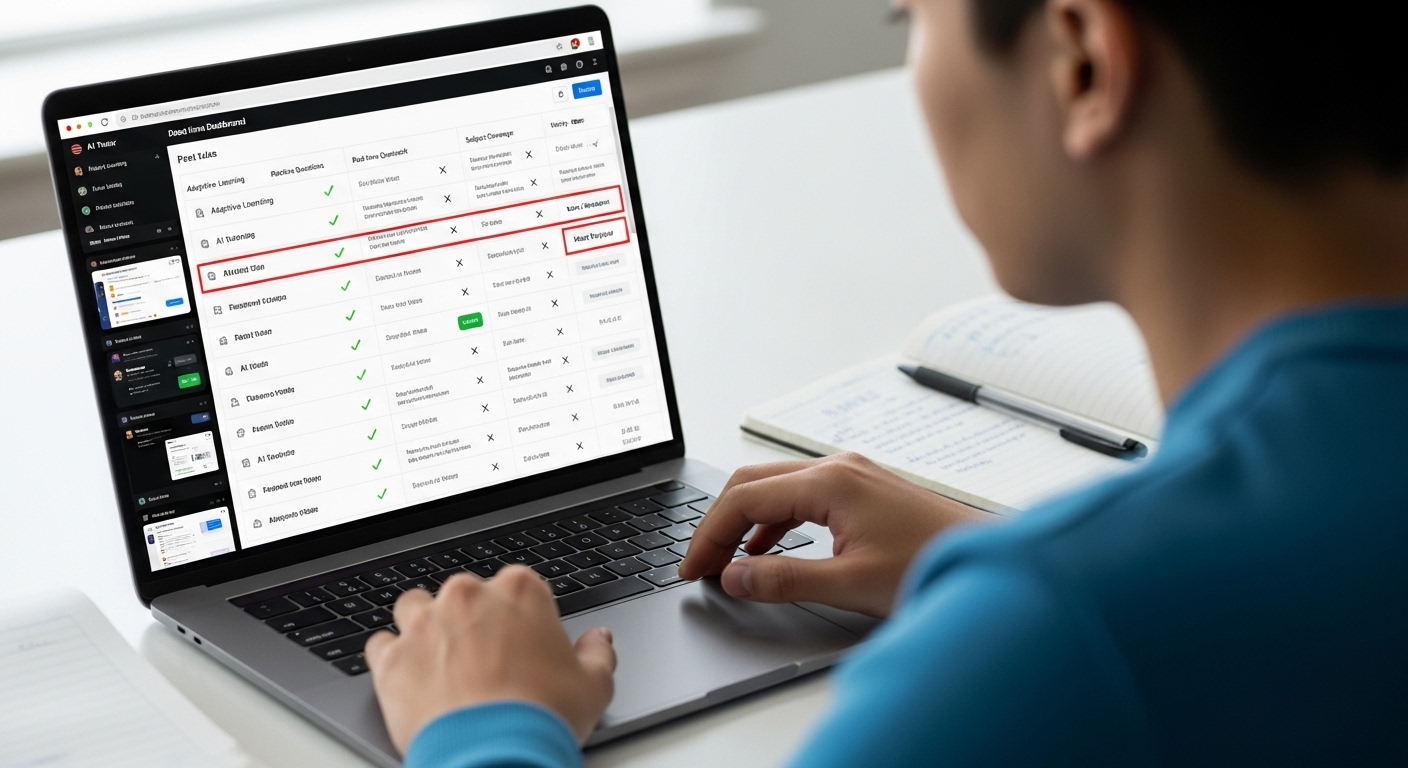
Student comparing multiple AI tutor platforms on laptop screen with feature comparison dashboard.

Once you know your goal, the next question becomes practical. Where do you actually get an AI tutor?

You generally have two paths. The first includes general AI chat platforms. These tools allow you to sign up, create an account, and begin asking homework questions almost immediately. Some offer a free plan with limited usage. They are flexible, but often less structured.

The second path involves education-specific AI tutors built for schools, districts, and universities. These platforms are designed with curriculum alignment, secure access, and faculty oversight in mind. They often require institutional login or paid access, but the structure is stronger.

For example, Khanmigo requires paid access and follows a teach-not-tell approach. Class Companion supports over 25,000 schools across America and automates grading for teachers. Tutor AI focuses on individual learners and can create personalized courses instantly, often through a free plus paid tier model. AI Tutor platforms have been used by more than 23 universities.

Structured solutions like CoTutor are built specifically for institutional integration, offering guided learning and safeguards rather than just quick answers.

Platform Best For Access Model Notable Feature
CoTutor Schools & Universities Institutional Structured guidance & safeguards
Khanmigo K-12 & College Institutional Teach-not-tell approach
Class Companion Schools & Teachers Paid Automates grading
Tutor AI Individual Learners Free + Paid Instant course creation


How Do You Set Up an AI Tutor for Maximum Personalization?

If you want real personalization, configuration matters more than you might expect. Start by creating an account and using a secure login, especially if your school or university provides institutional access. Once inside, avoid hopping between multiple chat threads.

Maintain one consistent conversation so the AI can connect past questions with new ones. Continuity strengthens your learning path.Next, upload context. Add your syllabus, lecture notes, or homework questions. The more specific your materials, the more accurate the feedback.

Many AI systems analyze uploaded data to tailor explanations and adjust difficulty levels based on performance. Over time, they track progress with detailed analytics, highlighting strengths and gaps.

Then configure the tone. Instruct the AI to guide you with hints rather than deliver final answers. Use Socratic prompting. Ask it to pose questions back to you. Request quizzes, flashcards, and practice material. Many systems can generate these instantly and adapt difficulty as your performance improves.

Steps to Setup AI Tutor for maximum personalization:

  • Create an Account: Sign up securely and verify your profile.
  • Upload Course Materials: Add syllabus, homework questions, lecture notes.
  • Set Guardrails: Instruct AI to guide with hints, not final answers.
  • Track Progress: Use analytics to measure improvement over time.


How Do AI Tutors Personalize Your Learning Journey?
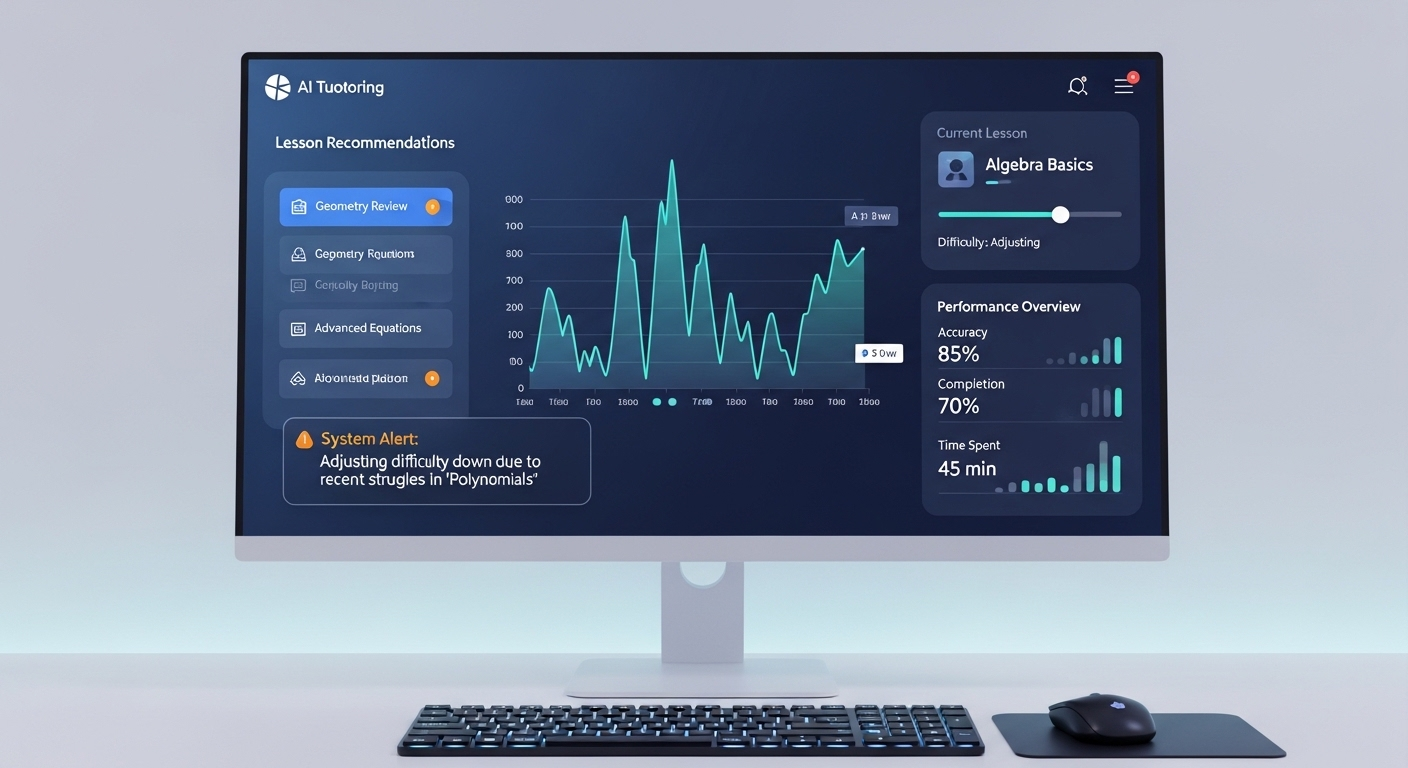
AI tutoring dashboard dynamically adjusting lesson difficulty based on real-time student performance analytics.

Adaptive learning systems sit at the core of most modern AI tutors, constantly analyzing your responses, pace, and patterns. Every answer becomes data. Every hesitation becomes a signal. The system continuously assesses performance and adjusts task difficulty in real time, so you are neither overwhelmed nor bored.

This creates what feels like differentiated coaching. If you struggle with math concepts, the AI can slow down, offer step-by-step feedback, and provide additional practice. If you master a topic quickly, it increases complexity. The learning pace adapts to you, not the other way around.

Many platforms also support multilingual explanations, which expands access for learners across different regions. Unlimited retakes on quizzes encourage engagement rather than punishment. You refine, retry, and improve.

Students often report increased confidence when they receive instant feedback. Mistakes are corrected immediately, not days later. That immediacy strengthens understanding and produces measurable learning gains. Over time, progress becomes visible, and you achieve mastery through structured, personalized guidance rather than guesswork.


Are Free AI Tutors Enough, or Should You Consider Paid Options?

Free AI tutors can be useful, especially when you are exploring how to get an AI tutor without immediate cost. Many platforms offer a free plan with basic access, limited chat sessions, and simple homework help. For light use, that may be enough.

But free access usually comes with usage caps. You may face daily limits, slower responses during peak demand, or restricted analytics. Progress tracking is often minimal. If you want deeper insights into performance trends or consistent feedback over time, the free tier can feel thin.

Paid plans expand that range. Higher usage limits, unlimited retakes, and more advanced analytics allow you to study without interruption. Some platforms follow tiered pricing models that unlock additional features gradually. Khanmigo, for example, requires payment to access its full functionality.

Institutional solutions often include secure infrastructure, faculty integration, and structured safeguards. The cost reflects stability and oversight. If your learning goals are serious or long term, paid access may offer a more reliable and scalable solution.


What Risks Should You Be Aware of When Getting an AI Tutor?

Student looking thoughtfully at AI tutor screen with subtle warning icons representing risks and responsibility.

AI tutors can accelerate learning, but they are not flawless. One obvious concern is accuracy. These systems generate answers based on patterns in data, not lived understanding. Occasionally, they produce incorrect explanations that sound convincing. If you submit those answers without verification, mistakes can compound.

There is also the risk of over reliance. When instant solutions are always available, critical thinking can weaken. You may begin to copy rather than understand. That habit erodes long-term skill development.

Bias is another factor. AI systems reflect the data they were trained on, which means subtle cultural or informational bias can appear in responses. Awareness matters.

Finally, privacy and data compliance require attention. If you are using AI within a school or university, the platform must meet secure standards and follow regulations such as FERPA. Student data should never be treated casually.


Why Structured AI Tutors Like CoTutor Offer More Control and Safeguards?
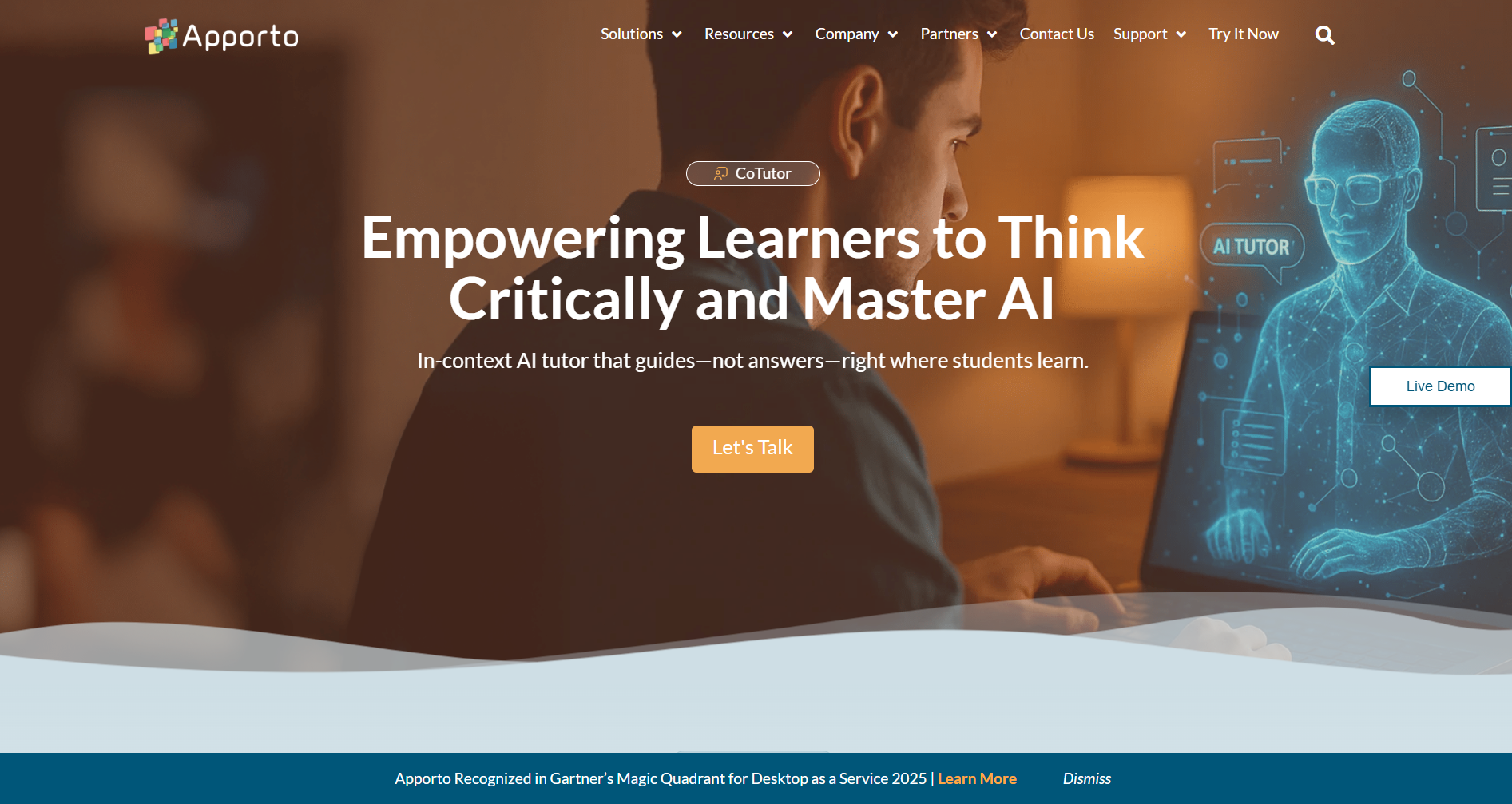
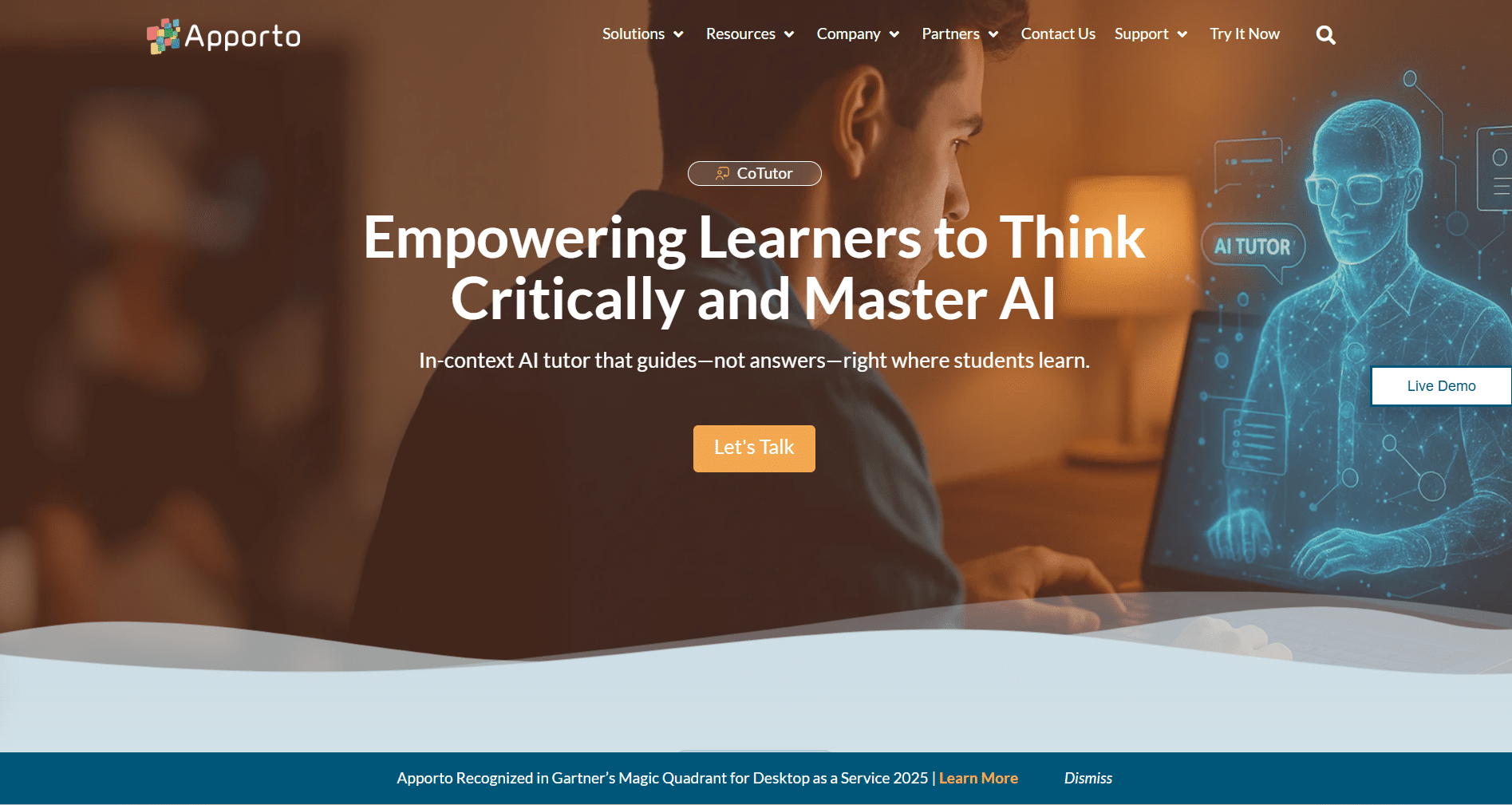
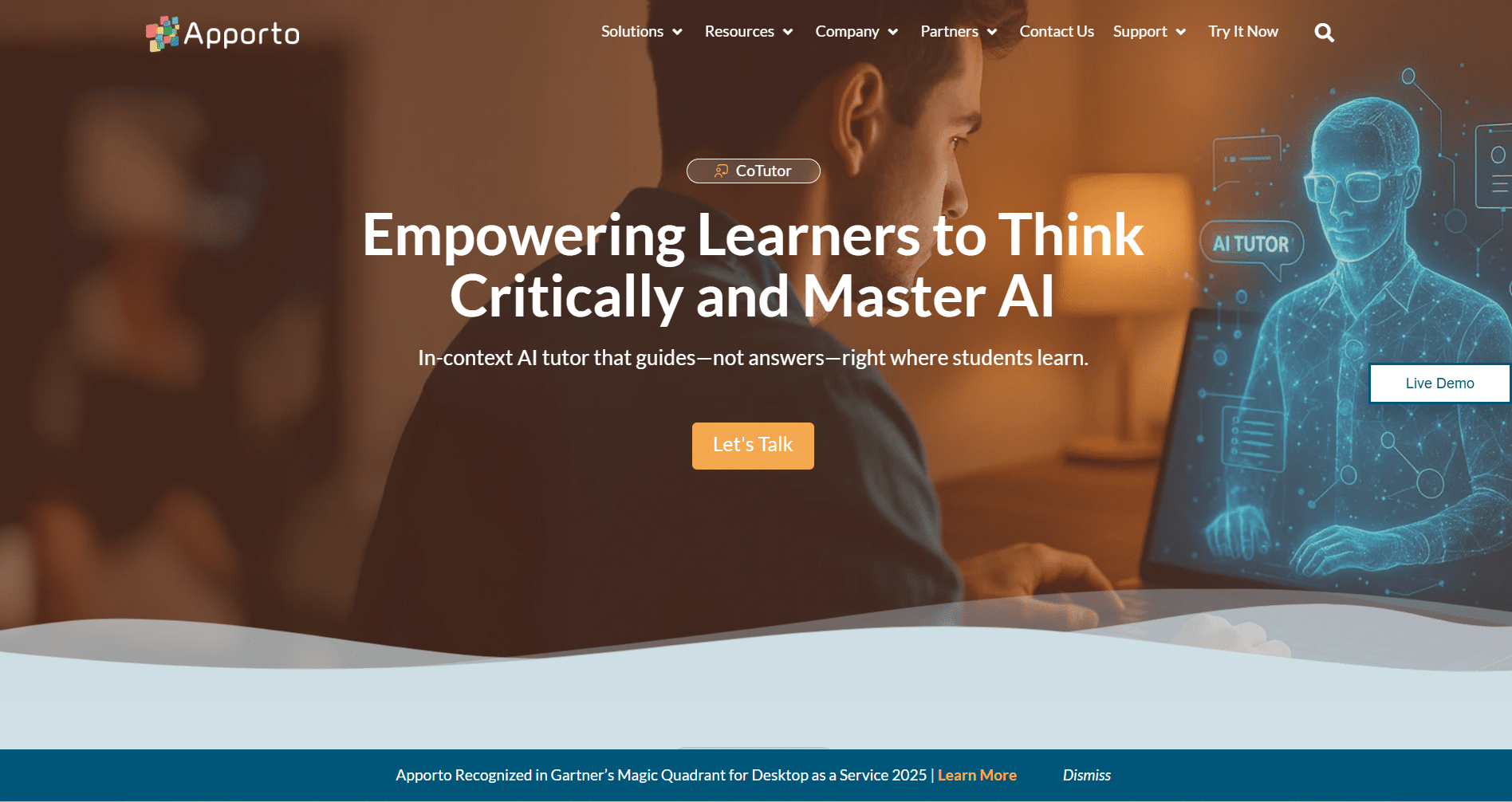
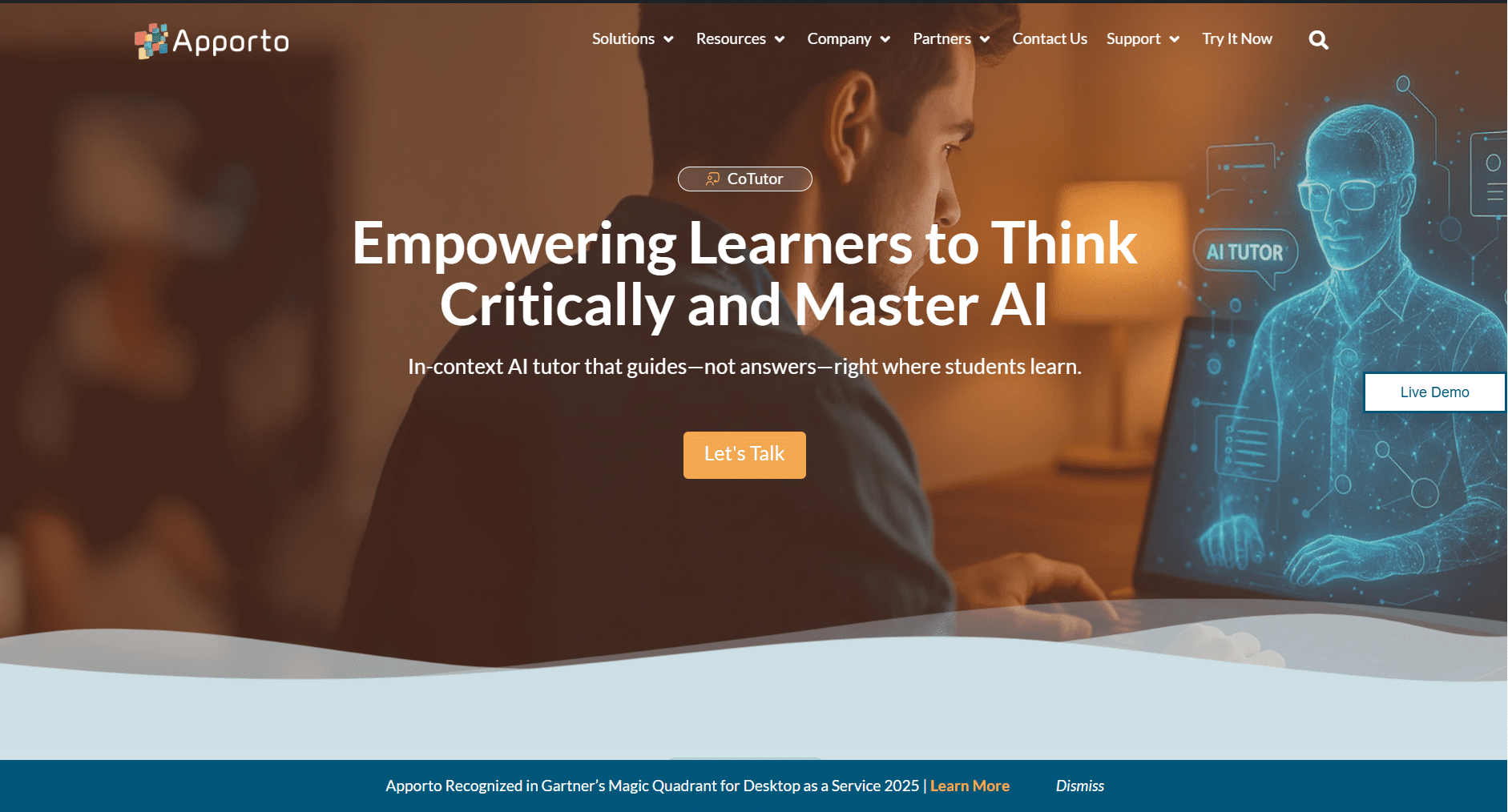
Apporto Cotutor page showing a student using a laptop alongside a holographic AI tutor interface with the headline “Empowering Learners to Think Critically and Master AI.”

Not all AI tutors are designed with institutions in mind. Some operate as open chat tools, useful but loosely governed. Structured systems likeCoTutor take a different approach. They are built specifically for schools, districts, and universities where accountability matters.

Faculty oversight plays a central role. Educators can configure prompts, align lessons with curriculum standards, and establish guardrails that prevent answer dumping. Instead of handing you final solutions, the platform delivers structured guidance that supports understanding first. That distinction protects academic integrity.

Secure institutional integration is another advantage. Access is controlled, student data is protected, and compliance standards are maintained. For universities and districts, that security is nonnegotiable.

Most importantly, CoTutor supports a structured learning journey. You move through concepts intentionally, with educator-configured checkpoints that maintain engagement without compromising integrity. The result feels balanced. You gain the efficiency of AI, but within a framework that respects the role of faculty and the long-term goals of education.


Final Thoughts

Getting started is simpler than it first appears. Define your goal, choose the right platform, configure it carefully, and stay consistent in how you use it. An AI tutor can expand access, generate practice, and deliver fast feedback, but responsibility still sits with you.

Verify important answers. Cross-check facts. Use the tool to understand concepts rather than shortcut assignments. The strongest results come from a hybrid model, where AI supports repetition and structure while teachers guide deeper thinking.

If you want a more structured, institution-ready solution, CoTutor offers a secure and guided starting point.


Frequently Asked Questions (FAQs)


1. How do you get an AI tutor for free?

You can start with general AI chat tools that offer a free plan. These platforms usually require a simple account sign up and provide limited daily usage. Free access often includes basic homework help and short conversations, but may restrict advanced analytics, unlimited questions, or deeper personalization features.

2. What is the best AI tutor platform for students?

The best platform depends on your needs. Generic chat tools offer flexibility, while structured solutions used by schools and universities provide stronger safeguards and curriculum alignment. Institutional platforms such as Apporto CoTutor integrate with faculty oversight, making them more suitable for formal education environments.

3. Can AI tutors create full courses?

Yes. Many AI tutors can generate structured courses instantly based on your goals, grade level, and prompts. You can request lessons, quizzes, practice exercises, and even project outlines. The quality improves when you provide detailed context and clearly defined learning objectives.

4. Do AI tutors track your learning progress?

Most modern AI tutors track progress using adaptive learning systems. They analyze performance data, adjust difficulty in real time, and provide feedback insights. Over time, analytics reveal strengths, weak areas, and patterns in understanding, helping you refine your learning path.

5. Is it safe to use AI tutors in schools and universities?

AI tutors can be safe when platforms follow secure data practices and comply with regulations such as FERPA. Schools and universities should choose systems with controlled access, faculty oversight, and privacy safeguards. Structured platforms like CoTutor are designed with institutional security standards in mind.

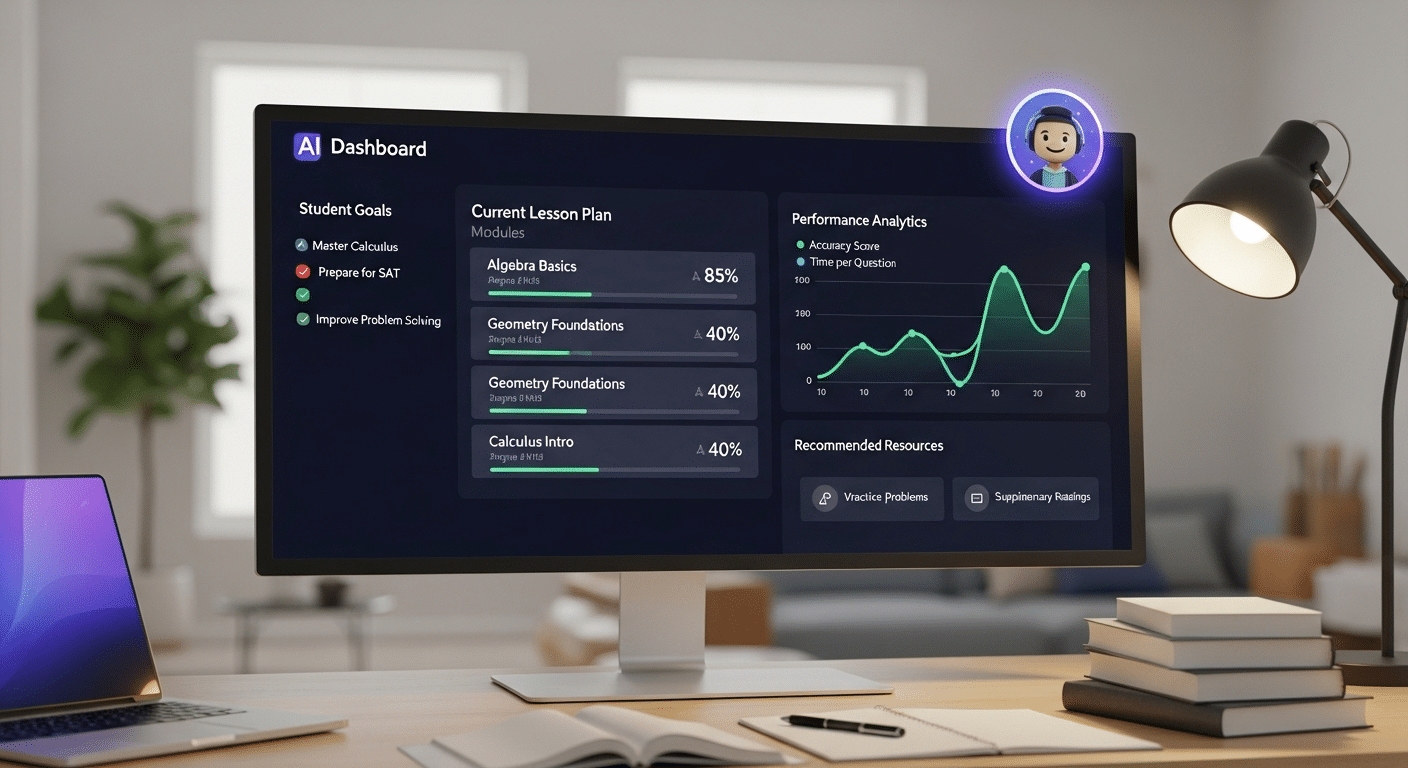
How to Choose an AI Tutor With Smart Learning Features

If you are trying to figure out how to choose an ai tutor with smart learning features, you are entering a fast-moving space. The global AI tutor market is projected to grow from $1.63 billion in 2024 to nearly $7.99 billion by 2030. That growth is not accidental. It reflects demand. Students struggle to get consistent 1:1 attention. Traditional tutoring remains expensive and limited in availability. Artificial intelligence has stepped in to fill that gap.

AI tools now offer instant feedback, adaptive lessons, and targeted practice across subjects. Schools and universities are integrating AI into mainstream education. Parents are exploring AI tutor apps at home. Professionals are using them to build new skills after hours.

But scale does not equal quality. Not all AI tutors are designed equally. Some simply provide answers. Others guide thinking. In this blog, you will explore what truly defines smart learning features and how to evaluate an AI tutor with clarity and confidence.


What Makes an AI Tutor Truly “Smart”?

A truly smart system relies on adaptive learning technology. That means it does not deliver the same lesson to everyone. It analyzes student data, evaluates patterns in performance, and adjusts the level of difficulty accordingly.

If you struggle with algebraic equations, the system slows down and offers structured reinforcement. If you master a concept quickly, it increases complexity. The experience evolves.

Personalized learning paths are another marker of intelligent tutoring. Instead of random practice questions, you receive lessons aligned to your learning goals. Some advanced platforms build internal knowledge graphs that track mastery of interconnected concepts, mapping strengths and gaps over time. That structure prevents fragmented understanding.

Predictive analytics adds another layer. By analyzing past interactions, the AI can anticipate where you might struggle next and introduce targeted practice before confusion deepens. Contextual understanding matters too. A quality system remembers previous questions and preferences, creating continuity rather than isolated exchanges.

Smart does not mean flashy. It means intentional design.

  • Adaptive Practice Adjusts difficulty based on your performance.
  • Progress Tracking Monitors mastery and suggests targeted practice.
  • Contextual Memory Remembers past interactions and preferences.
  • Predictive Analytics Anticipates areas where students may struggle.


How Do Smart AI Tutors Personalize Your Learning Experience?

Adaptive AI tutor dashboard customizing lessons based on student goals and performance data.

Personalization is where smart systems begin to separate themselves from generic chat tools. A well-designed AI tutor aligns instruction directly with your learning goals. If you are preparing for standardized tests, the system prioritizes targeted practice. If you are trying to understand abstract concepts in physics or writing, it shifts toward deeper explanation and structured reasoning.

Adjustment happens in real time. As you answer practice problems, the AI analyzes mistakes and provides instant feedback. It does not simply mark answers wrong. It offers step by step breakdowns, explains concepts clearly, and introduces follow up questions that test comprehension. That continuous loop of action and correction strengthens retention.

Learning style also matters. Some students absorb information visually, others through structured text, others through interactive problems. Smart AI tutors support multiple formats, presenting lessons through explanations, diagrams, quizzes, and guided exercises. Many platforms also include multilingual capabilities, expanding access and reducing barriers.

Engagement determines results. Students who actively interact, ask follow up questions, and request clarification see better outcomes than those who passively consume answers. Personalized tutoring is not automatic. It responds to your effort. When used deliberately, it becomes a dynamic learning experience rather than a static exchange.


Should You Choose an AI Tutor Over a Human Tutor?

This question deserves a careful answer. A human tutor brings qualities that artificial intelligence cannot replicate. Emotional intelligence stands at the top of that list. A human tutor can sense frustration, hesitation, or confidence in subtle ways.

They provide encouragement, adjust tone, and offer human support that builds trust. Traditional tutoring also allows for spontaneous discussion that moves beyond structured lessons.

AI tutors, however, introduce advantages that are difficult to ignore. Availability is constant. You receive consistent support at any hour, not just during scheduled sessions. Instant feedback arrives the moment you submit a response.

There is no waiting period. Scalability also changes the equation. AI systems can provide personalized tutoring to thousands of students simultaneously, something human teachers cannot realistically manage alone.

Cost plays a practical role. Human tutoring often requires significant financial investment and scheduling coordination. AI tools, by contrast, offer scalable pricing and broader access.

The strongest outcomes often emerge from a hybrid approach. Use AI for structured practice, targeted repetition, and quick correction. Rely on human tutors and teachers for emotional guidance, deeper dialogue, and complex reasoning. Each serves a distinct function.

Feature AI Tutor Human Tutor
Availability 24/7 Limited hours
Emotional Intelligence Limited High
Personalized Practice Adaptive algorithms Manual
Cost Scalable Often expensive
Progress Tracking Automated dashboards Manual feedback


What Smart Learning Features Should You Look For?

Student reviewing AI tutor platform with smart feature checklist including adaptive learning and step-by-step feedback.

Once you understand the difference between basic and intelligent tutoring, the next step is evaluation. Not all AI tools offer the same depth. Some provide quick answers. Others are designed to strengthen understanding over time. Your focus should be on key features that directly support your learning goals.

Adaptive learning technology should be at the top of your list. The system must adjust difficulty based on performance. If every lesson feels identical regardless of progress, the tool is not truly responsive. Smart tutors monitor student data continuously and refine practice accordingly.

Step by step feedback is equally critical. You need more than a correct or incorrect label. A strong AI tutor explains mistakes clearly, walks through reasoning, and helps you identify where thinking went off course. Targeted practice builds from those insights, reinforcing weak areas rather than repeating mastered material.

Natural language conversation matters as well. A tutor should understand follow up questions and rephrase explanations when confusion persists. Contextual memory allows the system to remember past interactions, creating continuity in your learning experience. Some advanced platforms map mastery through knowledge graph tracking, identifying gaps across interconnected concepts.

Integration with learning management systems such as Canvas or Google Classroom improves usability. Finally, secure data practices ensure student information is protected under regulations like FERPA and GDPR.


How Important Is Progress Tracking and Predictive Analytics?

Progress tracking is not a cosmetic feature. It is the backbone of intelligent tutoring. Without structured monitoring, an AI tutor becomes little more than a reactive answer engine. With it, the system begins to resemble a learning partner.

Intelligent progress monitoring analyzes your performance across lessons, quizzes, and assignments. It identifies knowledge gaps that may not be obvious at first glance. You might complete math practice problems correctly while still misunderstanding a foundational concept. A smart system detects that pattern and recommends targeted practice before the gap widens.

Predictive analytics adds another layer of sophistication. By examining prior responses and difficulty patterns, the tutor anticipates where you are likely to struggle next. It proactively introduces reinforcement exercises or simplified explanations. That foresight can be especially valuable when preparing for standardized tests, where cumulative mastery matters.

Most advanced AI tutors create structured quizzes and adjust difficulty dynamically. They highlight mistakes in context, explaining not only what went wrong but why. Immediate feedback strengthens retention, while adaptive difficulty keeps you challenged without overwhelming you.

Progress is not just recorded. It is interpreted. And that interpretation makes all the difference.


How Do You Evaluate Quality and Reliability?

Student critically evaluating AI tutor platform with checklist for accuracy, privacy, and institutional backing.

Choosing between AI tutors requires more than comparing features. You need to evaluate quality and reliability with the same care you would apply to any educational tool.

Start by examining data sources. Quality AI tutors rely on credible academic content, peer-reviewed materials, or structured curriculum frameworks. If a platform is vague about where its knowledge comes from, caution is warranted.

Artificial intelligence systems can occasionally generate incorrect responses, sometimes referred to as hallucinations. These answers may sound confident but contain factual errors. Cross-checking explanations against trusted textbooks or reliable references protects you from misinformation.

Institutional endorsements offer another signal. Platforms used by schools or universities typically undergo additional scrutiny. That does not guarantee perfection, but it suggests a baseline of accountability.

Transparency about training data and model design also matters. Reputable providers explain how student data is handled and whether information is used to train models.

Privacy policies deserve attention. Compliance with FERPA and GDPR is essential when student data is involved. Secure data practices should be explicit, not implied.

  • Check Institutional Backing: Endorsements from schools or universities.
  • Review Privacy Policy: Transparency about student data usage.
  • Test Accuracy: Cross-reference answers with trusted sources.


Do Smart AI Tutors Support Different Subjects and Learning Styles?

A smart AI tutor should not be confined to a narrow subject area. Strong platforms provide coverage across math, science, writing, reading, and languages, allowing you to move between disciplines without switching tools. That versatility matters if your learning goals evolve.

At the same time, some AI tutors are designed specifically for certain age groups or academic levels. Platforms like LittleLit focus on younger learners, blending structured lessons with age-appropriate support. Higher education tools, including those integrated with publishers such as Macmillan Learning, often align closely with university course materials. Context matters.

Learning style also deserves attention. Some students respond best to written explanations. Others benefit from visual aids or interactive problem solving. Advanced systems now support multi-modal interaction, including handwriting recognition for math equations or voice input for conversational practice. These features expand accessibility.

Mobile apps extend availability further. You can review practice questions, track progress, or revisit explanations anytime. For educators and parents, broad subject coverage combined with adaptable delivery creates consistent support across different learning preferences. The goal is not uniformity. It is flexibility without sacrificing depth.


What Role Should Parents, Teachers, and Educators Play?

AI tutors operate with impressive independence, but they should not operate alone. Human oversight remains essential. Teachers, parents, and educators provide context that no algorithm fully grasps. They understand long-term learning goals, emotional readiness, and the broader arc of education.

Teachers play a guiding role. They define objectives, align lessons with curriculum standards, and help students interpret feedback correctly. An AI tutor may provide instant corrections, but a teacher explains why certain concepts matter beyond the immediate assignment. That deeper framing strengthens critical thinking.

Parents contribute in quieter ways. Monitoring progress dashboards, reviewing performance trends, and asking reflective questions help reinforce accountability. When parents stay engaged, students are more likely to use AI tools responsibly rather than passively accepting answers.

Research and practical experience both suggest that the best outcomes emerge from a hybrid model. AI enhances repetition, adaptive practice, and targeted support. Human mentorship cultivates judgment, resilience, and intellectual curiosity. One does not replace the other. When balanced carefully, they create a more stable and comprehensive learning experience.


Why Structured AI Tutors Like CoTutor Stand Out?

Apporto Cotutor page showing a student using a laptop alongside a holographic AI tutor interface with the headline “Empowering Learners to Think Critically and Master AI.”

Not every AI tutor is designed specifically for institutional learning. Many are built for general use, flexible but loosely structured. That flexibility can be useful, yet it often lacks the safeguards and academic alignment that schools and universities require.

CoTutor takes a different approach. It is built for structured educational environments where educators need visibility, control, and accountability. The platform integrates with learning management systems, supports curriculum alignment, and operates within secure infrastructure standards. For institutions, that foundation is not optional.

More importantly, CoTutor emphasizes structured guidance rather than answer dumping. Prompts are pedagogically aligned, encouraging reasoning and mastery instead of shortcuts. This matters when the goal is long-term understanding, not quick completion of assignments.

Educators retain oversight while students receive adaptive support. Progress tracking is detailed and designed to inform instruction, not just display numbers. The result feels intentional. It functions as a learning solution rather than a generic chat tool.


Final Thoughts

Choosing the right AI tutor requires more than comparing price tags or flashy features. You now know what to look for. Adaptive learning technology. Step by step feedback. Progress tracking that actually interprets performance. Predictive analytics that anticipate difficulty. Secure data practices. Clear safeguards. Those are not extras. They are essentials.

Approach the process with curiosity. Test different tools. Explore how each platform responds to follow up questions, how it explains mistakes, and whether it adjusts to your learning goals. Experimentation helps you discover which smart learning features genuinely support your growth.

At the same time, verify information. Cross-check important answers. Combine AI practice with classroom instruction and human mentorship. The hybrid approach remains the most reliable path.

If you are evaluating options for schools or universities, structured institutional platforms like CoTutor offer a secure, guided starting point built specifically for educational environments.


Frequently Asked Questions? (FAQs)


1. What are smart learning features in an AI tutor?

Smart learning features include adaptive learning technology that adjusts difficulty based on performance, progress dashboards that monitor mastery over time, and predictive analytics that anticipate where you may struggle next. These tools work together to provide targeted practice and structured feedback instead of random answers.

2. Are AI tutors better than traditional tutoring?

AI tutors excel in scalability, consistent support, and 24/7 availability. Traditional tutoring offers emotional intelligence, mentorship, and nuanced human interaction. The most effective approach often combines both, using AI for adaptive practice and human tutors for deeper guidance and critical thinking development.

3. How do AI tutors personalize learning?

AI tutors personalize learning by analyzing performance data and adapting practice in real time. They use contextual memory to remember past interactions and adjust lessons accordingly. Adaptive practice ensures that difficulty increases gradually, while targeted feedback reinforces understanding and corrects mistakes efficiently.

4. Is student data safe with AI tutoring platforms?

Student data safety depends on the platform. Reputable providers comply with regulations such as FERPA and GDPR, maintain transparent privacy policies, and protect student information through secure infrastructure. You should review data practices carefully before committing to any AI tutoring tool.

5. Can AI tutors help with standardized test preparation?

Yes. AI tutors can provide targeted practice aligned with standardized test formats. They generate adaptive quizzes, adjust difficulty based on performance, and highlight mistakes in context. This structured approach helps reinforce weak areas while building confidence through repeated, focused preparation.

Is Brainly AI Tutor Unlimited? Here’s All You Need to Know

If you’ve searched the question is brainly ai tutor unlimited, you’re probably trying to figure out one simple thing: how far does your access actually go? The word “unlimited” appears frequently in marketing language, but in practice, unlimited access can mean very different things depending on the subscription tier.

Brainly began in 2009 as a community-driven homework help platform where students post questions and receive answers from other students. Over time, it evolved. The company added AI features, introduced premium subscriptions, and positioned its AI tutor as a faster way to generate answers and explanations.

Today, Brainly combines crowd-sourced responses with AI-generated support, creating a mixed experience that blends peer help and automated tutoring.

But does that mean you can ask unlimited questions? Does the AI tutor provide full access across all subjects? And what limits apply to the free version versus paid plans like Brainly Plus or Brainly Tutor?

In this article, you’ll break down the free plan restrictions, premium features, live tutoring limits, AI capabilities, and potential hidden costs. By the end, you’ll know exactly what “unlimited” really means on the Brainly platform.


What Is Brainly and How Did It Start?

To understand whether Brainly AI tutor is unlimited, you first need to understand what Brainly actually is, and how it came to be. Brainly started in 2009 as a simple community forum. No artificial intelligence, no premium tiers, no polished AI tutor interface. Just students helping students.

The model was straightforward. Students post questions about homework, other students respond with answers, explanations, sometimes even full solutions. In exchange, users earn points. Those points allow you to ask more questions later. It is a give-and-take system built on participation.

Over time, the platform expanded globally. Students worldwide, especially middle school and high school students, began using it as a quick homework help resource. The appeal was speed and scale. You could search previously answered questions and often find something similar to your homework problem in seconds.

The structure relies on crowd sourced answers. That means community answers vary in depth and accuracy. Brainly implemented community moderation and basic quality control to filter incorrect responses, but the responsibility still falls partly on you to verify critical information.

As usage grew, Brainly evolved. It introduced paid plans. It added Brainly AI, layering AI generated responses on top of its community content. Today, the platform blends two worlds, peer-to-peer learning and automated AI assistance. That hybrid identity shapes everything that follows, including how unlimited access is defined.


How Does Brainly AI Actually Work?

Student using a smartphone to scan a math problem with an AI homework app generating instant step-by-step solutions.

After years as a purely community-driven platform, Brainly introduced artificial intelligence to speed things up. Brainly AI is designed to generate answers and explanations instantly, reducing the reliance on waiting for other students to respond. Instead of refreshing the page and hoping someone replies, you often receive AI generated responses within seconds.

One of the most visible tools is the “Scan to Solve” feature. You upload a photo of your homework problem, usually in math or science, and the system analyzes the image to generate answers. In structured subjects like algebra equations or chemistry formulas, this tends to work reasonably well. With messy handwriting or complex formatting, accuracy can drop. The system relies on clear input.

Brainly AI is especially focused on math, physics, chemistry, and science topics. The explanations it produces are brief and structured. You typically see a direct solution followed by a short explanation. The goal is efficiency, not deep conceptual exploration.

Importantly, Brainly AI does not replace community answers. It sits on top of them. That means you may see AI generated content alongside crowd sourced responses from other students.

Brainly AI can:

  • Generate answers quickly when you are stuck
  • Provide step by step explanations for common problems
  • Create personalized quizzes in certain subjects
  • Help with exam prep through practice-style questions
  • Offer quick answers in a short time without waiting

The advantage is speed. The limitation is depth. AI generated responses often follow predictable patterns and may not fully unpack complex problems. For routine homework help, it works smoothly. For deeper understanding, results can feel somewhat surface-level.


Is Brainly AI Tutor Unlimited on the Free Plan?

Brainly’s free plan, often referred to as Brainly’s free tier, allows you to browse previously answered questions and submit your own. On the surface, it looks generous. You can sign up without paying. But the mechanics underneath tell a different story.

To ask questions on the free version, you must earn points. You earn points by answering other students’ questions. If you run out of points, you cannot post. It’s that simple. No points, no question submission. That structure creates a built-in limit.

The free plan also includes ads during studying. Some users tolerate them. Others find them distracting, especially when trying to focus on math or science problems. While the platform is technically free to join, it is not completely free in practice if you want smoother access or fewer interruptions.

Most importantly, there are no unlimited questions on the free version. Posting is regulated by the point system. AI features are also partially restricted unless you upgrade.

Free Version Limits:

  • Ads appear regularly during studying sessions
  • Point system required to ask questions
  • Limited access to premium AI features
  • Restricted question posting when points run out

So, is Brainly AI tutor unlimited on the free plan? No. The free plan provides access, but it operates within clear limits. Unlimited access only becomes a possibility when you move into paid tiers, and even then, the definition of unlimited needs careful examination.


What Does Brainly Plus Actually Offer?

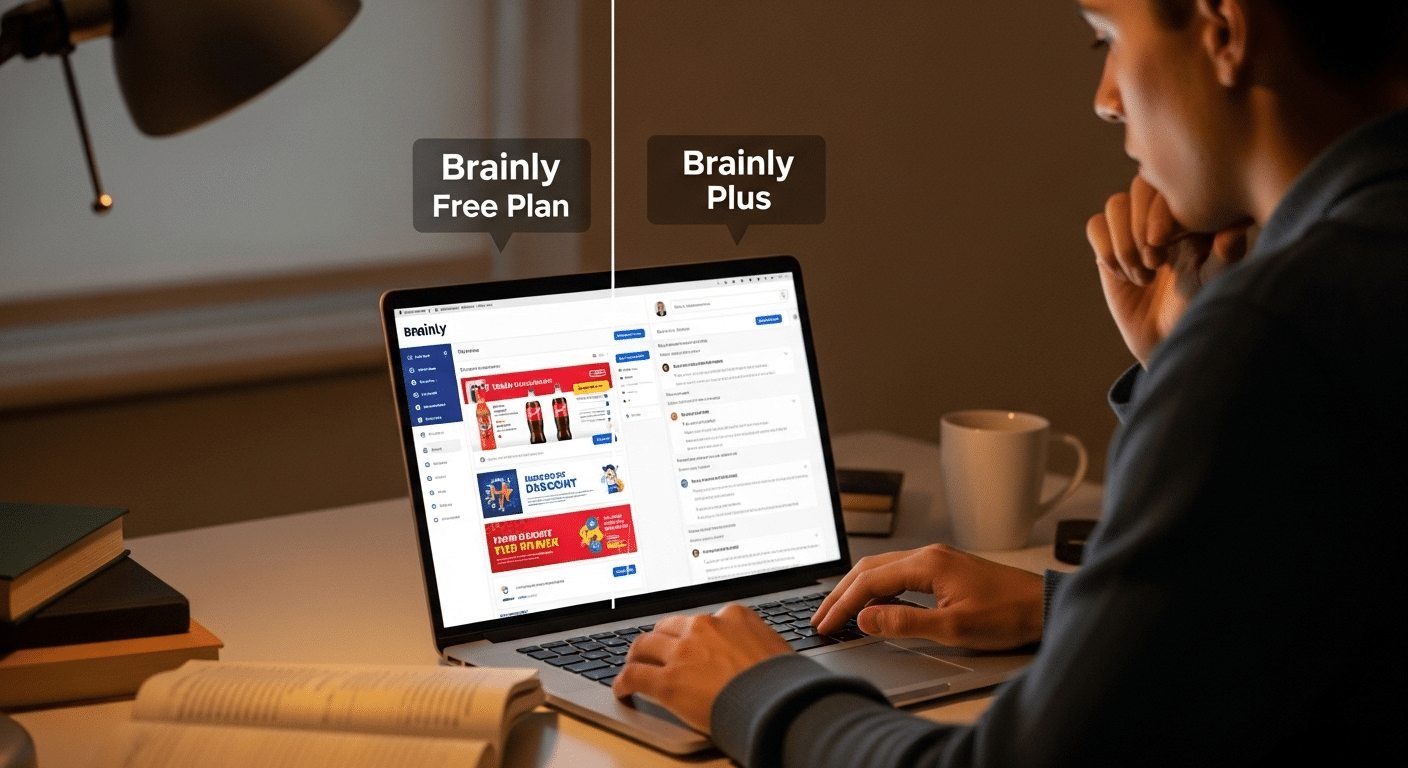
Student comparing Brainly free plan and Brainly Plus subscription on a laptop with ads disappearing on the premium side.

If the free plan feels restrictive, Brainly Plus is positioned as the upgrade that smooths things out. The pricing typically ranges from about $2.50 to $10 per month, depending on how long you commit to the subscription. Shorter billing cycles cost more per month, longer commitments lower the average price.

The most noticeable benefit is ad free studying. Once you subscribe, the constant ads disappear. For many students, that alone improves focus. Brainly Plus also expands access to certain premium features, including more robust AI explanations and fewer interruptions when browsing answers.

However, Brainly Plus does not allow unlimited question posting. The point system still applies. You may have a more comfortable experience, but you are not granted unrestricted submission privileges. That distinction often causes confusion when users assume “Plus” equals full access.

The plan includes a 7-day free trial. If you do not cancel before the trial ends, it converts automatically into a paid subscription. Auto-renewal is built into the billing model. Brainly does not offer refunds once a payment has been processed, which has led to billing complaints from some users who forget to cancel on time.

Brainly Plus vs Free Plan:

Feature Free Plan Brainly Plus
Ads Yes No
Ask questions Point-based Still limited
AI features Limited Expanded access
Cost Free Monthly subscription


While Brainly Plus improves usability, it does not deliver full access across all services. Before subscribing, it helps to understand both the benefits and the hidden costs tied to auto-renewal and non-refundable charges.


Does Brainly Tutor Provide Unlimited Live Tutoring?

This is the tier most people point to when they ask, is Brainly AI tutor unlimited. Brainly Tutor is marketed as the plan that includes live tutoring sessions, which immediately sounds closer to unlimited support. The pricing typically ranges from about $8 to $29 per month, depending on billing length and promotional offers.

Brainly Tutor does offer live tutoring. You can connect with tutors for real-time help, which reduces response time compared to waiting for community answers. That said, it is not open-ended. The service focuses on core STEM subjects, primarily math, physics, chemistry, and biology. If you need help outside those areas, availability narrows.

The most important detail is the session cap. Brainly Tutor includes up to 20 live sessions per month. Once you reach that limit, you cannot purchase extra sessions within the same billing cycle. You must wait until the next month for your allocation to reset.

So while marketing language may suggest unlimited live tutoring sessions, the structure includes clear limits.

Limitations of Brainly Tutor:

Feature Brainly Tutor
Live Sessions 20 per month
Subjects Core STEM only
Extra Sessions Not allowed
AI Access Included


Important Limitations to Know before using Brainly Tutor :

  • 20 session cap each billing cycle
  • Must wait for next billing cycle after reaching limit
  • Auto-renewal applies unless canceled
  • No refunds after payment is processed

So, is Brainly Tutor truly unlimited across services? No. It expands support beyond the free plan and Brainly Plus, but it still operates within defined monthly limits. For short-term homework help in math or science, it can be useful. For continuous, unrestricted tutoring, the boundaries become more visible.


Are Brainly Community Answers Reliable?

Student reviewing multiple homework answers on an online forum with verified badge icons next to some responses.

Before Brainly introduced AI, its foundation was built on community answers. That structure still plays a central role today. Students post questions, and other users respond, often within an average response time of around twenty minutes. In popular subjects like math and science, answers can appear quickly. In less common topics, you may wait longer.

Reliability, however, varies. Some responses are marked as verified answers, meaning they have been selected or endorsed within the platform. Others are simply posted by fellow students. Because Brainly relies on crowd sourced contributions, quality control depends on moderation and peer voting.

Incorrect answers can be reported, yet mistakes still appear. Some explanations are clear and correct. Others are rushed or incomplete.

You may also notice multiple answered questions that look similar to yours but offer different solution paths. That variety can be helpful, though it can also create confusion about which approach is correct. For important assignments, students are encouraged to verify critical details independently.

Here is a balanced look at the model:

Pros of Community Model Cons of Community Model
Many answers available across common subjects Quality control inconsistency despite moderation
Multiple solution approaches for similar questions Not always deep understanding in explanations
Peer learning through shared explanations Complex problems may receive incorrect or incomplete responses


Can Brainly Help You Develop Deep Understanding?

Brainly is often effective when you need quick help with a homework problem. If you are stuck on a math equation or a science definition, the platform can generate answers fast. For routine assignments, that speed is appealing. You get a solution, you move on.

Developing deep understanding, however, is a different goal. Complex problems usually require layered explanations, conceptual connections, and time to reflect. Brainly’s AI explanations tend to be brief and structured for efficiency.

They show the steps, but they do not always unpack the reasoning behind each step in depth. The platform gives you the path. It does not necessarily slow down and explore why that path works.

Because of that, you often need to study explanations independently. The tool provides the material, but the responsibility to focus, reread, and internalize the logic remains yours. Some students find this sufficient. Others feel the answers are surface-level.

Reviews across the web reflect that divide. Many users appreciate the convenience and quick responses. Others question whether the platform supports long-term mastery.

Compared to a dedicated personal tutor or AI-first systems like Astra AI, which are designed specifically for personalized learning from the ground up, Brainly can feel more oriented toward task completion than sustained conceptual growth.


Are There Hidden Costs or Subscription Risks?

Student reviewing subscription terms on a laptop with auto-renewal date highlighted on the screen.

When evaluating whether Brainly offers good value, it helps to look beyond features and examine billing policies. Several users across review platforms have raised concerns about hidden costs tied to subscription terms.

Brainly operates on an auto renewal system. If you sign up for a free trial and do not cancel before it ends, the subscription converts automatically into a paid plan. Some users report unexpected charges because they overlooked the billing date. Once payment is processed, Brainly’s policy states that there is no refund. That firm stance has led to frustration among users who believed cancellation was complete or misunderstood the timeline.

These policies do not make the service illegitimate. They simply require careful attention. Subscription models can be convenient, but they also demand awareness.

Before You Subscribe:

  • Check the billing cycle carefully
  • Cancel the free trial before the deadline
  • Understand the no refund rule clearly
  • Review the monthly cost to confirm it fits your budget

If you approach the subscription with clarity, you reduce the risk of surprises. If you overlook the fine print, dissatisfaction can follow.


So, Is Brainly AI Tutor Truly Unlimited?

After looking at each tier closely, the answer becomes straightforward. Brainly AI tutor is not unlimited across all services.

The free version is clearly limited. You must earn points to post questions, ads appear during studying, and access to AI features is restricted. There is no unlimited question posting on the free plan.

Brainly Plus improves the experience by removing ads and expanding certain premium features, but it still does not allow unlimited posting. The point system remains in place. You gain convenience, not unrestricted access.

Brainly Tutor goes further by adding live tutoring, yet it includes a 20-session cap per month. Once you reach that limit, you must wait for the next billing cycle. That is a defined boundary, not unlimited use.

AI features are accessible across tiers, but the depth and scope vary. Marketing language may suggest broader access, yet the actual limits are written into each subscription structure. Unlimited, in this case, depends heavily on which service you are referring to.


Who Should Use Brainly and Who Should Look Elsewhere?

Student quickly solving routine math homework using an online AI platform before a deadline.

Brainly can be useful, depending on what you expect from it. If your goal is quick clarification on a homework problem or a fast answer before a deadline, the platform can deliver. Its mix of community answers and AI responses works best when the task is routine and time-sensitive.

For students in earlier academic stages, especially middle school and high school students, the structure often feels manageable. The questions are familiar. The explanations are direct. You search, you find something similar, you move forward.

Where Brainly becomes less effective is in situations that demand sustained depth. Complex conceptual development requires more than short explanations. Long-term academic growth usually benefits from consistent guidance rather than scattered responses.

Suitable For:

  • Middle school and high school students
  • Quick homework help before submission
  • Routine math or science practice

Not Ideal For:

  • Deep subject mastery across semesters
  • Long-term exam prep strategy
  • Complex engineering-level subjects or advanced theoretical work

If you need efficiency, Brainly can help. If you need structured, layered learning over time, you may need something more consistent and focused.


Is There a More Consistent Alternative to Brainly’s Mixed Model?

Once you understand how Brainly operates, the broader question becomes less about limits and more about design. Brainly started as a community-driven forum and layered AI features on top over time. That hybrid structure explains both its flexibility and its inconsistencies. Community answers vary. AI explanations prioritize speed. Access depends on subscription tier.

Some platforms approach tutoring differently from the start.

CoTutor, for example, was built as an AI-native tutoring platform rather than a community forum with AI additions. There is no point system controlling participation. There is no ad-driven experience shaping usage. The architecture is designed for institutional reliability, not casual question exchanges.

CoTutor delivers uniform AI-powered tutoring across interactions, meaning the quality of guidance does not fluctuate between community responses and automated outputs. It operates within a secure, browser-based infrastructure aligned with higher education standards. That focus on security and scalability makes it suitable for structured academic environments.

Most importantly, the design emphasizes deeper understanding rather than quick homework answers. The system aims to guide reasoning consistently, not simply generate responses. If you are evaluating alternatives to Brainly’s mixed model, consistency and institutional-grade design may matter more than the word unlimited.


Conclusion

On homework platforms, the word unlimited rarely means unrestricted in every direction. More often, it means access within a particular subscription tier. Once you look closely at Brainly’s structure, the boundaries become clear. The free plan includes limits. Brainly Plus removes ads but does not remove posting restrictions. Brainly Tutor expands access, yet it carries a session cap.

That does not make the platform useless. Brainly can be helpful for quick support, especially when you need fast answers in math or science. The key is understanding what you are actually purchasing.

Before subscribing, take time to examine the details. Look at session caps, billing cycles, and feature differences between plans. Compare alternatives if your goal is deeper understanding rather than rapid homework completion.

Unlimited is often a marketing term. Real access depends on structure. If you evaluate features carefully and align them with your academic needs, you will make a smarter decision, and avoid surprises later.


Frequently Asked Questions (FAQs)


1. Is Brainly AI completely free?

Brainly AI is available on the free version, but access is limited. The free plan includes ads and restricted use of certain AI features. Full functionality typically requires a paid subscription such as Brainly Plus or Brainly Tutor.

2. How many questions can you ask on Brainly free plan?

On the free plan, you cannot ask unlimited questions. You must earn points by answering other students’ questions. If you run out of points, you cannot post new questions until you earn more.

3. Does Brainly Tutor offer unlimited sessions?

Brainly Tutor does not provide unlimited live sessions. The subscription includes up to 20 live tutoring sessions per month. Once you reach that cap, you must wait for the next billing cycle before accessing additional sessions.

4. Is Brainly reliable for homework help?

Brainly can be helpful for quick homework support, especially in common subjects like math and science. However, community answers vary in quality, so you should verify important information before relying on it for graded assignments.

5. Can you get a refund from Brainly?

Brainly does not offer refunds once a payment has been processed. Subscriptions renew automatically unless canceled before the billing date, which has caused frustration for some users who miss the deadline.

6. What subjects does Brainly Tutor cover?

Brainly Tutor primarily covers core STEM subjects, including math, physics, chemistry, and biology. Availability outside these subjects may be limited, so coverage depends on the academic area you need support in.

How Artificial Intelligence Enhances Education Using AI-Powered Tutoring

Education has always evolved alongside technology. What feels different now is the speed and precision of that change. When you look at how artificial intelligence enhances education AI powered tutoring, you begin to see something more structured than a trend. You see a shift in the learning process itself.

Traditional teaching methods were built around groups moving at the same pace. AI enhanced tutoring systems operate differently. They adapt. They analyze patterns in student performance. They respond in real time. And increasingly, the data shows measurable improvements in educational outcomes, from faster mastery of introductory material to higher retention and engagement rates.

This is not about replacing classrooms. It is about refining the learning experience. Artificial intelligence and AI tutoring platforms are enabling personalized learning at a scale that was previously impossible. Intelligent tutoring systems can now support individual students simultaneously, offering feedback, guidance, and tailored learning paths without delay.

The conversation is no longer whether AI technology will transform education. It already is. The deeper question is how you choose to integrate it thoughtfully, responsibly, and effectively.

In this blog, you will explore how AI-powered tutoring works, what the research says about its impact, how it supports both students and teachers, and why intelligent learning systems are becoming central to the future of education.


What Are Intelligent Tutoring Systems and How Do They Personalize Learning?

Intelligent tutoring systems sound abstract, almost clinical. In practice, they are surprisingly attentive. An intelligent tutoring system, often shortened to ITS, is an AI system designed to deliver personalized learning through continuous analysis of how individual students think, respond, and progress.

Instead of presenting the same material to everyone, it studies patterns quietly in the background and adjusts instruction accordingly.

1. How Do Intelligent Tutoring Systems Analyze Individual Students?

Intelligent tutoring systems rely on what is called a student model. Think of it as a living profile that tracks knowledge state, strengths, recurring mistakes, and conceptual gaps. Each response you give feeds into that model. Over time, it becomes more precise.

Machine learning, put simply, allows the system to recognize patterns in large amounts of student performance data. It learns which explanations lead to mastery and which ones fall flat. This learning does not stop after one lesson. It continues, constantly recalibrating.

Continuous assessment plays a central role. Rather than waiting for a final exam, the system evaluates understanding after each interaction. If your learning pace accelerates, the material becomes more challenging. If you struggle, the difficulty adjusts in real time. That dynamic adaptation supports individualized learning without public comparison or pressure.

What emerges is personalized instruction shaped moment by moment. Not static. Not generic. Responsive.

2. What Makes AI Powered Tutoring Systems Different From Traditional Teaching Methods?

AI powered tutoring systems diverge from traditional teaching methods in several measurable ways:

  • Personalized instruction adapts to individual students instead of delivering uniform content to students simultaneously.
  • Immediate feedback allows students to correct misunderstandings during the learning process.
  • Adaptive assessments adjust difficulty in real time to measure actual mastery.
  • Tailored learning experiences respect each student’s strengths and cognitive load.
  • AI systems automate routine tasks so teachers can focus on human interaction and emotional support.

Research shows that intelligent tutoring systems enhance educational outcomes through continuous personalization. They can support an unlimited number of students simultaneously, and in high-quality studies, AI tutoring systems have matched the success of human tutoring. That combination, scale and precision, begins to explain their growing influence.


How Does AI Improve Student Performance, Engagement, and Learning Gains?

Student using AI tutoring platform with performance improvement graph rising on screen.

Numbers tend to quiet skepticism. When you look at measurable outcomes, the conversation becomes less theoretical and more practical.

AI-assisted tutoring has been shown to increase topic mastery by 4 to 9 percentage points in controlled studies. That may sound modest at first glance. It isn’t. Across large student populations, even single-digit gains compound quickly. Over time, those gains influence overall student performance, retention, and confidence.

In some widely cited implementations, including platforms similar to Khan Academy, students using AI tutoring systems have progressed 30 to 50 percent faster compared to peers relying solely on traditional teaching methods.

Faster progress does not mean rushing. It means fewer lingering misunderstandings, fewer stalled lessons, fewer gaps that quietly widen over a semester.

Engagement improves as well. Students interacting with AI tutoring platforms report higher levels of motivation and persistence. When explanations adapt to your learning pace, frustration drops. When targeted feedback arrives immediately, you do not carry confusion into the next topic. That immediacy matters.

High dose tutoring, delivered by human tutors, has long been considered one of the most effective academic interventions. The limitation has always been scale. AI systems, however, can support students simultaneously without diminishing quality. You receive individualized instruction without waiting in line.

Continuous real time feedback accelerates mastery in subtle ways. Errors are corrected in the moment. Cognitive overload decreases because the material adjusts before it becomes overwhelming. Over time, those small corrections produce meaningful learning gains.


What Does the Research Say About Learning Outcomes?  

AI Capability Impact on Students Learning
Immediate feedback Faster correction of errors and reduced accumulation of misconceptions
Adaptive difficulty Better alignment with student performance and current knowledge state
Personalized learning paths Higher motivation, persistence, and sustained engagement
Data-driven instruction Improved curriculum decisions and refined teaching strategies


Research grounded in educational psychology suggests that AI tutoring enhances learning outcomes primarily through targeted feedback. Real time feedback prevents misunderstandings from hardening into long-term knowledge gaps.

Students learning in adaptive environments also report greater confidence and autonomy compared to traditional models. The pattern is consistent.

When instruction adapts, performance improves. When feedback is timely, learning gains accelerate. And when engagement rises, retention tends to follow.


Can AI Tutoring Foster Advanced Cognitive Skills and Critical Thinking?

The real test of any learning tool is not speed, but depth. Can it foster advanced cognitive skills? Can it strengthen critical thinking rather than shortcut it? That is where AI tutoring becomes interesting.

One of its quieter strengths lies in how it helps manage cognitive load. When material is delivered too quickly or with too much complexity at once, working memory becomes overwhelmed.

Intelligent systems adjust difficulty and pacing in real time, allowing you to focus on understanding instead of scrambling to keep up. That control over learning pace creates space for reflection.

High quality explanations matter as well. AI systems can present multiple explanations for the same concept, shifting examples until clarity clicks. In project based learning environments, AI tutoring can guide students through structured problem solving, offering prompts instead of finished answers. The goal is not to replace reasoning but to sharpen it.

Generative AI adds another layer. Through interactive dialogue, you are encouraged to explain your thinking, question assumptions, and revisit earlier steps. That process supports metacognition, the habit of thinking about how you think.

When designed responsibly, AI systems guide students rather than hand them solutions outright. They support introductory material and complex reasoning alike, helping develop advanced cognitive skills gradually, not abruptly.


How Does AI Enhance Educational Equity and Access to Quality Education?

Student in a rural setting using AI-powered tutoring platform on a tablet, symbolizing equal access to quality education.

Conversations about artificial intelligence often drift toward efficiency. The more urgent question, though, is access. Who benefits? Who gets left behind? When applied carefully, AI tutoring can narrow gaps that have persisted for decades.

Educational equity has long been constrained by geography, funding, and staffing shortages. In underfunded schools, access to high-quality tutoring or advanced coursework is often limited. AI personal tutors change that equation. By delivering personalized learning experiences through scalable platforms, you gain access to individualized education regardless of location.

The idea of democratizing education at scale is no longer abstract. AI systems can provide one-size-fits-one instruction to thousands, even millions, of students simultaneously. Individualized learning becomes less dependent on zip code and more dependent on thoughtful implementation. That matters.

Generative AI further strengthens this approach by adapting explanations to your needs in real time. If you struggle with foundational material, support deepens. If you advance quickly, the challenge increases. The learning process respects both pace and potential.

Some of the benefits for expanding access include:

  • 24/7 personalized support beyond classroom hours, allowing learning to continue when teachers are unavailable.
  • Consistent quality instruction regardless of district funding or local resource constraints.
  • Immediate feedback without social judgment, reducing fear of asking questions.
  • Personalized AI tutors that create non-judgmental environments where students feel safe experimenting and revising answers.
  • Scalable support capable of serving large student populations without diminishing tailored support.

AI tutoring does not solve systemic inequality alone. But it can reduce educational inequity by expanding access to quality education in measurable ways.

When educational institutions integrate these tools responsibly, individualized instruction becomes more than an aspiration. It becomes attainable.


How Does AI Support Teachers Instead of Replacing Them?

The fear that AI will replace teachers surfaces quickly in almost every discussion. It is understandable. Yet the research tells a more grounded story. AI tutoring systems are most effective when they operate alongside human teachers, not in place of them.

In practical terms, AI automates grading and other routine tasks that quietly consume hours each week. It tracks student progress continuously, identifying patterns that might otherwise go unnoticed.

You receive clear data on where students struggle, where they excel, and where intervention is needed. That kind of visibility strengthens teacher support rather than diminishing it.

When administrative work decreases, space opens. Teachers can spend more time on mentorship, guiding students through complex reasoning, and offering emotional support that no algorithm can replicate. Human interaction remains essential in moments of confusion, frustration, or breakthrough.

Successful implementation depends on collaborative effort. AI systems provide precision and scale. Human teachers provide context, judgment, and care. The two are not competing forces. They are complementary strengths working in tandem.

AI Systems and Human Teachers: Complementary Strengths  

AI System Human Teachers
Immediate feedback Emotional support
Pattern recognition in data Contextual judgment
Scalable individualized instruction Social and moral guidance
Automates administrative tasks Builds relationships


AI does not replace teachers. It enhances teacher support by reducing repetitive work and expanding insight. Human tutors and educators remain central to learning. Technology can assist, but education is still, at its core, relational.


How Can Educational Institutions Successfully Implement AI Tutoring Platforms?

University leadership team reviewing AI tutoring implementation strategy on a digital dashboard.

Adoption without strategy rarely ends well. Integrating AI into an existing learning environment requires more than purchasing an AI tutoring platform and switching it on. It demands alignment, oversight, and patience.

You begin by ensuring that AI technology supports curriculum standards rather than drifting away from them. Content must reinforce learning objectives already in place.

The goal is coherence, not novelty. Secure AI system architecture is equally critical. Protecting sensitive student data is not optional, particularly in higher education where regulatory compliance matters.

Data-informed decision-making should guide the process. AI tutoring platforms generate analytics that reveal patterns in student performance, engagement, and mastery. Used responsibly, that data enables continuous improvement in both instruction and system design. Used carelessly, it creates confusion. Governance matters.

Successful implementation also requires coordination across leadership. A senior vice president of academic affairs may oversee strategic alignment. IT leadership ensures secure deployment and technical stability. Human resources may adapt the system for corporate training or workforce development initiatives. Collaboration across these roles strengthens long-term impact.

An effective rollout typically follows a structured approach:

  • Define instructional objectives clearly before integrating AI into coursework.
  • Train faculty on AI tutoring platforms so they understand both capabilities and limits.
  • Monitor student performance data responsibly to guide adjustments.
  • Protect sensitive student data through secure access controls and governance policies.
  • Phase rollout gradually instead of deploying campus-wide immediately.
  • Measure educational outcomes continuously to support ongoing refinement.

Integrating AI is not a one-time event. It is an evolving process shaped by evidence, leadership, and sustained attention.


What Role Does Generative AI Play in Modern AI-Enhanced Tutoring?

Generative AI is often described in technical language, but the core idea is straightforward. It refers to artificial intelligence systems that can produce new content in response to a prompt. In tutoring environments, that means generating explanations, examples, follow-up questions, and even alternative ways of framing a concept, all in real time.

At the center of many of these systems is a large language model. You can think of it as a highly trained prediction engine that has learned patterns in language, reasoning, and subject matter.

Within AI enhanced tutoring systems, that model enables fluid dialogue rather than rigid scripts. The result feels less like navigating a static worksheet and more like engaging in guided conversation.

Generative AI supports individualized learning by adjusting explanations to match your strengths and weaknesses. If you grasp theory but struggle with application, the system pivots. If foundational gaps appear, it circles back without embarrassment or delay. Personalized learning experiences emerge from those micro-adjustments.

The feedback is immediate and context-aware. Instead of waiting for graded results, you receive real time feedback as you work. That responsiveness supports self-directed learning because you can experiment, revise, and progress independently.

Equally important is scalability. Generative AI enhances the scalability of personalized education by allowing AI tutoring systems to support students simultaneously without sacrificing tailored guidance.

The dialogue remains focused on the individual, even as thousands engage with the platform at once. That balance between personalization and reach defines much of modern AI tutoring.


How Is CoTutor Advancing AI-Powered Tutoring in Higher Education?

Student using a laptop with an AI tutor interface displayed on screen, representing AI-powered learning and critical thinking support in education.

After examining the mechanics and evidence behind AI tutoring, the natural question becomes practical. How does this translate into higher education settings that require security, scale, and accountability?

Apporto built CoTutor with those realities in mind. It operates as a browser-based AI tutoring platform, removing installation barriers while aligning with secure, Zero Trust infrastructure models common in higher education. That alignment matters. Institutions cannot afford experimental tools that compromise data integrity or governance standards.

CoTutor is designed specifically for academic environments, not generic consumer use. It delivers personalized AI tutoring at institutional scale, supporting individualized learning while respecting curriculum structure and faculty oversight.

The intent is not to replace teachers. Instead, it strengthens teacher support by handling routine guidance, offering immediate contextual feedback, and expanding access to tailored instruction beyond classroom hours.

When aligned with goals such as student success, retention, equity, and scalable teacher support, CoTutor becomes less of an add-on and more of a strategic asset within higher education.


Conclusion

The conversation often frames artificial intelligence as either a revolution or a threat. In practice, it behaves more like an amplifier. AI enhances education, but it works best alongside human teachers who provide judgment, empathy, and context. The evidence points in that direction consistently.

Personalized learning at scale is no longer theoretical. Intelligent systems can adapt to individual students while serving thousands simultaneously. That capability expands access to individualized education in ways that were previously constrained by staffing and funding. Educational equity, when approached deliberately, can be meaningfully advanced through responsible deployment of AI tutoring.

Still, technology alone does not guarantee better outcomes. Thoughtful integration remains essential. Institutions must evaluate AI tutoring platforms carefully, align them with academic standards, and ensure secure implementation.

The real opportunity lies in partnership, not replacement. When AI systems support faculty and empower students, education becomes more responsive, more inclusive, and, perhaps most importantly, more sustainable for the long term.


Frequently Asked Questions (FAQs)


1. What are intelligent tutoring systems and how do they work?

Intelligent tutoring systems are AI-driven platforms that deliver personalized instruction by analyzing how individual students respond to questions and exercises. They build a student model that tracks strengths, gaps, and pace, then adjust difficulty and explanations in real time.

2. Does AI tutoring improve student performance?

Research indicates that AI tutoring can increase topic mastery by several percentage points and accelerate progress significantly. Real time feedback, adaptive assessments, and targeted feedback contribute to measurable learning gains and stronger overall student performance.

3. Can AI replace human teachers?

AI does not replace human teachers. It supports them by automating routine tasks, providing continuous data insights, and delivering individualized instruction at scale. Human interaction, mentorship, and emotional support remain essential components of effective education.

4. How does AI provide personalized learning experiences?

AI systems analyze patterns in student performance and adapt lessons accordingly. They adjust pacing, vary explanations, and offer context-aware feedback. This individualized learning approach ensures instruction aligns with each student’s strengths and areas for improvement.

5. Is AI tutoring secure for higher education institutions?

When implemented properly, AI tutoring platforms align with institutional security standards. Secure cloud-based architectures, controlled access, and responsible data governance help protect sensitive student information within higher education environments.

6. What role does generative AI play in tutoring systems?

Generative AI enables tutoring systems to produce real-time explanations, follow-up questions, and tailored examples. Powered by large language models, it supports interactive dialogue, personalized learning paths, and scalable individualized instruction for diverse student populations.

How Can AI Help Students in Their Studies?

Artificial intelligence is no longer a futuristic concept discussed only in research labs. It is already part of classrooms, online platforms, and higher education systems across the world. As AI integration becomes more common in K-12 schools and universities, one question keeps surfacing: how can AI help students in their studies in a way that truly improves the learning process?

The answer is not as simple as faster homework help or automated grading. AI in education is reshaping how students receive feedback, engage with complex concepts, and move through the educational process at their own pace.

At the same time, educators continue to emphasize that artificial intelligence should function as a support system, not a replacement for human interaction.

In this Blog, you will explore how AI can personalize learning, provide immediate feedback, strengthen student engagement, expand equitable access, and raise important ethical considerations within the modern learning experience.


How Do AI Tools Personalize the Learning Experience for Individual Students?

You do not learn the same way as the person sitting next to you. That seems obvious, yet traditional classrooms often move at one fixed speed, one syllabus, one rhythm. AI tools attempt to change that.

At the core of personalized learning are adaptive AI systems powered by machine learning algorithms. In simple terms, these systems analyze patterns in your answers, your mistakes, your response time, even the types of questions you hesitate on. Over time, they build a profile of your strengths and blind spots. Not a perfect portrait, but a working map.

As your student performance patterns evolve, the system adjusts your learning pace dynamically. If you master a math problem quickly, it increases complexity. If you struggle with abstract concepts, it slows down and offers additional explanations.

Platforms like Khan Academy use AI powered platforms to recommend lessons tailored to your progress. Generative AI tools can help structure essays, summarize research, and break down complex concepts into manageable parts. It feels responsive. Because it is.

AI can help students by:

  • Creating adaptive lesson plans aligned with your current understanding
  • Providing personalized feedback instead of generic comments
  • Adjusting difficulty based on student progress
  • Generating practice quizzes and flashcards for review
  • Supporting independent learning across diverse learning needs

The result is a learning experience that bends slightly toward you, instead of requiring you to bend entirely toward it.


Can AI Improve Student Engagement and Encourage Critical Thinking?

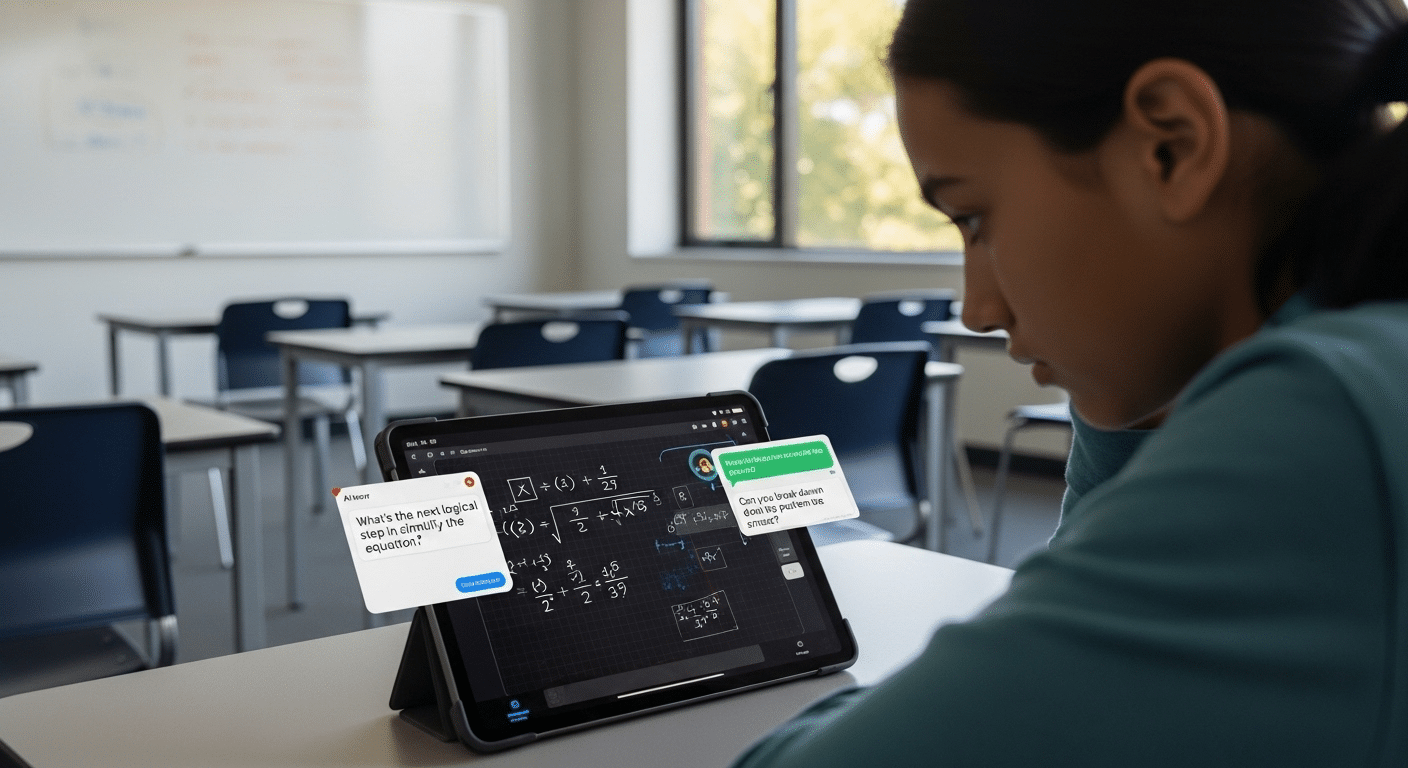
Student solving a math problem on a tablet while an AI tutor asks guiding questions instead of giving answers, classroom setting.

Engagement is fragile. You feel it when a topic clicks, and you notice it when your attention drifts. AI can strengthen student engagement, but only if it is designed to pull you deeper into the learning process rather than hand you finished answers.

When content adapts to your level, curiosity tends to stay alive. Tailored prompts, interactive quizzes, and guided explanations can make complex ideas feel approachable instead of overwhelming. Some AI systems, like Khanmigo, rely on a Socratic method.

Instead of solving the problem for you, they ask questions that push your reasoning forward. That structure encourages independent learning. You still have to think. You still have to wrestle with the math problem or argument.

AI also supports collaboration through online platforms. In group projects, it can help organize research, clarify roles, or suggest discussion points. Used thoughtfully, it becomes a teaching assistant rather than a shortcut.

Still, there is a line. Educators consistently emphasize that AI should remain a complementary aid. Overreliance can dull problem solving skills. If you let the system complete every draft or calculate every answer, critical thinking weakens. Ethical implications matter too. Academic integrity concerns, plagiarism, and passive learning are real risks.


How Does AI Provide Immediate and Targeted Feedback That Improves Student Performance?

Feedback works best when it arrives while the idea is still fresh in your mind. Wait too long and the moment passes. AI systems shorten that gap dramatically. Instead of waiting days for grading assignments, you can receive immediate feedback within seconds of submitting an answer.
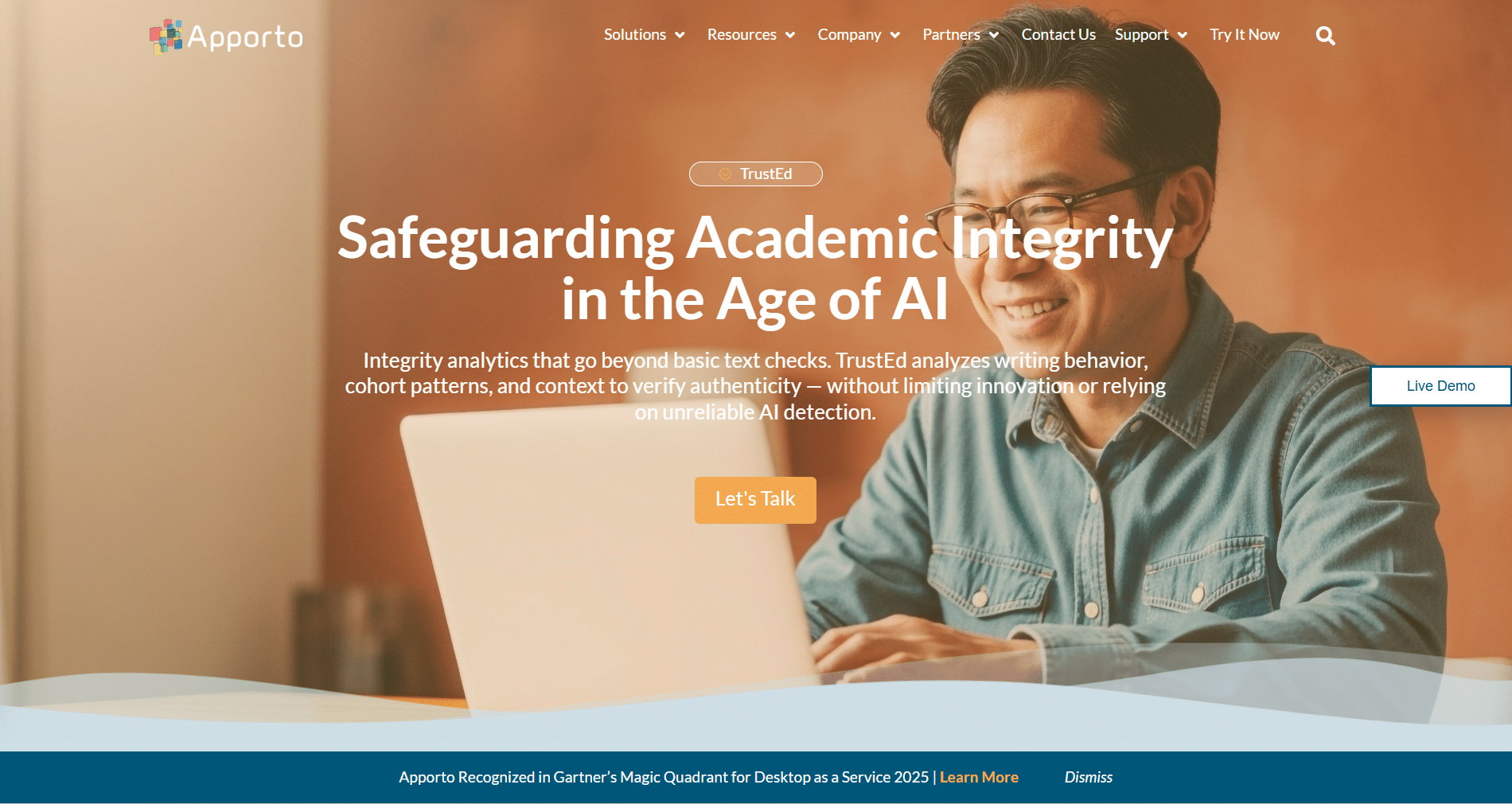
That speed matters. When you solve a math problem incorrectly and see where the reasoning broke down right away, the correction sticks. AI powered tools analyze patterns in your responses and deliver targeted feedback based on your specific mistakes, not generic comments applied to the entire class.

AI writing assistants like Grammarly examine grammar, clarity, and structure in real time. Intelligent tutoring systems go further, identifying misunderstandings and guiding you step by step toward a stronger explanation. The result is a learning loop that tightens, rather than stretches out over weeks.

Below is a simple breakdown:

AI Capability Impact on Students
Immediate feedback Faster correction of errors
AI writing assistant Improved clarity and structure
Adaptive quizzes Targeted feedback
Intelligent tutoring Personalized approach


When feedback becomes timely and specific, student performance often improves because you are adjusting in motion, not after the fact.


How Can AI Support Diverse Learning Needs and Create an Inclusive Learning Environment?

Student with visual impairment using AI text-to-speech software on a laptop with headphones in a classroom setting.

Not every student encounters the same barriers. Some struggle with reading speed. Others navigate language differences, visual impairments, or learning differences that make traditional instruction harder to access. AI technologies can help reduce those obstacles when used thoughtfully.

Accessibility tools are one of the most practical applications of AI in education. Text to speech systems such as Speechify and Microsoft Immersive Reader allow you to listen to written material instead of straining through dense paragraphs. For students with visual impairments or processing difficulties, that option changes the learning experience entirely. It opens the door rather than narrowing it.

Speech recognition tools convert spoken words into text, helping students who find typing difficult or who think more clearly out loud. Translation features assist learners who are navigating coursework in a second language, promoting equitable access regardless of socioeconomic status or linguistic background.

AI also supports adaptive content formats. Lessons can adjust presentation style based on how you engage with material. Diagrams instead of text. Audio instead of slides. Slower pacing when necessary.

Some accessibility AI tools provide:

  • Text to speech for visual impairments
  • Speech recognition for writing assistance
  • Translation for language barriers
  • Personalized learning experiences for diverse learning needs


How Does AI Help Educators Support Students More Effectively?

AI does not only serve students. It also strengthens the way educators support them. Much of teaching involves time-consuming administrative tasks that quietly consume hours, grading assignments, organizing materials, updating student records. When those processes become automated, attention can return to what actually matters, your growth.

AI systems assist with managing student records and tracking student progress in real time. Through structured data collection, patterns begin to surface. Predictive analytics can analyze data across assessments and participation metrics to identify students who may be at risk of falling behind. Instead of reacting late, educators can intervene earlier. That timing changes outcomes.
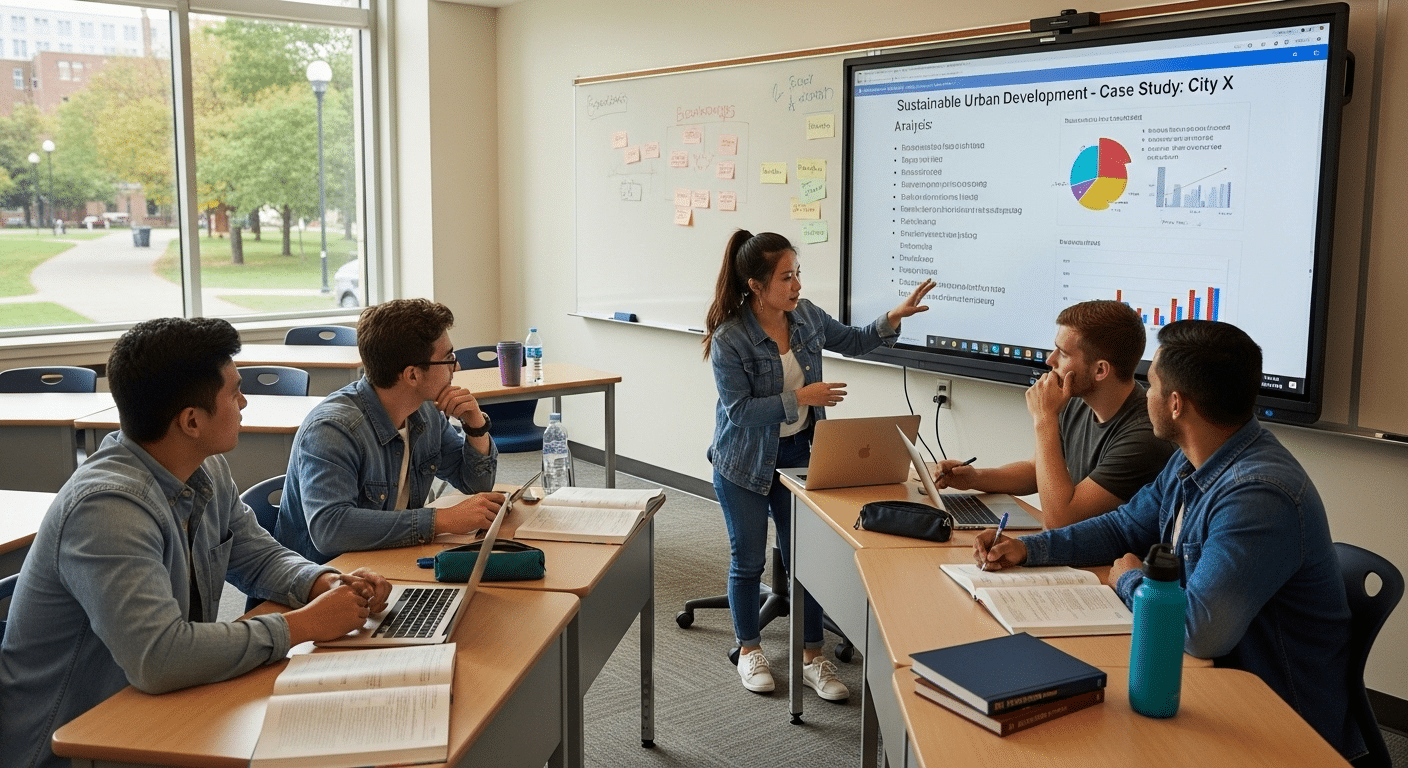
AI can also function as a digital teaching assistant. It helps generate draft lesson plans, suggest practice materials, and summarize classroom insights.

These tools do not replace professional judgment. They support it. Teaching practices become more informed because they are grounded in patterns rather than guesswork.

AI helps educators by:

  • Automating grading assignments
  • Managing student records efficiently
  • Analyzing student performance patterns
  • Supporting lesson plan creation
  • Freeing time for human interaction


What Are the Ethical Considerations and Risks of AI in Education?

Student using an AI learning platform while a transparent data privacy shield icon overlays the screen, representing data protection concerns.

Every technology that promises potential benefits also carries ethical considerations. AI in education is no exception. If you rely on these systems daily, questions about data privacy naturally follow. What information is being collected, how long is it stored, and who has access to it? Student records, performance patterns, even writing samples become part of a larger data ecosystem.

Bias in AI algorithms is another concern. These systems learn from historical data. If that data reflects uneven educational access or language bias, the outputs may unintentionally disadvantage non-native English speakers or students from underrepresented backgrounds. Small distortions, repeated often enough, can affect educational outcomes.

There is also the risk of misuse. AI can generate essays, solve math problems, and summarize complex documents. That convenience creates temptation. Cheating and plagiarism concerns remain real, particularly in higher education settings where academic integrity defines credibility.

Cost is less discussed but equally important. Advanced adaptive systems can require significant financial investment, limiting access for institutions with fewer resources.

Ethical considerations includes:

  • Data privacy and personal information protection
  • Algorithm bias affecting non-native English speakers
  • Reduced teacher-to-student interactions
  • Risk of disengagement from the learning process
  • High implementation costs


How Can AI Prepare Students for Future Careers and a Technology-Driven World?

The tools shaping your education today are not separate from the tools shaping your future careers. As industries increasingly rely on data, automation, and AI powered tools, familiarity becomes an advantage. When you learn to use artificial intelligence responsibly during your studies, you are also preparing students for environments where these systems are standard practice.

Exposure matters. Collaborative online platforms mirror modern workplaces where teams coordinate across locations and time zones. AI can help simulate real-world problem solving, from analyzing data trends to drafting proposals efficiently. You are not just completing assignments. You are building adaptability.

Training programs in many fields now incorporate AI technologies, creating new possibilities for skill development. When students enter the workforce with experience navigating these tools thoughtfully, they are better equipped to evaluate outputs critically rather than accept them blindly.

Preparation is not about automation replacing effort. It is about learning how to work alongside emerging systems intelligently and responsibly.


How Can Institutions Integrate AI Responsibly While Preserving Human Interaction?

University classroom where teacher leads discussion while AI dashboard supports lesson planning in the background.

Bringing AI into classrooms is not simply a technical decision, it is a cultural one. When institutions begin integrating AI into teaching practices, the goal should remain clear, support students, not sideline educators. AI integration works best when it enhances the educational process rather than redefining it entirely.

Teacher-student relationships remain central to learning. Human interaction builds trust, accountability, and motivation in ways no algorithm can replicate. AI can analyze patterns, generate materials, and offer practice opportunities, but it cannot replace mentorship or emotional insight. That distinction matters.

Responsible AI integration in higher education requires guardrails. Clear policies on academic integrity. Transparent data use. Thoughtful training for faculty. When structured properly, AI becomes an academic tool that strengthens instruction instead of weakening it.

From there, attention naturally turns toward more structured, secure AI tutoring systems designed specifically to complement institutional goals rather than operate as informal, open-ended tools.


How Is CoTutor Supporting Personalized, Secure AI Tutoring in Higher Education?

CoTutor page in which Student using a laptop with a holographic AI tutor interface, illustrating AI-guided learning and critical thinking support in education.

As institutions look for structured ways to integrate AI tutoring, design becomes critical. Tools built casually for general use often lack the safeguards and consistency required in higher education. CoTutor approaches the problem differently. It is an platform that is developed with institutional needs in mind rather than layered on afterward.

Because it operates through a browser-based secure infrastructure, students receive secure access without complicated installations or risky data transfers. That matters when student records and academic work must remain protected. More importantly, CoTutor delivers a personalized approach at scale. AI systems provide immediate and targeted feedback while maintaining consistency across interactions.
The goal is not automation for its own sake. It is student success supported by reliable systems that complement faculty expertise. Professors remain central. The platform strengthens their reach rather than replacing it.


Conclusion

So, how can AI help students in their studies without replacing the very thing that makes learning meaningful? The answer lies in balance. AI enhances student performance by delivering immediate feedback, adaptive practice, and personalized learning experiences that once required one-on-one tutoring. Student engagement often improves when content responds to your pace and progress rather than forcing uniform timing.

Yet scale should not erase connection. Personalized learning at scale is now technically possible, but ethical integration remains essential. Data privacy, academic integrity, and algorithmic fairness cannot be afterthoughts. They must shape implementation from the beginning.

Human interaction still anchors the educational experience. Mentorship, encouragement, and intellectual challenge come from people, not systems. AI can support students, clarify complex ideas, and extend faculty capacity, but it should never replace critical thinking or conversation.

As you evaluate AI tools, look beyond convenience. Choose solutions that strengthen learning rather than shortcut it.


Frequently Asked Questions (FAQs)


1. Can AI replace teachers in the learning process?

No. AI can assist with tutoring, grading assignments, and providing immediate feedback, but it cannot replace human interaction, mentorship, or emotional support. Educators remain central to guiding critical thinking and shaping the broader educational process.

2. Does AI improve student performance?

Research and classroom reports suggest AI can improve student performance when used responsibly. Personalized feedback, adaptive practice, and intelligent tutoring systems help students correct mistakes quickly and strengthen understanding over time.

3. Is AI safe for students in higher education?

AI can be safe when institutions implement secure access controls, clear data privacy policies, and responsible oversight. However, ethical considerations such as bias in AI algorithms and proper data protection must always be addressed.

4. How does AI personalize learning?

AI analyzes student performance patterns using machine learning algorithms to adjust content, pacing, and difficulty. This personalized approach supports diverse learning styles and allows students to move through material at a pace aligned with their progress.

5. Can AI support students with disabilities?

Yes. AI technologies such as text-to-speech, speech recognition, and translation tools create more inclusive learning environments. These tools provide equitable access for students with visual, auditory, or language-related challenges.

6. What are the long-term benefits of AI in education?

AI prepares students for future careers by building familiarity with advanced technologies. It also enables scalable personalized learning, improved feedback systems, and data-informed teaching practices that support student success.

How Does Grading Work in University? A Complete Guide

If you’ve ever wondered how does grading work in university, the simple answer is this: your performance in each course is converted into letter grades, those letters translate into grade points, and those grade points are averaged across credit hours to produce your grade point average, or GPA.

At first glance, the grading system seems straightforward. You complete assignments, take exams, receive a final grade, and move on.

But in higher education, those grades carry weight. They determine academic progress, influence eligibility for financial aid, affect graduation requirements, and signal whether you remain in good standing.

Every course syllabus outlines how your work will be evaluated. Your letter grades reflect how well you meet course expectations, and your GPA summarizes performance across multiple classes. Over time, that cumulative number becomes a measure of consistency, not just isolated success.

In this blog post, you will see how the grading system works and what it means for your academic journey.


What Is the U.S. University Grading System and How Is It Structured?

To understand how does grading work in university, you need to begin with the structure itself. Most US universities follow a standardized grading system built around letter grades, a numerical grading scale, and percentage grades that translate performance into measurable outcomes.

In most institutions, the university grading system uses five primary letter grades, A through F. There is no E. Each regular letter grade corresponds to a percentage range defined in the course syllabus.

For example, an A often reflects work in the 90 to 100 percent range, while a B may represent 80 to 89 percent, and so on. Exact percentage grades can vary slightly across many schools, but the overall framework remains consistent across US universities.

Most institutions also use a plus and minus system. This allows adjustments of approximately 0.3 grade points. An A minus equals 3.7, a B plus equals 3.3, and so forth. These refinements provide more nuance in evaluating student performance.

The lowest passing grade in most post-secondary institutions is a D. However, a D is often considered an unsatisfactory passing grade, especially for major requirements. Students may receive credit awarded for the course, yet the grade may not satisfy prerequisite requirement standards.

An F, by contrast, is a failing grade. It indicates that performance revealed little to no understanding of the course material.

Standard Letter Grades and Grade Points Explained

Letter Grade Meaning Grade Points Passing Status
A Exceptional, highest grade 4.0 Passing
B Above average 3.0 Passing
C Average 2.0 Passing
D Minimum passing but unsatisfactory 1.0 Passing, often limited for major credit
F Failing grade 0.0 Not passing


How Does a Course Instructor Determine Your Final Grade?

University professor reviewing a syllabus with grading breakdown percentages highlighted.

Your final grade does not appear out of thin air. It is built, piece by piece, across the term. The course syllabus acts as the blueprint. On the first week of class, you are given a document that outlines grading policies, weight distribution, assignment deadlines, and expectations. That syllabus is not decorative. It governs how your performance is evaluated.

The course instructor, often a faculty member with authority over the course, determines how each component contributes to your overall result. Some instructors rely heavily on final exams.

Others distribute weight across projects, presentations, and weekly assignments. The structure varies by discipline, especially in fields like computer science or lab-based courses where performance is cumulative.

Most grading systems rely on weighted components such as:

  • Final exams, often held during finals week
  • Midterm exams or quizzes
  • Participation and attendance
  • Projects or research assignments
  • Work completed in individual courses
  • Extra credit opportunities
  • Performance in elective courses

Optional grading policies may also apply. Some courses allow Pass or Fail enrollment, while others use only regular letter grade formats.

At the end of the term, the instructor submits final grades to the university registrar. Once recorded, those grades appear on your official transcript and contribute to your cumulative GPA. Accuracy matters. Documentation matters. The process may feel routine, but it carries long-term consequences for academic progress.

What Is Curved Grading and How Does It Affect All the Students?

Curved grading operates differently from a fixed grading scale. Instead of evaluating performance against a predetermined standard, curved grading ranks students relative to one another. Your grade depends partly on class rank.

This model can foster competition. In a curved system, not everyone can receive the highest grade, even if overall performance is strong. Some institutions use it in large lecture courses.

Unlike a fixed grading scale, curved grading adjusts outcomes based on distribution, not solely mastery of material.


How Is Your Grade Point Average, GPA, Calculated?

Once you understand letter grades, the next logical question is how those letters translate into a grade point average. Your GPA is a numerical summary of academic performance across courses. It is calculated by assigning grade points to each letter grade and averaging them based on credit hours.

Each letter grade carries a point value on a grading scale that typically ranges from 0.0 to 4.0. An A equals 4.0 grade points, a B equals 3.0, a C equals 2.0, a D equals 1.0, and an F equals 0.0.

When you complete a course, those grade points are multiplied by the number of credit hours assigned to that course. The result is called quality points.

The formula for GPA calculations is straightforward: divide the total quality points earned by the total credit hours attempted. Certain grades, such as withdrawals or audits, may not count toward hours attempted. Credit awarded and hours attempted are not always identical, so it is important to check grading policies carefully.

A term GPA reflects performance within a single semester. Your cumulative GPA includes all courses taken across spring terms and prior semesters. This cumulative GPA determines academic standing and eligibility for graduation.

Some institutions add extra weighting for advanced or honors courses, allowing a GPA to exceed 4.0. However, most US universities use the standard 4.0 scale.

Step-by-Step Guide to Calculate Grade Point Averages

  1. Multiply grade points earned in each course by its credit hours
  2. Add all quality points together
  3. Divide the total quality points by total credit hours attempted

Example GPA Calculation  

Course Letter Grade Grade Points Credit Hours Quality Points
English A 4.0 3 12.0
History B 3.0 3 9.0
Biology C 2.0 4 8.0
Math B 3.0 3 9.0
Total 13 38.0


38.0 quality points divided by 13 credit hours equals a GPA of 2.92.


What Is the Lowest Passing Grade in University?

Student reviewing final grades online with concern over minimum passing requirements.

The lowest passing grade in many US universities is a D. On paper, a D allows credit awarded for the course. You complete the requirement. You move forward. But in practice, the story is more complicated.

In post-secondary education, a D is often considered an unsatisfactory passing grade. While it may count toward total credit hours, it may not satisfy prerequisite requirements for advanced courses. If you earn a D in a foundational class, especially within your major, you may be required to repeat the same course to progress. That distinction matters.

The difference between undergraduate students and graduate students is even more pronounced. At the undergraduate level, a D usually keeps you technically passing, though it may affect academic standing. In graduate school, however, a C may already be considered unsatisfactory performance. Many graduate programs require a B or higher to maintain satisfactory performance standards.

Some programs use alternative distinctions such as high pass and low pass instead of traditional letter grades. Even in those systems, minimum thresholds still apply. Falling below them can impact academic progress.

In short, the lowest passing grade depends on context. Consider:

  • D is often the minimum passing grade for undergraduate students
  • D may not satisfy prerequisite requirement standards
  • C may be unsatisfactory in graduate school
  • Graduate students are often held to higher performance thresholds
  • High pass and low pass systems still enforce minimum standards

Passing does not always mean progressing comfortably.


What Happens If You Receive an Incomplete (I) or Withdraw (W)?

Not every course ends neatly. Life intervenes. Deadlines collide. Emergencies happen. When that occurs, the university grading system includes several special designations that appear on your official transcript. Each carries specific consequences.

Incomplete Grade (I)

An incomplete grade is not a permanent result. It is a temporary grade issued when you are unable to finish required assignments due to special circumstances or documented extenuating circumstances. The assumption is that you were performing at a satisfactory level before the interruption occurred.

Common points to understand are:

  • An incomplete grade is temporary
  • Remaining work must be completed within an agreed timeframe
  • It converts automatically to an F if unresolved
  • It must be changed to a permanent grade within one year
  • You cannot graduate with an I on your record
  • Students may request an incomplete only under approved conditions

If the remaining work is completed on time, the instructor submits a grade change. If not, the incomplete lapses into a failing grade. That conversion can significantly affect your cumulative GPA.

Withdrawal (W)

A W indicates that you withdrew from a course before the official deadline. It does not count as credit awarded, but it also does not affect your GPA.

Important details:

  • Withdrawal must occur before the published deadline
  • It is not calculated in GPA
  • It remains visible on your official transcript

Withdrawal Fail (WF)

If you withdraw after the deadline, the situation changes.

  • A WF may count as unsatisfactory performance
  • It can impact academic standing

Policies vary by institution, so always consult the course syllabus and registrar guidelines.

Pass/Fail (P/F)

Some courses allow optional grading under a Pass or Fail structure.

  • A P grants credit awarded but does not affect GPA
  • An F results in no credit and affects GPA

NC Grades and AU Audit

Additional designations include:

  • NC grades, meaning no credit earned
  • AU audit, indicating you attended without seeking credit

Each of these notations influences academic progress differently. Understanding them protects you from unintended consequences.


What Happens If You Fail or Repeat a Course?

University transcript displaying an F grade and its impact on cumulative GPA.

A failing grade carries weight. An F signals that performance in the required exercises revealed little to no understanding of the course content. It earns zero grade points, which means it pulls your cumulative GPA down immediately. One failing grade can shift academic standing, especially if your GPA was already close to the minimum threshold for good standing.

The impact does not end there. A failing grade can delay graduation requirements, interrupt prerequisite requirement chains, and affect eligibility for financial aid. In competitive programs, even a single F may require careful recovery planning.

Many schools allow a repeated course to repair the damage, but policies vary. Some institutions replace grades, meaning the new grade substitutes for the original course in GPA calculations. Others average both attempts, which means the earlier failing grade still affects the cumulative GPA.

Important distinctions to consider:

  • A repeated course may require formal approval
  • Replace grades policies differ across many schools
  • Some institutions count both attempts in GPA calculations
  • Second enrollment may be limited in certain programs
  • The original course remains visible on your official transcript

Repeating the same course can improve understanding and restore academic progress. However, it also extends time and cost. Before enrolling in a second attempt, review grading policies carefully. Recovery is possible, but it works best when you understand exactly how the university grading system records each attempt.


How Do Grades Affect Academic Standing and Graduation Requirements?

Grades are not isolated marks. They determine academic progress and define whether you remain in good standing within your institution.

Most universities require a cumulative GPA of 2.0 or higher to maintain good standing. Falling below that threshold can trigger academic probation, which signals that performance must improve within a defined period.

Academic standing influences more than pride. It affects eligibility for scholarships, financial aid, and even enrollment in future courses. To qualify for federal financial aid, you must meet Standards of Academic Progress, often referred to as SAP. This includes maintaining a minimum GPA and successfully completing a certain percentage of credit hours attempted.

Graduation requirements depend heavily on cumulative GPA. Earning enough credit hours alone is not sufficient. You must also meet minimum performance standards across your degree requirements. Some programs require higher GPA thresholds for major courses, particularly in competitive disciplines.

Key areas influenced by grades include:

  • Academic progress evaluation each semester
  • Good standing status, typically at or above 2.0 cumulative GPA
  • Satisfactory progress standards for financial aid eligibility
  • Academic probation if GPA falls below required level
  • Completion of graduation requirements and degree requirements
  • Scholarship eligibility tied to performance

In higher education, grades act as a record of consistency. They signal readiness to continue, to graduate, and sometimes to compete for advanced opportunities.


How Does University Grading Differ from High Schools and Secondary Schools?

Grading may look similar across educational levels, but the expectations are not the same. Many students assume the same grading system applies from high schools to US universities. That assumption can lead to surprises during the first semester.

Here is a clear comparison:

Category High Schools / Secondary Schools US Universities
Passing Standards D is typically acceptable and sufficient D may earn credit but often considered unsatisfactory for major requirements
GPA Weighting Honors or AP courses may boost GPA above 4.0 Most use standard 4.0 scale, some weight advanced courses
Academic Consequences Lower stakes, structured support systems GPA affects academic standing, probation, financial aid
Performance Expectations Focus on completion and effort Emphasis on mastery, independence, critical thinking


In secondary schools, instructors often provide structured reminders and frequent checkpoints. In higher education, responsibility shifts more directly to you. The grading scale may appear familiar, but the consequences are more immediate.

US universities evaluate not only whether you pass, but whether your performance reflects readiness for advanced coursework. Academic independence becomes central. The standards tighten, even if the letter grades look the same.


How Does Grading Work for Graduate Students?

Graduate student reviewing transcript showing B average requirement for academic good standing.

Grading becomes more demanding once you enter graduate school. The structure may resemble the undergraduate grading system, but the expectations rise sharply. Graduate students are evaluated not only on completion, but on depth of understanding, analytical rigor, and professional readiness.

In many programs, a C is considered unsatisfactory performance. While it may technically count as a passing grade at the undergraduate level, in graduate school it can place you at risk of academic probation. Some departments require a minimum B average to remain in good standing. The margin for error narrows.

Specialized programs, particularly in academic medicine, law, and engineering, often apply even stricter evaluation standards. In computer science programs, for example, performance may be judged heavily on complex projects, research contributions, and advanced problem-solving skills.

Some graduate programs move away from traditional letter grades altogether. Instead, they may use distinctions such as high pass and low pass. These categories still reflect performance tiers, but they emphasize competency within advanced study rather than simple grade accumulation.

Graduate evaluation signals readiness for professional or academic advancement. Precision matters. Consistency matters even more.


Can You Request a Grade Change?

Yes, you can request a grade change, but the process is structured and rarely automatic. Universities treat grade reports as official academic records, so revisions require documentation and justification. A grade change is not about negotiating points. It is about correcting an error or addressing verified extenuating circumstances.

If you believe a mistake occurred, act promptly. Most institutions have deadlines for submitting formal appeals. Waiting too long can close your options.

The typical process follows these steps:

  1. Contact the course instructor first. Review the course syllabus and grading policies before raising concerns.
  2. If the issue remains unresolved, escalate the matter to the department chair. Provide clear documentation and evidence.
  3. If a correction is approved, the instructor submits the updated grade to the university registrar.
  4. The university registrar processes the grade change and updates your official transcript accordingly.

Grade appeals require professionalism and clarity. When extenuating circumstances are involved, documentation matters. Universities aim to preserve fairness, which means adjustments must be supported by clear evidence rather than preference.


How Do Universities Ensure Fairness and Academic Integrity in Grading?

TrustEd page banner showing a professional using a laptop under the headline “Safeguarding Academic Integrity in the Age of AI” promoting TrustEd integrity analytics.

Fair grading does not happen by accident. Universities build systems around academic integrity to ensure that every grade reflects actual performance rather than preference, pressure, or inconsistency. The foundation begins with clear grading policies.

Every course syllabus outlines expectations, weighting, and evaluation standards. When those policies are transparent, disputes decrease.

Rubrics add another layer of structure. A well-designed rubric clarifies criteria before assignments are submitted. You understand how work will be measured. Faculty members apply consistent standards across all submissions. This transparency protects both students and instructors.

Avoiding grade inflation is another concern in higher education. Institutions monitor grade distributions to ensure that a regular letter grade reflects meaningful achievement, not automatic advancement. Academic integrity safeguards, including plagiarism detection and exam security measures, further protect the credibility of the grading system.

Documentation also matters. Grades recorded on your official transcript must be supported by evidence. Clear records help prevent unsatisfactory performance disputes and reduce confusion when a grade change is requested.

Systems such as TrustEd function as academic integrity support platforms. They help standardize grading documentation, align rubrics with outcomes, reduce grade disputes, and enhance transparency for both faculty members and students. Technology, when implemented carefully, strengthens fairness rather than replacing judgment.


Final Thoughts

By now, you understand how does grading work in university, at least structurally. But grades are indicators, not identity. A letter on a transcript reflects performance during a specific course, in a specific moment. It does not define your full capability, your growth, or your long-term potential.

What matters more is what those grades represent. Are you building students skills that endure beyond finals week? Are you strengthening discipline, time management, analytical thinking? The cumulative GPA summarizes outcomes, but the habits you develop shape long-term academic success.

Take the time to review each course syllabus carefully. Understand grading policies before assignments accumulate. Ask questions early, not after the final grade appears. When you understand the grading system, you gain agency within it.

Numbers matter. Academic standing matters. But consistent effort, clarity of expectations, and steady improvement often matter more in the long run.


Frequently Asked Questions (FAQs)


1. How does grading work in university in simple terms?

In simple terms, you earn letter grades in each course based on your performance. Those letter grades convert into grade points, which are averaged across your credit hours to calculate your grade point average, or GPA, which reflects overall academic progress.

2. What is the lowest passing grade in college?

In many US universities, a D is the lowest passing grade. You may receive credit awarded for the course, but it is often considered unsatisfactory for major or prerequisite requirement standards, especially in competitive programs.

3. How is GPA calculated in US universities?

Your GPA is calculated by multiplying grade points by credit hours for each course, adding the total quality points, and dividing by total credit hours attempted. Most institutions use a 4.0 grading scale.

4. Does a D count as passing?

Yes, a D typically counts as a passing grade in undergraduate programs. However, it may not meet prerequisite requirement standards or satisfy degree requirements in certain majors. In graduate school, expectations are usually higher.

5. What happens if you get an incomplete grade?

An incomplete grade is temporary and requires you to finish remaining work within a specified timeframe. If unresolved, it converts to a failing grade. You cannot graduate with an incomplete on your official transcript.

6. Can you repeat a course to improve GPA?

Many schools allow a repeated course to improve GPA. Some replace grades in GPA calculations, while others average both attempts. Policies vary, so reviewing your institution’s grading system guidelines is important.

7. Do withdrawals affect GPA?

A withdrawal completed before the deadline does not affect your GPA, though it appears on your official transcript. A withdrawal fail, issued after the deadline, may count as unsatisfactory performance and impact academic standing.

Why is Authenticity Important in Assessment?

A quiet question has been gaining volume in faculty meetings and curriculum reviews: why is authenticity important in assessment? You see it surface whenever conversations turn toward student learning, accountability, and the limits of traditional assessments.

Typical tests can measure recall efficiently. They can sort, rank, and generate grades. But do they confirm student outcomes in ways that truly reflect readiness?

In higher education especially, dissatisfaction with standardized formats is growing. Educators want valid and reliable data about student performance, not just a snapshot of memorized content under timed conditions. You need evidence that students can apply knowledge, demonstrate judgment, and perform in realistic contexts.

Authentic assessments offer a compelling alternative. Rather than isolating facts, they evaluate how well students use what they know. They shift assessment from passive recall to educative assessment, where performance becomes proof of learning.

In this blog post, you will explore why authenticity is important in assessment and how it reshapes student learning, outcomes, and readiness for the real world.


What Does Authenticity in Assessment Actually Mean?

Before you can answer why is authenticity important in assessment, you need clarity on what authenticity actually means. The term gets used loosely. In practice, authentic assessment refers to evaluation methods that require students to apply their knowledge and skills in real world contexts. You are not asking for isolated facts. You are asking for performance.

An authentic assessment asks students to complete tasks that resemble the kinds of challenges they will encounter beyond the classroom. These may involve solving a complex task, interpreting multiple perspectives, presenting an argument, or designing a solution under realistic constraints. The emphasis rests on application, judgment, and demonstration of competence.

Unlike traditional assessments that rely heavily on standardized formats, authentic tasks move beyond selecting a single correct answer. They require students to decide what knowledge is relevant, how to use it, and why it matters. In doing so, authentic assessment collect valid evidence of what students can actually do.

This approach is student-centered and performance-based. It can function as formative assessment during instruction or as summative assessments at the end of a course. Authentic tasks indicators often include relevance, complexity, and alignment with meaningful learning objectives.

In short, authenticity changes what counts as proof.

How Are Authentic Assessments Different from Traditional Assessments?


Authentic Assessments Traditional Assessments
Real world tasks Typical tests
Complex task, multiple perspectives Single right answer
Demonstrate learning in context Measure recall
Provide usable diagnostic data Limited insight
Encourage student ownership Focus on grading outcome


Why Is Authenticity Important in Assessment for Student Learning and Cognitive Development?

University students analyzing complex case studies together, demonstrating higher-order thinking and authentic learning.

When assessment moves beyond recall, something deeper begins to happen. Authenticity matters because it activates higher order thinking skills that typical tests rarely reach. You are no longer checking whether students can repeat information. You are examining whether they can interpret, evaluate, design, and justify.

Authentic learning requires students to wrestle with ideas. They analyze competing perspectives. They make decisions under uncertainty. They revise their thinking when new evidence appears.

This process strengthens critical thinking and decision making skills in ways that isolated questions simply cannot. Over time, that repeated engagement supports measurable cognitive development.

Metacognition plays a central role. When students self assess their progress against clear criteria, they begin to monitor their own learning. They identify gaps. They refine performances. They adjust strategy. This awareness improves student performance because improvement becomes intentional rather than accidental.

Authentic assessments also support student achievement by connecting integrated challenges to meaningful outcomes. Complex tasks demand synthesis, not fragmentation. Students understand how concepts fit together, rather than memorizing them in isolation. That coherence strengthens retention and future performance.

Perhaps most important, authenticity builds ownership. When you allow students to apply knowledge in realistic contexts, they take responsibility for their own learning. Engagement deepens. Effort becomes purposeful. And the student’s ability to demonstrate competence grows in ways that are visible, practical, and lasting.


How Do Authentic Assessments Improve Real-World Relevance and Workforce Readiness?

University students participating in a simulated boardroom presentation, defending decisions under pressure.

If assessment stops at the classroom door, its value shrinks. Authentic assessments close that gap by aligning learning with professional practice. When you design tasks that simulate real world scenarios, you move beyond theory and into application.

Students confront messy complexity, incomplete information, and competing priorities. That is precisely how most professions operate.

Preparing students for fields such as academic medicine, business, engineering, and public policy requires more than familiarity with particular knowledge. It demands performance. You want graduates who can analyze evidence, communicate clearly, and make defensible decisions under pressure. Authentic assessments cultivate those capacities by embedding learning in contexts that resemble professional demands.

This approach strengthens workforce readiness skills because it requires transferable skills, not narrow test-taking strategies. Students must integrate communication skills, technical knowledge, and collaborative judgment.

They learn to navigate ambiguity. They refine their thinking in response to feedback. Real world relevance becomes part of the learning process itself.

When assessment mirrors professional expectation, preparation becomes practical. You are not simply grading assignments. You are shaping competence that extends beyond the academic setting.

Workforce Skills Do Authentic Assessments Strengthen are:

  • Teamwork
  • Communication
  • Problem solving
  • Adaptability
  • Ethical reasoning
  • Presenting multiple perspectives


How Do Authentic Assessments Provide More Valid and Reliable Data Than Typical Tests?

When you evaluate learning, you want data that actually means something. Valid and reliable data, in simple terms, means the assessment measures what it claims to measure, and does so consistently.

If a test says it measures critical thinking, the evidence should reflect genuine reasoning, not just memorized content. And if two instructors review the same work using clear grading criteria, the results should not vary wildly.

Authentic assessment collect valid evidence because students must demonstrate learning through performance. You are not inferring ability from a selected answer.

You are observing how students apply knowledge, solve problems, and communicate ideas in context. That visible performance allows you to confirm student outcomes more directly.

Typical standardized formats often narrow what can be measured. They may privilege speed, familiarity with testing structures, or comfort under pressure.

Authentic performance, by contrast, reveals how students integrate knowledge across disciplines and respond to real constraints. This approach can reduce representation bias, offering multiple ways to demonstrate competence.

Because authentic assessments unfold over time, they also provide usable diagnostic information. You see strengths. You identify gaps. You track growth. Ensuring authentic performance through clear rubrics and aligned grading criteria produces deeper insight into student outcomes than a single test score ever could.


How Do Authentic Assessments Support Student Engagement and Motivation?

University students enthusiastically collaborating on a real-world project in a modern classroom.

Engagement rarely grows from repetition alone. Students engage when tasks feel connected to real world contexts, when the work resembles something that matters beyond the classroom. Authentic tasks invite that connection.

Instead of preparing for a single high-stakes exam, students apply knowledge to problems that resemble professional and personal challenges.

This approach often reduces anxiety. High-pressure, one-time testing can distort performance and narrow attention. Authentic assessments provide students with opportunities to demonstrate learning through iterative effort, which builds confidence gradually.

As students refine performances over time, self-efficacy strengthens. You begin to see progress as something you control.

Student satisfaction improves when assessment feels fair and meaningful. When learners understand how tasks connect to real practice, they are more likely to take ownership.

Inquiry deepens. Problem-solving becomes active rather than reactive. Authentic assessment becomes a form of student support, not simply a mechanism for grading.

Why Students Respond Positively

  • Realistic stakes tied to real world relevance
  • Opportunities to refine performances through feedback
  • Peer review and collaboration that strengthen understanding
  • Ability to demonstrate proficiency in multiple ways

Authentic assessment shifts engagement from compliance to participation.


How Should You Design Authentic Assessments Using Backward Design Principles?

Designing assessments without a clear destination often leads to confusion. Backward design principles offer a disciplined alternative. You begin with the end in mind, not the activity itself. The question is simple, what should students be able to do by the end of the course?

Start with learning objectives. Identify the particular knowledge and skills that define competence. Be specific. Vague goals produce vague assignments. Once outcomes are clear, you can identify authentic tasks indicators, evidence that demonstrates real understanding in action.

These indicators might include application in real world contexts, integration of multiple perspectives, or demonstration of proficiency under constraints.

From there, design grading criteria aligned tightly with those outcomes. Transparent rubrics reduce ambiguity and strengthen teaching excellence. Students should understand exactly how their work will be evaluated before they begin. This clarity encourages ownership.

You may also allow students to brainstorm formats that meet established criteria. Choice, within structure, promotes engagement. Consult resources and build an authentic assessment toolbox that supports varied tasks, from simulations to portfolios.

Throughout the process, incorporate formative assessment checkpoints. Early feedback prevents last-minute confusion and supports steady growth.

Step-by-Step Framework for Designing Authentic Assessments are:

  1. Clarify desired student outcomes
  2. Identify real world contexts that mirror professional demands
  3. Define grading rubric and criteria aligned with objectives
  4. Incorporate peer review and self assess opportunities
  5. Provide feedback loops that allow revision
  6. Align summative assessments to authentic performance


What Challenges Come With Incorporating Authentic Assessments?

University professor reviewing multiple detailed student projects with rubrics spread across a desk.

Incorporating authentic assessments can elevate learning, yet the process is not effortless. You quickly encounter practical challenges that demand careful planning and patience.

  • More time to grade: Evaluating authentic performance, especially across multiple drafts, often requires more time than scoring standardized formats or typical research papers.
  • Complex task with no single criterion: Authentic tasks rarely rely on one only criterion. They integrate analysis, creativity, communication, and application, making evaluation more nuanced.
  • Student anxiety: When students are unfamiliar with performance-based formats, uncertainty can initially increase anxiety.
  • Ensuring academic integrity: Designing assessments that protect originality while allowing collaboration requires thoughtful structure.
  • Managing fairness: Consistency in grading complex work demands clear expectations and calibrated teaching methods.
  • Scaling in large classes: Providing detailed feedback to many students can strain faculty workload.
  • Need for clear rubrics: Without transparent criteria, confusion and perceived inequity can arise.

These challenges are real. Yet with careful design and refinement, the long-term benefits often outweigh the strain. Authentic assessment demands more intention, but it returns deeper insight into student learning.


Why Does Authenticity Ultimately Strengthen Teaching Excellence?

Teaching excellence is not defined by delivery alone. It is measured by alignment. When assessment reflects authentic learning, your teaching methods begin to mirror the realities students will encounter beyond higher education. Instruction becomes purposeful. Activities connect clearly to outcomes. Nothing feels ornamental.

Authenticity also encourages reflective practice. When you evaluate performance over time, you gain clearer insight into the learning process itself. You see where students struggle, where they accelerate, and where misconceptions persist. That visibility allows you to adjust instruction with intention rather than guesswork.

Clear learning objectives become essential in this model. You cannot confirm student outcomes meaningfully without articulating what competence looks like. Authentic assessment sharpens that clarity. In doing so, it elevates both student performance and the standard of teaching excellence.


How Can Technology Support Authentic Assessment Without Compromising Integrity?

TrustEd page banner showing a professional using a laptop under the headline “Safeguarding Academic Integrity in the Age of AI” promoting TrustEd integrity analytics.

Technology can either complicate assessment or quietly strengthen it. The difference lies in how you use it. Digital rubrics, when thoughtfully designed, create consistency across sections and instructors. They clarify grading criteria, reduce ambiguity, and allow you to assess complex student performance with greater precision.

Structured feedback systems also matter. Authentic assessments depend on iteration. Students refine work, respond to guidance, and improve future performance. When tools allow you to provide feedback efficiently and track revisions over time, formative assessment becomes practical rather than overwhelming.

Maintaining academic integrity remains central. Technology can support originality checks, version tracking, and transparent documentation without reducing learning to surveillance. The goal is ensuring authentic performance, not policing creativity.

Grading efficiency improves when workflows are organized. Student progress tracking becomes visible instead of scattered across spreadsheets and emails. Within a broader authentic assessment toolbox, platforms such as TrustEd can streamline documentation, align feedback to rubrics, and support student support at scale. Used carefully, these tools enhance judgment rather than replace it, allowing you to focus on meaningful evaluation instead of administrative burden.


Conclusion

At this point, the question circles back to you. Why is authenticity important in assessment? Because what you choose to measure quietly defines what students value. If standardized formats dominate, students adapt to those expectations. They study for recall. They optimize for speed. They aim for the correct answer.

But pause for a moment. Do your current assessments measure transferable skills such as decision making, communication, and problem solving? Do they capture how well students apply knowledge in unfamiliar contexts, or do they primarily confirm short-term retention?

Authenticity asks you to reconsider what counts as evidence. It invites you to examine whether your grading criteria reflect real competence. Redesign does not require abandoning structure. It requires aligning assessment with purpose.

Modern tools can support that work, making authentic performance more manageable and consistent. The deeper task, though, is reflective. You must decide what matters most, then design assessments that measure exactly that.


Frequently Asked Questions (FAQs)


1. Why is authenticity important in assessment?

Authenticity is important in assessment because it measures what students can actually do with their knowledge. Instead of focusing on recall, you evaluate application, critical thinking, and transferable skills in real-world contexts that better reflect future academic and professional demands.

2. How do authentic assessments improve student performance?

Authentic assessments improve student performance by requiring students to apply concepts, solve complex problems, and refine their work over time. This active process strengthens understanding, builds confidence, and supports long-term retention more effectively than traditional memorization-based testing.

3. Are authentic assessments more valid than traditional assessments?

Authentic assessments often provide more valid evidence of student learning because they evaluate performance in realistic situations. You gain deeper insight into a student’s ability to apply knowledge, rather than simply confirming whether they can select the correct answer.

4. Can authentic assessments replace traditional exams?

Authentic assessments can complement or, in some cases, replace traditional exams when learning objectives emphasize application and higher-order thinking. However, traditional assessments may still serve a purpose for measuring foundational knowledge efficiently in certain contexts.

5. Do authentic assessments reduce test anxiety?

Yes, many students report lower anxiety with authentic assessments because they involve realistic tasks and iterative feedback rather than high-stakes, one-time exams. This structure allows students to demonstrate proficiency without the pressure of a single testing moment.

6. What types of tasks are considered authentic assessments?

Authentic assessments include performance tasks, case studies, simulations, portfolios, presentations, research projects, and real-world problem-solving activities. These tasks require students to demonstrate learning in meaningful ways that mirror professional and personal life situations.

7. How can instructors manage the grading workload of authentic assessments?

Instructors can manage grading workload by using clear rubrics, incorporating formative checkpoints, encouraging peer review, and leveraging structured feedback tools. These strategies help maintain consistency, support academic integrity, and improve efficiency without compromising assessment quality.

When Do Educators Use Authentic Assessments?

When do educators use authentic assessments? You see this question surface more often in higher education as expectations around student learning continue to evolve. Institutions no longer measure success by a correct answer alone. They measure whether students can apply knowledge in meaningful application beyond the classroom.

Authentic assessment focuses on real-world tasks that reflect how knowledge and skills are used in professional and personal contexts. In contrast, traditional assessments often emphasize recall, fixed responses, and teacher-structured evaluation. While traditional assessments still have a place, they do not always capture deeper learning outcomes.

As student engagement, accountability, and measurable outcomes take center stage, educators are rethinking how assessment should function. This guide explores when authentic assessment is most effective, why it matters, the challenges involved, and how modern tools can support the process.


What Is Authentic Assessment and How Is It Different from Traditional Assessments?

Step into any classroom and you can usually tell what kind of assessment philosophy is in play. Some environments revolve around selecting the correct answer. Others ask students to build, design, argue, present, solve. That distinction matters.

Authentic assessment asks students to perform real world tasks that mirror the complexity of life beyond school. Instead of recalling isolated facts, you apply concepts in ways that demonstrate meaningful application of essential knowledge and skills.

The focus moves from short-term recall to sustained understanding. Over time, instructors observe, document, and evaluate student performance as it unfolds, not just at a single testing moment.

Traditional assessments operate differently. They are typically teacher-structured, tightly controlled, and centered on arriving at one correct answer. You often measure how well students remember learned knowledge under time pressure.

Grades reflect accuracy, speed, and alignment with predetermined responses. That approach can be efficient. It can also limit how fully you see a child’s understanding or capacity for critical thinking.

Authentic assessment expands what counts as evidence. Traditional assessments narrow it.

How Do Authentic and Traditional Assessments Compare?


Authentic Assessment Traditional Assessments
Students apply concepts in real world scenarios Focus on correct answer
Demonstrate meaningful application of knowledge and skills Teacher-structured and standardized
Measure critical thinking and problem solving Measure recall of learned knowledge
Evaluate student performance across time Offer a limited view of a child’s understanding


When Do Educators Use Authentic Assessments in Higher Education?

Higher education classroom where students collaborate on a real-world case study presentation to reflect authentic assessment.

So when do educators use authentic assessments in higher education? You turn to them when the goal is not memorization, but transfer. When learning objectives emphasize application over recall, authentic assessment becomes the natural choice.

If students must demonstrate meaningful application of ideas, theory alone will not suffice. You need evidence that they can apply concepts in unfamiliar, real conditions.

In many programs, especially those preparing students for professional practice, traditional testing falls short. A future nurse, engineer, teacher, or business leader cannot rely on selecting the correct answer from four options.

You need to evaluate the student’s ability to perform, communicate, analyze, and adapt. That requires something richer than a timed exam.

Educators use authentic assessments when:

  • Learning objectives prioritize applied knowledge and skills
  • Students must demonstrate meaningful application in realistic contexts
  • Courses are aligned with career readiness and professional standards
  • Student engagement declines under traditional testing formats
  • Instructors want to measure communication skills and collaboration
  • Group work and collaborative activities reflect real professional environments
  • Teaching fields require simulation of real world tasks

In higher education, the stakes are practical. You are not simply grading comprehension. You are assessing readiness. Authentic assessment plays a crucial role when a student’s ability to apply concepts, solve problems, and perform in context matters more than selecting a correct answer on paper.


What Are Real Examples of Authentic Assessment Across Disciplines?

Theory becomes meaningful when you test it against reality. That is where authentic assessment earns its place. Across disciplines, instructors design tasks that mirror real world scenarios, not abstract exercises disconnected from professional demands.

You are not asking students to repeat information. You are asking them to create, decide, analyze, and demonstrate understanding under conditions that resemble the complexity of practice.

These examples of authentic assessment show how different fields translate knowledge into action.

Some examples of Authentic Assessment in Professional Fields

  • Social Work: Create an intervention plan for a client scenario, using case studies that require ethical reasoning and practical judgment.
  • Education: Develop a lesson plan aligned with course objectives, demonstrating how theory informs classroom decisions.
  • Psychology: Role-play a counseling session, applying communication skills and diagnostic frameworks in real time.
  • Public Health: Create educational material addressing a current public health issue, translating research into accessible messaging.
  • Nursing: Take vital signs of mock patients in simulation, responding appropriately to changing conditions.
  • Engineering: Plan and build a functional device, integrating technical knowledge with problem solving.
  • Business: Develop a business plan for a mock or real company, analyzing markets, costs, and strategy.
  • Foreign Language: Role-play a real life conversation, demonstrating fluency beyond memorized phrases.

Each task reflects real world complexity. Students engage in group projects, collaborative activities, and independent work that prepare them not only for a grade, but for personal life and professional environments where decisions carry weight.


How Does Authentic Assessment Improve Student Learning and Engagement?

University students collaborating on a real-world problem-solving project, actively discussing and presenting ideas.

You learn differently when the task feels real. Authentic assessment fosters deep learning because it requires you to wrestle with ideas, not simply recognize them on a page. When you apply concepts to real problems, knowledge stops being abstract and starts becoming usable. That transition matters.

Active learning sits at the center of this process. Instead of passively absorbing information, you analyze, design, present, collaborate. You make decisions. You revise them.

In doing so, you sharpen critical thinking and problem solving in ways traditional tests rarely demand. Student engagement tends to rise when tasks feel connected to future careers or personal life. Motivation follows relevance.

Authentic assessment also improves how instructors provide feedback. Because work unfolds over time, you receive guidance during the process, not only after a final grade. Self assessment becomes part of the rhythm. Reflection becomes routine. That continuous feedback loop strengthens knowledge retention and supports measurable student progress.

Compared to traditional tests, authentic assessments offer several advantages. They evaluate learning outcomes more fully, develop communication skills through collaborative activities, and reveal how well you can actually use what you know. Not just what you remember.


How Does the Authentic Assessment Process Work in Practice?

The authentic assessment process unfolds deliberately. It is structured, but not rigid. You are not measuring a single moment. You are tracking growth over time, often within the familiar classroom environment where learning naturally occurs.

In practice, the process follows several interconnected steps:

  1. Define clear learning objectives.
    Start by identifying the knowledge and skills students must demonstrate. If the objectives are vague, the assessment will be vague.
  2. Create authentic tasks aligned with outcomes.
    Design activities that require students to apply concepts in realistic situations. Tasks should mirror professional or real life demands.
  3. Observe and document student performance.
    Instructors assess by watching how students approach problems, collaborate, and respond to feedback. Documentation becomes essential evidence.
  4. Use rubrics and clear criteria.
    Transparent criteria help you evaluate fairly and communicate expectations before grading begins.
  5. Provide iterative feedback.
    Feedback is ongoing, not a final note at the bottom of a paper. Students revise and improve.
  6. Reflect and refine.
    Both instructors and students reflect on performance, adjusting tools and methods as needed.

Authentic assessment takes time. That is part of its strength.


What Challenges Do Educators Face When Implementing Authentic Assessments?

University professor reviewing multiple student project portfolios with detailed rubrics, showing time-intensive grading.

Authentic assessment offers depth, but depth requires effort. Instructors quickly discover that implementation is not effortless. The benefits are clear. The logistics can be demanding.

Common challenges educators face are:

  • Time-consuming documentation and grading.
  • Harder to evaluate consistently.
  • Subjective criteria.
  • Difficulty finding the right tools.
  • Managing group projects fairly.
  • Scaling feedback in large classes.
  • Aligning tasks with standards.

While authentic assessment strengthens education, its implementation can strain time, energy, and institutional resources.


Why Authentic Assessment Matters for Career Readiness and Higher Education Outcomes ?

Higher education is not only about mastering content. It is about preparing students for professional practice and the expectations that follow graduation. Authentic assessment bridges the gap between theory and application by asking students to complete real world tasks that mirror future responsibilities.

When you evaluate ability through projects, simulations, and applied work, you measure higher-level skills such as analysis, communication, and problem solving. These are competencies employers expect. Authentic assessments also reduce rote memorization by shifting attention toward performance and outcomes.

What students practice in the classroom should resemble what they will actually do beyond it.


How Can TrustEd Support Authentic Assessment at Scale?

TrustEd page banner showing a professional using a laptop under the headline “Safeguarding Academic Integrity in the Age of AI” promoting TrustEd integrity analytics.

Authentic assessment thrives on detail. You observe carefully. You assess process as much as product. You provide feedback that guides improvement, not just a number at the top of the page. In small classes, this rhythm feels manageable.

In large sections, it can become overwhelming. Detailed evaluation of student performance across multiple drafts demands time, focus, and consistency.

Rubric-based grading helps create shared criteria, yet even well-designed rubrics can produce uneven interpretation. When several instructors grade similar assignments, variation creeps in. Students notice.

Consistency matters because learning outcomes matter. This is where the right tools become essential.

TrustEd is designed to support authentic assessment at scale without stripping away instructor expertise. It streamlines grading workflows, aligns feedback directly with rubric criteria, and organizes documentation so you can assess more efficiently.

Structured feedback supports iterative improvement, allowing students to refine their skills over time. At the same time, academic integrity safeguards remain central.

Technology does not replace professional judgment. It enhances it. With thoughtful integration, instructors can provide feedback that is timely, consistent, and focused on real growth rather than administrative burden.


Final Thoughts

So when do educators use authentic assessments? You turn to them when learning objectives demand application, when student engagement falters under traditional tests, and when professional readiness matters more than recall. You use them when the student’s ability to apply concepts tells you more than a correct answer ever could.

It may be worth asking a simple question. Do your current assessments truly measure meaningful application, or are they measuring familiarity with format?

Strong assessment strengthens learning. And with modern tools like TrustEd, implementing authentic assessment can become more manageable, consistent, and sustainable at scale.


Frequently Asked Questions (FAQs)


1. When do educators use authentic assessments instead of traditional tests?

Educators use authentic assessments when learning objectives prioritize application over memorization, especially in higher education programs tied to professional practice. They are most effective when evaluating a student’s ability to apply concepts, demonstrate skills, and produce meaningful work in realistic contexts.

2. Are authentic assessments harder to grade?

Authentic assessments can be more complex to grade because they rely on nuanced criteria and subjective evaluation. Clear rubrics and structured feedback tools help instructors assess student performance consistently while maintaining fairness across diverse projects and collaborative activities.

3. Do authentic assessments improve student engagement?

Yes, authentic assessments often increase student engagement because tasks feel relevant and connected to real life situations. When students apply knowledge in meaningful ways, motivation rises and learning becomes more active and sustained over time.

4. What are examples of authentic assessment tasks?

Examples include group projects, case studies, business plan development, lesson planning, simulations, role-playing professional scenarios, and creating public-facing materials. These tasks require students to demonstrate understanding through applied performance rather than selecting a correct answer.

5. How can technology help manage authentic assessments?

Technology can streamline documentation, align grading with rubric criteria, and provide structured feedback at scale. Tools like TrustEd help instructors assess efficiently, maintain academic integrity, and deliver timely feedback that supports student growth without overwhelming faculty workload.