
How Does Plagiarism Affect Academic Integrity?
Plagiarism violates academic integrity by presenting someone else’s work or ideas as your own, breaking trust between students, educators, and institutions. It undermines fair evaluation and learning outcomes, often leading to serious academic and professional consequences. Tools like Apporto TrustEd help support responsible review and maintain integrity standards
At first glance, plagiarism can seem minor. A few copied words. A borrowed paragraph. An idea reused without citation. It may look like a shortcut taken under pressure. Yet the real impact is not small at all. It reaches into the structure of academic integrity itself.
Academic integrity is the foundation of higher education. It allows the academic community to trust that student work reflects genuine effort, that research papers represent honest inquiry, and that degrees signify earned knowledge. Without that shared trust, education loses coherence. You cannot measure learning accurately if the work submitted does not belong to the person submitting it.
Plagiarism disrupts this foundation. It is not merely a technical mistake or a formatting error. It is a form of academic dishonesty that misrepresents authorship and undermines fairness. When someone presents someone else’s work as their own, the relationship between students, faculty, and institutions weakens.
What Is Plagiarism And Why Is It Taken So Seriously?
Plagiarism is defined as presenting work or ideas from another source as your own without full acknowledgement. That definition applies to text, data, images, computer code, and even structure or argument.
In academic writing, you are expected to distinguish clearly between your own words and the words or ideas of others. Proper credit and citation are not optional details. They are central to intellectual honesty.
Plagiarism is often described as a form of fraud. When you submit a research paper or assignment, you are implicitly stating that the work reflects your own thinking. If that claim is false, the submission becomes a misrepresentation.
In that sense, plagiarism functions as academic theft. It takes intellectual property and claims ownership without permission or acknowledgement.
There is also an important distinction between intentional plagiarism and unintentional plagiarism. Intentional plagiarism involves a deliberate attempt to deceive, such as copying entire passages or purchasing someone else’s work.
Unintentional plagiarism can occur when citation rules are misunderstood, when quotation marks are omitted, or when sources are not properly documented. Both violate academic integrity, though the intent may affect how academic misconduct is addressed.
In recent years, artificial intelligence has added complexity. Students must acknowledge AI assistance when it contributes meaningfully to their work. Failing to disclose AI generated content is treated similarly to failing to cite a human source.
Common forms of plagiarism include:
- Verbatim copying without quotation marks
- Paraphrasing someone else’s work without proper credit
- Submitting someone else’s work as your own
- Collusion, or unauthorized collaboration
- Auto-plagiarism, submitting previously graded work again
- Contract cheating through third parties
- AI-generated work without disclosure
Plagiarism is taken seriously because it strikes at the core principles that sustain education itself.
How Plagiarism Violates Academic Integrity at Its Core?
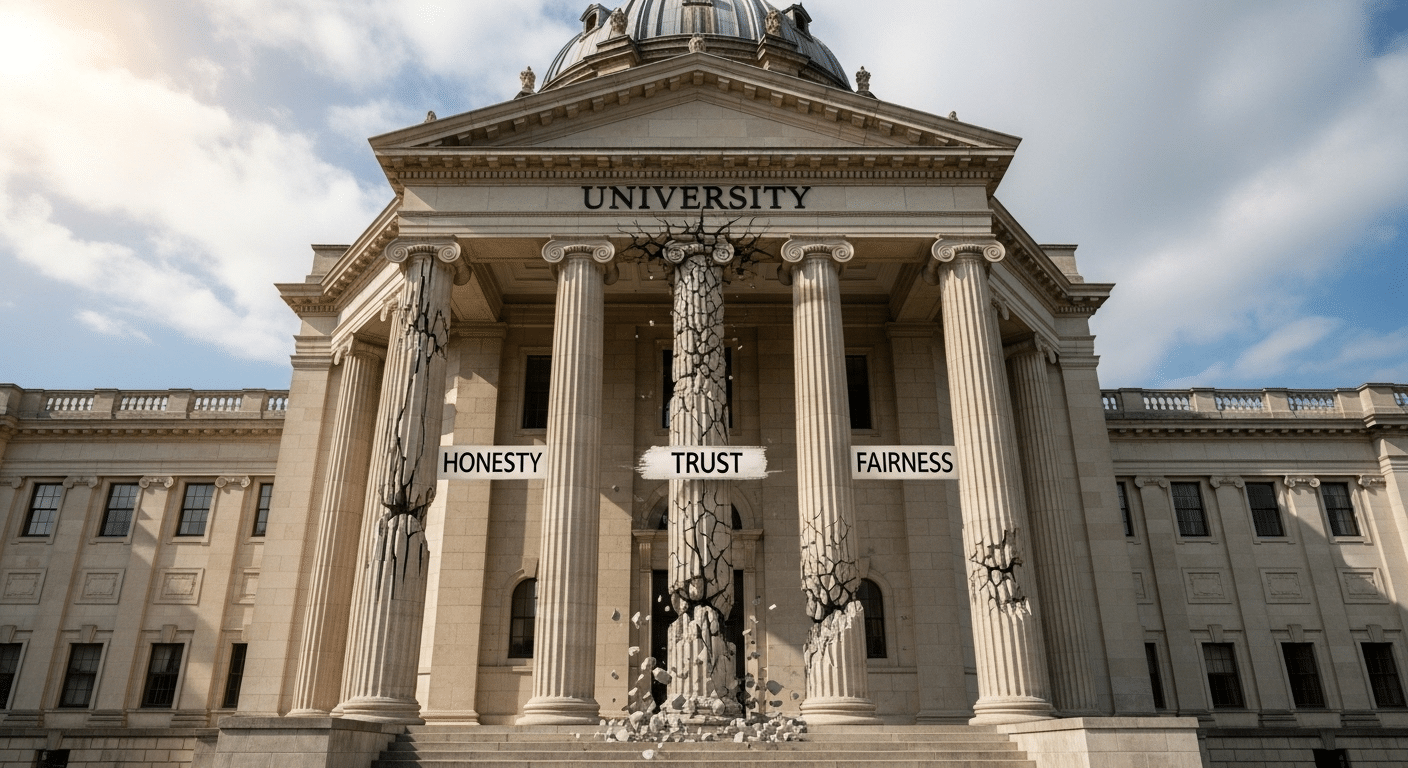
Academic integrity rests on a simple premise. The work you submit reflects your own words, your own ideas, and your own effort. That expectation creates trust between students and faculty, and it allows the academic community to function with confidence. Without that trust, evaluation becomes unreliable and learning becomes uncertain.
Plagiarism violates academic integrity because it breaks this foundation of academic honesty. When you take credit for others ideas or present someone else’s work as your own work, you misrepresent what you know and what you can do.
The issue is not only about citation rules. It is about truthfulness. A research paper or assignment is meant to demonstrate understanding. If the ideas or wording are not yours, the demonstration becomes false.
This misrepresentation carries consequences beyond the individual assignment. Plagiarism creates an unfair advantage over other students who complete their work independently. Grades are meant to reflect effort, skill, and critical thinking. When plagiarism occurs, that system becomes distorted.
To violate academic integrity is to undermine the educational purpose itself. Education is not merely about producing correct answers. It is about developing judgment, analysis, and intellectual independence.
When you substitute copied material for genuine thought, academic honesty erodes. The relationship between effort and achievement weakens. Over time, the standards that sustain higher education begin to fray, and the value of academic work becomes less certain.
What are the Immediate Academic Consequences of Plagiarism?
Plagiarism is not treated as a minor oversight in higher education. It is classified as an academic integrity violation, and the consequences can be immediate and severe.
Many professors are required to report suspected academic misconduct, even if the incident appears small. Once reported, the situation often moves beyond the classroom and into formal review.
In many universities, the first penalty is straightforward. You may receive a zero on the assignment. In more serious cases, that zero extends to the entire course, resulting in a failing grade. That failure can delay graduation, affect financial aid, and damage your standing within the institution.
The impact does not stop there. Repeated offenses, or particularly serious cases of intentional plagiarism, can lead to suspension or expulsion. A notation of academic dishonesty may be placed on your student’s record or transcript.
That mark can follow you beyond your current institution. Graduate schools, law schools, and medical programs routinely review transcripts for integrity violations. A single notation can jeopardize future admissions.
Possible penalties include:
- Failing the assignment
- Failing the entire course
- Academic probation
- Suspension from the university
- Expulsion from the institution
- Permanent transcript notation
These are not symbolic punishments. They are serious consequences that can reshape your academic trajectory.
Plagiarism is considered a breach of trust, and institutions respond accordingly. Even one incident can carry far-reaching consequences that extend well beyond the classroom.
The Long-Term Professional and Ethical Consequences

Plagiarism does not end with a grade penalty. It can follow you long after graduation. In many contexts, plagiarism is viewed as a form of fraud. When academic dishonesty appears on your record, it can raise concerns about credibility and ethical judgment.
Employers, licensing boards, and graduate programs often examine academic history closely. A single violation can cast doubt on your professional reputations.
The far reaching consequences extend beyond documentation. If you develop a habit of taking shortcuts in academic work, that pattern may continue into your career. Unethical behavior learned in education can resurface in professional settings, where the stakes are even higher.
In research fields, misrepresentation can lead to retractions, loss of funding, or public disgrace. In business or law, it can damage client trust and lead to legal repercussions.
Academic dishonesty does not exist in isolation. It shapes character and signals reliability. Years after graduation, questions about integrity can resurface unexpectedly.
Your career depends not only on knowledge and skills, but on trust. Once damaged, that trust is difficult to rebuild.
How Plagiarism Harms the Academic Community?
Plagiarism does not harm only the individual who commits it. It affects the entire academic community. Education depends on trust.
Faculty trust that the student work submitted reflects independent effort. Students trust that evaluation is fair. Universities trust that research and academic writing meet accepted standards. When plagiarism occurs, that trust begins to erode.
The relationship between faculty and students is particularly vulnerable. If instructors begin to suspect that assignments or research papers are not original work, the tone of education shifts. Conversations become guarded.
Feedback becomes cautious. Suspicion replaces openness. That change affects everyone, including students who complete their work honestly.
Plagiarism also devalues degrees. A university credential signals that you have met rigorous academic expectations. If academic dishonesty becomes widespread, the perceived value of that degree declines. Other colleges, employers, and graduate programs may question whether academic materials reflect genuine learning or borrowed content.
Research is equally affected. Original research builds on verified contributions. When plagiarized material enters academic writing, it disrupts that chain of knowledge. Misattributed ideas halt academic progress by obscuring intellectual origins and weakening scholarly accountability.
Over time, repeated academic misconduct can lead to a broader loss of confidence in an institution. The academic community relies on integrity to sustain credibility.
When plagiarism undermines that foundation, the consequences extend far beyond a single assignment or a single student.
Plagiarism and the Loss of Critical Thinking

Plagiarism is often discussed in terms of rules and consequences. Less attention is given to what it quietly removes from the learning process. When you copy instead of create, you bypass intellectual development. The assignment may be completed, but the growth that should accompany it does not occur.
A research paper is not merely a finished document. It is an academic exercise designed to strengthen your ability to question, analyze, and synthesize information.
When you substitute borrowed material for independent work, that exercise is short circuited. You may receive temporary relief from effort, but the deeper skills remain underdeveloped.
Academic development depends on struggle. Wrestling with ideas forces you to clarify your own thinking. Writing in your own words strengthens understanding.
If you rely on someone else’s work, the opportunity to build reasoning skills diminishes. Over time, this pattern can weaken your ability to form arguments from your own mind.
The damage is subtle but cumulative. Skills that should expand instead remain stagnant.
Skills weakened by plagiarism include:
- Critical thinking
- Research synthesis
- Academic writing
- Analytical reasoning
- Intellectual independence
Higher education is structured to cultivate these abilities. Plagiarism interrupts that cultivation. It replaces growth with imitation, and in doing so, it undermines the very purpose of learning.
Technology, AI, and the New Forms of Plagiarism
Technology has not created plagiarism, but it has changed its scale and speed. Artificial intelligence now allows students to generate essays, summaries, and even research outlines within seconds.
AI generated text can appear polished and coherent, which makes academic dishonesty harder to detect at a glance. The challenge is no longer limited to copying from another student’s paper. It now includes automated production of work that may never have existed before.
Contract cheating has also expanded. Online services advertise custom papers, problem sets, and even computer code for a fee.
Access to vast digital archives makes it easier to retrieve and reuse academic materials. During the pandemic, as online learning increased, reports of cheating rose as well. The environment made unsupervised submission more common, and institutions struggled to respond quickly.
Plagiarism detection software remains important, yet it struggles to keep pace with generative models. AI generated content is often original in wording but not in authorship. That complicates enforcement.
You are now expected not only to cite human sources properly, but also to acknowledge meaningful AI assistance. Ethical use requires transparency. Unethical use hides automated contribution and presents it as independent work.
New risks include:
- AI-generated essays submitted without disclosure
- Fabricated citations or invented research data
- Contract cheating services completing assignments
- Sharing computer code without proper attribution
- Auto-plagiarism through reuse of archived digital submissions
Technology amplifies both opportunity and risk. The responsibility to maintain academic integrity remains human.
Intentional vs Unintentional Plagiarism

Not all plagiarism arises from the same motive. Intentional plagiarism involves a deliberate decision to deceive. You may copy large sections of a research paper, submit someone else’s work, or conceal the use of artificial intelligence in order to gain an unfair advantage. In these cases, the intent is clear. The goal is to misrepresent authorship.
Unintentional plagiarism is different, though the impact can still violate academic integrity. It often results from inaccurate citation, confusion about what qualifies as common knowledge, or careless note-taking.
You might paraphrase too closely to the original source. You might forget to include quotation marks around borrowed words. These errors are common, especially in early academic development.
Intent does matter when institutions determine consequences, yet both forms require correction. Avoiding plagiarism depends on learning how to cite sources properly from the beginning of your studies.
Clear documentation, consistent referencing, and careful distinction between your own words and those of others are essential habits. If you are unsure about citation rules, seeking guidance from instructors or writing centers can prevent future problems.
Understanding the difference between intentional and unintentional plagiarism helps clarify responsibility. Academic integrity demands awareness, not just good intentions.
Why Preventing Plagiarism Is an Educational Responsibility?
Plagiarism is not only a disciplinary issue. It is an educational one. If students violate academic integrity because they do not fully understand citation rules, fair use, or copyright expectations, the response cannot be punishment alone. Education must address the root causes.
Teaching academic integrity should begin early in a course and continue throughout the semester. Clear honor codes establish expectations, but those expectations must be explained in practical terms.
Many students enter higher education with uneven preparation in academic writing. Without structured guidance, confusion can lead to mistakes that escalate into academic misconduct.
Faculty play a central role in prevention. When instructors provide feedback on drafts, they reinforce standards before violations occur. Writing centers also support students by clarifying how to cite sources properly and how to distinguish original work from borrowed material.
Transparent policy communication helps students understand what qualifies as acceptable student conduct and what crosses the line.
Effective prevention strategies include:
- Early instruction in citation practices
- Constructive feedback on drafts before final submission
- Clear explanation of the honor code and its purpose
- Transparent academic conduct policies that define expectations
- AI literacy education that explains responsible technology use
Avoiding plagiarism is not simply about rule enforcement. It is about equipping students with the skills and understanding necessary to uphold academic integrity throughout their education.
How Intelligent Review Strengthens Academic Integrity?
Plagiarism detection software has become a standard tool in higher education, yet software alone cannot determine intent. A similarity score does not reveal whether a student misunderstood citation rules, relied too heavily on a source, or deliberately engaged in academic misconduct.
When institutions rely only on automated flags, they risk reducing complex academic integrity violations to numerical thresholds.
Maintaining academic integrity requires responsible oversight. Context matters. A context-based analysis examines the pattern of student work over time, the structure of assignments, and documented revisions.
Inconsistencies across drafts often reveal more than isolated phrases highlighted by detection systems. Pattern recognition can surface meaningful concerns, but those concerns must be interpreted by faculty who understand the course, the student, and the learning goals.
Human judgment remains central. Transparency in AI authorship and clear documentation of sources protect students from wrongful accusations while preserving academic standards. Technology should support review, not replace it.
Institutions seeking to balance fairness and accountability increasingly rely on solutions such as TrustEd, which provide deeper insight into potential academic misconduct. Protecting both student trust and institutional credibility depends on this careful balance.
Conclusion
Plagiarism may begin with a few borrowed words, but its impact is far larger. It reaches into the core of academic integrity and challenges the trust that sustains education. When you submit academic work, you affirm that the ideas, analysis, and expression reflect your own effort.
That affirmation allows faculty to evaluate fairly, allows other students to compete honestly, and allows universities to award degrees with credibility.
Education depends on that trust. Without academic honesty, grades lose meaning and research loses authority. Plagiarism is not a minor shortcut. It is a breach that weakens intellectual growth, damages reputations, and undermines the academic community as a whole.
Institutions cannot rely solely on punishment to respond. A proactive approach, grounded in education, clear policy, and intelligent review, is essential to maintain academic integrity. Technology can support this effort when it is used thoughtfully and paired with human judgment.
If your institution is examining how to strengthen oversight while protecting student trust, exploring solutions designed for responsible review is a practical next step.
Frequently Asked Questions (FAQs)
1. Is plagiarism always intentional?
No. Plagiarism can be intentional or unintentional. Intentional plagiarism involves deliberately presenting someone else’s work as your own. Unintentional plagiarism often results from inaccurate citation, confusion about common knowledge, or poor note-taking. Even without intent, it can still violate academic integrity.
2. What happens if you plagiarize?
Consequences vary by institution, but they are often serious. You may receive a zero on the assignment or fail the course. More severe cases can lead to suspension or expulsion. Plagiarism is treated as academic misconduct because it misrepresents your academic work.
3. Can plagiarism appear on transcripts?
Yes. Some universities place a notation of academic dishonesty on a student’s record or transcript. This can affect graduate school applications and professional opportunities. Even a single academic integrity violation may have long-term consequences.
4. Does AI increase plagiarism?
Artificial intelligence can make plagiarism easier by generating essays, summaries, or computer code quickly. However, AI itself is not the violation. Failing to disclose AI generated content or presenting it as your own work is what constitutes plagiarism.
5. Why is plagiarism considered fraud?
Plagiarism is considered fraud because it involves taking credit for others ideas or words without proper acknowledgement. You are representing work as original when it is not. That misrepresentation undermines academic honesty and trust.
6. How can students avoid plagiarism?
Students can avoid plagiarism by citing sources properly, using quotation marks for direct quotes, and clearly distinguishing their own words from borrowed material. Seeking feedback from faculty or writing centers also reduces risk.
7. How can universities detect plagiarism fairly?
Universities use plagiarism detection software to identify similarities in student work, but fair detection requires human review. Context-based analysis and consistent academic conduct policies help ensure that academic integrity is upheld without wrongful accusations.
8. How does plagiarism harm academic integrity?
Plagiarism harms academic integrity by misrepresenting authorship and breaking trust between students, educators, and institutions. It creates unfair advantages, weakens accurate assessment of learning, and undermines intellectual honesty. Over time, it reduces the credibility of academic work and the value of educational qualifications.
