
Is Brainly AI Tutor Unlimited?
Brainly AI Tutor is not fully unlimited across all subscription tiers. The free plan restricts question posting through a point system, while Brainly Plus expands AI access without removing all usage limits. Brainly Tutor adds live tutoring sessions, but monthly session caps still apply. AI tutoring platforms like CoTutor offer alternative learning experiences with different access models.
If you’ve searched the question is brainly ai tutor unlimited, you’re probably trying to figure out one simple thing: how far does your access actually go? The word “unlimited” appears frequently in marketing language, but in practice, unlimited access can mean very different things depending on the subscription tier.
Brainly began in 2009 as a community-driven homework help platform where students post questions and receive answers from other students. Over time, it evolved. The company added AI features, introduced premium subscriptions, and positioned its AI tutor as a faster way to generate answers and explanations.
Today, Brainly combines crowd-sourced responses with AI-generated support, creating a mixed experience that blends peer help and automated tutoring.
But does that mean you can ask unlimited questions? Does the AI tutor provide full access across all subjects? And what limits apply to the free version versus paid plans like Brainly Plus or Brainly Tutor?
In this article, you’ll break down the free plan restrictions, premium features, live tutoring limits, AI capabilities, and potential hidden costs. By the end, you’ll know exactly what “unlimited” really means on the Brainly platform.
What Is Brainly and How Did It Start?
To understand whether Brainly AI tutor is unlimited, you first need to understand what Brainly actually is, and how it came to be. Brainly started in 2009 as a simple community forum. No artificial intelligence, no premium tiers, no polished AI tutor interface. Just students helping students.
The model was straightforward. Students post questions about homework, other students respond with answers, explanations, sometimes even full solutions. In exchange, users earn points. Those points allow you to ask more questions later. It is a give-and-take system built on participation.
Over time, the platform expanded globally. Students worldwide, especially middle school and high school students, began using it as a quick homework help resource. The appeal was speed and scale. You could search previously answered questions and often find something similar to your homework problem in seconds.
The structure relies on crowd sourced answers. That means community answers vary in depth and accuracy. Brainly implemented community moderation and basic quality control to filter incorrect responses, but the responsibility still falls partly on you to verify critical information.
As usage grew, Brainly evolved. It introduced paid plans. It added Brainly AI, layering AI generated responses on top of its community content. Today, the platform blends two worlds, peer-to-peer learning and automated AI assistance. That hybrid identity shapes everything that follows, including how unlimited access is defined.
How Does Brainly AI Actually Work?

After years as a purely community-driven platform, Brainly introduced artificial intelligence to speed things up. Brainly AI is designed to generate answers and explanations instantly, reducing the reliance on waiting for other students to respond. Instead of refreshing the page and hoping someone replies, you often receive AI generated responses within seconds.
One of the most visible tools is the “Scan to Solve” feature. You upload a photo of your homework problem, usually in math or science, and the system analyzes the image to generate answers. In structured subjects like algebra equations or chemistry formulas, this tends to work reasonably well. With messy handwriting or complex formatting, accuracy can drop. The system relies on clear input.
Brainly AI is especially focused on math, physics, chemistry, and science topics. The explanations it produces are brief and structured. You typically see a direct solution followed by a short explanation. The goal is efficiency, not deep conceptual exploration.
Importantly, Brainly AI does not replace community answers. It sits on top of them. That means you may see AI generated content alongside crowd sourced responses from other students.
Brainly AI can:
- Generate answers quickly when you are stuck
- Provide step by step explanations for common problems
- Create personalized quizzes in certain subjects
- Help with exam prep through practice-style questions
- Offer quick answers in a short time without waiting
The advantage is speed. The limitation is depth. AI generated responses often follow predictable patterns and may not fully unpack complex problems. For routine homework help, it works smoothly. For deeper understanding, results can feel somewhat surface-level.
Is Brainly AI Tutor Unlimited on the Free Plan?
Brainly’s free plan, often referred to as Brainly’s free tier, allows you to browse previously answered questions and submit your own. On the surface, it looks generous. You can sign up without paying. But the mechanics underneath tell a different story.
To ask questions on the free version, you must earn points. You earn points by answering other students’ questions. If you run out of points, you cannot post. It’s that simple. No points, no question submission. That structure creates a built-in limit.
The free plan also includes ads during studying. Some users tolerate them. Others find them distracting, especially when trying to focus on math or science problems. While the platform is technically free to join, it is not completely free in practice if you want smoother access or fewer interruptions.
Most importantly, there are no unlimited questions on the free version. Posting is regulated by the point system. AI features are also partially restricted unless you upgrade.
Free Version Limits:
- Ads appear regularly during studying sessions
- Point system required to ask questions
- Limited access to premium AI features
- Restricted question posting when points run out
So, is Brainly AI tutor unlimited on the free plan? No. The free plan provides access, but it operates within clear limits. Unlimited access only becomes a possibility when you move into paid tiers, and even then, the definition of unlimited needs careful examination.
What Does Brainly Plus Actually Offer?
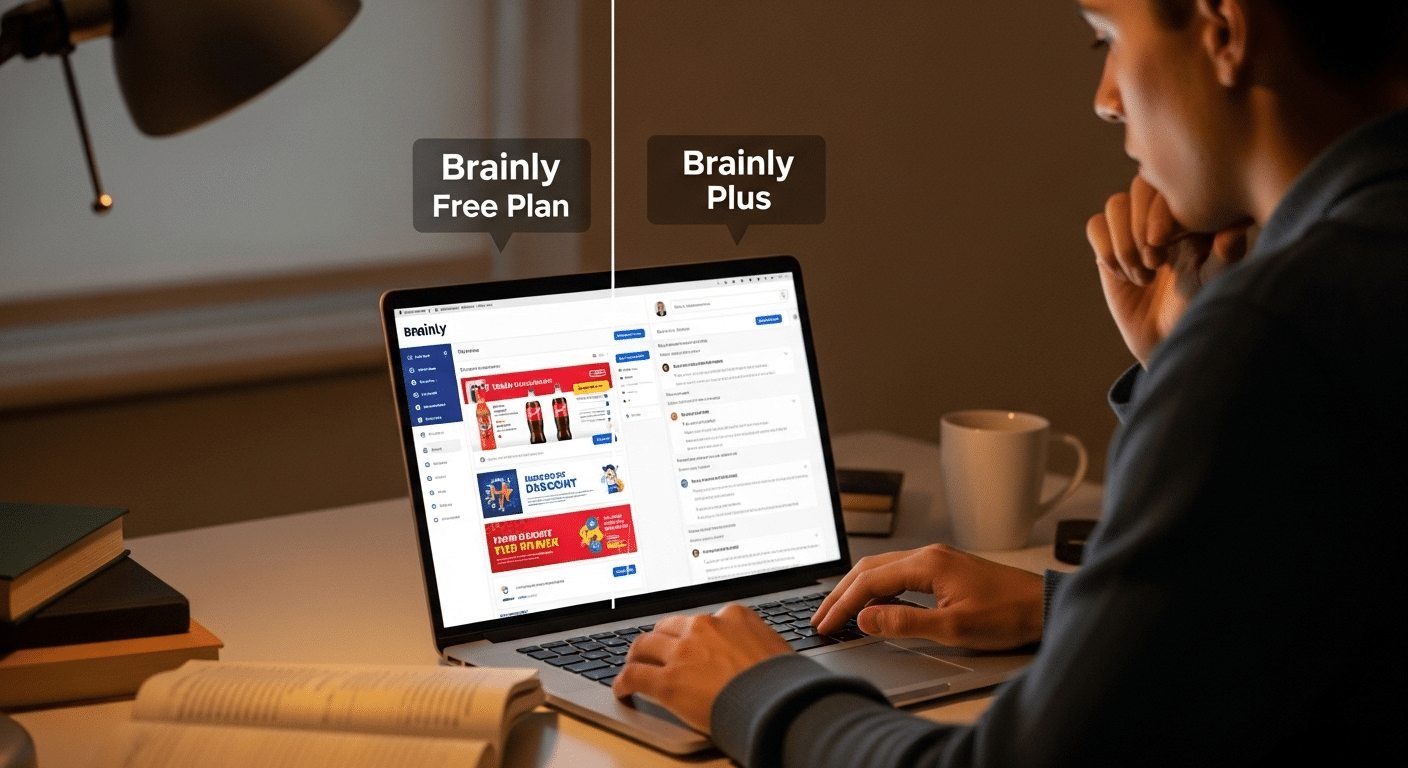
If the free plan feels restrictive, Brainly Plus is positioned as the upgrade that smooths things out. The pricing typically ranges from about $2.50 to $10 per month, depending on how long you commit to the subscription. Shorter billing cycles cost more per month, longer commitments lower the average price.
The most noticeable benefit is ad free studying. Once you subscribe, the constant ads disappear. For many students, that alone improves focus. Brainly Plus also expands access to certain premium features, including more robust AI explanations and fewer interruptions when browsing answers.
However, Brainly Plus does not allow unlimited question posting. The point system still applies. You may have a more comfortable experience, but you are not granted unrestricted submission privileges. That distinction often causes confusion when users assume “Plus” equals full access.
The plan includes a 7-day free trial. If you do not cancel before the trial ends, it converts automatically into a paid subscription. Auto-renewal is built into the billing model. Brainly does not offer refunds once a payment has been processed, which has led to billing complaints from some users who forget to cancel on time.
Brainly Plus vs Free Plan:
| Feature | Free Plan | Brainly Plus |
|---|---|---|
| Ads | Yes | No |
| Ask questions | Point-based | Still limited |
| AI features | Limited | Expanded access |
| Cost | Free | Monthly subscription |
While Brainly Plus improves usability, it does not deliver full access across all services. Before subscribing, it helps to understand both the benefits and the hidden costs tied to auto-renewal and non-refundable charges.
Does Brainly Tutor Provide Unlimited Live Tutoring?
This is the tier most people point to when they ask, is Brainly AI tutor unlimited. Brainly Tutor is marketed as the plan that includes live tutoring sessions, which immediately sounds closer to unlimited support. The pricing typically ranges from about $8 to $29 per month, depending on billing length and promotional offers.
Brainly Tutor does offer live tutoring. You can connect with tutors for real-time help, which reduces response time compared to waiting for community answers. That said, it is not open-ended. The service focuses on core STEM subjects, primarily math, physics, chemistry, and biology. If you need help outside those areas, availability narrows.
The most important detail is the session cap. Brainly Tutor includes up to 20 live sessions per month. Once you reach that limit, you cannot purchase extra sessions within the same billing cycle. You must wait until the next month for your allocation to reset.
So while marketing language may suggest unlimited live tutoring sessions, the structure includes clear limits.
Limitations of Brainly Tutor:
| Feature | Brainly Tutor |
|---|---|
| Live Sessions | 20 per month |
| Subjects | Core STEM only |
| Extra Sessions | Not allowed |
| AI Access | Included |
Important Limitations to Know before using Brainly Tutor :
- 20 session cap each billing cycle
- Must wait for next billing cycle after reaching limit
- Auto-renewal applies unless canceled
- No refunds after payment is processed
So, is Brainly Tutor truly unlimited across services? No. It expands support beyond the free plan and Brainly Plus, but it still operates within defined monthly limits. For short-term homework help in math or science, it can be useful. For continuous, unrestricted tutoring, the boundaries become more visible.
Are Brainly Community Answers Reliable?

Before Brainly introduced AI, its foundation was built on community answers. That structure still plays a central role today. Students post questions, and other users respond, often within an average response time of around twenty minutes. In popular subjects like math and science, answers can appear quickly. In less common topics, you may wait longer.
Reliability, however, varies. Some responses are marked as verified answers, meaning they have been selected or endorsed within the platform. Others are simply posted by fellow students. Because Brainly relies on crowd sourced contributions, quality control depends on moderation and peer voting.
Incorrect answers can be reported, yet mistakes still appear. Some explanations are clear and correct. Others are rushed or incomplete.
You may also notice multiple answered questions that look similar to yours but offer different solution paths. That variety can be helpful, though it can also create confusion about which approach is correct. For important assignments, students are encouraged to verify critical details independently.
Here is a balanced look at the model:
| Pros of Community Model | Cons of Community Model |
|---|---|
| Many answers available across common subjects | Quality control inconsistency despite moderation |
| Multiple solution approaches for similar questions | Not always deep understanding in explanations |
| Peer learning through shared explanations | Complex problems may receive incorrect or incomplete responses |
Can Brainly Help You Develop Deep Understanding?
Brainly is often effective when you need quick help with a homework problem. If you are stuck on a math equation or a science definition, the platform can generate answers fast. For routine assignments, that speed is appealing. You get a solution, you move on.
Developing deep understanding, however, is a different goal. Complex problems usually require layered explanations, conceptual connections, and time to reflect. Brainly’s AI explanations tend to be brief and structured for efficiency.
They show the steps, but they do not always unpack the reasoning behind each step in depth. The platform gives you the path. It does not necessarily slow down and explore why that path works.
Because of that, you often need to study explanations independently. The tool provides the material, but the responsibility to focus, reread, and internalize the logic remains yours. Some students find this sufficient. Others feel the answers are surface-level.
Reviews across the web reflect that divide. Many users appreciate the convenience and quick responses. Others question whether the platform supports long-term mastery.
Compared to a dedicated personal tutor or AI-first systems like Astra AI, which are designed specifically for personalized learning from the ground up, Brainly can feel more oriented toward task completion than sustained conceptual growth.
Are There Hidden Costs or Subscription Risks?

When evaluating whether Brainly offers good value, it helps to look beyond features and examine billing policies. Several users across review platforms have raised concerns about hidden costs tied to subscription terms.
Brainly operates on an auto renewal system. If you sign up for a free trial and do not cancel before it ends, the subscription converts automatically into a paid plan. Some users report unexpected charges because they overlooked the billing date. Once payment is processed, Brainly’s policy states that there is no refund. That firm stance has led to frustration among users who believed cancellation was complete or misunderstood the timeline.
These policies do not make the service illegitimate. They simply require careful attention. Subscription models can be convenient, but they also demand awareness.
Before You Subscribe:
- Check the billing cycle carefully
- Cancel the free trial before the deadline
- Understand the no refund rule clearly
- Review the monthly cost to confirm it fits your budget
If you approach the subscription with clarity, you reduce the risk of surprises. If you overlook the fine print, dissatisfaction can follow.
So, Is Brainly AI Tutor Truly Unlimited?
After looking at each tier closely, the answer becomes straightforward. Brainly AI tutor is not unlimited across all services.
The free version is clearly limited. You must earn points to post questions, ads appear during studying, and access to AI features is restricted. There is no unlimited question posting on the free plan.
Brainly Plus improves the experience by removing ads and expanding certain premium features, but it still does not allow unlimited posting. The point system remains in place. You gain convenience, not unrestricted access.
Brainly Tutor goes further by adding live tutoring, yet it includes a 20-session cap per month. Once you reach that limit, you must wait for the next billing cycle. That is a defined boundary, not unlimited use.
AI features are accessible across tiers, but the depth and scope vary. Marketing language may suggest broader access, yet the actual limits are written into each subscription structure. Unlimited, in this case, depends heavily on which service you are referring to.
Who Should Use Brainly and Who Should Look Elsewhere?

Brainly can be useful, depending on what you expect from it. If your goal is quick clarification on a homework problem or a fast answer before a deadline, the platform can deliver. Its mix of community answers and AI responses works best when the task is routine and time-sensitive.
For students in earlier academic stages, especially middle school and high school students, the structure often feels manageable. The questions are familiar. The explanations are direct. You search, you find something similar, you move forward.
Where Brainly becomes less effective is in situations that demand sustained depth. Complex conceptual development requires more than short explanations. Long-term academic growth usually benefits from consistent guidance rather than scattered responses.
Suitable For:
- Middle school and high school students
- Quick homework help before submission
- Routine math or science practice
Not Ideal For:
- Deep subject mastery across semesters
- Long-term exam prep strategy
- Complex engineering-level subjects or advanced theoretical work
If you need efficiency, Brainly can help. If you need structured, layered learning over time, you may need something more consistent and focused.
Is There a More Consistent Alternative to Brainly’s Mixed Model?
Once you understand how Brainly operates, the broader question becomes less about limits and more about design. Brainly started as a community-driven forum and layered AI features on top over time. That hybrid structure explains both its flexibility and its inconsistencies. Community answers vary. AI explanations prioritize speed. Access depends on subscription tier.
Some platforms approach tutoring differently from the start.
CoTutor, for example, was built as an AI-native tutoring platform rather than a community forum with AI additions. There is no point system controlling participation. There is no ad-driven experience shaping usage. The architecture is designed for institutional reliability, not casual question exchanges.
CoTutor delivers uniform AI-powered tutoring across interactions, meaning the quality of guidance does not fluctuate between community responses and automated outputs. It operates within a secure, browser-based infrastructure aligned with higher education standards. That focus on security and scalability makes it suitable for structured academic environments.
Most importantly, the design emphasizes deeper understanding rather than quick homework answers. The system aims to guide reasoning consistently, not simply generate responses. If you are evaluating alternatives to Brainly’s mixed model, consistency and institutional-grade design may matter more than the word unlimited.
Conclusion
On homework platforms, the word unlimited rarely means unrestricted in every direction. More often, it means access within a particular subscription tier. Once you look closely at Brainly’s structure, the boundaries become clear. The free plan includes limits. Brainly Plus removes ads but does not remove posting restrictions. Brainly Tutor expands access, yet it carries a session cap.
That does not make the platform useless. Brainly can be helpful for quick support, especially when you need fast answers in math or science. The key is understanding what you are actually purchasing.
Before subscribing, take time to examine the details. Look at session caps, billing cycles, and feature differences between plans. Compare alternatives if your goal is deeper understanding rather than rapid homework completion.
Unlimited is often a marketing term. Real access depends on structure. If you evaluate features carefully and align them with your academic needs, you will make a smarter decision, and avoid surprises later.
Frequently Asked Questions (FAQs)
1. Is Brainly AI Tutor free to use?
Brainly AI Tutor offers limited free access through Brainly’s basic plan, but several features are restricted. Users must earn points to ask questions, view ads during studying sessions, and upgrade to paid subscriptions for expanded AI access and tutoring features.
2. How many questions can you ask on Brainly free plan?
On the free plan, you cannot ask unlimited questions. You must earn points by answering other students’ questions. If you run out of points, you cannot post new questions until you earn more.
3.Does Brainly Tutor offer unlimited tutoring sessions?
No, Brainly Tutor does not provide unlimited live tutoring sessions. The platform includes a monthly session cap, typically allowing up to 20 tutoring sessions per billing cycle, after which users must wait until the next subscription period for additional access.
4. Is Brainly reliable for homework help?
Brainly can be useful for quick homework support, especially in subjects like math and science, but answer quality may vary because the platform combines community-generated responses with AI-generated explanations. Students should verify important information independently before using answers for graded assignments.
5. Can you get a refund from Brainly?
Brainly does not offer refunds once a payment has been processed. Subscriptions renew automatically unless canceled before the billing date, which has caused frustration for some users who miss the deadline.
6. What subjects does Brainly Tutor cover?
Brainly Tutor primarily covers core STEM subjects, including math, physics, chemistry, and biology. Availability outside these subjects may be limited, so coverage depends on the academic area you need support in.
