

How to Choose an AI Tutor With Smart Learning Features?
A smart AI tutor uses adaptive learning, progress tracking, personalized feedback, and predictive analytics to adjust lessons based on student performance. The best platforms support different learning styles, provide step-by-step explanations, and protect student data. Solutions like Apporto CoTutor also offer structured, secure AI tutoring designed for educational institutions.
If you are trying to figure out how to choose an ai tutor with smart learning features, you are entering a fast-moving space. The global AI tutor market is projected to grow from $1.63 billion in 2024 to nearly $7.99 billion by 2030. That growth is not accidental. It reflects demand. Students struggle to get consistent 1:1 attention. Traditional tutoring remains expensive and limited in availability. Artificial intelligence has stepped in to fill that gap.
AI tools now offer instant feedback, adaptive lessons, and targeted practice across subjects. Schools and universities are integrating AI into mainstream education. Parents are exploring AI tutor apps at home. Professionals are using them to build new skills after hours.
But scale does not equal quality. Not all AI tutors are designed equally. Some simply provide answers. Others guide thinking. In this blog, you will explore what truly defines smart learning features and how to evaluate an AI tutor with clarity and confidence.
What Makes an AI Tutor Truly “Smart”?
A truly smart system relies on adaptive learning technology. That means it does not deliver the same lesson to everyone. It analyzes student data, evaluates patterns in performance, and adjusts the level of difficulty accordingly.
If you struggle with algebraic equations, the system slows down and offers structured reinforcement. If you master a concept quickly, it increases complexity. The experience evolves.
Personalized learning paths are another marker of intelligent tutoring. Instead of random practice questions, you receive lessons aligned to your learning goals. Some advanced platforms build internal knowledge graphs that track mastery of interconnected concepts, mapping strengths and gaps over time. That structure prevents fragmented understanding.
Predictive analytics adds another layer. By analyzing past interactions, the AI can anticipate where you might struggle next and introduce targeted practice before confusion deepens. Contextual understanding matters too. A quality system remembers previous questions and preferences, creating continuity rather than isolated exchanges.
Smart does not mean flashy. It means intentional design.
- Adaptive Practice Adjusts difficulty based on your performance.
- Progress Tracking Monitors mastery and suggests targeted practice.
- Contextual Memory Remembers past interactions and preferences.
- Predictive Analytics Anticipates areas where students may struggle.
How Do Smart AI Tutors Personalize Your Learning Experience?
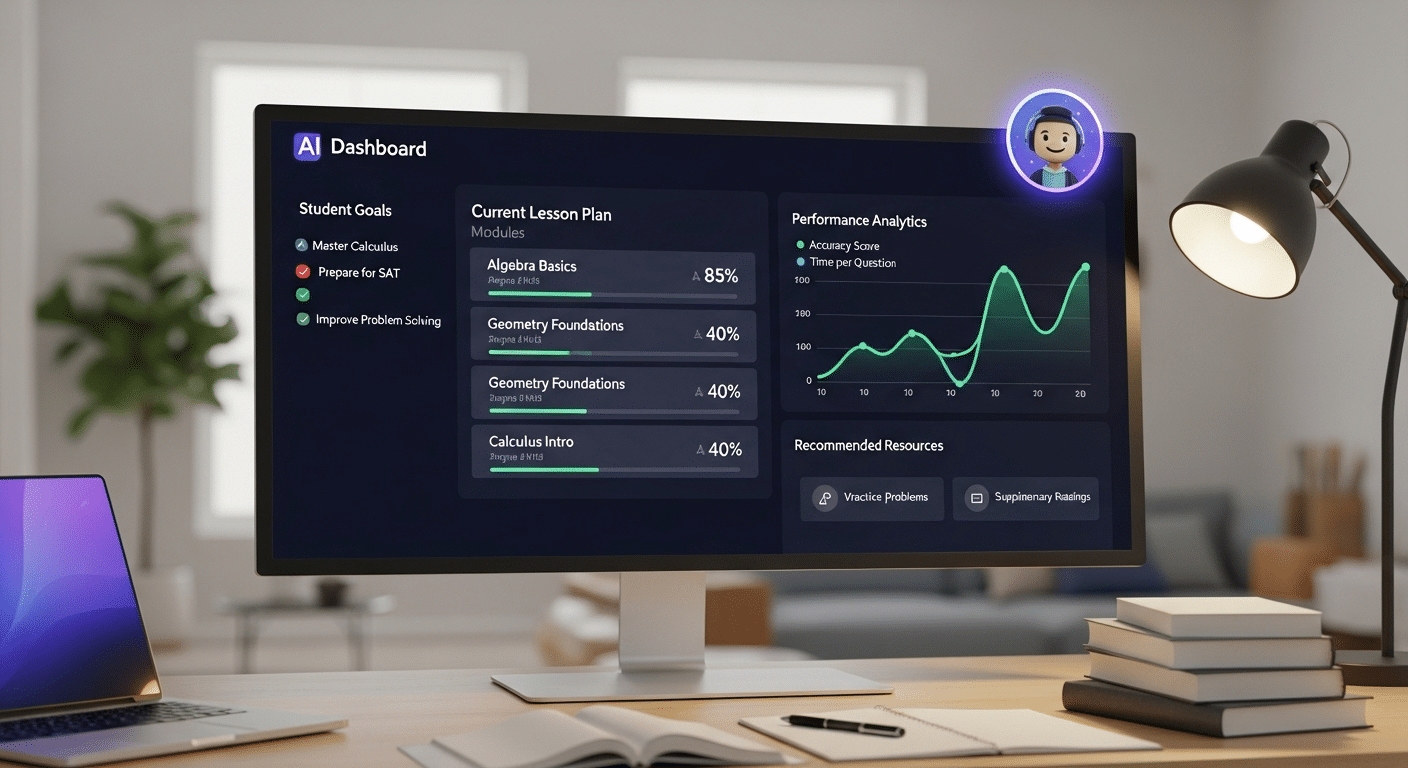
Personalization is where smart systems begin to separate themselves from generic chat tools. A well-designed AI tutor aligns instruction directly with your learning goals. If you are preparing for standardized tests, the system prioritizes targeted practice. If you are trying to understand abstract concepts in physics or writing, it shifts toward deeper explanation and structured reasoning.
Adjustment happens in real time. As you answer practice problems, the AI analyzes mistakes and provides instant feedback. It does not simply mark answers wrong. It offers step by step breakdowns, explains concepts clearly, and introduces follow up questions that test comprehension. That continuous loop of action and correction strengthens retention.
Learning style also matters. Some students absorb information visually, others through structured text, others through interactive problems. Smart AI tutors support multiple formats, presenting lessons through explanations, diagrams, quizzes, and guided exercises. Many platforms also include multilingual capabilities, expanding access and reducing barriers.
Engagement determines results. Students who actively interact, ask follow up questions, and request clarification see better outcomes than those who passively consume answers. Personalized tutoring is not automatic. It responds to your effort. When used deliberately, it becomes a dynamic learning experience rather than a static exchange.
Should You Choose an AI Tutor Over a Human Tutor?
This question deserves a careful answer. A human tutor brings qualities that artificial intelligence cannot replicate. Emotional intelligence stands at the top of that list. A human tutor can sense frustration, hesitation, or confidence in subtle ways.
They provide encouragement, adjust tone, and offer human support that builds trust. Traditional tutoring also allows for spontaneous discussion that moves beyond structured lessons.
AI tutors, however, introduce advantages that are difficult to ignore. Availability is constant. You receive consistent support at any hour, not just during scheduled sessions. Instant feedback arrives the moment you submit a response.
There is no waiting period. Scalability also changes the equation. AI systems can provide personalized tutoring to thousands of students simultaneously, something human teachers cannot realistically manage alone.
Cost plays a practical role. Human tutoring often requires significant financial investment and scheduling coordination. AI tools, by contrast, offer scalable pricing and broader access.
The strongest outcomes often emerge from a hybrid approach. Use AI for structured practice, targeted repetition, and quick correction. Rely on human tutors and teachers for emotional guidance, deeper dialogue, and complex reasoning. Each serves a distinct function.
| Feature | AI Tutor | Human Tutor |
|---|---|---|
| Availability | 24/7 | Limited hours |
| Emotional Intelligence | Limited | High |
| Personalized Practice | Adaptive algorithms | Manual |
| Cost | Scalable | Often expensive |
| Progress Tracking | Automated dashboards | Manual feedback |
What Smart Learning Features Should You Look For?

Once you understand the difference between basic and intelligent tutoring, the next step is evaluation. Not all AI tools offer the same depth. Some provide quick answers. Others are designed to strengthen understanding over time. Your focus should be on key features that directly support your learning goals.
Adaptive learning technology should be at the top of your list. The system must adjust difficulty based on performance. If every lesson feels identical regardless of progress, the tool is not truly responsive. Smart tutors monitor student data continuously and refine practice accordingly.
Step by step feedback is equally critical. You need more than a correct or incorrect label. A strong AI tutor explains mistakes clearly, walks through reasoning, and helps you identify where thinking went off course. Targeted practice builds from those insights, reinforcing weak areas rather than repeating mastered material.
Natural language conversation matters as well. A tutor should understand follow up questions and rephrase explanations when confusion persists. Contextual memory allows the system to remember past interactions, creating continuity in your learning experience. Some advanced platforms map mastery through knowledge graph tracking, identifying gaps across interconnected concepts.
Integration with learning management systems such as Canvas or Google Classroom improves usability. Finally, secure data practices ensure student information is protected under regulations like FERPA and GDPR.
How Important Is Progress Tracking and Predictive Analytics?
Progress tracking is not a cosmetic feature. It is the backbone of intelligent tutoring. Without structured monitoring, an AI tutor becomes little more than a reactive answer engine. With it, the system begins to resemble a learning partner.
Intelligent progress monitoring analyzes your performance across lessons, quizzes, and assignments. It identifies knowledge gaps that may not be obvious at first glance. You might complete math practice problems correctly while still misunderstanding a foundational concept. A smart system detects that pattern and recommends targeted practice before the gap widens.
Predictive analytics adds another layer of sophistication. By examining prior responses and difficulty patterns, the tutor anticipates where you are likely to struggle next. It proactively introduces reinforcement exercises or simplified explanations. That foresight can be especially valuable when preparing for standardized tests, where cumulative mastery matters.
Most advanced AI tutors create structured quizzes and adjust difficulty dynamically. They highlight mistakes in context, explaining not only what went wrong but why. Immediate feedback strengthens retention, while adaptive difficulty keeps you challenged without overwhelming you.
Progress is not just recorded. It is interpreted. And that interpretation makes all the difference.
How Do You Evaluate Quality and Reliability?

Choosing between AI tutors requires more than comparing features. You need to evaluate quality and reliability with the same care you would apply to any educational tool.
Start by examining data sources. Quality AI tutors rely on credible academic content, peer-reviewed materials, or structured curriculum frameworks. If a platform is vague about where its knowledge comes from, caution is warranted.
Artificial intelligence systems can occasionally generate incorrect responses, sometimes referred to as hallucinations. These answers may sound confident but contain factual errors. Cross-checking explanations against trusted textbooks or reliable references protects you from misinformation.
Institutional endorsements offer another signal. Platforms used by schools or universities typically undergo additional scrutiny. That does not guarantee perfection, but it suggests a baseline of accountability.
Transparency about training data and model design also matters. Reputable providers explain how student data is handled and whether information is used to train models.
Privacy policies deserve attention. Compliance with FERPA and GDPR is essential when student data is involved. Secure data practices should be explicit, not implied.
- Check Institutional Backing: Endorsements from schools or universities.
- Review Privacy Policy: Transparency about student data usage.
- Test Accuracy: Cross-reference answers with trusted sources.
Do Smart AI Tutors Support Different Subjects and Learning Styles?
A smart AI tutor should not be confined to a narrow subject area. Strong platforms provide coverage across math, science, writing, reading, and languages, allowing you to move between disciplines without switching tools. That versatility matters if your learning goals evolve.
At the same time, some AI tutors are designed specifically for certain age groups or academic levels. Platforms like LittleLit focus on younger learners, blending structured lessons with age-appropriate support. Higher education tools, including those integrated with publishers such as Macmillan Learning, often align closely with university course materials. Context matters.
Learning style also deserves attention. Some students respond best to written explanations. Others benefit from visual aids or interactive problem solving. Advanced systems now support multi-modal interaction, including handwriting recognition for math equations or voice input for conversational practice. These features expand accessibility.
Mobile apps extend availability further. You can review practice questions, track progress, or revisit explanations anytime. For educators and parents, broad subject coverage combined with adaptable delivery creates consistent support across different learning preferences. The goal is not uniformity. It is flexibility without sacrificing depth.
What Role Should Parents, Teachers, and Educators Play?
AI tutors operate with impressive independence, but they should not operate alone. Human oversight remains essential. Teachers, parents, and educators provide context that no algorithm fully grasps. They understand long-term learning goals, emotional readiness, and the broader arc of education.
Teachers play a guiding role. They define objectives, align lessons with curriculum standards, and help students interpret feedback correctly. An AI tutor may provide instant corrections, but a teacher explains why certain concepts matter beyond the immediate assignment. That deeper framing strengthens critical thinking.
Parents contribute in quieter ways. Monitoring progress dashboards, reviewing performance trends, and asking reflective questions help reinforce accountability. When parents stay engaged, students are more likely to use AI tools responsibly rather than passively accepting answers.
Research and practical experience both suggest that the best outcomes emerge from a hybrid model. AI enhances repetition, adaptive practice, and targeted support. Human mentorship cultivates judgment, resilience, and intellectual curiosity. One does not replace the other. When balanced carefully, they create a more stable and comprehensive learning experience.
Why Structured AI Tutors Like CoTutor Stand Out?
Not every AI tutor is designed specifically for institutional learning. Many are built for general use, flexible but loosely structured. That flexibility can be useful, yet it often lacks the safeguards and academic alignment that schools and universities require.
CoTutor takes a different approach. It is built for structured educational environments where educators need visibility, control, and accountability. The platform integrates with learning management systems, supports curriculum alignment, and operates within secure infrastructure standards. For institutions, that foundation is not optional.
More importantly, CoTutor emphasizes structured guidance rather than answer dumping. Prompts are pedagogically aligned, encouraging reasoning and mastery instead of shortcuts. This matters when the goal is long-term understanding, not quick completion of assignments.
Educators retain oversight while students receive adaptive support. Progress tracking is detailed and designed to inform instruction, not just display numbers. The result feels intentional. It functions as a learning solution rather than a generic chat tool.
Final Thoughts
Choosing the right AI tutor requires more than comparing price tags or flashy features. You now know what to look for. Adaptive learning technology. Step by step feedback. Progress tracking that actually interprets performance. Predictive analytics that anticipate difficulty. Secure data practices. Clear safeguards. Those are not extras. They are essentials.
Approach the process with curiosity. Test different tools. Explore how each platform responds to follow up questions, how it explains mistakes, and whether it adjusts to your learning goals. Experimentation helps you discover which smart learning features genuinely support your growth.
At the same time, verify information. Cross-check important answers. Combine AI practice with classroom instruction and human mentorship. The hybrid approach remains the most reliable path.
If you are evaluating options for schools or universities, structured institutional platforms like CoTutor offer a secure, guided starting point built specifically for educational environments.
Frequently Asked Questions? (FAQs)
1. What are smart learning features in an AI tutor?
Smart learning features include adaptive learning technology that adjusts difficulty based on performance, progress dashboards that monitor mastery over time, and predictive analytics that anticipate where you may struggle next. These tools work together to provide targeted practice and structured feedback instead of random answers.
2. Are AI tutors better than traditional tutoring?
AI tutors excel in scalability, consistent support, and 24/7 availability. Traditional tutoring offers emotional intelligence, mentorship, and nuanced human interaction. The most effective approach often combines both, using AI for adaptive practice and human tutors for deeper guidance and critical thinking development.
3. How do AI tutors personalize learning?
AI tutors personalize learning by analyzing performance data and adapting practice in real time. They use contextual memory to remember past interactions and adjust lessons accordingly. Adaptive practice ensures that difficulty increases gradually, while targeted feedback reinforces understanding and corrects mistakes efficiently.
4. Is student data safe with AI tutoring platforms?
Student data safety depends on the platform. Reputable providers comply with regulations such as FERPA and GDPR, maintain transparent privacy policies, and protect student information through secure infrastructure. You should review data practices carefully before committing to any AI tutoring tool.
5. Can AI tutors help with standardized test preparation?
Yes. AI tutors can provide targeted practice aligned with standardized test formats. They generate adaptive quizzes, adjust difficulty based on performance, and highlight mistakes in context. This structured approach helps reinforce weak areas while building confidence through repeated, focused preparation.
