

Are AI Language Tutors Good for Learning?
AI language tutors help learners practice speaking, improve pronunciation, and receive real-time feedback through adaptive conversation exercises and personalized lessons. They are effective for daily language practice and confidence building, while human tutors still provide cultural nuance and deeper conversation skills. Platforms like Apporto CoTutor combine AI-guided practice with structured learning support for language development.
Are AI language tutors good, or are they just the latest shiny promise in language learning? That question keeps popping up, and not without reason. In the past few years, AI language tutors have multiplied at a dizzying pace.
New apps appear every month, each claiming smarter conversations, sharper feedback, faster progress. It can feel like everyone is suddenly talking to an AI tutor.
The appeal is obvious. You get speaking practice on demand. You receive immediate feedback on pronunciation, grammar, even word choice. Some platforms simulate realistic conversations so you can rehearse job interviews or casual chats in your target language. For language learners chasing speaking fluency, that sounds powerful.
AI tools can support reaching fluency, especially when they remove fear and friction from practice. But good design matters. Pedagogy matters. How you use the tool matters. This article looks carefully at both the strengths and the cracks, and what a thoughtful hybrid future might actually look like.
What Exactly Are AI Language Tutors and How Do They Work?
Before deciding whether AI language tutors are good, you need to understand what they actually are. Strip away the glossy interface and cheerful avatars, and you are looking at a system built to process language at scale.
You speak, it listens. You type, it responds. Underneath that simplicity sits a layered set of AI tools designed to simulate conversation practice in a way that feels natural enough to keep you engaged.
Most AI language learning apps rely on speech recognition to convert your voice into text. That text is analyzed by an AI conversation engine trained on large language datasets.
The system evaluates your grammar, vocabulary, and sentence structure, then generates a reply that fits the context. Ideally, the exchange resembles realistic conversations rather than rigid drills.
Here is what typically powers the interaction:
- Speech recognition captures your spoken input and translates it into analyzable text
- AI conversation engines generate context-aware replies based on conversation topics
- Conversation transcripts store each exchange for later review
- Real-time corrections allow you to self correct mid sentence
- Written corrections highlight grammar errors and suggest clearer phrasing
- Grammar questions reinforce patterns you just practiced
- Word choice suggestions introduce new vocabulary organically
How Do AI Language Learning Apps Personalize the Learning Process?
Personalization is where many AI language tutors attempt to stand out. Adaptive learning methods adjust the difficulty of conversation practice based on performance.
Beginner lessons emphasize foundational grammar and essential vocabulary. Advanced learners encounter more complex sentence structures and layered conversation topics.
Some platforms track progress over time, allowing you to save words and build a personalized bank of new vocabulary. Others follow a guided curriculum that mirrors structured language courses, gradually increasing complexity while reinforcing earlier material.
In theory, the learning process becomes responsive. You are not pushed forward blindly. The system recalibrates as you go, sometimes subtly, sometimes quite obviously.
What Are the Real Benefits of AI Language Tutors?
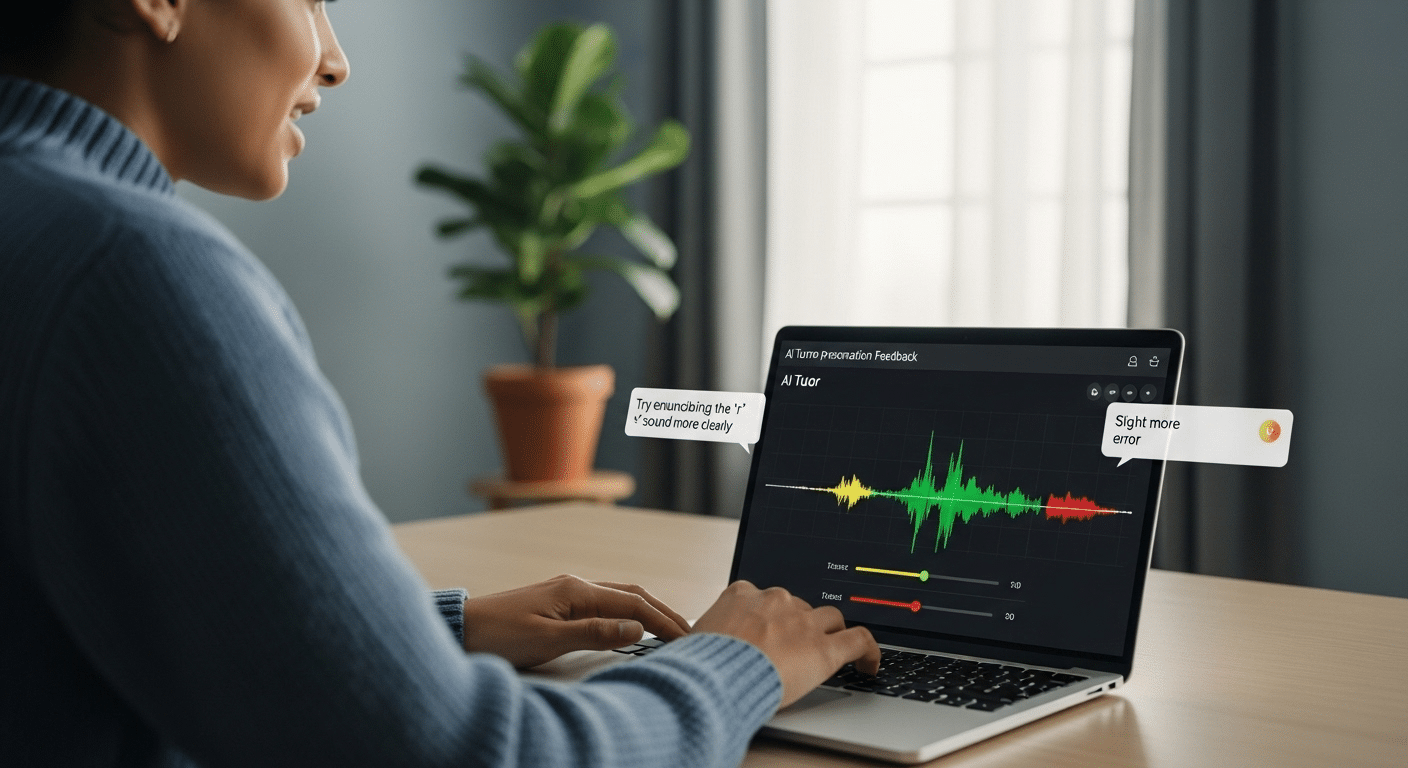
So, are AI language tutors good when it comes to actual results? The answer becomes clearer when you look at what they do consistently well. Not magically. Not perfectly. But reliably.
For many language learners, the hardest part is not memorizing vocabulary or understanding grammar rules. It is opening your mouth and starting to speak. That small, uncomfortable moment. AI lowers the barrier.
Why Is AI So Effective for Speaking Practice?
AI tutors create conditions that encourage language practice without social friction. That matters more than most people realize.
- Personalized, low-pressure environment. You can practice speaking without worrying about sounding foolish or making obvious mistakes
- Unlimited practice opportunities. There is no scheduling constraint, no hourly rate ticking in the background
- Immediate feedback on grammar and pronunciation. Corrections happen in real time, allowing you to adjust before errors fossilize
- Multimodal learning that blends listening comprehension, speaking skills, and visual prompts in one session
- Practice for specific scenarios like job interviews, travel situations, or presentations
- Builds speaking fluency without fear of judgment, which often accelerates confidence
That combination can be powerful. You are free to experiment. You can pause mid sentence, try again, self correct, and continue. The repetition feels mechanical at times, yes, but repetition builds comfort.
Where Does AI Perform Best in the Learning Process?
AI tends to shine in structured environments. Vocabulary acquisition, for example, benefits from constant exposure and reinforcement. When you repeatedly encounter new words inside conversation practice, retention improves.
Repetition-based drills also suit AI systems. Patterns, verb conjugations, core sentence structures, they respond well to immediate feedback loops. Beginner lessons especially benefit from this structure. Clear prompts, clear corrections, clear progress.
Structured conversation practice is another strength. You can move through curated dialogue sequences that gradually increase in complexity, reinforcing grammar and speaking skills without overwhelming you.
Listening comprehension support adds another layer. Hearing phrases repeatedly, then responding, tightens the connection between input and output.
All of this contributes toward reaching fluency, though not instantly, and not effortlessly. AI can create momentum. The question is whether momentum alone is enough.
Do AI Language Tutors Actually Improve Speaking Fluency?
Speaking fluency is not just about knowing words. It is about using them without freezing. Without overthinking. Without translating every phrase in your head. That is where AI language tutors often make a noticeable difference.
First, confidence. A low affective filter environment, meaning a space where anxiety is reduced, changes how you practice speaking. You are not worried about a raised eyebrow from a human tutor. That safety encourages you to start talking earlier in the learning process, which matters more than most textbooks admit.
Real time corrections also play a role. When an AI tutor flags grammar or word order immediately, you can adjust before the mistake becomes habitual. That tight feedback loop strengthens speaking skills through repetition.
Role play features add another layer. You might simulate a job interview, a restaurant order, or casual small talk. The AI acts as a conversation partner, responding in context. It feels like real conversation, even if you know it is simulated. That illusion lowers hesitation.
Repetition matters too. The more you repeat structures and phrases, the more automatic they become. Fluency grows from familiarity.
Still, nuance matters. AI can help you sound more native like in controlled settings, but real interactions are messy. Humans interrupt. They change topics abruptly. They laugh at jokes you did not expect. That spontaneity is harder for AI to replicate.
So yes, AI helps you move faster toward speaking fluency. It does not replace the unpredictability of real human exchange.
What Are the Limitations of AI Language Tutors?
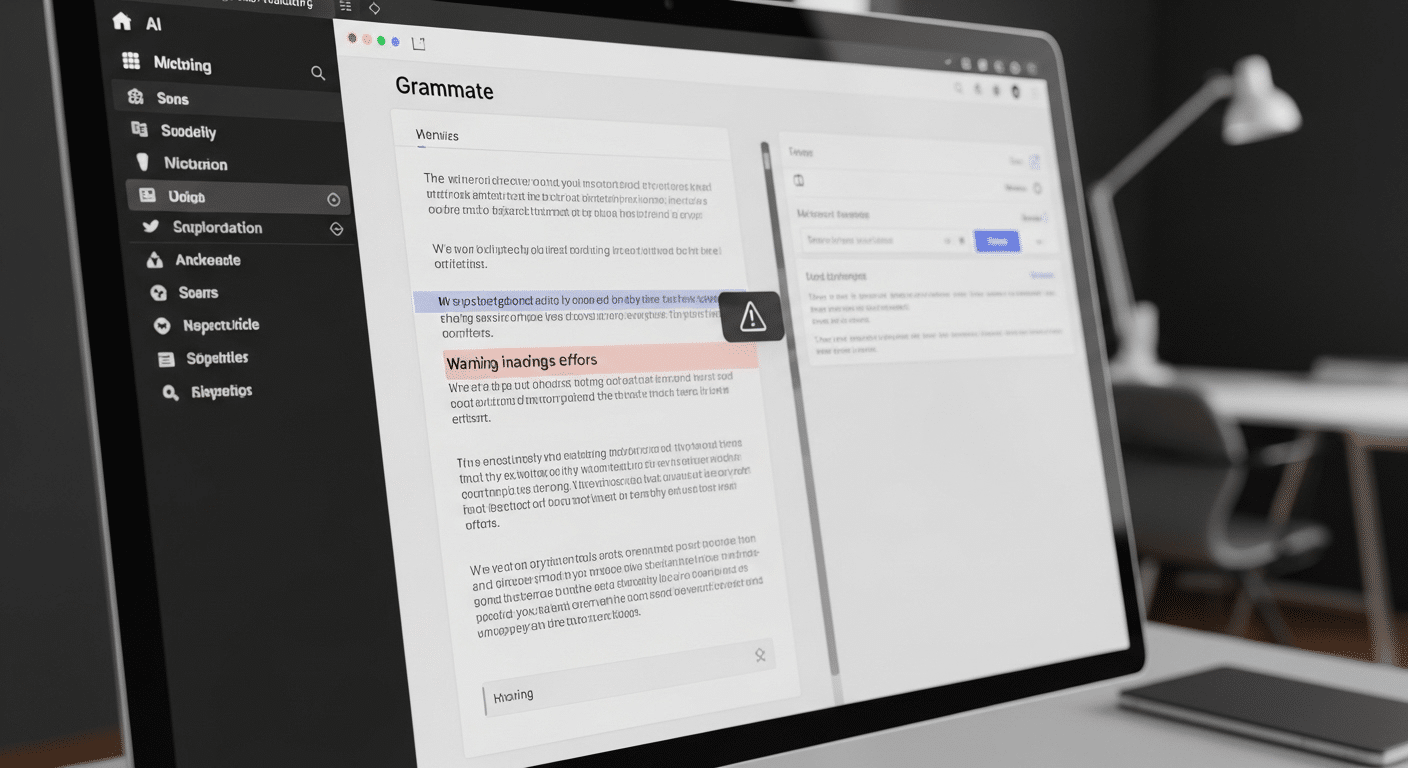
For all their efficiency, AI language tutors carry blind spots. Some are technical. Others are deeply human.
When you rely heavily on an AI tutor, you are engaging with a system that predicts language patterns. It does not truly understand why a joke lands or why it fails. That gap becomes more visible as your language skills advance.
Where AI Falls Short Compared to a Human Tutor?
- Lack of emotional intelligence. An AI tutor cannot read your frustration or adjust its tone with genuine empathy
- Limited cultural nuance. It may explain vocabulary, but subtle social meaning often slips through
- Robotic or predictable conversation flow. Exchanges can feel structured, sometimes formulaic
- Voices not always representative of real humans, even when marketed as realistic
- May give incorrect grammar advice or oversimplified explanations
- Algorithmic bias that reflects the data used to train the system
- Cannot replicate native speaker spontaneity in real interactions
- May encourage unnatural slow speech patterns because the system responds best to careful pacing
None of these flaws make AI language tools useless. They simply define their boundaries.
Why Cultural Nuance and Real Humans Still Matter?
Language is more than grammar questions and vocabulary drills. It is shaped by your native language, your assumptions, your tone. A human tutor recognizes native language interference in ways that go beyond pattern matching. They can explain why a phrase sounds slightly off, not just technically incorrect.
Accent realism is another layer. Practicing with a synthetic voice labeled as a Mexican accent may expose you to pronunciation differences, but it rarely captures the rhythm and unpredictability of a native speaker in a real setting. That difference matters when you step outside controlled practice.
Real world spontaneity challenges you in ways AI language systems struggle to replicate. Conversations veer off topic. Humor surfaces unexpectedly. Sarcasm creeps in. Complex debate unfolds without warning.
Reaching fluency requires exposure to that unpredictability. AI can prepare you. Real humans complete the picture.
How Do the Best AI Language Tutors Compare in 2026?
If you are asking whether AI language tutors are good, the next logical question is which one performs best. Not all platforms are built the same. Some focus heavily on speaking fluency. Others prioritize structured beginner lessons. A few try to do everything and end up scattered.
Three names come up repeatedly in discussions about the best AI language tutor in 2025, Langua, Talkpal, and Duolingo Max. Each approaches AI language learning with a slightly different philosophy.
Langua
Langua is often described as one of the most advanced tools for speaking fluency. Its strength lies in realistic conversations powered by human-like AI voices. You can select from multiple accents, exposing yourself to different languages and dialect variations within your target language.
After each session, Langua provides a detailed conversation transcript with post-conversation feedback. Grammar, vocabulary, and phrasing are broken down for review. Pricing sits at $29.99 per month or $199.99 per year, and a free trial is available.
For learners focused on extended conversation practice, Langua aims to simulate something closer to real dialogue.
Talkpal
Talkpal takes a slightly different approach. It offers free-form chat, structured role play, and even debate modes. That range makes it appealing to learners who want to move beyond scripted prompts.
The subscription cost is $6 per month or $72 per year, making it more accessible. With a 4.7 rating on the App Store, user reception appears strong. Structured conversation modes help guide practice while still allowing flexibility.
Duolingo Max
Duolingo Max, priced at $30 per month, integrates AI features into its broader ecosystem. Its call mode, often referred to as the Call Lily video call feature with tutor Lily, allows brief conversational exchanges. It is beginner-friendly and easy to navigate. Some users, however, find interactions repetitive and less challenging over time.
Comparison Table
| Feature | Langua | Talkpal | Duolingo Max |
|---|---|---|---|
| Pricing | $29.99/month or $199.99/year | $6/month or $72/year | $30/month |
| Speaking Feedback | Detailed post-session analysis with conversation transcript | Real-time corrections with structured review | Limited session feedback |
| Realistic Conversations | Human-like AI voices with extended dialogue | Free-form chat and debates | Short AI interactions |
| Role Play | Yes | Yes, plus debate mode | Limited |
| Accent Options | Multiple accents available | Varies | Minimal |
Each tool serves a different learner profile. The right choice depends on your goals, your budget, and how much depth you expect from an AI conversation partner.
Should You Replace a Human Tutor with an AI Tutor?
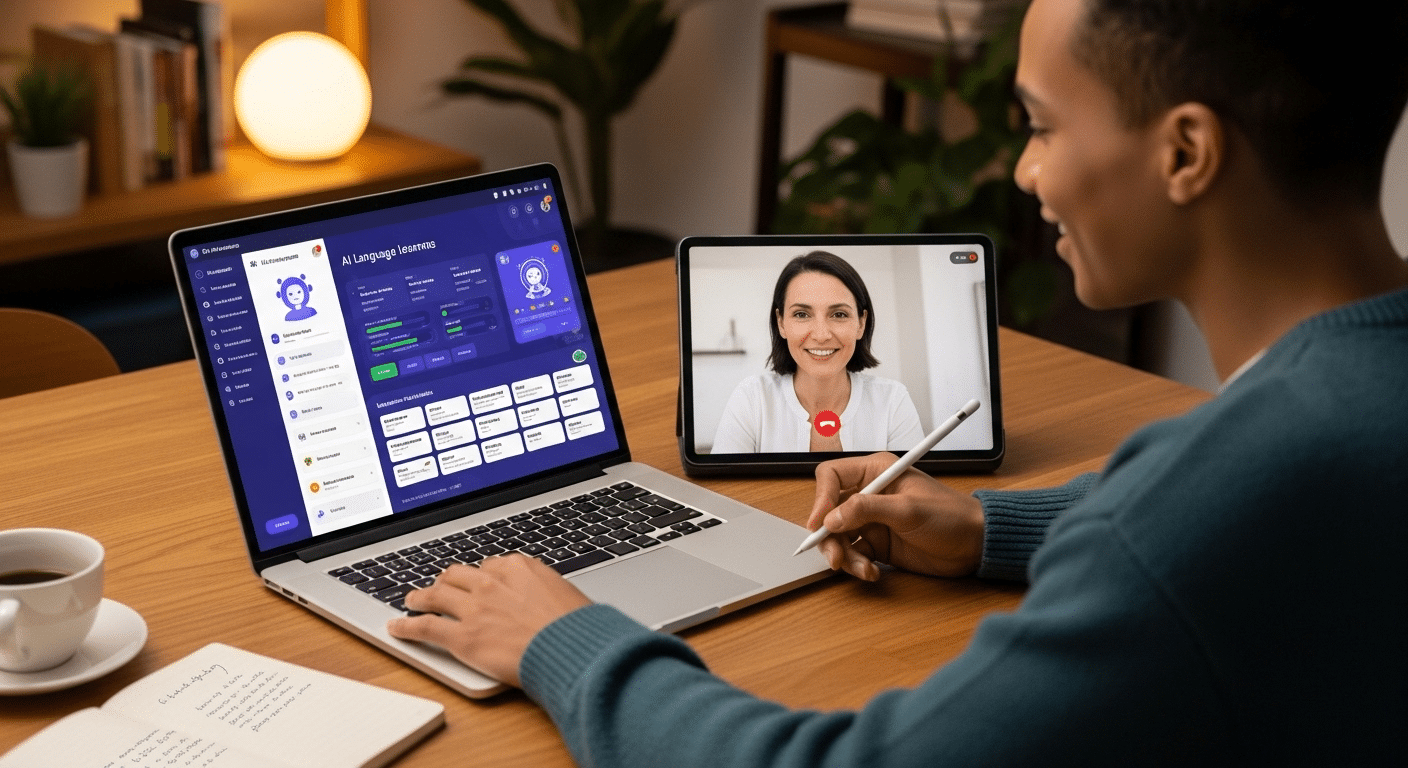
It is tempting to think in extremes. Either AI language tutors are the future, or human tutors remain essential. In practice, the answer sits somewhere in the middle.
Research on language learning suggests that AI tools perform best in structured, repetition-heavy tasks. Drills. Vocabulary reinforcement. Immediate grammar correction. Daily speaking practice that keeps your foreign language active.
In these areas, an AI tutor can be remarkably consistent. You can practice every day without scheduling friction, and that consistency compounds.
Where AI struggles is complexity. Real interactions are messy. Humans interrupt. They change direction mid conversation. A human tutor or experienced language teacher can respond to nuance, detect hesitation, and challenge your thinking in ways algorithms still cannot.
The strongest learning methods often combine both. Use AI for daily language practice and confidence building. Use a human tutor for cultural depth, debate, and unpredictable dialogue that mirrors real life.
Replacing human guidance entirely may limit your growth. Integrating AI thoughtfully, alongside other resources, tends to produce better long-term results.
So, Are AI Language Tutors Good Or Just Convenient?
Yes, AI language tutors are good for structured practice. They excel at repetition, vocabulary reinforcement, and guided conversation drills. If you want consistent language practice without coordinating schedules, they deliver.
The ability to practice speaking every day, receive immediate corrections, and revisit a conversation transcript is not trivial. It builds momentum.
Yes, they are good for confidence. A private, low-pressure environment allows you to experiment. You can mispronounce a word, pause mid sentence, try again, and keep going. That freedom often helps you start talking earlier than you otherwise would. Confidence compounds over time.
But no, AI alone does not provide cultural depth. Subtle humor, social nuance, regional idioms, and emotional cues emerge most clearly through real human interaction. Algorithms approximate these layers. They do not live inside them.
And no, AI cannot replace genuine human connection. Real conversation involves unpredictability, disagreement, shared context. It carries emotional weight. That dimension still belongs to people.
AI is a tool. A powerful one, increasingly refined. Yet it remains an instrument, not the language itself. Use it deliberately, and it amplifies your progress. Expect it to replace human language entirely, and you will eventually feel the limits.
Why CoTutor Represents the Next Step in AI Language Learning?
If AI language tutors are evolving, the next question is how they mature. Convenience alone is not enough. Fluency demands structure, accountability, and a framework that connects practice to measurable growth. That is where CoTutor begins to distinguish itself.
CoTutor is not built as a casual conversation app. It is designed around structured, guided curriculum. The system combines AI conversation with academic scaffolding, meaning your exchanges are not random chats drifting between conversation topics. They are aligned to learning objectives inside real language courses.
For institutions, this matters. Language teachers need visibility. Students need progress markers. Administrators need data that makes sense. CoTutor integrates directly into formal learning environments, supporting multiple languages while tracking performance in a way that moves beyond surface-level corrections.
Rather than simply offering immediate feedback, it emphasizes real feedback. Patterns are identified. Vocabulary growth is documented. Grammar improvement is measurable. Reaching fluency becomes a gradual, accountable process rather than a vague goal.
The direction is clear. AI can amplify language learning, but only when it respects pedagogy. See how CoTutor blends structured curriculum with meaningful conversation practice.
Final Thoughts
AI language learning is not something you simply adopt and forget about. It requires intention. Tools can accelerate progress, but only if you use them deliberately rather than passively scrolling through exercises.
Approach AI tutors as structured practice partners. Use them daily for repetition, pronunciation work, and targeted conversation drills. Let the system challenge your grammar and expand your vocabulary. Take advantage of the safety it offers. Start talking sooner than you feel ready. But do not stop there.
Combine AI conversation practice with real conversation whenever possible. Speak with native speakers. Engage in unscripted exchanges. Experience the small surprises that only human interaction delivers. That friction is part of growth.
Think of AI as an amplifier. It strengthens habits. What it amplifies, however, depends on you. Technology shapes how you practice. Yet learning ultimately shapes who you become, how you think, and how you connect across languages. Use the tool wisely, and it becomes an ally rather than a crutch.
Frequently Asked Questions (FAQs)
2. Are AI language tutors good for beginners?
Yes, AI language tutors are especially helpful for beginners because they provide structured lessons, immediate feedback, and low-pressure speaking practice. You can build basic vocabulary, practice pronunciation, and gain confidence before engaging in real conversations with native speakers.
3. Can AI help you speak like a native speaker?
AI can improve pronunciation, grammar accuracy, and speaking fluency through repetition and real-time corrections. However, sounding truly native like requires exposure to real humans, cultural nuance, humor, and spontaneous interaction that AI systems cannot fully replicate.
4. Are AI language tutors better than human tutors?
AI language tutors are not inherently better than human tutors. They excel at drills, vocabulary reinforcement, and daily speaking practice. Human tutors provide emotional intelligence, cultural insight, and complex dialogue that remains essential for advanced fluency.
5. Do AI tutors give correct grammar advice?
Most AI tutors provide accurate grammar corrections, especially for common structures and vocabulary errors. That said, they occasionally offer oversimplified or incorrect advice, so reviewing explanations critically or confirming with other resources is wise.
6. What is the best AI language tutor in 2026?
The best AI language tutor in 2026 depends on your goals. Some platforms focus on realistic conversations and detailed feedback, while others emphasize beginner lessons or structured role play. The right choice aligns with your learning style and fluency objectives.
7. Can AI help you prepare for job interviews in another language?
Yes, AI tutors can simulate job interviews through role play features and structured conversation topics. You can practice answering questions, refine vocabulary, and receive immediate feedback, which helps reduce anxiety before real-world interactions.
8. Is a hybrid model better than AI alone?
For most learners, a hybrid model works best. AI supports daily practice and confidence building, while human tutors provide real interactions, debate, and cultural nuance. Combining both approaches typically leads to stronger long-term language development.
