

When Do Educators Use Authentic Assessments?
Educators use authentic assessments when students must apply knowledge and skills in real-world contexts rather than rely on memorization alone. These assessments improve engagement, critical thinking, and career readiness through projects, simulations, and collaborative tasks. Tools like Apporto TrustEd help instructors manage consistent feedback and assessment at scale.
When do educators use authentic assessments? You see this question surface more often in higher education as expectations around student learning continue to evolve. Institutions no longer measure success by a correct answer alone. They measure whether students can apply knowledge in meaningful application beyond the classroom.
Authentic assessment focuses on real-world tasks that reflect how knowledge and skills are used in professional and personal contexts. In contrast, traditional assessments often emphasize recall, fixed responses, and teacher-structured evaluation. While traditional assessments still have a place, they do not always capture deeper learning outcomes.
As student engagement, accountability, and measurable outcomes take center stage, educators are rethinking how assessment should function. This guide explores when authentic assessment is most effective, why it matters, the challenges involved, and how modern tools can support the process.
What Is Authentic Assessment and How Is It Different from Traditional Assessments?
Step into any classroom and you can usually tell what kind of assessment philosophy is in play. Some environments revolve around selecting the correct answer. Others ask students to build, design, argue, present, solve. That distinction matters.
Authentic assessment asks students to perform real world tasks that mirror the complexity of life beyond school. Instead of recalling isolated facts, you apply concepts in ways that demonstrate meaningful application of essential knowledge and skills.
The focus moves from short-term recall to sustained understanding. Over time, instructors observe, document, and evaluate student performance as it unfolds, not just at a single testing moment.
Traditional assessments operate differently. They are typically teacher-structured, tightly controlled, and centered on arriving at one correct answer. You often measure how well students remember learned knowledge under time pressure.
Grades reflect accuracy, speed, and alignment with predetermined responses. That approach can be efficient. It can also limit how fully you see a child’s understanding or capacity for critical thinking.
Authentic assessment expands what counts as evidence. Traditional assessments narrow it.
How Do Authentic and Traditional Assessments Compare?
| Authentic Assessment | Traditional Assessments |
|---|---|
| Students apply concepts in real world scenarios | Focus on correct answer |
| Demonstrate meaningful application of knowledge and skills | Teacher-structured and standardized |
| Measure critical thinking and problem solving | Measure recall of learned knowledge |
| Evaluate student performance across time | Offer a limited view of a child’s understanding |
When Do Educators Use Authentic Assessments in Higher Education?
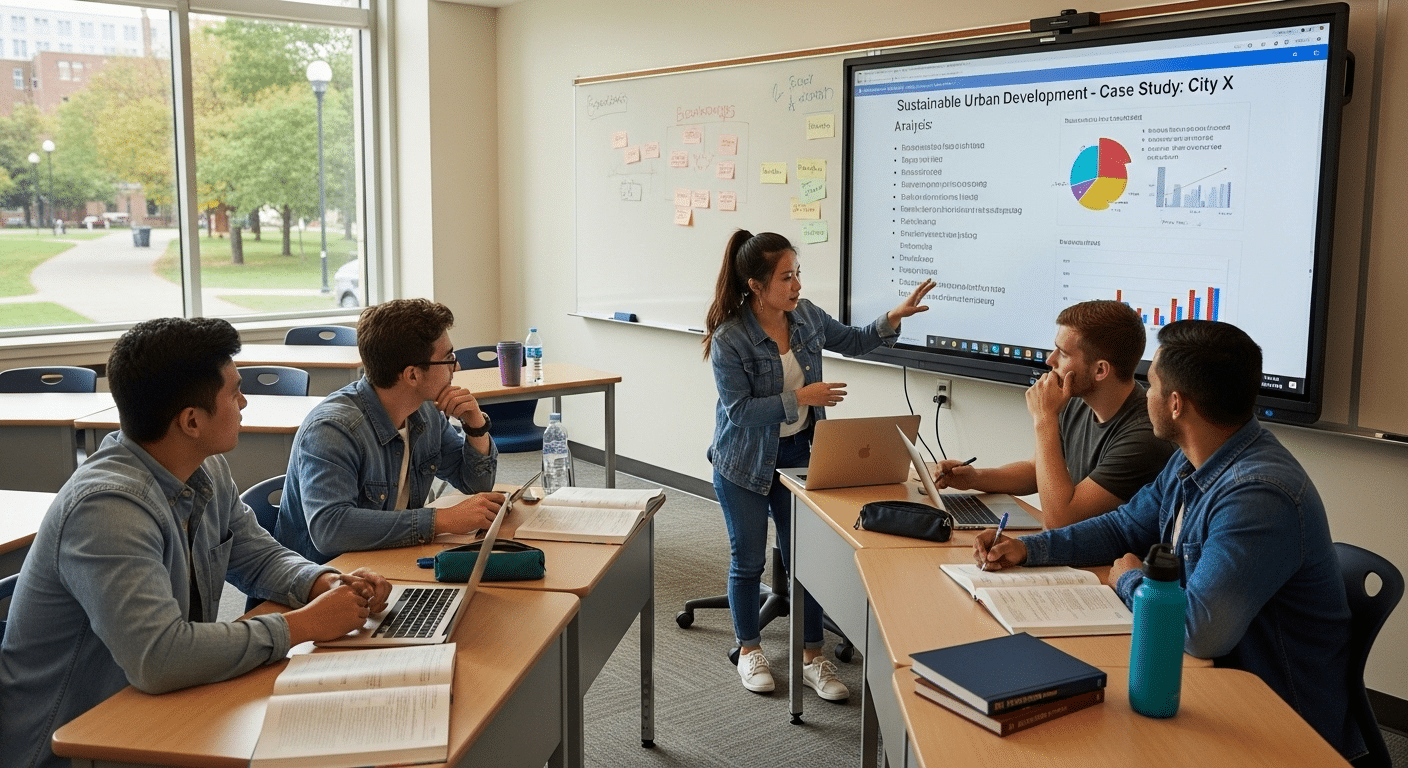
So when do educators use authentic assessments in higher education? You turn to them when the goal is not memorization, but transfer. When learning objectives emphasize application over recall, authentic assessment becomes the natural choice.
If students must demonstrate meaningful application of ideas, theory alone will not suffice. You need evidence that they can apply concepts in unfamiliar, real conditions.
In many programs, especially those preparing students for professional practice, traditional testing falls short. A future nurse, engineer, teacher, or business leader cannot rely on selecting the correct answer from four options.
You need to evaluate the student’s ability to perform, communicate, analyze, and adapt. That requires something richer than a timed exam.
Educators use authentic assessments when:
- Learning objectives prioritize applied knowledge and skills
- Students must demonstrate meaningful application in realistic contexts
- Courses are aligned with career readiness and professional standards
- Student engagement declines under traditional testing formats
- Instructors want to measure communication skills and collaboration
- Group work and collaborative activities reflect real professional environments
- Teaching fields require simulation of real world tasks
In higher education, the stakes are practical. You are not simply grading comprehension. You are assessing readiness. Authentic assessment plays a crucial role when a student’s ability to apply concepts, solve problems, and perform in context matters more than selecting a correct answer on paper.
What Are Real Examples of Authentic Assessment Across Disciplines?
Theory becomes meaningful when you test it against reality. That is where authentic assessment earns its place. Across disciplines, instructors design tasks that mirror real world scenarios, not abstract exercises disconnected from professional demands.
You are not asking students to repeat information. You are asking them to create, decide, analyze, and demonstrate understanding under conditions that resemble the complexity of practice.
These examples of authentic assessment show how different fields translate knowledge into action.
Some examples of Authentic Assessment in Professional Fields
- Social Work: Create an intervention plan for a client scenario, using case studies that require ethical reasoning and practical judgment.
- Education: Develop a lesson plan aligned with course objectives, demonstrating how theory informs classroom decisions.
- Psychology: Role-play a counseling session, applying communication skills and diagnostic frameworks in real time.
- Public Health: Create educational material addressing a current public health issue, translating research into accessible messaging.
- Nursing: Take vital signs of mock patients in simulation, responding appropriately to changing conditions.
- Engineering: Plan and build a functional device, integrating technical knowledge with problem solving.
- Business: Develop a business plan for a mock or real company, analyzing markets, costs, and strategy.
- Foreign Language: Role-play a real life conversation, demonstrating fluency beyond memorized phrases.
Each task reflects real world complexity. Students engage in group projects, collaborative activities, and independent work that prepare them not only for a grade, but for personal life and professional environments where decisions carry weight.
How Does Authentic Assessment Improve Student Learning and Engagement?

You learn differently when the task feels real. Authentic assessment fosters deep learning because it requires you to wrestle with ideas, not simply recognize them on a page. When you apply concepts to real problems, knowledge stops being abstract and starts becoming usable. That transition matters.
Active learning sits at the center of this process. Instead of passively absorbing information, you analyze, design, present, collaborate. You make decisions. You revise them.
In doing so, you sharpen critical thinking and problem solving in ways traditional tests rarely demand. Student engagement tends to rise when tasks feel connected to future careers or personal life. Motivation follows relevance.
Authentic assessment also improves how instructors provide feedback. Because work unfolds over time, you receive guidance during the process, not only after a final grade. Self assessment becomes part of the rhythm. Reflection becomes routine. That continuous feedback loop strengthens knowledge retention and supports measurable student progress.
Compared to traditional tests, authentic assessments offer several advantages. They evaluate learning outcomes more fully, develop communication skills through collaborative activities, and reveal how well you can actually use what you know. Not just what you remember.
How Does the Authentic Assessment Process Work in Practice?
The authentic assessment process unfolds deliberately. It is structured, but not rigid. You are not measuring a single moment. You are tracking growth over time, often within the familiar classroom environment where learning naturally occurs.
In practice, the process follows several interconnected steps:
- Define clear learning objectives.
Start by identifying the knowledge and skills students must demonstrate. If the objectives are vague, the assessment will be vague. - Create authentic tasks aligned with outcomes.
Design activities that require students to apply concepts in realistic situations. Tasks should mirror professional or real life demands. - Observe and document student performance.
Instructors assess by watching how students approach problems, collaborate, and respond to feedback. Documentation becomes essential evidence. - Use rubrics and clear criteria.
Transparent criteria help you evaluate fairly and communicate expectations before grading begins. - Provide iterative feedback.
Feedback is ongoing, not a final note at the bottom of a paper. Students revise and improve. - Reflect and refine.
Both instructors and students reflect on performance, adjusting tools and methods as needed.
Authentic assessment takes time. That is part of its strength.
What Challenges Do Educators Face When Implementing Authentic Assessments?

Authentic assessment offers depth, but depth requires effort. Instructors quickly discover that implementation is not effortless. The benefits are clear. The logistics can be demanding.
Common challenges educators face are:
- Time-consuming documentation and grading.
- Harder to evaluate consistently.
- Subjective criteria.
- Difficulty finding the right tools.
- Managing group projects fairly.
- Scaling feedback in large classes.
- Aligning tasks with standards.
While authentic assessment strengthens education, its implementation can strain time, energy, and institutional resources.
Why Authentic Assessment Matters for Career Readiness and Higher Education Outcomes ?
Higher education is not only about mastering content. It is about preparing students for professional practice and the expectations that follow graduation. Authentic assessment bridges the gap between theory and application by asking students to complete real world tasks that mirror future responsibilities.
When you evaluate ability through projects, simulations, and applied work, you measure higher-level skills such as analysis, communication, and problem solving. These are competencies employers expect. Authentic assessments also reduce rote memorization by shifting attention toward performance and outcomes.
What students practice in the classroom should resemble what they will actually do beyond it.
How Can TrustEd Support Authentic Assessment at Scale?
Authentic assessment thrives on detail. You observe carefully. You assess process as much as product. You provide feedback that guides improvement, not just a number at the top of the page. In small classes, this rhythm feels manageable.
In large sections, it can become overwhelming. Detailed evaluation of student performance across multiple drafts demands time, focus, and consistency.
Rubric-based grading helps create shared criteria, yet even well-designed rubrics can produce uneven interpretation. When several instructors grade similar assignments, variation creeps in. Students notice.
For larger classes, best automated grading software can help reduce repetitive grading work while leaving instructors in control of the more nuanced parts of evaluation. Consistency matters because learning outcomes matter. This is where the right tools become essential.
TrustEd is designed to support authentic assessment at scale without stripping away instructor expertise. It streamlines grading workflows, aligns feedback directly with rubric criteria, and organizes documentation so you can assess more efficiently.
Structured feedback supports iterative improvement, allowing students to refine their skills over time. At the same time, academic integrity safeguards remain central.
Technology does not replace professional judgment. It enhances it. With thoughtful integration, instructors can provide feedback that is timely, consistent, and focused on real growth rather than administrative burden.
Final Thoughts
So when do educators use authentic assessments? You turn to them when learning objectives demand application, when student engagement falters under traditional tests, and when professional readiness matters more than recall. You use them when the student’s ability to apply concepts tells you more than a correct answer ever could.
It may be worth asking a simple question. Do your current assessments truly measure meaningful application, or are they measuring familiarity with format?
Strong assessment strengthens learning. And with modern tools like TrustEd, implementing authentic assessment can become more manageable, consistent, and sustainable at scale.
Frequently Asked Questions (FAQs)
2. When do educators use authentic assessments instead of traditional tests?
Educators use authentic assessments when learning objectives prioritize application over memorization, especially in higher education programs tied to professional practice. They are most effective when evaluating a student’s ability to apply concepts, demonstrate skills, and produce meaningful work in realistic contexts.
3. Are authentic assessments harder to grade?
Authentic assessments can be more complex to grade because they rely on nuanced criteria and subjective evaluation. Clear rubrics and structured feedback tools help instructors assess student performance consistently while maintaining fairness across diverse projects and collaborative activities.
4. Do authentic assessments improve student engagement?
Yes, authentic assessments often increase student engagement because tasks feel relevant and connected to real life situations. When students apply knowledge in meaningful ways, motivation rises and learning becomes more active and sustained over time.
6. How can technology help manage authentic assessments?
Technology can streamline documentation, align grading with rubric criteria, and provide structured feedback at scale. Tools like TrustEd help instructors assess efficiently, maintain academic integrity, and deliver timely feedback that supports student growth without overwhelming faculty workload.
