

How Does Grading Work in University?
University grading works by converting course performance into letter grades and grade points that contribute to a cumulative GPA. Instructors evaluate exams, assignments, participation, and projects using course-specific grading policies. Academic integrity and grading consistency may also be supported through structured evaluation platforms such as Apporto TrustEd.
If you’ve ever wondered how does grading work in university, the simple answer is this: your performance in each course is converted into letter grades, those letters translate into grade points, and those grade points are averaged across credit hours to produce your grade point average, or GPA.
At first glance, the grading system seems straightforward. You complete assignments, take exams, receive a final grade, and move on.
But in higher education, those grades carry weight. They determine academic progress, influence eligibility for financial aid, affect graduation requirements, and signal whether you remain in good standing.
Every course syllabus outlines how your work will be evaluated. Your letter grades reflect how well you meet course expectations, and your GPA summarizes performance across multiple classes. Over time, that cumulative number becomes a measure of consistency, not just isolated success.
In this blog post, you will see how the grading system works and what it means for your academic journey.
What Is the U.S. University Grading System and How Is It Structured?
To understand how does grading work in university, you need to begin with the structure itself. Most US universities follow a standardized grading system built around letter grades, a numerical grading scale, and percentage grades that translate performance into measurable outcomes.
In most institutions, the university grading system uses five primary letter grades, A through F. There is no E. Each regular letter grade corresponds to a percentage range defined in the course syllabus.
For example, an A often reflects work in the 90 to 100 percent range, while a B may represent 80 to 89 percent, and so on. Exact percentage grades can vary slightly across many schools, but the overall framework remains consistent across US universities.
Most institutions also use a plus and minus system. This allows adjustments of approximately 0.3 grade points. An A minus equals 3.7, a B plus equals 3.3, and so forth. These refinements provide more nuance in evaluating student performance.
The lowest passing grade in most post-secondary institutions is a D. However, a D is often considered an unsatisfactory passing grade, especially for major requirements. Students may receive credit awarded for the course, yet the grade may not satisfy prerequisite requirement standards.
An F, by contrast, is a failing grade. It indicates that performance revealed little to no understanding of the course material.
Standard Letter Grades and Grade Points Explained
| Letter Grade | Meaning | Grade Points | Passing Status |
|---|---|---|---|
| A | Exceptional, highest grade | 4.0 | Passing |
| B | Above average | 3.0 | Passing |
| C | Average | 2.0 | Passing |
| D | Minimum passing but unsatisfactory | 1.0 | Passing, often limited for major credit |
| F | Failing grade | 0.0 | Not passing |
How Does a Course Instructor Determine Your Final Grade?

Your final grade does not appear out of thin air. It is built, piece by piece, across the term. The course syllabus acts as the blueprint. On the first week of class, you are given a document that outlines grading policies, weight distribution, assignment deadlines, and expectations. That syllabus is not decorative. It governs how your performance is evaluated.
The course instructor, often a faculty member with authority over the course, determines how each component contributes to your overall result. Some instructors rely heavily on final exams.
Others distribute weight across projects, presentations, and weekly assignments. The structure varies by discipline, especially in fields like computer science or lab-based courses where performance is cumulative.
Most grading systems rely on weighted components such as:
- Final exams, often held during finals week
- Midterm exams or quizzes
- Participation and attendance
- Projects or research assignments
- Work completed in individual courses
- Extra credit opportunities
- Performance in elective courses
Optional grading policies may also apply. Some courses allow Pass or Fail enrollment, while others use only regular letter grade formats.
At the end of the term, the instructor submits final grades to the university registrar. Once recorded, those grades appear on your official transcript and contribute to your cumulative GPA. Accuracy matters. Documentation matters. The process may feel routine, but it carries long-term consequences for academic progress.
For educators looking to streamline the evaluation process before grades are finalized, best automated grading software can help automate repetitive grading tasks while keeping instructors involved in final decisions.
What Is Curved Grading and How Does It Affect All the Students?
Curved grading operates differently from a fixed grading scale. Instead of evaluating performance against a predetermined standard, curved grading ranks students relative to one another. Your grade depends partly on class rank.
This model can foster competition. In a curved system, not everyone can receive the highest grade, even if overall performance is strong. Some institutions use it in large lecture courses.
Unlike a fixed grading scale, curved grading adjusts outcomes based on distribution, not solely mastery of material.
How Is Your Grade Point Average, GPA, Calculated?
Once you understand letter grades, the next logical question is how those letters translate into a grade point average. Your GPA is a numerical summary of academic performance across courses. It is calculated by assigning grade points to each letter grade and averaging them based on credit hours.
Each letter grade carries a point value on a grading scale that typically ranges from 0.0 to 4.0. An A equals 4.0 grade points, a B equals 3.0, a C equals 2.0, a D equals 1.0, and an F equals 0.0.
When you complete a course, those grade points are multiplied by the number of credit hours assigned to that course. The result is called quality points.
The formula for GPA calculations is straightforward: divide the total quality points earned by the total credit hours attempted. Certain grades, such as withdrawals or audits, may not count toward hours attempted. Credit awarded and hours attempted are not always identical, so it is important to check grading policies carefully.
A term GPA reflects performance within a single semester. Your cumulative GPA includes all courses taken across spring terms and prior semesters. This cumulative GPA determines academic standing and eligibility for graduation.
Some institutions add extra weighting for advanced or honors courses, allowing a GPA to exceed 4.0. However, most US universities use the standard 4.0 scale.
Step-by-Step Guide to Calculate Grade Point Averages
- Multiply grade points earned in each course by its credit hours
- Add all quality points together
- Divide the total quality points by total credit hours attempted
Example GPA Calculation
| Course | Letter Grade | Grade Points | Credit Hours | Quality Points |
|---|---|---|---|---|
| English | A | 4.0 | 3 | 12.0 |
| History | B | 3.0 | 3 | 9.0 |
| Biology | C | 2.0 | 4 | 8.0 |
| Math | B | 3.0 | 3 | 9.0 |
| Total | 13 | 38.0 |
38.0 quality points divided by 13 credit hours equals a GPA of 2.92.
What Is the Lowest Passing Grade in University?

The lowest passing grade in many US universities is a D. On paper, a D allows credit awarded for the course. You complete the requirement. You move forward. But in practice, the story is more complicated.
In post-secondary education, a D is often considered an unsatisfactory passing grade. While it may count toward total credit hours, it may not satisfy prerequisite requirements for advanced courses. If you earn a D in a foundational class, especially within your major, you may be required to repeat the same course to progress. That distinction matters.
The difference between undergraduate students and graduate students is even more pronounced. At the undergraduate level, a D usually keeps you technically passing, though it may affect academic standing. In graduate school, however, a C may already be considered unsatisfactory performance. Many graduate programs require a B or higher to maintain satisfactory performance standards.
Some programs use alternative distinctions such as high pass and low pass instead of traditional letter grades. Even in those systems, minimum thresholds still apply. Falling below them can impact academic progress.
In short, the lowest passing grade depends on context. Consider:
- D is often the minimum passing grade for undergraduate students
- D may not satisfy prerequisite requirement standards
- C may be unsatisfactory in graduate school
- Graduate students are often held to higher performance thresholds
- High pass and low pass systems still enforce minimum standards
Passing does not always mean progressing comfortably.
What Happens If You Receive an Incomplete (I) or Withdraw (W)?
Not every course ends neatly. Life intervenes. Deadlines collide. Emergencies happen. When that occurs, the university grading system includes several special designations that appear on your official transcript. Each carries specific consequences.
Incomplete Grade (I)
An incomplete grade is not a permanent result. It is a temporary grade issued when you are unable to finish required assignments due to special circumstances or documented extenuating circumstances. The assumption is that you were performing at a satisfactory level before the interruption occurred.
Common points to understand are:
- An incomplete grade is temporary
- Remaining work must be completed within an agreed timeframe
- It converts automatically to an F if unresolved
- It must be changed to a permanent grade within one year
- You cannot graduate with an I on your record
- Students may request an incomplete only under approved conditions
If the remaining work is completed on time, the instructor submits a grade change. If not, the incomplete lapses into a failing grade. That conversion can significantly affect your cumulative GPA.
Withdrawal (W)
A W indicates that you withdrew from a course before the official deadline. It does not count as credit awarded, but it also does not affect your GPA.
Important details:
- Withdrawal must occur before the published deadline
- It is not calculated in GPA
- It remains visible on your official transcript
Withdrawal Fail (WF)
If you withdraw after the deadline, the situation changes.
- A WF may count as unsatisfactory performance
- It can impact academic standing
Policies vary by institution, so always consult the course syllabus and registrar guidelines.
Pass/Fail (P/F)
Some courses allow optional grading under a Pass or Fail structure.
- A P grants credit awarded but does not affect GPA
- An F results in no credit and affects GPA
NC Grades and AU Audit
Additional designations include:
- NC grades, meaning no credit earned
- AU audit, indicating you attended without seeking credit
Each of these notations influences academic progress differently. Understanding them protects you from unintended consequences.
What Happens If You Fail or Repeat a Course?
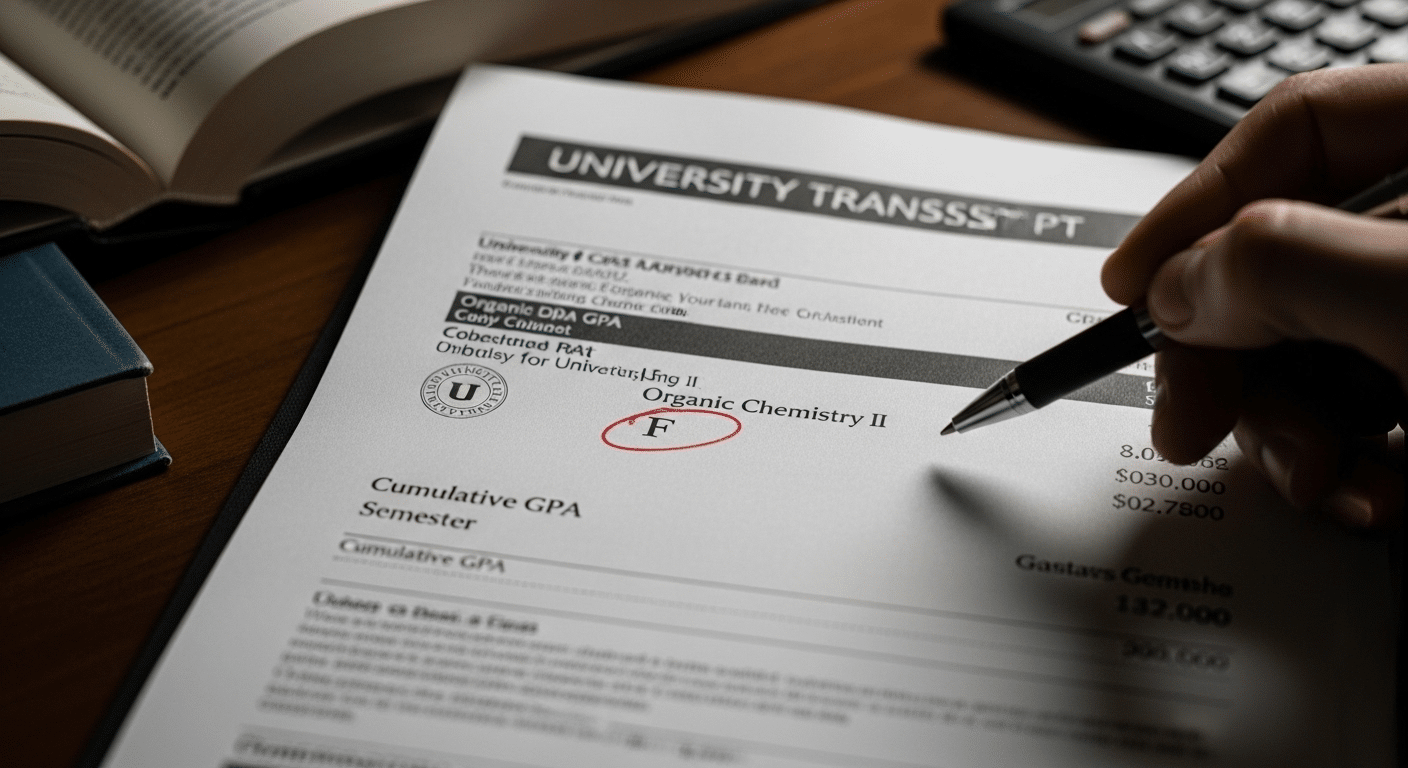
A failing grade carries weight. An F signals that performance in the required exercises revealed little to no understanding of the course content. It earns zero grade points, which means it pulls your cumulative GPA down immediately. One failing grade can shift academic standing, especially if your GPA was already close to the minimum threshold for good standing.
The impact does not end there. A failing grade can delay graduation requirements, interrupt prerequisite requirement chains, and affect eligibility for financial aid. In competitive programs, even a single F may require careful recovery planning.
Many schools allow a repeated course to repair the damage, but policies vary. Some institutions replace grades, meaning the new grade substitutes for the original course in GPA calculations. Others average both attempts, which means the earlier failing grade still affects the cumulative GPA.
Important distinctions to consider:
- A repeated course may require formal approval
- Replace grades policies differ across many schools
- Some institutions count both attempts in GPA calculations
- Second enrollment may be limited in certain programs
- The original course remains visible on your official transcript
Repeating the same course can improve understanding and restore academic progress. However, it also extends time and cost. Before enrolling in a second attempt, review grading policies carefully. Recovery is possible, but it works best when you understand exactly how the university grading system records each attempt.
How Do Grades Affect Academic Standing and Graduation Requirements?
Grades are not isolated marks. They determine academic progress and define whether you remain in good standing within your institution.
Most universities require a cumulative GPA of 2.0 or higher to maintain good standing. Falling below that threshold can trigger academic probation, which signals that performance must improve within a defined period.
Academic standing influences more than pride. It affects eligibility for scholarships, financial aid, and even enrollment in future courses. To qualify for federal financial aid, you must meet Standards of Academic Progress, often referred to as SAP. This includes maintaining a minimum GPA and successfully completing a certain percentage of credit hours attempted.
Graduation requirements depend heavily on cumulative GPA. Earning enough credit hours alone is not sufficient. You must also meet minimum performance standards across your degree requirements. Some programs require higher GPA thresholds for major courses, particularly in competitive disciplines.
Key areas influenced by grades include:
- Academic progress evaluation each semester
- Good standing status, typically at or above 2.0 cumulative GPA
- Satisfactory progress standards for financial aid eligibility
- Academic probation if GPA falls below required level
- Completion of graduation requirements and degree requirements
- Scholarship eligibility tied to performance
In higher education, grades act as a record of consistency. They signal readiness to continue, to graduate, and sometimes to compete for advanced opportunities.
How Does University Grading Differ from High Schools and Secondary Schools?
Grading may look similar across educational levels, but the expectations are not the same. Many students assume the same grading system applies from high schools to US universities. That assumption can lead to surprises during the first semester.
Here is a clear comparison:
| Category | High Schools / Secondary Schools | US Universities |
|---|---|---|
| Passing Standards | D is typically acceptable and sufficient | D may earn credit but often considered unsatisfactory for major requirements |
| GPA Weighting | Honors or AP courses may boost GPA above 4.0 | Most use standard 4.0 scale, some weight advanced courses |
| Academic Consequences | Lower stakes, structured support systems | GPA affects academic standing, probation, financial aid |
| Performance Expectations | Focus on completion and effort | Emphasis on mastery, independence, critical thinking |
In secondary schools, instructors often provide structured reminders and frequent checkpoints. In higher education, responsibility shifts more directly to you. The grading scale may appear familiar, but the consequences are more immediate.
US universities evaluate not only whether you pass, but whether your performance reflects readiness for advanced coursework. Academic independence becomes central. The standards tighten, even if the letter grades look the same.
How Does Grading Work for Graduate Students?

Grading becomes more demanding once you enter graduate school. The structure may resemble the undergraduate grading system, but the expectations rise sharply. Graduate students are evaluated not only on completion, but on depth of understanding, analytical rigor, and professional readiness.
In many programs, a C is considered unsatisfactory performance. While it may technically count as a passing grade at the undergraduate level, in graduate school it can place you at risk of academic probation. Some departments require a minimum B average to remain in good standing. The margin for error narrows.
Specialized programs, particularly in academic medicine, law, and engineering, often apply even stricter evaluation standards. In computer science programs, for example, performance may be judged heavily on complex projects, research contributions, and advanced problem-solving skills.
Some graduate programs move away from traditional letter grades altogether. Instead, they may use distinctions such as high pass and low pass. These categories still reflect performance tiers, but they emphasize competency within advanced study rather than simple grade accumulation.
Graduate evaluation signals readiness for professional or academic advancement. Precision matters. Consistency matters even more.
Can You Request a Grade Change?
Yes, you can request a grade change, but the process is structured and rarely automatic. Universities treat grade reports as official academic records, so revisions require documentation and justification. A grade change is not about negotiating points. It is about correcting an error or addressing verified extenuating circumstances. Clear grading criteria and supporting evidence also help educators justify student grading when a student questions how an evaluation was determined.
If you believe a mistake occurred, act promptly. Most institutions have deadlines for submitting formal appeals. Waiting too long can close your options.
The typical process follows these steps:
- Contact the course instructor first. Review the course syllabus and grading policies before raising concerns.
- If the issue remains unresolved, escalate the matter to the department chair. Provide clear documentation and evidence.
- If a correction is approved, the instructor submits the updated grade to the university registrar.
- The university registrar processes the grade change and updates your official transcript accordingly.
Grade appeals require professionalism and clarity. When extenuating circumstances are involved, documentation matters. Universities aim to preserve fairness, which means adjustments must be supported by clear evidence rather than preference.
How Do Universities Ensure Fairness and Academic Integrity in Grading?

Fair grading does not happen by accident. Universities build systems around academic integrity to ensure that every grade reflects actual performance rather than preference, pressure, or inconsistency. The foundation begins with clear grading policies.
Every course syllabus outlines expectations, weighting, and evaluation standards. When those policies are transparent, disputes decrease.
Rubrics add another layer of structure. A well-designed rubric clarifies criteria before assignments are submitted. You understand how work will be measured. Faculty members apply consistent standards across all submissions. This transparency protects both students and instructors.
Avoiding grade inflation is another concern in higher education. Institutions monitor grade distributions to ensure that a regular letter grade reflects meaningful achievement, not automatic advancement. Academic integrity safeguards, including plagiarism detection and exam security measures, further protect the credibility of the grading system.
Documentation also matters. Grades recorded on your official transcript must be supported by evidence. Clear records help prevent unsatisfactory performance disputes and reduce confusion when a grade change is requested.
Systems such as TrustEd function as academic integrity support platforms. They help standardize grading documentation, align rubrics with outcomes, reduce grade disputes, and enhance transparency for both faculty members and students. Technology, when implemented carefully, strengthens fairness rather than replacing judgment.
Final Thoughts
By now, you understand how does grading work in university, at least structurally. But grades are indicators, not identity. A letter on a transcript reflects performance during a specific course, in a specific moment. It does not define your full capability, your growth, or your long-term potential. This broader perspective also raises an important question: is academic grading helpful when grades capture only part of a student’s overall learning and development?
What matters more is what those grades represent. Are you building students skills that endure beyond finals week? Are you strengthening discipline, time management, analytical thinking? The cumulative GPA summarizes outcomes, but the habits you develop shape long-term academic success.
Take the time to review each course syllabus carefully. Understand grading policies before assignments accumulate. Ask questions early, not after the final grade appears. When you understand the grading system, you gain agency within it.
Numbers matter. Academic standing matters. But consistent effort, clarity of expectations, and steady improvement often matter more in the long run.
Frequently Asked Questions (FAQs)
1. How does the university grading system work?
The university grading system works by assigning letter grades based on performance in exams, assignments, projects, and participation. Each letter grade corresponds to grade points that contribute to a cumulative GPA, which universities use to measure academic progress, graduation eligibility, and academic standing.
2. What is the lowest passing grade in college?
In many US universities, a D is the lowest passing grade. You may receive credit awarded for the course, but it is often considered unsatisfactory for major or prerequisite requirement standards, especially in competitive programs.
3. How do I calculate my university grade?
You calculate your university grade by multiplying each course’s grade points by its credit hours, adding the total quality points, and dividing by the total credit hours attempted. Most universities use a 4.0 grading scale to calculate GPA and overall academic performance.
4. How is GPA calculated in US universities?
Your GPA is calculated by multiplying grade points by credit hours for each course, adding the total quality points, and dividing by total credit hours attempted. Most institutions use a 4.0 grading scale.
5. Does a D count as passing?
Yes, a D typically counts as a passing grade in undergraduate programs. However, it may not meet prerequisite requirement standards or satisfy degree requirements in certain majors. In graduate school, expectations are usually higher.
6. What if I fail a class in college?
Failing a class in college can lower your GPA, affect academic standing, and delay graduation requirements. Many universities allow students to repeat courses to improve performance, though grade replacement policies vary by institution and some schools continue showing both attempts on transcripts.
7. Will one F ruin my GPA?
One F can lower your GPA significantly, especially if you have completed only a few courses. However, many students recover by improving future grades or repeating the course, depending on the university’s grade replacement and academic standing policies.
8. What happens if you get an incomplete grade?
An incomplete grade is temporary and requires you to finish remaining work within a specified timeframe. If unresolved, it converts to a failing grade. You cannot graduate with an incomplete on your official transcript.
9. Can you repeat a course to improve GPA?
Many schools allow a repeated course to improve GPA. Some replace grades in GPA calculations, while others average both attempts. Policies vary, so reviewing your institution’s grading system guidelines is important.
10. Do withdrawals affect GPA?
A withdrawal completed before the deadline does not affect your GPA, though it appears on your official transcript. A withdrawal fail, issued after the deadline, may count as unsatisfactory performance and impact academic standing.
