

Is AI Grading Accurate?
AI grading can be accurate for structured tasks like quizzes, coding, and grammar checks, where clear rules apply. However, it struggles with nuance, creativity, and context. Hybrid approaches combining AI speed with human judgment are most reliable, with tools like Apporto’s AI Power Grader supporting consistent, guided evaluation.
Grades are coming back faster than ever, sometimes minutes after submission, yet the confidence in those grades has not risen at the same pace. If anything, questions are multiplying.
Artificial intelligence is now embedded across education systems, from learning management platforms to essay feedback tools. With that growth comes a natural pause.
Not panic, but scrutiny. Educators are asking whether AI grading accuracy actually matches the trust traditionally placed in human judgment.
This article examines that question carefully. Not with hype. Not with fear. Instead, by separating speed from accuracy, consistency from understanding, and automation from fairness.
Ahead, you’ll see what research shows, where AI performs well, where it falls short, and why hybrid grading models are becoming the default rather than the exception.
Why Are Educators Questioning the Accuracy of AI Grading?
AI grading did not appear overnight, but its visibility did. Over the last few years, generative AI tools moved from optional experiments to built-in features inside learning management systems, assessment platforms, and writing tools used daily in classrooms. This broader shift toward AI marking has also changed how educators think about automated assessment and evaluation.
That shift brought benefits. Faster turnaround. Reduced grading time. More frequent feedback. But it also introduced tension. Educators are under real pressure to manage large class sizes, increased writing assignments, and tighter feedback expectations. AI grading promises relief, yet many instructors are discovering that speed alone does not guarantee accuracy, fairness, or instructional value.
Concerns are not abstract. They are practical.
- Can AI interpret nuanced student writing?
- Does consistency mean correctness?
- Are certain students unintentionally disadvantaged?
To frame the issue clearly, three distinctions matter:
Key clarifications educators are making:
- Faster grading does not automatically mean better grading
- Consistency does not equal understanding
- Automation does not guarantee fairness
These questions lead directly to a deeper one. Before judging AI grading accuracy, it’s necessary to define what “accurate” even means in an educational context.
What Does “Accurate” Mean in the Context of Grading?
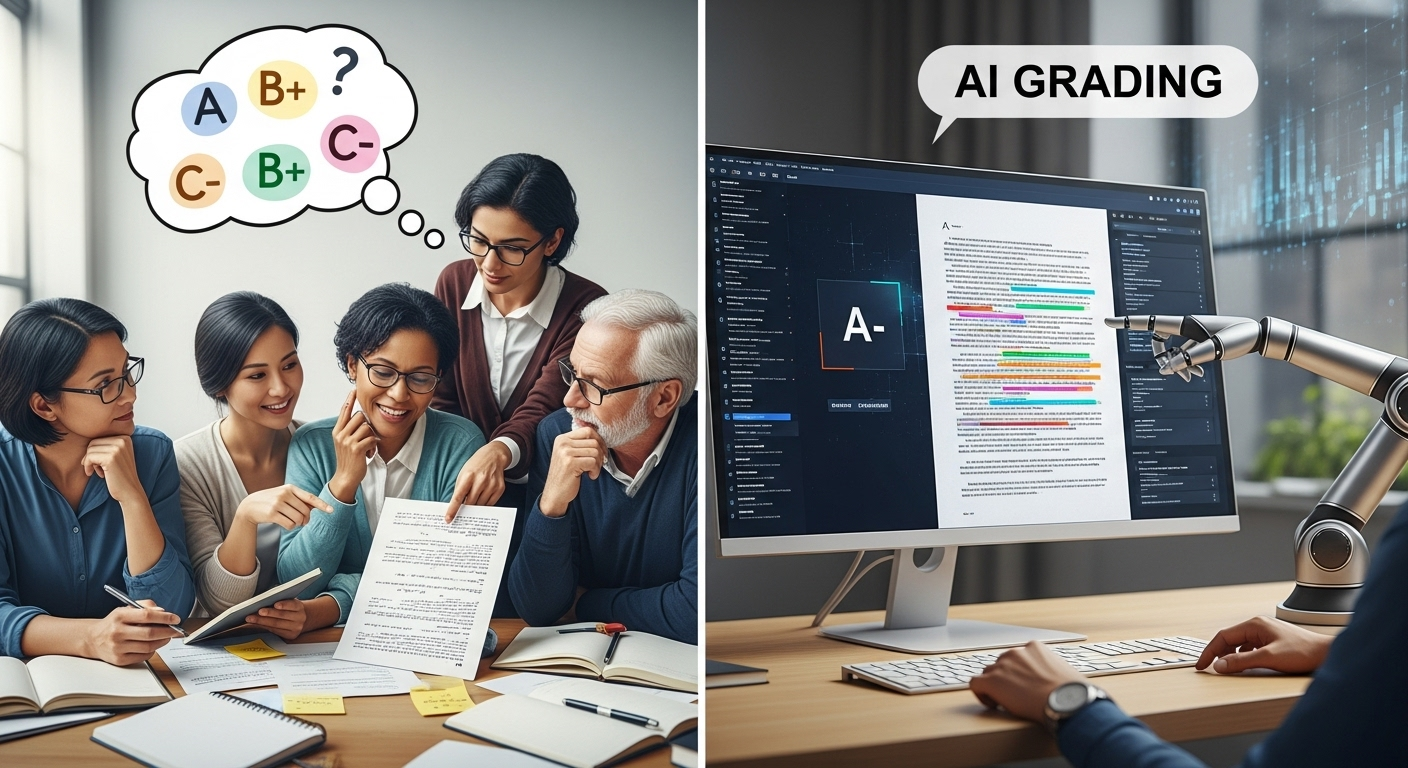
Accuracy in grading is often misunderstood as simple score matching. Did two graders give the same number? Did the system reproduce a human score? That definition is incomplete, and educational research has shown why.
Human graders themselves disagree more often than many assume. Studies consistently show that human raters reach exact agreement only about 50% of the time, influenced by fatigue, interpretation, and subjective judgment. AI systems, by comparison, show exact agreement with human scores roughly 40% of the time, depending on task type and rubric quality.
But grading accuracy is broader than agreement. AI can also analyze student performance data to inform grading decisions, identifying trends and learning gaps that may not be immediately visible to human graders.
It includes:
- Fair application of criteria
- Valid interpretation of student work, including assessment of students’ knowledge
- Consistency across submissions
- Sensitivity to context and intent
- Accurate measurement of student performance
To make this distinction clear, consider how accuracy looks across grading dimensions.
What “Accuracy” Really Means
| Dimension | Human Grading | AI Grading |
|---|---|---|
| Exact agreement | ~50% | ~40% |
| Consistency | Variable | High |
| Context awareness | High | Low |
| Bias risk | Human bias | Data bias |
This comparison reveals the core tension. AI excels at consistency and scale, while humans excel at interpretation and context.
Neither approach is fully ‘accurate’ on its own. Evaluating student work at a deeper level, beyond surface features, remains a significant challenge when you grade student essays with AI.
Understanding this distinction sets the stage for the next sections, where the discussion shifts from definitions to evidence. Specifically, how accurate AI grading actually is in practice, and where that accuracy reliably breaks down.
How Accurate Is AI Grading Compared to Human Graders?
The short answer is that AI grading accuracy depends on what you are comparing and how accuracy is defined. Research shows that AI and human graders do not fail in the same ways, which is why direct score matching only tells part of the story.
In controlled studies, ChatGPT scored within one point of trained human graders about 89% of the time. That sounds impressive until you look closer. Exact score agreement occurs only around 40% of the time, which is roughly comparable to agreement rates between human raters themselves. Humans, it turns out, disagree with each other more than most people expect.
Where AI shines is objectivity and stamina. It does not get tired. It does not rush at midnight. It applies the same rubric every time. On tasks with clear criteria, this often leads to fewer random errors than human grading.
Where humans still outperform AI is nuance. Subtle reasoning. Intent. Voice.
At a glance:
- AI = consistent, fast, fatigue-free
- Humans = contextual, empathetic, adaptive
- Both make errors, just in different ways
This comparison sets up the real question: can AI grade essays effectively, and which kinds of assignments actually benefit from AI grading?
What Types of Assignments Is AI Grading Most Accurate At?
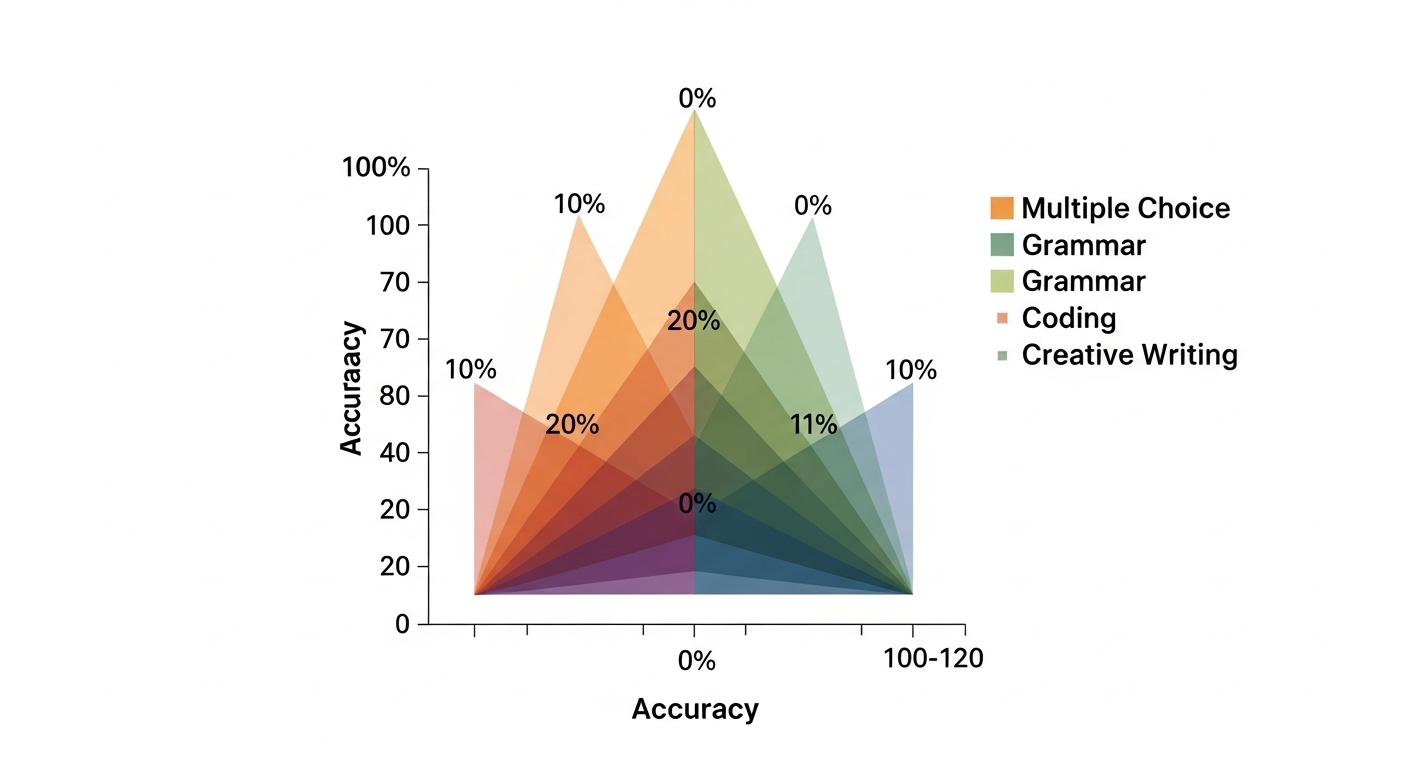
AI grading accuracy rises sharply when the task has clear structure and predictable evaluation rules. When ambiguity increases, accuracy drops.
High-accuracy use cases
- Multiple-choice questions (≈99% accuracy in standardized formats)
- Grammar and spelling checks
- Math and coding assignments with defined outputs
- Structured writing, such as five-paragraph essays with explicit rubrics
Lower-accuracy use cases
- Creative writing with unconventional voice or structure
- Argumentative essays requiring nuanced reasoning
- Critical thinking tasks without a single correct approach
AI Accuracy by Task Type
| Task Type | AI Accuracy |
|---|---|
| Multiple choice | Very high |
| Grammar | Very high |
| Coding | High |
| Essays (creative) | Low |
The pattern is clear. AI graders perform best when the grading process resembles pattern recognition rather than interpretation. For a standardized-testing example, AI grading the SAT and ACT shows how automated scoring can work alongside human oversight in high-stakes assessments. This limitation becomes more visible when originality enters the picture.
Where Does AI Grading Break Down?
AI grading struggles when student work moves beyond predictable structures. It does not “understand” ideas. It recognizes patterns that resemble what it has seen before.
Breakdowns typically occur in areas such as:
- Irony or satire, which may be misread as incoherence
- Original structures that do not follow standard templates
- Cultural context unfamiliar to training data
- Higher-order reasoning that requires interpretation
Common failure signals educators report:
- Penalizing unconventional but valid answers
- Clustering scores in the middle range
- Overreacting to small changes in wording or format
- Treating surface fluency as depth
These failures are not random. They are structural. Which leads directly to the role prompts and rubrics play in shaping AI grading outcomes.
Why Does Prompt Design Affect AI Grading Accuracy?

AI grading systems rely on instructions more than principles. Small wording changes can shift outcomes because large language models respond to patterns, not intent.
AI grading the SAT provides a useful contrast because standardized SAT scoring relies on predefined scoring rules rather than interpretive AI grading. A vague rubric produces vague scoring. A narrow prompt produces narrow evaluation.
Several factors consistently influence accuracy:
- Rubric clarity – vague criteria lead to inconsistent results
- Prompt specificity – unclear expectations confuse scoring logic
- Task complexity – higher abstraction lowers reliability
- Context provided – missing background limits interpretation
Prompt engineering is not a technical detail. It is a core grading control. When educators refine rubrics and prompts carefully, AI accuracy improves noticeably. When they do not, errors multiply.
This sensitivity raises another question. Even if AI is imperfect, is it at least more consistent than human graders?
Is AI More Consistent Than Human Graders?
Consistency is one of AI grading’s strongest advantages. Research shows that AI systems demonstrate internal consistency rates between 59% and 82%, while human graders average around 43%, influenced by mood, fatigue, and time pressure.
The feedback provided by AI systems is also consistent, ensuring that students receive reliable and timely AI feedback on their work. This consistency in grading and feedback supports student learning by offering dependable information for improvement. With AI handling routine assessments, teachers can focus on higher-value instructional activities that require human insight, such as personalized mentorship and fostering critical thinking.
AI does not rush through the last essay of the night. Humans sometimes do.
Consistency Comparison
| Metric | AI | Humans |
|---|---|---|
| Fatigue | No | Yes |
| Mood bias | No | Yes |
| Context awareness | No | Yes |
However, consistency should not be confused with fairness. A consistently flawed interpretation remains flawed. Which brings the discussion to bias.
Does AI Grading Reduce or Reinforce Bias?

AI grading can reduce some biases while amplifying others. It often eliminates name-based or demographic assumptions that affect human judgment. But it introduces data-driven bias, which can be harder to detect.
Key concerns include:
- Training data that reflects majority writing styles
- Disadvantaging ESL and bilingual students
- Penalizing non-standard dialects or rhetorical styles
Major risks educators identify:
- Bias embedded in training data
- False sense of objectivity
- Unequal impact on certain student groups
Because AI decisions appear neutral, they can mask inequities rather than correct them. This is why human review remains essential.
Why Human Oversight Is Still Non-Negotiable
AI grading lacks empathy. It does not recognize growth arcs, effort, or intellectual risk-taking. It cannot interpret silence, struggle, or breakthrough moments in learning.
Teachers do more than assign scores. They contextualize progress. They interpret intention. They adjust expectations when needed.
There is also a subtle effect many educators notice. AI-generated scores can influence how teachers perceive student ability, even when those scores are imperfect. Without oversight, AI can quietly shape judgment instead of supporting it.
For high-stakes assessments, this risk is unacceptable. Human educators must retain final authority. AI works best as a preliminary grader, not a decision-maker.
The most effective systems treat AI as a tool for speed and pattern detection, while humans handle meaning, fairness, and growth. That balance, more than raw accuracy numbers, is what ultimately determines whether AI grading improves education or quietly undermines it.
When evaluating AI grading platforms, it helps to compare how each supports instructor control and meaningful feedback. Our guide to Apporto PowerGrader vs Packback examines their differences in assessment workflows, AI capabilities, and the role of educators in grading decisions.
When Is AI Grading a Good Idea?

AI grading performs best when the goal is feedback, not final judgment. In practice, its strongest use cases are low-risk, high-volume moments where speed and consistency matter more than interpretation.
These are situations where instructors want patterns, signals, and momentum rather than definitive conclusions.
AI grading is particularly effective for:
- Formative assessments, where the purpose is improvement, not evaluation
- Early drafts, especially in writing-heavy courses
- Grammar, structure, and clarity checks, where rules are explicit
- Pattern analysis across a class, helping instructors spot shared gaps
- Frequent, low-stakes assignments, where fast turnaround supports learning
In these contexts, AI grading acts like a wide-angle lens. It surfaces trends humans would struggle to see at scale, and it does so without fatigue. Students benefit from faster feedback, and teachers regain time for instruction rather than triage.
The key is intention. When AI is positioned as a learning accelerator rather than an authority, accuracy improves because the stakes align with its strengths.
When Should AI Never Be the Final Grader?
There are lines AI grading should not cross, and educators are increasingly clear about where those lines sit.
Any situation that requires judgment beyond surface features demands human review. Speed becomes secondary. Fairness becomes primary.
AI should never be the final grader in cases such as:
- High-stakes exams that influence progression, certification, or graduation
- Creative writing, where originality and voice matter more than structure
- Equity-sensitive contexts, including assessments involving multilingual or non-standard dialects
- Disciplinary or evaluative decisions, where scores carry real consequences
In these scenarios, AI’s consistency can become a liability. A consistently shallow interpretation is still shallow. Without context, effort, growth, and intellectual risk-taking disappear from the evaluation.
Most institutions now recognize this distinction. AI may assist, flag, or summarize. But final authority must remain human. Accuracy, here, is inseparable from responsibility.
How Teachers Actually Use AI Grading in Classrooms

In real classrooms, AI grading rarely operates as an all-or-nothing system. Instead, it slips into workflows quietly, handling the parts of grading teachers never wanted to do in the first place. These are often AI-powered tools that streamline grading tasks and provide advanced analytics.
Teachers looking for the best automated grading software can compare platforms based on their grading workflows, assignment types, and level of educator control.
Teachers use AI to:
- Reduce time spent on repetitive feedback, especially for large cohorts
- Increase the amount of student writing, knowing feedback won’t bottleneck
- Identify patterns before misconceptions spread
- Support lesson planning, using aggregated insights rather than intuition alone
The feedback provided by AI-powered grading tools is a key benefit for both students and teachers, enabling more immediate and personalized responses. This supports student learning by allowing instruction to be more responsive and tailored to individual needs.
The human role does not shrink. It shifts.
Teachers report spending less time correcting the same mechanical issues and more time discussing ideas, reasoning, and improvement strategies. Oversight remains constant. AI output is reviewed, adjusted, sometimes discarded. Ongoing professional development is important for teachers to effectively integrate AI grading into their practice and ensure fair, accurate evaluations.
The classroom impact is subtle but real. Feedback cycles shorten. Instruction becomes more responsive. Grading feels less like clerical work and more like pedagogy again.
What Research Says About AI Grading Accuracy
The research consensus is not that AI grading is “accurate” in isolation. It is that accuracy improves dramatically when AI operates inside a hybrid model.
Across multiple studies, several patterns repeat:
- AI grading alone is not reliable enough for high-stakes evaluation
- Rubric quality can double AI accuracy, compared to vague criteria
- Task complexity strongly predicts error rates
- Hybrid models consistently outperform either AI-only or human-only grading
Researchers emphasize that AI accuracy is conditional. It depends on task type, rubric clarity, and oversight. When those conditions are met, AI becomes a stabilizing force. When they are not, errors compound.
One recurring conclusion appears across reports: AI is best at amplifying good assessment design, not compensating for poor design. Accuracy, in other words, starts with humans.
How AI Improves Feedback Without Replacing Teachers
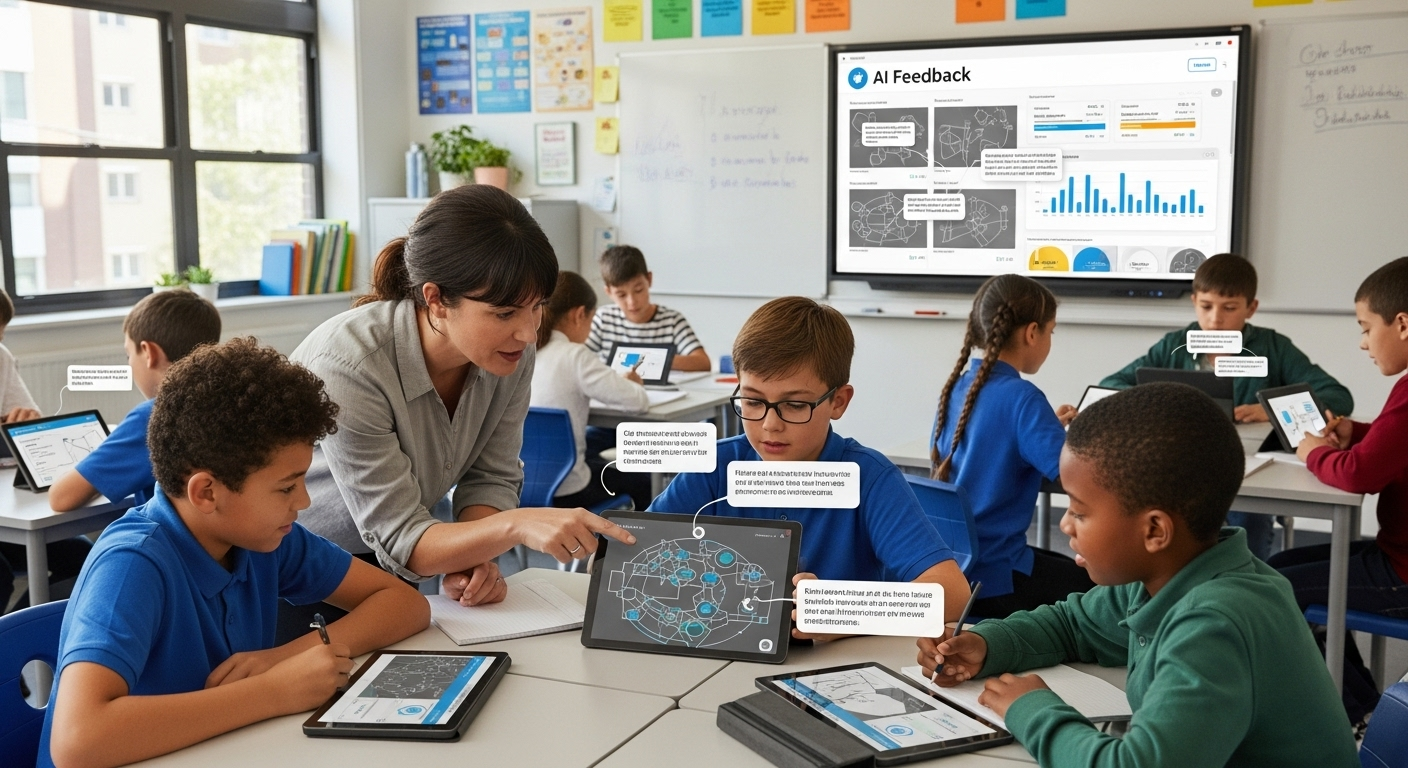
AI-generated feedback tends to be fluent, immediate, and scalable. Those qualities matter more than they seem.
Timely AI feedback provides constructive and structured comments, which is essential for supporting student learning and revision. One of the key advantages of AI-assisted grading is the ability to deliver personalized feedback, tailored to each student’s needs. Timely feedback strengthens learning because students can act while the work is still cognitively active. AI enables that speed. Teachers add what AI cannot: prioritization, tone, and instructional framing.
In practice, the feedback loop looks like this:
- AI delivers fast, structured, and personalized feedback on form and clarity
- Teachers add depth, nuance, and emphasis
- Students receive guidance that is both timely and meaningful
This layered approach improves uptake. Students are more likely to revise when feedback arrives quickly, and more likely to understand why when teachers contextualize it.
AI does not replace the teacher’s voice. It clears space for it.
How AI PowerGrader Makes AI Grading More Accurate and Fair
Accuracy improves when control stays with educators. AI PowerGrader is an AI-powered tool built around that principle, designed to enhance grading practices in education.
Rather than treating AI as an autonomous grader, AI PowerGrader uses a rubric-first approach, where instructors define criteria and standards before any grading occurs. The AI-powered system applies those criteria consistently, supporting fair and accurate grading practices, while educators retain final authority.
To see how Apporto PowerGrader compares with another assessment platform, explore our detailed guide to Apporto PowerGrader vs Formative, including differences in grading workflows, feedback, and assessment capabilities.
Main design elements include:
- Instructor-controlled AI, not black-box scoring
- Pattern detection with human oversight, surfacing trends without dictating outcomes
- Human-in-the-loop workflows, ensuring accountability
- Transparency and fairness, rather than automation for its own sake
By grounding AI grading in educator judgment, AI PowerGrader addresses the core accuracy concern. Not whether AI is fast, but whether it is trustworthy. Try AI PowerGrader for yourself today!
Conclusion
AI grading is accurate in the ways it was designed to be. It is fast. It is consistent. It is tireless.
It is not understanding.
Accuracy in education is not a single number. It is alignment between criteria, context, intent, and consequence. AI supports that alignment when used deliberately. It undermines it when used blindly.
The evidence points to one conclusion. Hybrid models work best. AI handles scale and consistency. Humans handle meaning and fairness.
As AI grading continues to evolve, its role in the future of education will depend on keeping the focus on meaningful assessment and student development. Ultimately, the goal of any grading system should be to support student learning and prepare both educators and students for the challenges ahead.
Frequently Asked Questions (FAQs)
1. Is AI grading more accurate than human grading?
AI is more consistent than humans but less context-aware. Humans interpret nuance better. Accuracy improves most when AI and human judgment are combined.
2. Can AI grading be trusted for final grades?
Not on its own. Most research recommends AI assist with grading, while educators retain final decision-making authority.
3. Does AI grading reduce bias?
It can reduce some human biases, but it may introduce data-driven bias. Human oversight is essential to monitor fairness.
4. What assignments does AI grade most accurately?
Structured tasks like quizzes, grammar checks, coding, and rubric-driven writing show the highest accuracy.
5. Why do AI grading errors happen?
Errors occur when tasks require interpretation, creativity, or cultural context that AI systems cannot fully understand.
6. Does rubric quality affect AI grading accuracy?
Yes. Clear, specific rubrics significantly improve AI grading performance and consistency.
7. Will AI grading replace teachers?
No. AI grading supports teachers by reducing workload, but human judgment remains central to assessment.
