
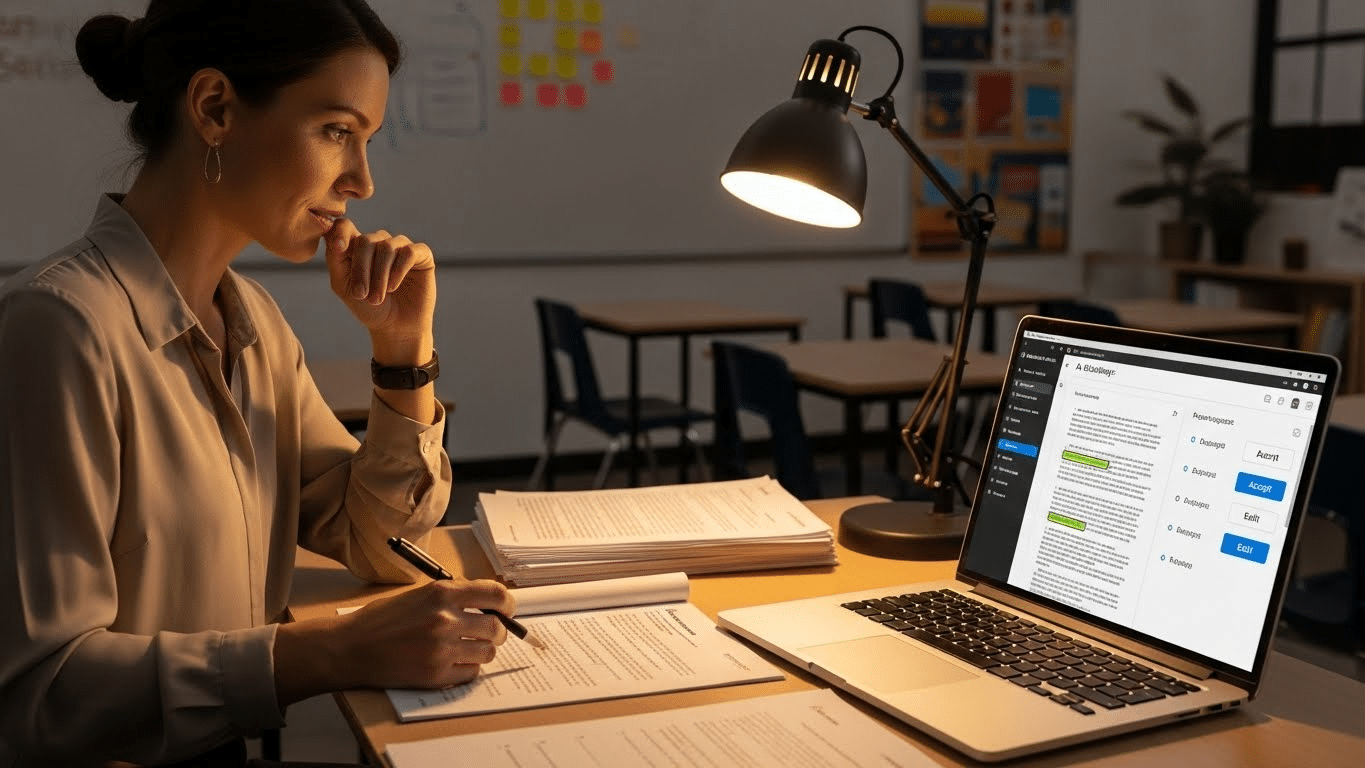
How to Use AI for Grading?
Teachers can use AI for grading by automating first-pass reviews, rubric-based scoring, grammar checks, and structured feedback while keeping final evaluation under human oversight. AI grading works best for quizzes, short answers, essays, and coding assignments with clear criteria. Platforms like PowerGrader help educators apply AI consistently while preserving fairness, transparency, and instructor control.
Somewhere between the third essay stack and the fifteenth late submission, grading stops feeling like pedagogy and starts feeling like endurance. Not because teachers don’t care, but because time is finite. Feedback isn’t.
AI enters the picture right there, not as a miracle cure, but as a pressure valve. Used carefully, it helps you grade faster, more consistently, and with less mental drain, without handing over professional judgment.
This article walks through how to use AI for grading in a way that actually makes sense in real classrooms. Not theory. Not hype. Just what works, where it works, and where it clearly doesn’t.
Why Are Teachers Turning to AI for Grading in the First Place?
Grading takes time. A lot of it. Especially when class sizes grow, assignments multiply, and expectations around feedback keep rising. Many teachers spend evenings and weekends doing work that never quite feels finished.
AI grading systems step in at that pressure point. Teachers who use them often report saving around eight hours a week, mostly by automating first-pass reviews and repetitive checks.
That time savings isn’t about cutting corners. It’s about reducing fatigue. When you’re tired, inconsistency creeps in. AI applies the same criteria every time, which helps stabilize the grading process.
There’s also growing pressure to give faster, more detailed feedback. Students expect it. Institutions encourage it. AI makes that possible without replacing the teacher. And that’s the key shift.
AI is increasingly used as a grading assistant, not a replacement. It handles the heavy lifting so educators can focus on judgment, context, and actual teaching. That balance is why interest keeps growing.
What Types of Assignments Can AI Actually Grade Well?
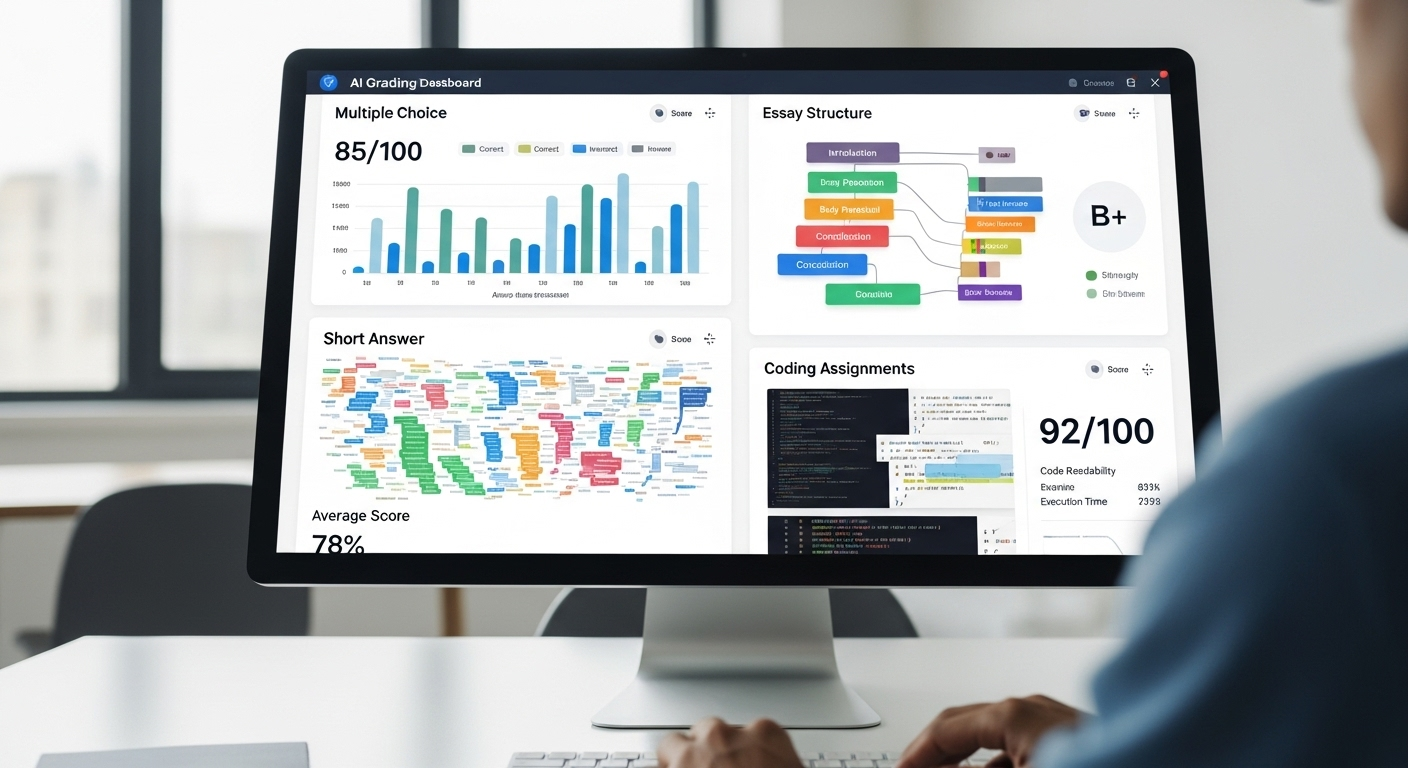
AI grading works best when structure exists. The clearer the expectations, the stronger the results. That doesn’t mean creativity disappears, but it does mean some assignment types are better suited than others.
For structured assessments, AI performs reliably. Automated scoring thrives when answers follow defined patterns or rubrics. When assignments drift into highly subjective territory, human review becomes essential.
In practice, AI grading tools handle these assignment types most effectively:
- Multiple choice and fill-in-the-blank questions, where answers are clearly defined
- Short answer questions with clear criteria, especially when rubrics specify key points
- Structured essays, such as five-paragraph formats with thesis statements and logical flow
- Code assignments, where logic, functionality, and efficiency can be evaluated objectively
AI struggles more with experimental writing or unconventional responses. That’s not a flaw. It’s a reminder. Different assignment types require different grading approaches. Knowing where AI fits keeps expectations realistic and results useful.
How Does AI Grade Student Writing and Essays?
At the heart of AI essay grading is Natural Language Processing. NLP allows AI graders to read text in a way that goes beyond spellcheck. These systems analyze grammar, syntax, coherence, and overall structure. They don’t just count errors. They look for patterns.
AI can evaluate whether a thesis statement is present, whether arguments are logically organized, and whether transitions make sense. It can compare similar answers across a class to detect consistency or divergence in quality. That pattern recognition is something humans do intuitively but slowly. AI does it quickly.
Typically, AI grading tools focus on:
- Grammar and syntax checks, flagging sentence-level issues
- Coherence and structure analysis, identifying logical flow problems
- Pattern recognition across similar answers, highlighting strengths and weaknesses
Where AI falls short is nuance. Creative voice, unconventional structure, or subtle rhetorical choices may be misread. That’s why human review matters. AI offers a strong first pass. Teachers provide the final interpretation. Together, the process becomes faster, fairer, and still unmistakably human.
How Do You Set Up an AI Grading System Correctly?
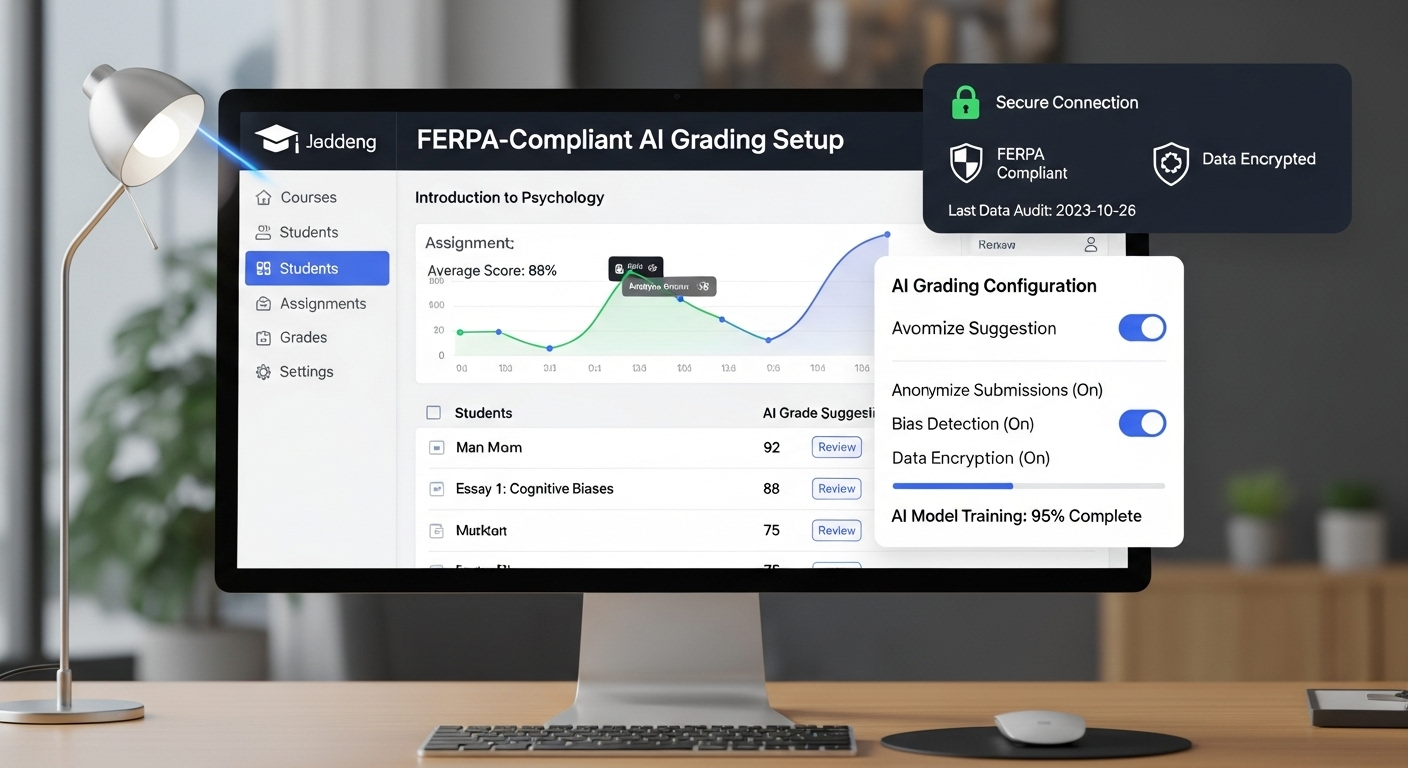
Getting AI grading right starts before you upload a single assignment. The foundation is trust. That means choosing FERPA-compliant, education-specific tools designed for classrooms, not generic writing checkers repurposed for grading. Data privacy is not optional here. It’s table stakes.
Once the tool is selected, context does the heavy lifting. AI grading systems do not “understand” expectations unless you give them some.
Uploading a grading rubric anchors the system to your standards and keeps evaluation consistent. Align those criteria with state standards or course objectives so feedback makes sense in your instructional context.
Before rolling it out widely, test the setup on sample work. Small adjustments early prevent bigger problems later.
A practical setup usually includes:
- Choose a trusted AI grading tool built for education
- Upload your rubric or grading standards before grading begins
- Define criteria clearly so the AI knows what matters most
- Test the system on sample work to check alignment and tone
How Can AI Provide Feedback Without Replacing Teachers?
AI is fast. Teachers are thoughtful. The goal is not to pick one. It’s to let each do what they do best.
AI provides immediate, structured feedback at a scale that humans simply can’t sustain. Grammar flags. Rubric-aligned comments. Pattern-based suggestions. All of that happens quickly. What AI cannot do is understand intent, emotion, or the broader context behind a student’s work. It doesn’t know when a risk was brave or when confusion signals a deeper learning moment.
That’s where teachers stay central. Educators review and adjust AI feedback, soften language when needed, and connect comments to classroom conversations. Final grades remain a human decision.
Used this way, AI becomes a first draft of feedback, not the final word. It supports written feedback and personalized guidance while preserving the professional judgment that makes teaching, teaching.
What Does a Responsible AI Grading Workflow Look Like?
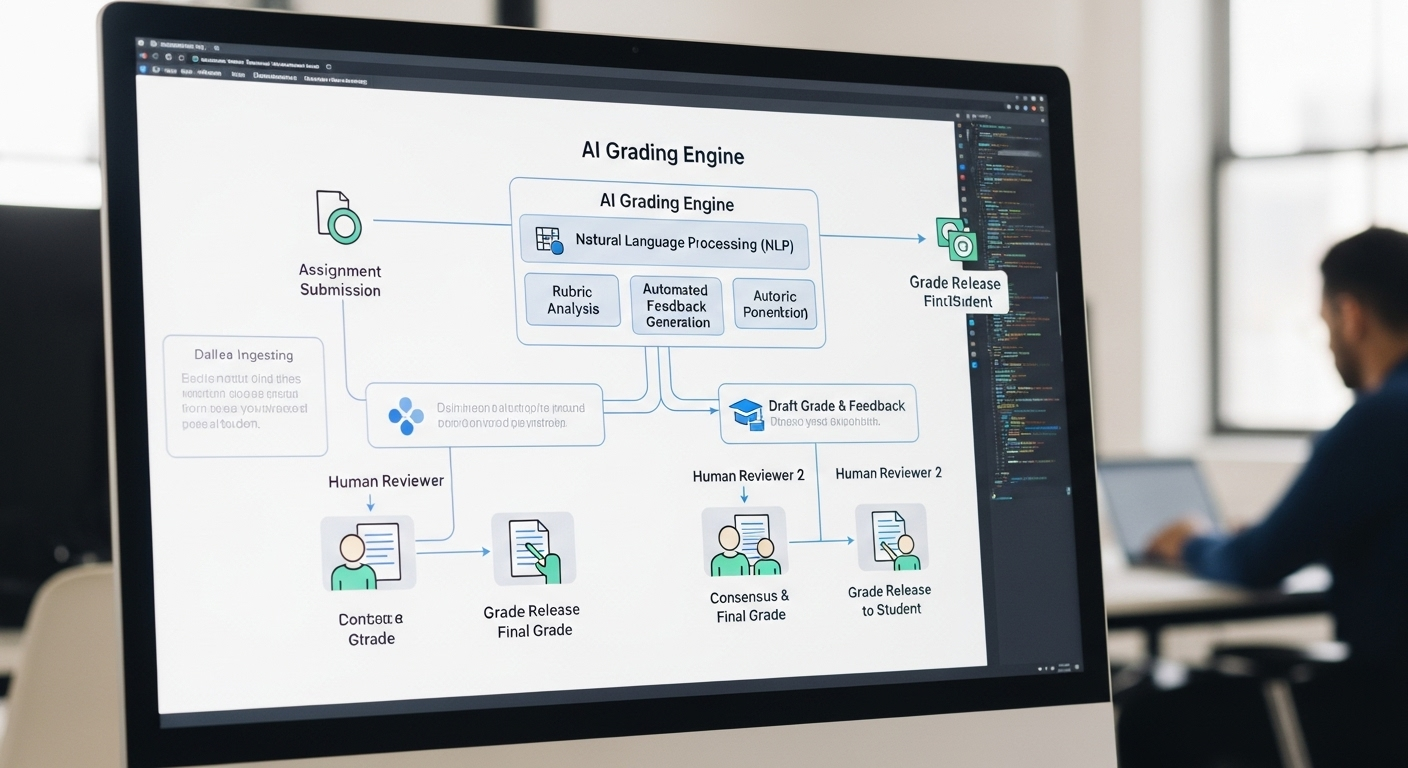
Responsible AI grading is less about automation and more about orchestration. AI works best as a co-pilot, handling repetitive tasks while humans steer.
Transparency matters. Students should know when AI is used and how it fits into the grading process. Anonymized grading can also help reduce bias, especially during first-pass reviews. But no workflow ends without human review. That final check protects fairness and accuracy.
In practice, a responsible workflow looks like this:
- Disclose AI grading in the syllabus so expectations are clear
- Use AI for first-pass grading to surface patterns and draft feedback
- Double check scores and suggestions before releasing grades
- Adjust grades where context matters, especially in edge cases
The result is not faster grading alone. It’s more consistent, more thoughtful grading with less burnout attached.
How Accurate Is AI Grading, Really?
Accuracy is the question everyone asks, and the answer is nuanced. Teachers using AI grading tools often report accuracy levels above 90 percent, particularly for structured assignments with clear rubrics. AI applies criteria uniformly. It doesn’t get tired. It doesn’t drift.
But accuracy depends on inputs. Bias can exist in training data, and nuance can be missed if criteria are vague. That’s why clear rubrics and human oversight matter so much. The better the rubric, the better the output.
AI grading is reliable at scale, not infallible. It’s strongest when paired with professional judgment. Think of it as consistency on demand, guided by human standards rather than raw automation.
What Are the Limitations and Risks of Using AI for Grading?

AI grading is powerful, but it isn’t neutral. There are limits worth respecting.
Creative or unconventional responses may be misinterpreted. Bias and fairness concerns can surface if training data lacks diversity. Data privacy must be actively protected, especially when student writing is uploaded. And when automation goes too far, teacher-student relationships can thin out.
Common risks include:
- Bias in training data affecting outcomes
- Privacy and FERPA concerns if tools are poorly chosen
- Missed nuance in creative writing or original thinking
- Over-reliance risks that weaken critical thinking and mentorship
These risks don’t cancel the benefits. They simply demand intentional use.
How Can AI Help Teachers Give Better Feedback Faster?
Speed alone doesn’t help learning. Quality does. AI helps with both when used correctly.
By grouping similar responses, AI allows teachers to review patterns instead of isolated papers. Detailed feedback can be generated at scale, giving students more than a grade and a sentence. Immediate feedback helps students act while the work is still fresh.
Meanwhile, teachers spend less time correcting mechanics and more time supporting understanding. Instructional conversations replace red-pen marathons. That shift, quiet but meaningful, is where AI’s real value shows up.
How Can PowerGrader Help Educators Use AI for Grading Responsibly?
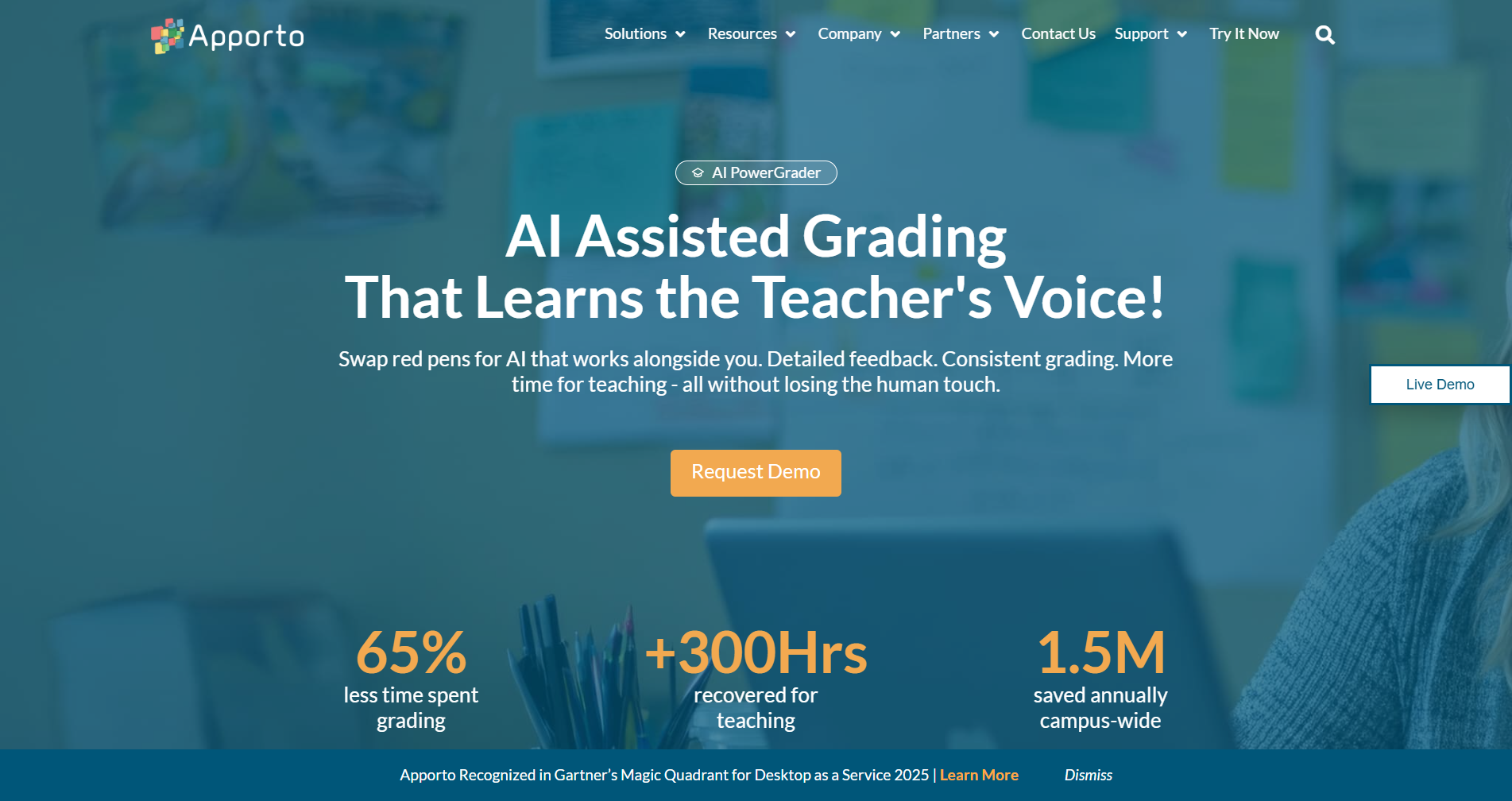
PowerGrader is designed around a simple idea: AI should assist educators, not outrank them. It offers instructor-controlled AI grading, ensuring rubrics and standards come from teachers, not algorithms.
The platform applies criteria consistently, detects patterns across submissions, and reduces grading time without lowering rigor. Most importantly, it keeps humans in the loop. Educators can review, adjust, and override AI output at any stage.
Built with FERPA-conscious design and an education-first approach, PowerGrader focuses on trust, fairness, and control. It supports responsible AI grading at scale while preserving professional judgment where it matters most. Try it now!
Conclusion
AI grading isn’t heading toward replacement. It’s moving toward partnership.
In the future, AI will continue acting as a grading assistant, handling volume while humans handle meaning. Ethical, transparent use will shape adoption. The focus shifts from speed alone to quality, fairness, and sustainability.
Education doesn’t need faster grading at any cost. It needs better grading, done thoughtfully, with tools that respect context. AI fits there, not above it.
Frequently Asked Questions (FAQs)
1. Is there an AI for grading?
Yes, AI grading tools can evaluate quizzes, essays, short answers, and coding assignments using rubrics, natural language processing, and pattern recognition. Platforms like PowerGrader help educators automate first-pass grading, provide structured feedback, and maintain consistency while keeping final grading decisions under teacher oversight.
2. How to use AI to grade exams?
Teachers can use AI to grade exams by uploading assignments, setting grading rubrics, and allowing AI tools to evaluate responses based on defined criteria. AI works best for structured assessments and first-pass reviews, while educators verify results, adjust feedback, and make final grading decisions.
3. Do teachers use AI for grading?
Yes, many teachers use AI grading tools to save time, improve consistency, and provide faster feedback on assignments. AI is commonly used for quizzes, essays, and structured assessments, while teachers remain responsible for reviewing results, applying context, and making final academic judgments.
4. Can AI grade essays fairly?
AI can grade structured essays fairly using rubrics, but creative nuance still requires human review to ensure context and originality are properly evaluated.
5. Is AI grading allowed in schools?
Yes, when used responsibly. Most institutions allow AI grading as an assistive tool, provided transparency, privacy compliance, and human oversight remain in place.
6. How much time can AI grading save teachers?
Teachers report saving around eight hours per week by using AI grading tools for first-pass reviews and repetitive feedback tasks.
7. Does AI grading replace teachers?
No. AI supports grading efficiency, but teachers remain responsible for judgment, context, and final grades.
