

Is AI Grading the SAT?
No, the SAT is not graded by generative AI. The exam uses automated, rule-based scoring and statistical equating to ensure fairness across test versions. AI supports operational tasks like security monitoring and fraud detection, while human oversight remains central to scoring policies and standardized testing integrity.
Short answer first, because that’s what most people want to know right away. No, the SAT is not graded by generative AI.
There’s no large language model reading essays or judging student reasoning behind the scenes. What is happening is something far more ordinary and, frankly, less dramatic.
SAT scoring is automated, but it’s rule-based and statistical. The confusion usually comes from mixing up different ideas: machine learning, adaptive testing, and automated grading systems. They sound similar. They are not the same thing.
The College Board has been clear on this point. While technology plays a role in delivering and processing the SAT exam, human oversight remains central to the assessment and scoring process. AI systems may support operational tasks, but they do not replace judgment in how standardized tests are evaluated.
So when people ask, “Is AI grading the SAT?” they’re usually reacting to headlines, not policy. The reality is quieter, more controlled, and very intentional.
How Is the SAT Actually Scored Today?
SAT scoring follows a structure that hasn’t changed as much as people assume. Every test score still falls within the familiar 400 to 1600 range.
That total comes from two sections: Evidence-Based Reading and Writing, often shortened to EBRW, and Math. Each section contributes equally to the final score.
There’s no penalty for wrong answers. If a question is left blank or answered incorrectly, it simply doesn’t earn points. That design encourages students to attempt every question rather than play it safe.
Behind the scenes, raw scores are converted into scaled scores using a process called statistical equating. This ensures fairness across different test versions.
Some test forms are slightly harder than others, and equating adjusts for that. Importantly, this process relies on predefined algorithms, not artificial intelligence making judgments.
To be explicit, statistical algorithms are not the same as AI judgment. There is no natural language processing evaluating written responses because, in the current SAT, there are no essays to evaluate. The system processes data, not meaning.
What Changed With the Digital SAT (And What Didn’t)?

The move to the digital SAT introduced changes that feel dramatic, especially if you’re used to paper tests. But the biggest shifts are about delivery, not grading. The digital SAT uses Multistage Adaptive Testing, which sounds more complex than it actually is.
Here’s how it works. Every student starts with a first module that establishes a baseline. Based on performance in that module, the second module adjusts in difficulty.
Strong performance leads to harder questions. Weaker performance leads to easier ones. This adaptivity happens between modules, not question by question.
What didn’t change is just as important. Scoring logic remains standardized. All students are still scored on the same scale, using the same statistical framework, regardless of which questions they see.
To break it down clearly:
- The first module sets a performance baseline
- The second module adapts difficulty based on patterns in answers
- Scoring remains standardized and comparable across all test-takers
Machine learning supports the adaptive design, helping identify patterns in performance. But it does not grade answers in an interpretive way. The digital SAT looks modern on the surface, yet underneath, the assessment process remains tightly controlled and consistent.
Where AI Is Used in the SAT Ecosystem (But Not for Grading)
AI does exist inside the SAT ecosystem. Just not where most people assume. Its role is operational, not evaluative, and that distinction matters more than it sounds.
Behind the scenes, AI supports exam security and integrity. It helps monitor testing environments, flag unusual behavior, and detect patterns that could indicate misconduct. For example, automated systems analyze answer patterns across thousands of test-takers to identify suspicious similarities that don’t occur by chance. Sudden timing anomalies. Identical response strings. Irregular navigation behavior. These are red flags humans would struggle to catch at scale.
AI also assists with fraud detection, especially in digital testing environments where remote access adds complexity. Monitoring abnormal testing behavior protects the validity of scores without interfering in how answers are judged.
The College Board has been explicit here. AI-assisted monitoring strengthens security, but scoring itself remains separate. In other words, AI assists operations, not evaluation. It supports the system, not the judgment. That boundary is intentional and carefully maintained.
What About the SAT Essay? Is AI Grading That?

This question comes up constantly, and the answer is straightforward. No. The SAT essay is no longer part of the standard exam. In the digital SAT, it has been fully discontinued. There is no writing section that requires essay scoring, automated or otherwise.
When the essay did exist, it was evaluated by human graders. Trained readers assessed written responses using standardized criteria. There was no AI grading student essays for the SAT, even then.
So where does the confusion come from? Mostly from elsewhere. AI essay scoring does exist in other parts of the education sector.
Some state assessments use automated scoring for written responses. College admissions offices increasingly rely on AI tools to analyze essays at scale. But those systems are not connected to SAT scoring.
In short, AI can evaluate sentences and writing in other contexts. It simply isn’t doing so for the SAT.
Why People Think AI Is Grading the SAT
The idea didn’t appear out of nowhere. It’s the result of several real developments colliding in public conversation, then blurring together online.
First, there’s state testing. Texas, for example, uses AI to score written responses for students starting in third grade.
Similar AI grading systems operate in at least 21 states, often with human review layered on top. Headlines rarely mention the safeguards. The takeaway becomes “AI is grading tests.”
Second, there’s higher education. Colleges increasingly use AI to help review admissions essays, looking for patterns across tens of thousands of applications. Again, AI assists. Humans decide. But nuance gets lost.
Third, there’s the noise. When ChatGPT-4 scored a 1460 on the SAT, headlines traveled faster than explanations. People saw “AI beats most students” and assumed AI must also be grading them.
Put together, it looks like this:
- Texas Education Agency using AI scoring for written responses
- AI-assisted review of college admissions essays
- ChatGPT-4 SAT score headlines dominating search results
Did ChatGPT Really Outscore Most Humans on the SAT?

Yes. And no. Both are true, depending on what you think “outscoring” actually means.
When researchers tested ChatGPT-4 on the SAT, it achieved a 1460, placing it in roughly the 96th percentile. That means it scored higher than most human test-takers. On paper, that’s impressive. It also made headlines for a reason.
But context matters. ChatGPT excels at pattern recognition and standardized formats. The SAT, by design, rewards exactly that. Questions follow predictable structures. Answer choices are constrained. The system tests recognition, elimination, and consistency more than lived understanding.
What this performance does not demonstrate is human-like intelligence. ChatGPT does not reason about the world the way students do. It does not learn from mistakes in a personal sense, nor does it apply knowledge outside the testing frame. It recognizes patterns it has seen before, drawn from massive training data.
So yes, the score is accurate. The conclusion many people jump to is not. AI success in testing environments does not translate to real-world intelligence, judgment, or learning in unpredictable situations.
If AI Can Ace the SAT, Why Isn’t It Used to Grade It?
This is where testing moves from technical curiosity to public policy.
High-stakes exams like the SAT require more than reliability. They demand transparency, explainability, and legal defensibility.
Every score must be justifiable, appealable, and consistent across millions of students. AI grading, especially when driven by machine learning models, struggles to meet all three at once.
Bias risks are a central concern. AI systems learn from training data, and if that data reflects historical inequities, the system can quietly reproduce them. Equity concerns grow sharper when tests influence college admissions, scholarships, and life opportunities.
The SAT prioritizes public trust above innovation speed. Even if AI grading were statistically reliable, that alone wouldn’t be enough. Acceptability matters as much as accuracy. A system must be understandable to students, parents, educators, and courts.
In short, reliability does not equal readiness. For now, human judgment remains the standard.
Are States Using AI to Grade Other Standardized Tests?
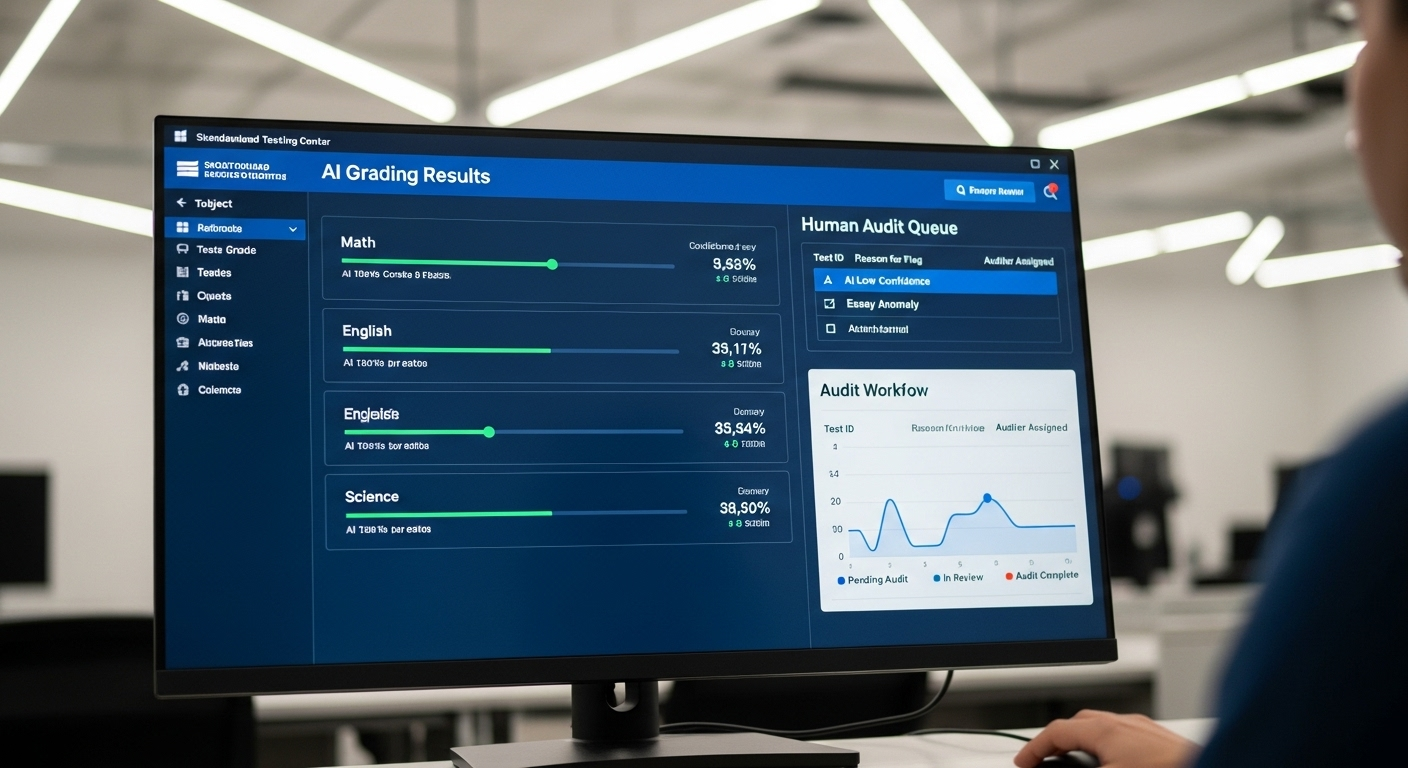
Yes. This is where much of the confusion comes from.
Several states have already adopted AI grading systems, particularly for written responses. Texas is the most cited example. The Texas Education Agency uses AI to score certain written portions of standardized tests for students in third grade and above.
However, safeguards are built in. Roughly 25% of AI-scored responses are reviewed by human graders. These checks help catch errors, bias, and edge cases. The system is audited continuously, not left to run unattended.
Why do states pursue this? Cost and scale. AI grading can save millions of dollars annually while handling enormous testing volumes. Still, equity concerns remain, especially for bilingual students and English learners.
Key safeguards typically include:
- Human review layers for AI scores
- Cost efficiency paired with oversight
- Ongoing audits to monitor accuracy and fairness
This is real adoption, but it’s cautious, limited, and heavily supervised.
What Are the Risks of AI Grading in High-Stakes Testing?
The risks aren’t hypothetical. They’re structural.
AI inherits bias from its training data. Language patterns, cultural references, and writing styles that fall outside the “norm” can be misinterpreted. That creates fairness issues, especially in diverse testing populations.
Language and cultural mismatch is another concern. Subtle phrasing, idiomatic expression, or unconventional reasoning may be penalized even when the underlying understanding is strong. Over-automation compounds the problem by reducing opportunities for human correction.
This is why the SAT has avoided AI scoring. High-stakes testing magnifies consequences. A small systematic error, repeated at scale, becomes a serious injustice.
Researchers consistently warn that while AI can assist evaluation, it should not independently decide outcomes where stakes are high. For now, the risks outweigh the benefits.
Will AI Ever Grade the SAT?

Technically, yes. Practically, it’s complicated.
AI grading the SAT is possible from a computing standpoint. But adoption would require far more than accuracy benchmarks.
It would demand explainable models, robust public oversight, and years of phased validation across diverse student populations.
Policy change in standardized testing moves slowly for a reason. Trust is fragile. Once lost, it’s hard to recover. Any shift toward AI grading would be incremental, transparent, and heavily regulated.
What’s more likely is continued AI use around the edges. Security. Analytics. Test delivery optimization. Scoring itself will remain human-governed for the foreseeable future.
The future of assessment isn’t about replacing judgment. It’s about supporting it, carefully, and only where it truly belongs.
What This Means for Students, Parents, and Educators
Here’s the steady ground beneath all the noise. SAT scoring remains human-governed. That hasn’t changed, and it matters.
Scores are produced through standardized, rule-based processes that prioritize fairness and comparability across millions of students. AI, despite its growing presence in education, is a tool, not an authority.
For students, this means preparation still rewards core skills: reading closely, reasoning clearly, solving problems under pressure. For parents, it means confidence that results aren’t being decided by opaque models.
And for educators, it reinforces an important distinction: classroom assessment is not the same thing as standardized testing. The goals differ. The safeguards differ. So do the acceptable uses of technology.
Understanding that difference helps everyone focus on what counts. Academic readiness for college is built in classrooms, over time, with feedback and guidance. Not in a single test sitting, and not by an algorithm acting alone.
How AI PowerGrader Fits Where AI Actually Belongs
AI has a meaningful role in assessment. Just not inside high-stakes exams like the SAT. Its real value shows up in classrooms, where feedback, iteration, and learning conversations happen every day.
AI PowerGrader is designed for that environment. It supports AI-assisted grading while keeping educators firmly in control. Instructors define rubrics.
The system applies them consistently, drafts feedback, and detects patterns that point to learning gaps. Teachers review, refine, and decide.
This human-in-the-loop approach matters. It allows AI to handle scale and repetition while educators provide judgment, context, and empathy. Rubric-driven evaluation keeps standards clear.
Pattern detection helps identify where students are struggling before small issues become larger ones. And education-first governance ensures the tool serves learning, not shortcuts.
Used this way, AI doesn’t replace expertise. It amplifies it, right where it belongs.
The Bottom Line
No. Generative AI is not grading SAT answers. It doesn’t evaluate responses, assign scores, or make decisions about student performance. AI supports security and analytics only, helping protect test integrity and monitor irregularities at scale.
Human oversight remains non-negotiable. That’s by design. High-stakes testing depends on transparency, trust, and accountability, all of which still rest with people, not models.
If you’re curious about how AI can be applied responsibly, the answer isn’t to look at standardized exams. It’s to look at classrooms.
Explore how AI PowerGrader applies AI where judgment matters most—supporting teachers, improving feedback, and strengthening learning without compromising trust.
Frequently Asked Questions (FAQs)
1. Is the SAT scored by artificial intelligence?
No. The SAT uses automated, rule-based scoring and statistical equating, not generative AI. Human oversight governs how scores are produced and validated across test forms.
2. Does the Digital SAT use machine learning to grade answers?
The Digital SAT uses adaptive testing to adjust question difficulty between modules. Scoring itself remains standardized and statistical, not interpretive or AI-driven.
3. Can ChatGPT get a 1600 on SAT?
ChatGPT can achieve very high SAT scores because large language models perform well on pattern recognition, reading comprehension, and standardized question formats. However, AI systems do not demonstrate human reasoning or understanding, and SAT scoring itself is still governed by standardized statistical processes and human oversight.
4. Are essays on the SAT graded by AI?
No. The SAT essay has been discontinued in the digital format. When essays existed, they were scored by trained human graders, not AI systems.
5. Is AI used anywhere in SAT testing today?
Yes, but only for operations. AI supports security, fraud detection, and pattern analysis to protect test integrity. It does not evaluate or score student answers.
6. Are states using AI to grade other standardized tests?
Some states, including Texas, use AI to assist with scoring written responses. These systems include human review layers and ongoing audits to manage accuracy and equity.
7. Could AI grade the SAT in the future?
Technically possible, but unlikely in the near term. High-stakes exams require explainability, legal defensibility, and public trust, which currently favor human-governed scoring systems.
