From Ban-or-Allow to Real Policy: Why Higher Ed Needs Tiered AI Guidance

One of the clearest signs that higher education is moving into a more mature AI era is the decline of the old policy debate. For a time, many institutions approached generative AI with a binary mindset. Ban it or allow it. Restrict it or embrace it. But that framing is proving far too simplistic for the realities campuses now face.

AI is not a single behavior. It is a category of capabilities being used in very different ways across writing, coding, research, design, feedback, tutoring, and study support. A policy model built around broad prohibition or broad permission cannot account for those differences. And when institutions rely on that kind of blunt framework, they push the real burden of interpretation onto faculty and students.

That is exactly what many leaders are now trying to fix.

Across higher education, students are encountering widely different expectations depending on the course, department, or instructor. In one class, AI-supported brainstorming may be encouraged. In another, similar use may be treated as misconduct. In one department, attribution may be expected but not clearly defined. In another, there may be no guidance at all. This inconsistency does more than create confusion. It weakens trust, increases enforcement challenges, and makes it harder for students to develop sound judgment.

The answer is not more restrictive language. It is better structured guidance.

That is why tiered AI policy frameworks are becoming more important. Rather than trying to classify AI as simply allowed or prohibited, institutions can define categories such as AI-prohibited, AI-limited, AI-supported, and AI-encouraged. The point is not to create more bureaucracy. The point is to align AI use with learning objectives.

For example, if the goal of an assignment is to assess a student’s unaided writing fluency, AI-generated drafting may be inappropriate. If the goal is to evaluate editing, critique, or argument refinement, then guided AI support might be reasonable with disclosure. If the task is coding in a real-world workflow, use of AI may actually be part of the authentic skill being assessed. A tiered model gives institutions and faculty a practical way to reflect those differences. For leaders looking at how peers are navigating these questions at scale, the 2026 State of AI in Higher Education Leadership Survey offers a broader view of the policy, governance, and readiness challenges shaping the sector.

This is where policy becomes far more useful when it is connected to pedagogy.

Too many early AI policy conversations focused on enforcement before design. But durable policy only works when it reflects how learning is meant to happen. Faculty need support in translating broad institutional principles into assignment-level expectations. Students need examples that make the rules concrete. Advising, orientation, and teaching support teams need shared language that can be repeated consistently across the institution.

In other words, policy cannot stay at the level of abstract principle statements.

This is a challenge many institutions are still working through. Leaders report that policies often exist as draft language, borrowed templates, or high-level values statements that have not yet been operationalized. That creates ambiguity at exactly the moment when clarity matters most. A campus may say it supports responsible AI use, but if students cannot tell what that means in a lab, seminar, take-home exam, or capstone, the policy has not done its job.

A more effective approach starts with three practical moves.

First, define a shared institution-wide vocabulary. Everyone should understand the difference between prohibited use, supported use, and conditional use. That vocabulary should appear not just in policy documents, but also in syllabus guidance, student resources, and faculty development materials.

Second, build discipline-specific interpretation on top of that shared language. AI expectations in computer science, business, nursing, and writing-intensive humanities courses will not be identical. That is fine. The goal is consistency in structure, not sameness in every rule.

Third, connect policy to real workflows. Faculty need model syllabus statements. Students need examples of disclosure and attribution. Academic integrity teams need procedures that reflect the realities of AI-related cases. Teaching and learning centers need resources that help instructors design assignments around the policy rather than bolt it on after the fact.

The institutions moving in this direction are not trying to eliminate judgment. They are trying to support it. They understand that responsible AI use is not just about restricting misuse. It is also about helping students learn how and when to use AI well.

That point matters because AI literacy is becoming a core institutional goal in its own right. If students are going to graduate into workplaces where AI is embedded in everyday tasks, then higher education cannot limit itself to warning them about AI. It has to teach them how to evaluate outputs, document use, recognize limitations, and apply judgment in context. Policy is part of that educational infrastructure.

The shift from ban-or-allow to tiered guidance is not a cosmetic change. It reflects a deeper evolution in how higher education understands AI. Institutions are beginning to recognize that the challenge is not just controlling a tool. It is creating coherent expectations across teaching, learning, and assessment.

That work is not simple. But it is far more sustainable than leaving every course to invent its own rules from scratch.

The campuses that get this right will not necessarily have the longest policy documents. They will have the clearest ones. Their policies will be understandable, actionable, and connected to actual learning design. And in an AI-enabled academic environment, that kind of clarity is quickly becoming one of the most valuable forms of institutional leadership. For a deeper look at how higher ed leaders across the market are approaching AI policy, readiness, and academic integrity, download the full leadership survey report.


What Is AI Marking? And Why It Matters?

Marking used to be invisible work. Late nights, quiet weekends, stacks that never quite disappeared. Lately, though, it has become a headline issue.

Across education and professional training, marking workloads are rising faster than time or staffing can realistically absorb.

That pressure explains the shift. Institutions are moving away from traditional automated marking systems and toward AI marking tools that promise scale, speed, and consistency.

But the language has become messy. AI marking, AI grading, generative AI. They are often used interchangeably, even though they mean very different things.

What’s changing now is the focus. The conversation is no longer just about grades. It is about learning-focused feedback processes and how feedback actually helps students improve.

Quality assurance bodies are beginning to address AI marking explicitly, not as a novelty, but as a practice that needs definition, limits, and accountability.

That is why the question what is AI marking suddenly matters more than it did before.


What Is AI Marking, in Plain and Honest Terms?

At its simplest, AI marking is the use of artificial intelligence to mark assessments and assignments. Not to judge students as people. Not to replace educators. To assist with the work of evaluating student responses at scale.

AI marking systems rely on machine learning and natural language processing to evaluate students’ written responses, not just right-or-wrong answers. That means they can look at structure, relevance, and alignment with marking criteria, then draft feedback based on those patterns. In many cases, this feedback is aligned to existing rubrics provided by educators.

What AI marking does not do is remove humans from the process. Human markers remain essential, especially where context, creativity, or consequences matter.

In practice, AI marking is:

  • Not just grades, but draft feedback and insights
  • Support for learning-focused feedback, not one-off scoring
  • Humans making final decisions, always
  • Designed to support human judgement, not override it

Used honestly, AI marking is an assistant. Not an authority.


How Is AI Marking Different From Traditional Automated Marking Systems?

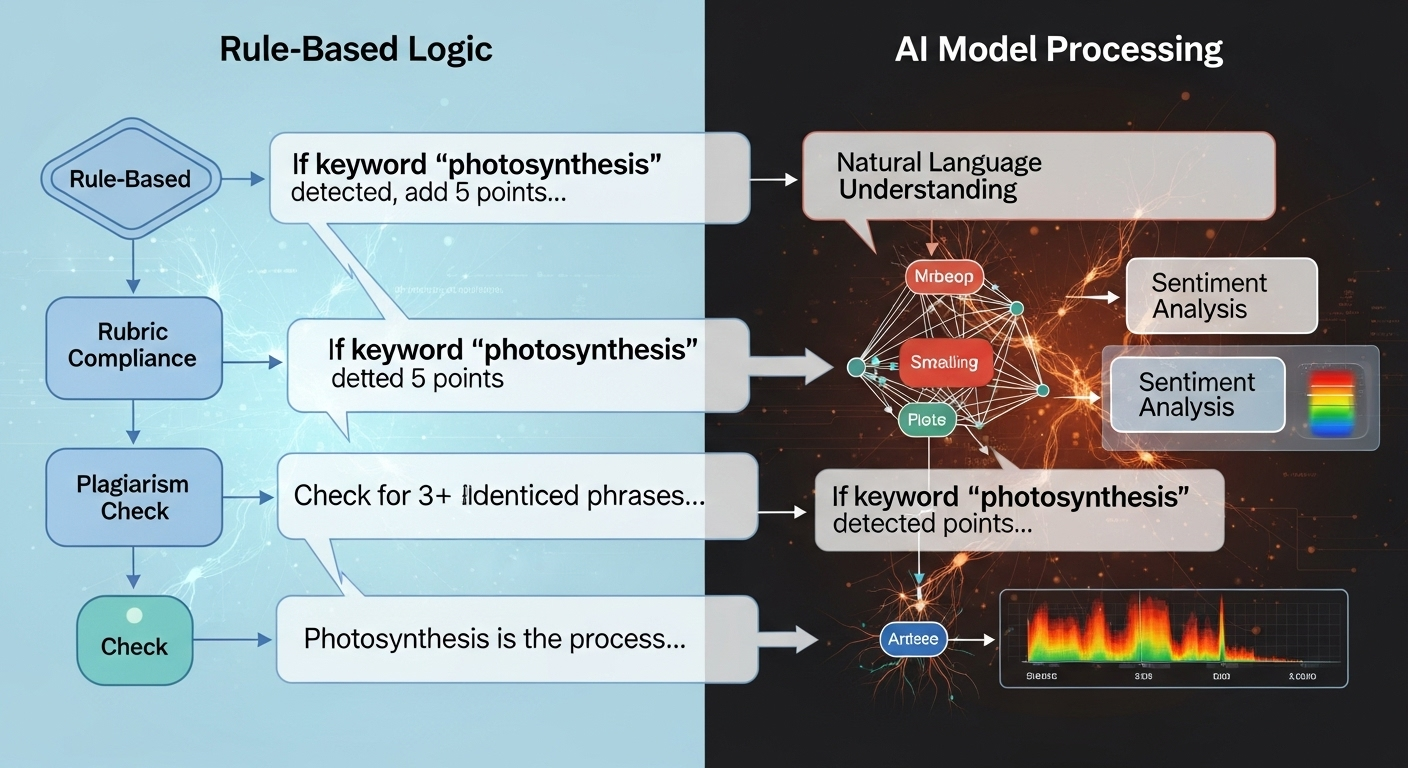
Student answers flowing through two different grading pipelines: rule-based logic and AI model processing.

Traditional automated marking systems rely on fixed rules. If an answer matches a predefined pattern, it passes. If it doesn’t, it fails. The logic is deterministic. Same input, same output. Every time. That approach works for tightly constrained tasks, but it collapses the moment responses become more nuanced.

AI marking works differently. It uses machine learning models that learn from large sets of previously scored work. Instead of checking for exact matches, the system compares student answers against learned patterns of quality. The result is probabilistic, not absolute. The same input may vary slightly over time, especially as models update or context shifts.

Here’s the contrast, plainly:


Traditional Automated Marking AI Marking
Fixed rules Machine learning models
Deterministic output Probabilistic output
Same input → same output Same input may vary
Right/wrong only Quality-based evaluation
No feedback Draft and summary feedback


Because current large language models are stochastic, AI marking can handle open-ended responses. That flexibility is its strength, and also why human oversight remains essential.


How Does AI Mark Student Work Behind the Scenes?

Behind the interface, AI marking is less mysterious than it sounds. These systems are trained on thousands of pre-scored answers, learning the signals that distinguish strong responses from weak ones. Over time, they internalize patterns linked to clarity, coherence, relevance, and alignment with criteria.

Natural language processing allows the system to read student writing as language, not just text. It evaluates structure and meaning, not only grammar.

Machine learning models then compare new submissions to what they have learned, assessing similarity and divergence across the same tasks and the same answers.

AI marking can also handle extended written responses and many coding tasks. It can flag identical student work, cluster similar answers, and surface patterns that would be easy to miss manually.

Under the hood, this usually involves:

  • Natural language processing for written responses
  • Machine learning for pattern detection across cohorts
  • Comparison of same tasks and same answers to ensure consistency
  • Drafting inline comments and summary feedback for educator review


What Types of Assessments Does AI Mark Most Accurately?

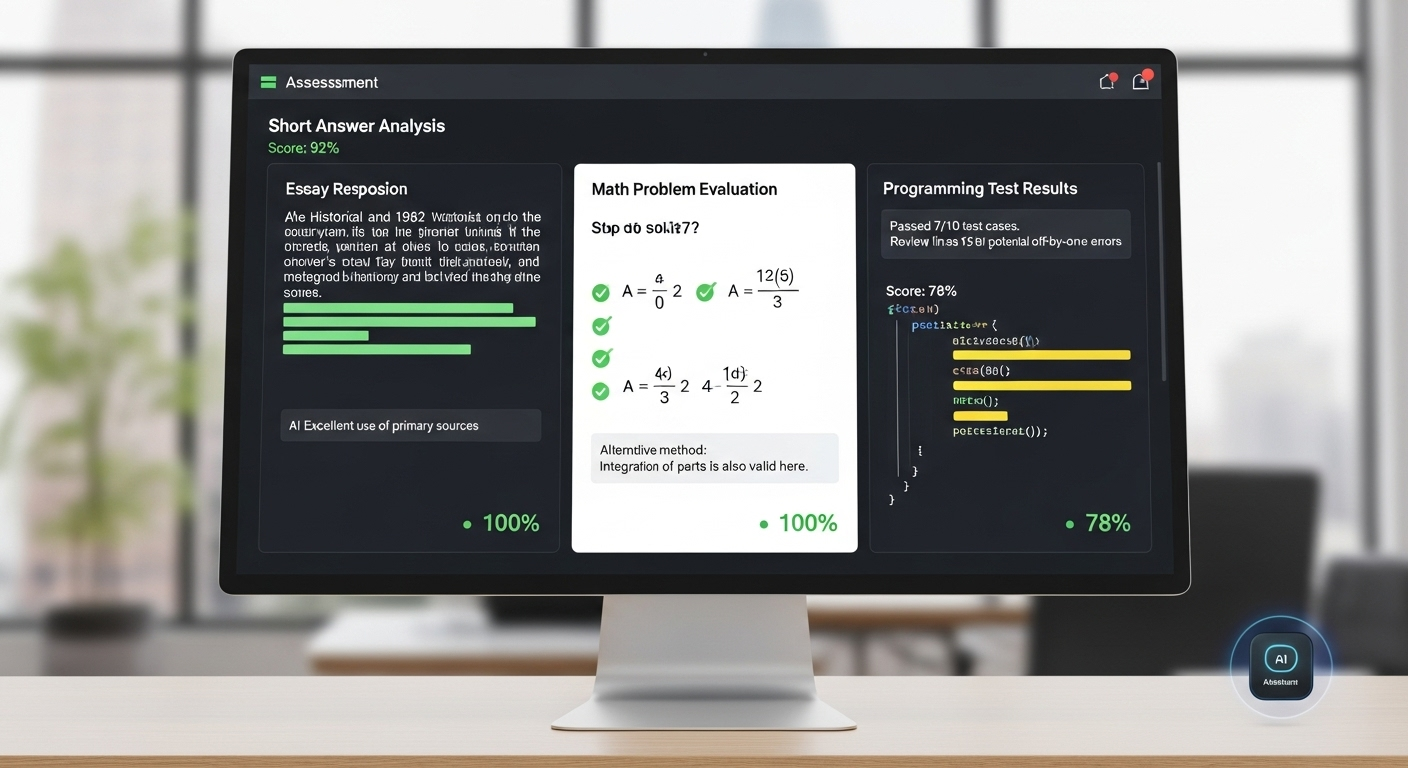
Digital assessment system accurately scoring short answers, math problems, and programming tests using artificial intelligence.

Accuracy improves as structure increases. That pattern shows up repeatedly in empirical work.

AI marking reaches its highest accuracy on assessments where expectations are clear and variation is limited. In some studies, agreement with human markers exceeds 90 percent for these task types.

As subjectivity rises, accuracy drops. Not because the system fails outright, but because interpretation becomes harder.

AI performs best on:

  • Tightly constrained short answers
  • Simple short answer marking with clear criteria
  • Numeric or algebraic results
  • Coding tasks and programming tests
  • Right-or-wrong questions

These formats limit ambiguity. The same answer should receive the same mark, and AI handles that consistency well.

Once creativity, voice, or novel reasoning enters the picture, accuracy depends increasingly on human judgment layered on top of the system’s suggestions.


Where AI Marking Becomes Unreliable or Risky

AI marking has edges. Clear ones. And pretending otherwise does more harm than good.

The biggest problems appear when responses stop following familiar paths. Creative writing, reflective essays, and open reasoning tasks push beyond patterns the system has seen before.

Current large language models are stochastic by design, which means their outputs are probabilistic, not fixed. The same prompt, with the same settings, can produce slightly different results at different times.

That variability is compounded by model updates. Monthly or even silent version changes can affect consistency, which becomes a real issue when assessments are compared across cohorts or semesters. What counted as a strong response last term may be interpreted differently now, even if the work is identical.

AI marking becomes risky when it encounters:

  • Open-ended creative responses with unconventional structure
  • Novel reasoning paths that do not match learned patterns
  • Model drift across versions, changing outputs over time
  • Non-deterministic behavior, even with the same prompt

These limits don’t make AI marking useless. They make boundaries essential.


Why Human Oversight Is Essential in AI Marking

Human and artificial intelligence collaborating in academic assessment, showing trust and accountability.

AI marking must never operate autonomously. Not in education. Not where outcomes carry real weight.

At its best, AI acts as an assistant or a second marker. It drafts, flags, and suggests. Humans decide. That division of labor is not optional.

It is required for fairness, accountability, and legal defensibility, especially in high-stakes assessments where marks influence progression, certification, or employment.

Human oversight ensures context is not lost. Effort is recognized. Unusual but valid reasoning is protected. Without that layer, AI marking risks becoming efficient but unjust.

In responsible systems:

  • Human markers retain authority over final outcomes
  • The AI sandwich approach (AI → human → AI) supports review and refinement
  • Serious consequences if misused are actively mitigated
  • Support, not replacement, remains the guiding principle

Accuracy in marking is inseparable from responsibility. Humans carry that responsibility.


How AI Marking Improves Feedback Quality (Not Just Speed)

Speed gets the headlines, but feedback quality is where AI marking quietly changes the game.

AI can draft feedback aligned directly to rubrics, linking comments to specific criteria instead of vague impressions. It can suggest alternative explanations when a student’s reasoning goes astray, helping them see not just that something is wrong, but why.

Across large cohorts, it maintains a consistent tone, avoiding the accidental harshness or inconsistency that creeps in when humans are exhausted.

Perhaps most importantly, AI provides instant feedback. Students don’t wait weeks. They respond while the work is still fresh in mind. When educators review and refine that feedback, quality improves rather than declines.

In practice, this looks like:

  • Draft feedback for review, not automatic release
  • Rubric-linked explanations that clarify expectations
  • Consistent tone across all submissions
  • Instant feedback that supports learning momentum

Used this way, AI marking supports a learning-focused approach. Not faster grading. Better guidance.


Is AI Marking Accurate Enough to Trust?

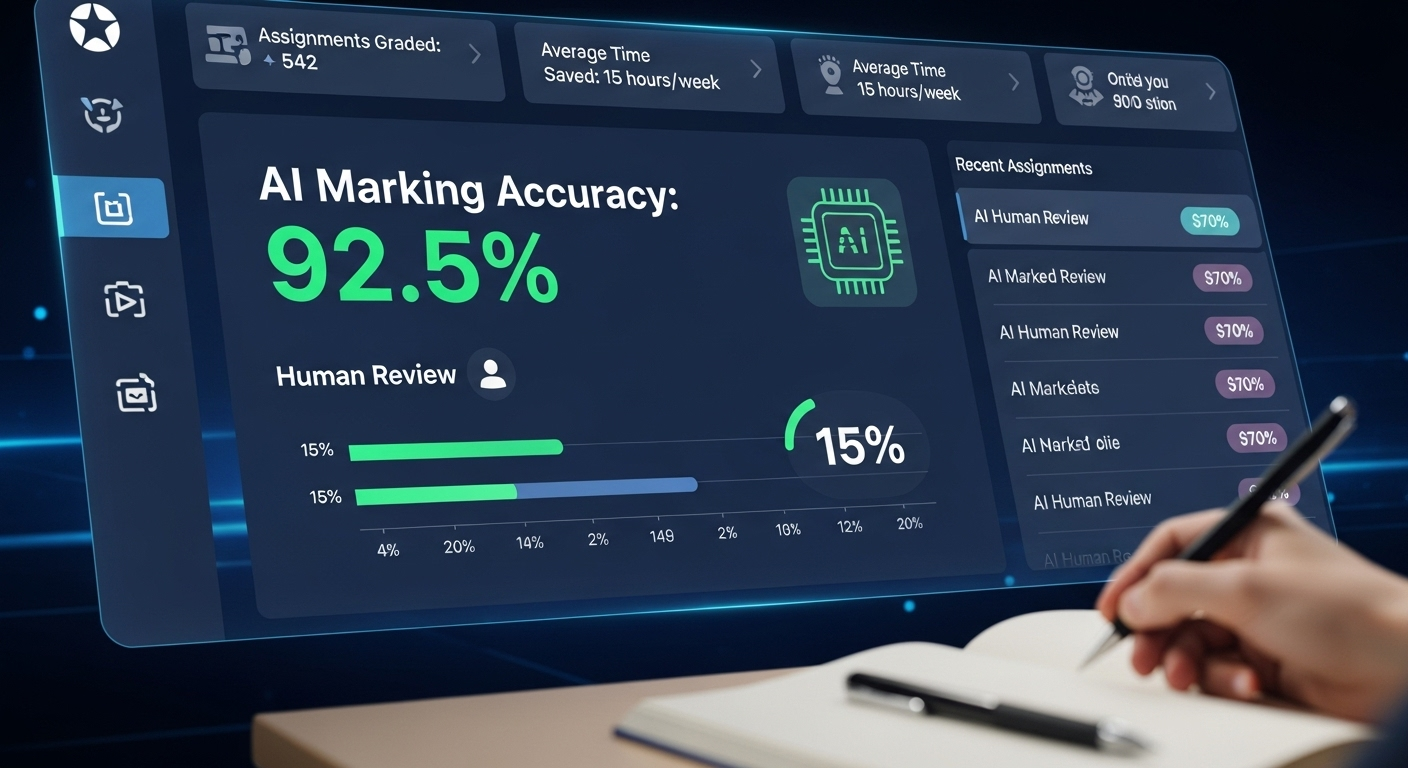
Modern classroom dashboard showing AI marking accuracy above 90 percent alongside human review.

Short answer. Yes, in the right places. Longer, more honest answer: accuracy depends on how and where you use it.

AI marking shows high accuracy when tasks are structured. Short answers. Coding problems. Clearly defined criteria. In these cases, studies repeatedly show the same finding: AI outputs align with human markers at very high rates, often above 90 percent. That’s not hype. That’s data.

But AI marking is probabilistic, not exact. It does not “know” in the human sense. It estimates. It predicts. Which means clarity matters. The clearer the rubric, the more accurate the marking. Vague criteria produce vague outcomes.

The realistic position is this: AI marking works best as an assistant. An accelerator. A consistency checker. Not a final judge. Used that way, it earns trust. Used alone, it overreaches.

Accuracy is real. Certainty is not. And that distinction matters.


Ethical and Practical Risks of AI Marking

Used well, AI marking improves feedback quality. Used carelessly, it introduces new risks that institutions cannot ignore.

The first issue is bias. Generative AI poses challenges when training data reflects historical inequities. Without careful oversight, those patterns can quietly shape outcomes. Then there’s privacy. Student work is sensitive data, and systems must comply with GDPR, FERPA, and local regulations. Anything less is unacceptable.

Over-automation is another risk. When educators defer too much to the system, human judgement weakens. Feedback becomes technically correct but educationally thin. Governance gaps widen. Confusion creeps in. Helping turns into maintaining the system rather than the learner.

Key risks include:

  • Bias and fairness issues rooted in training data
  • Data confidentiality and regulatory compliance failures
  • Over-reliance on automated decisions
  • Governance gaps that reduce accountability

AI marking demands restraint as much as adoption.


How AI Marking Fits Into Real Educational and Institutional Workflows

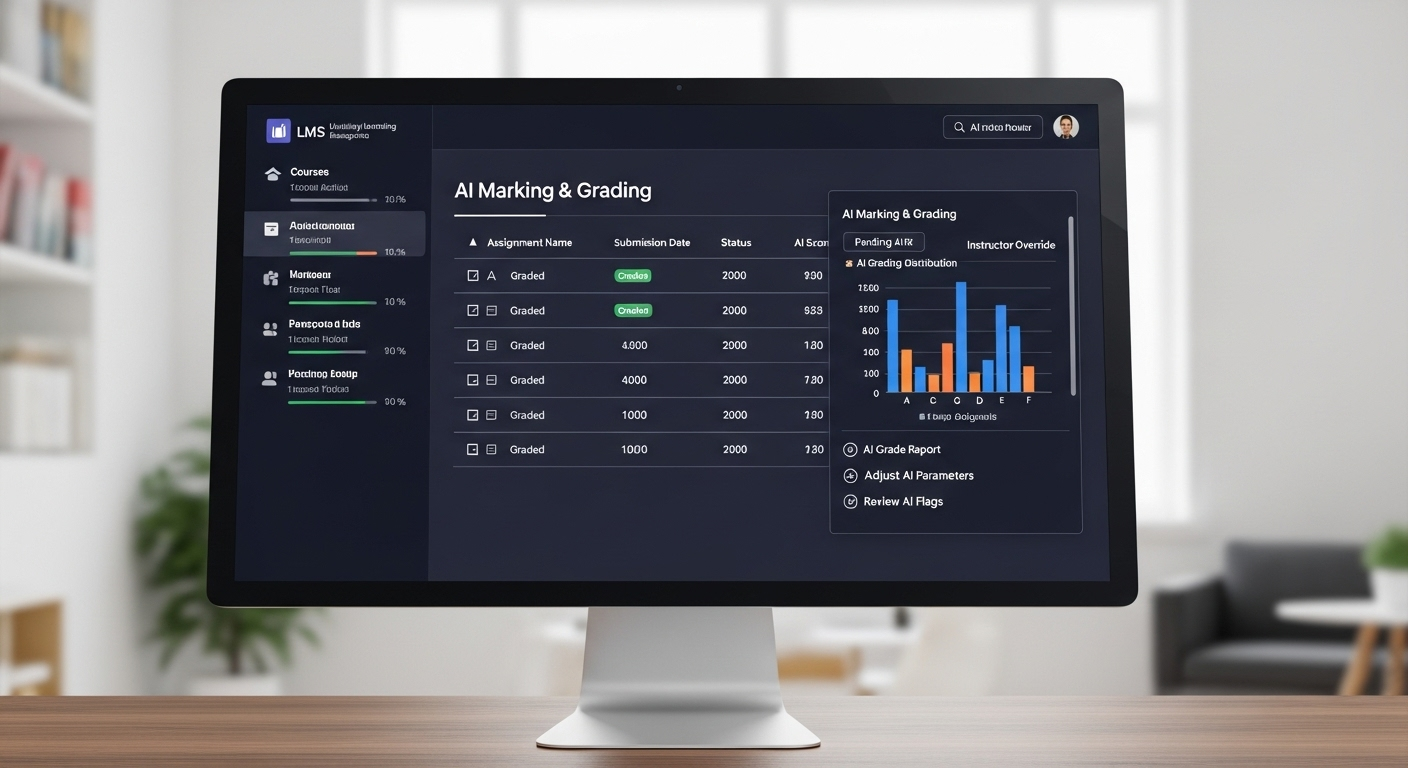
University Learning Management System dashboard with integrated AI marking and grading workflows.

AI marking doesn’t sit off to the side. It lives inside real systems, doing unglamorous but necessary work.

Most tools integrate directly into Learning Management Systems. That matters. It allows educators to apply the same model, the same criteria, across large cohorts without reinventing workflows. Supporting admin tasks becomes the quiet win. Sorting. Flagging. Drafting. Pattern detection across hundreds or thousands of submissions.

In universities, this scales marking during peak periods. In professional and workplace assessment, it enables consistent evaluation across regions and time zones. The goal is not novelty. It’s reliability.

Common uses include:

  • LMS integration for seamless workflows
  • Supporting admin tasks like triage and review
  • Same model applied consistently across cohorts
  • Scalable evaluation without losing oversight

Used this way, AI marking develops local patterns without dictating outcomes.


How AI PowerGrader Enables Responsible AI Marking

AI PowerGrader is designed around a simple principle: humans stay in charge.

It uses a rubric-first design, meaning marking criteria come from educators, not the model. AI assists by drafting feedback, identifying patterns, and surfacing inconsistencies. It does not assign final marks. Humans do that. Always.

The system operates with human-in-the-loop AI marking, ensuring every output can be reviewed, adjusted, or overridden. Pattern detection happens with oversight, not automation for its own sake. Governance is built in, not bolted on later.

Equally important, AI PowerGrader is institution-ready. It is designed with FERPA- and GDPR-conscious safeguards, recognizing that trust depends on privacy and accountability, not just performance.

This is AI marking that supports judgement instead of pretending to replace it. Quiet. Careful. And deliberate.


The Bottom Line

AI marking is not here to replace human markers. That’s the honest answer.

Empirical work is still evolving, and the evidence points in one direction: learning-focused feedback processes outperform blind automation every time. AI helps scale. Humans provide judgement. Together, they work. Separately, both fall short.

The future isn’t about choosing speed over fairness or efficiency over care. It’s about balance. Using AI to handle volume while protecting meaning. Letting systems suggest while people decide.

A realistic position matters here. AI marking is powerful. It is also limited. When those limits are respected, it becomes a tool worth trusting.


Frequently Asked Questions (FAQs)


1. Is AI marking the same as traditional automated marking?

No. Traditional systems follow fixed rules. AI marking uses machine learning to evaluate quality and meaning, especially in written responses, with human oversight required.

2. Can AI marking replace human markers?

No. AI marking supports human judgement by drafting feedback and flagging patterns, but final decisions must always remain with human markers.

3. How accurate is AI marking?

AI marking is highly accurate for structured tasks when clear rubrics are used, but it remains probabilistic and should not be treated as infallible.

4. Is AI marking fairer than human marking?

It can improve consistency, but fairness depends on training data, rubric quality, and strong human oversight to prevent bias.

5. Does AI marking work for creative assignments?

It struggles with highly creative or novel responses. Human review is essential for these tasks.

6. Is student data safe in AI marking systems?

Only if platforms are designed with strong governance and comply with regulations like GDPR and FERPA.

7. Should AI marking be used in high-stakes assessments?

Only as a support tool. High-stakes decisions require human judgement and accountability.

Can Teachers Detect AI Essays?

It didn’t start as a scandal. It started as a quiet shift. After 2023, generative AI stopped being a novelty and became background noise in student life. Tools that once felt experimental were suddenly everywhere. Unsurprisingly, student essays began to change too.

Smoother. Faster. Sometimes eerily consistent. That’s when the question surfaced, again and again: can teachers detect AI essays at all?

Many schools responded by updating syllabi, adding AI policy disclosures almost overnight. Not because they had clear answers, but because uncertainty itself became disruptive. Detection anxiety now affects both sides of the desk.

Students fear false accusations. Instructors worry about missing misuse. Meanwhile, academic integrity enforcement is quietly shifting. Less punishment. More verification. That shift matters, especially as false accusations move from edge cases to documented institutional risk.


Can Teachers Actually Tell If an Essay Was Written by AI?

The honest answer is less dramatic than most people expect.

Teachers rarely rely on intuition alone. The idea of a professor simply “knowing” an essay was written by AI makes for a good headline, but it’s not how real decisions are made.

Detection is comparative, not absolute. An essay is read in context. Against a student’s own writing history. Against drafts, in-class work, discussion posts, even the rhythm of how ideas usually unfold on the page.

Sudden stylistic jumps don’t trigger conclusions. They trigger review. Educators look for mismatches between process and product, not perfection itself.

They weigh multiple signals before escalating concerns, because most cases live in a gray zone. Suspicion, yes. Certainty, rarely. Human written text can be polished. AI-generated text can be edited. That overlap is exactly why most teachers proceed cautiously.


What Do AI Detection Tools Really Do (and What They Don’t)?

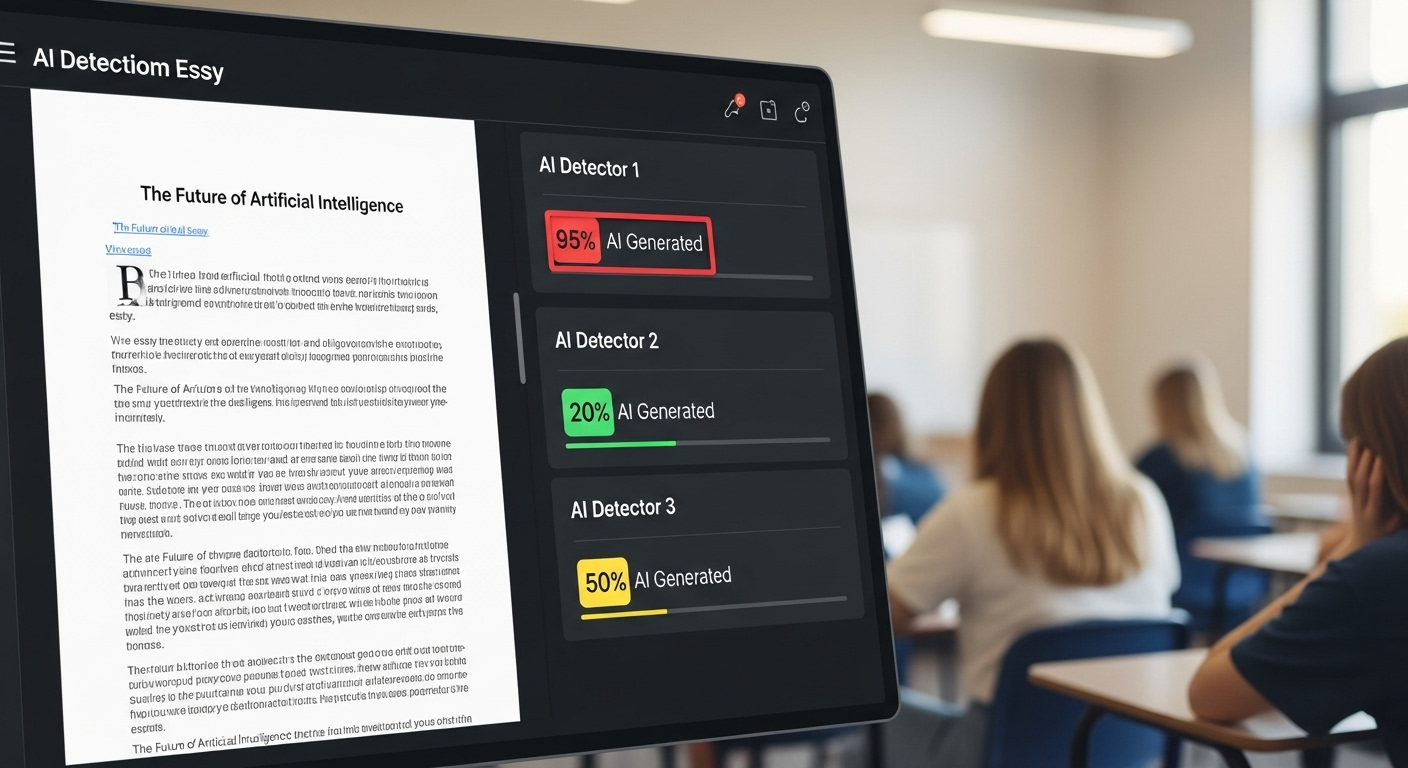
Digital dashboard displaying conflicting AI detection scores for the same student essay.

AI detection tools don’t identify authorship. They estimate likelihood.

Under the hood, detection software analyzes linguistic patterns, sentence structure, and probability distributions that resemble known AI-generated text.

The output is a score, not a verdict. One tool might flag an essay as “likely AI-generated” while another rates the same text as human-written. Conflicting results are common, not exceptional.

Accuracy drops sharply once a student edits, rewrites, or partially authors the text themselves. Hybrid writing breaks most detection systems.

Non-native English patterns further complicate things, and high-performing human writers are frequently misflagged, especially when their writing is clear, consistent, and grammatically tight.

What AI detection tools do:

  • Probability scoring, not proof
  • Pattern similarity analysis
  • Section-level flagging

What they do not do:

  • Confirm intent or authorship
  • Access writing process or drafts
  • Understand context or learning history

False positive rates are a known problem. That’s why most educators treat detection tools as signals, not evidence.


What Writing Signals Raise Red Flags for Teachers?

Sometimes it’s not what’s wrong with an essay. It’s what’s missing.

AI-generated content tends to arrive fully polished, almost suspiciously so. Perfect grammar. Clean transitions. No hesitation. Yet beneath that surface, teachers often notice a lack of developmental thinking. Ideas don’t wander. They don’t struggle. They don’t revise themselves mid-paragraph the way human thinking usually does during the writing process.

Another signal shows up in tone. Many AI essays sit in a neutral, academic middle ground. Safe. Careful. Bloodless. There’s little risk-taking, no sharp turns, no course-specific vocabulary that signals real engagement with lectures, discussions, or readings. The writing could belong to almost any class. Or any student.

Fabricated citations raise the loudest alarm. Generative AI models are known to hallucinate sources, quotes, or page numbers. When references don’t exist, concern shifts quickly from suspicion to verification.

Common red flags teachers watch for:

  • Uniform sentence structure repeated across paragraphs
  • Predictable transitions and formulaic phrasing
  • Vague evidence that sounds researched but isn’t
  • Absence of personal voice, reflection, or position

None of this proves AI use. But together, these patterns invite closer scrutiny.


Why AI Detection Software Alone Isn’t Reliable

Educator questioning AI detection results displayed on a digital dashboard.

Detection software feels authoritative. The dashboards. The percentages. The labels. But the science underneath is far less settled than the interface suggests.

Large language models are fundamentally non-deterministic. The same prompt can generate different outputs across sessions, versions, or even seconds apart.

As AI writing grows more human-like, detection accuracy declines rather than improves. Edited or partially written AI text further degrades reliability, producing wildly different results across tools.

False positives are not edge cases. High-performing students, English learners, and students with strong command of structure are disproportionately flagged.

That raises serious academic integrity and equity concerns. Institutions have learned, sometimes the hard way, that a false accusation carries reputational and legal risk.

Because of this, many universities explicitly prohibit detector-only decisions. AI detection systems are now treated as indicators, not evidence. A signal. Not a verdict.


How Teachers Actually Verify Authorship Today

Verification has quietly shifted from “gotcha” moments to pattern analysis over time.

Teachers compare drafts. They review version history and timestamps when platforms allow it.

They look at how ideas evolved across weeks, not just how they appear in the final submission. In-class writing samples serve as baselines, offering a snapshot of a student’s natural writing style under normal conditions.

Oral explanation has become especially valuable. Asking a student to explain their argument, sources, or reasoning often reveals whether the work reflects genuine understanding or surface-level assembly. Consistency matters more than polish.

Common authorship verification practices include:

  • Draft history and revision comparison
  • In-class writing baselines
  • Oral defenses or follow-up questions
  • Style continuity across assignments

This mosaic approach reduces false accusations while preserving academic integrity.


Why “Definitive Proof” of AI Use Is So Hard to Claim

Because the idea of a clean line no longer matches reality.

AI-generated text is probabilistic, not fixed. Large language models don’t produce identical outputs from the same prompt.

Students increasingly edit AI-generated drafts manually, blending their own writing with suggested phrasing. Hybrid authorship is now common, even when use policies are unclear.

Detection tools don’t see the writing process. They don’t know which sentences were drafted first, which were revised, or which reflect original thought. They analyze a final snapshot stripped of context.

That’s why definitive proof is rare. Most cases remain probabilistic, not conclusive. Responsible institutions acknowledge this uncertainty instead of pretending it doesn’t exist.

And honestly, that restraint may be the most human part of the system left.


The Real Risk: False Positives and Broken Trust

The sharpest danger isn’t that AI slips past detection. It’s that a student gets flagged when nothing dishonest actually happened.

False positives from AI detection systems are now well documented across education. A probability score gets misread as proof. A rushed decision turns into an accusation.

What follows is rarely clean. Appeals. Grievances. Meetings with administrators. Sometimes, formal academic misconduct proceedings that linger far longer than the original assignment ever should have.

The damage goes beyond paperwork. Trust erodes. Students become guarded. Teachers become wary. Classroom dynamics shift from collaboration to quiet suspicion, and that tension affects learning far more than any single essay ever could.

Worse still, disciplinary errors tend to land unevenly. English learners, first-generation students, and those with non-standard writing styles are disproportionately flagged by AI detection tools. That reality has pushed many institutions to step back.

Increasingly, schools are moving toward evidence-based review frameworks, where suspicion triggers verification, not punishment. The goal is clarity. And fairness. Not a win-loss outcome.


How Teachers Are Redesigning Assignments to Reduce AI Misuse

Teacher guiding students through multi-stage assignment drafts in a modern classroom.

Instead of chasing detection scores, many educators are changing the game entirely.

Assignment design has become the first line of defense. Process matters more than polish now. Teachers are breaking large submissions into visible stages, making the learning process harder to outsource and easier to understand.

Reflection has become central. When students explain how they arrived at an idea, not just what the idea is, misuse becomes both less tempting and easier to spot.

Personalization plays a role too. Prompts tied to class discussions, lived experience, or local context don’t translate cleanly through generic AI tools.

Common redesign strategies include:

  • Draft milestones submitted over time
  • Reflection logs explaining decisions and revisions
  • Oral explanations or in-class writing components
  • Personalized prompts tied to specific course moments

These approaches strengthen critical thinking while quietly reducing AI misuse. No detectors required.


Why Open Conversations About AI Matter More Than Detection

When expectations around AI use are vague, students guess. Some guess wrong. Clear guidelines, discussed openly, reduce misuse far more effectively than punitive enforcement ever has. Students are more likely to comply when they understand why boundaries exist, not just where they’re drawn.

Open conversations also support ethical AI literacy. Students learn when AI use is appropriate, when it crosses a line, and how to engage responsibly with powerful tools they’ll encounter long after graduation.

Punitive-only approaches tend to backfire. They increase adversarial behavior, encourage concealment, and damage trust. Dialogue does the opposite. It normalizes questions, encourages disclosure, and keeps the focus on learning rather than enforcement.

In classrooms where AI is discussed openly, misuse rates drop. That pattern is repeating itself across institutions.


Where TrustEd Fits Into This New Reality

Apporto's page for TrustEd highlighting academic integrity and AI-powered authenticity analytics.

This is precisely where TrustEd was designed to operate.

TrustEd doesn’t try to guess whether text is AI-generated. It doesn’t assign probability scores or pretend to offer certainty where none exists. Instead, it focuses on authorship verification—grounded in evidence, context, and human review.

By combining writing history, submission patterns, and instructor-led evaluation, TrustEd helps institutions verify originality without relying on fragile detection signals.

That approach dramatically reduces false positives and supports decisions that are defensible, fair, and aligned with academic integrity policies.

TrustEd reinforces:

  • Verification over detection
  • Human-led judgment over automation
  • Fairness-first workflows over punitive shortcuts
  • Trust preservation over suspicion


The Takeaway

AI detection tools are imperfect by design. They surface signals, not truths. Treating them as verdicts creates more harm than clarity.

Human judgment remains central. Verification beats accusation every time. And institutions that balance academic integrity with fairness are better positioned to navigate what comes next.

The future isn’t about catching students. It’s about protecting learning, trust, and credibility in environments where AI is simply part of the landscape now.

If your institution is ready to move beyond fragile detection and toward defensible authorship verification, explore how TrustEd helps reduce false accusations, strengthen academic integrity, and preserve trust where it matters most.


Frequently Asked Questions (FAQs)


1. Can AI detection tools definitively prove that an essay was written by AI?

No. AI detection tools provide probability-based indicators, not definitive proof. They analyze linguistic patterns but cannot confirm authorship or intent, which is why human review remains essential.

2. How common are false positives in AI essay detection?

False positives are increasingly documented, especially among high-performing writers and English learners. Many institutions now recognize that detection tools can mislabel authentic student work.

3. Why do detection tools struggle with hybrid or edited writing?

When students partially edit AI-generated text or blend it with their own writing, detection accuracy drops sharply. Hybrid authorship blurs the patterns detectors rely on.

4. Do universities rely solely on AI detection software to accuse students?

Most do not. Many institutions explicitly prohibit detector-only decisions due to legal, ethical, and equity concerns, requiring additional evidence and human evaluation.

5. How are schools responding to the limitations of AI detection?

Schools are shifting toward verification workflows that include draft review, writing history, oral explanations, and contextual evaluation instead of relying on detection scores alone.

6. Does focusing on trust actually reduce academic misconduct?

Yes. Research and institutional experience show that transparent policies, open dialogue, and verification-based approaches reduce appeals, conflict, and misuse more effectively than punitive detection.

How to Use AI Ethically as a Student Essay


AI didn’t knock before walking into academic life. One semester it was a novelty, the next it was everywhere. Brainstorming topics. Fixing grammar. Explaining dense concepts at 2 a.m. So it’s no surprise that students now feel caught in the middle, unsure where helpful ends and harmful begins. Generative artificial intelligence is evolving rapidly and changing the educational landscape, making it even harder for students and educators to keep up.

Most students aren’t looking for shortcuts or loopholes. They’re looking for clarity. What’s allowed. What’s risky. Ethics is now central to these discussions, as students and educators navigate the boundaries of responsible AI use in academic writing.

What crosses the line. Meanwhile, colleges are quietly shifting gears. Instead of outright bans on AI-generated content, many are moving toward regulating how AI is used, and why. That’s where the confusion deepens.

Is using AI to outline an essay the same as letting it write the essay? Is feedback assistance still your own work? These questions sit at the heart of modern academic integrity. Ethical AI use today isn’t just about following rules. It’s about learning assurance. Proving the thinking, the struggle, and the voice are genuinely yours.

Colleges are increasingly concerned about AI-generated essays and are developing methods to detect them.


Introduction to AI in Education

Artificial intelligence is rapidly reshaping the landscape of education, offering students and educators new ways to approach learning, research, and writing. AI tools are now a common part of the academic toolkit, assisting with everything from organizing research papers to providing instant feedback on college essays. In the high-stakes world of college admissions, these tools can help students navigate the complex application process and present their best selves through compelling writing.

However, the real value of AI in education comes from using these tools ethically. Teaching students how to use AI tools responsibly means encouraging them to maintain their own voice and original thinking throughout the writing process. Rather than replacing student effort, AI should serve as a support system—helping to clarify ideas, improve structure, and refine grammar, while leaving the core reasoning and creativity in the hands of the student.

By integrating AI tools thoughtfully, educators can foster critical thinking and writing skills that are essential for success in higher education. The goal is not just to produce polished assignments, but to help students learn, grow, and express their unique perspectives in every piece of writing. As AI becomes more embedded in the classroom, learning how to use these tools ethically is a crucial part of preparing for college, research, and beyond.


What Does “Using AI Ethically” Actually Mean for Students?

Student thoughtfully using AI as a writing assistant while actively drafting their own essay.

Ethical AI use isn’t a loophole. It’s more like a guardrail. The idea, plain and honest, is that AI should support your thinking, not sneak in and do the thinking for you—this is the core of AI ethics in academic work. When you use AI ethically, you stay in the driver’s seat. The wheel matters.

In practical terms, that means the final essay must still carry your intellectual fingerprints. Your reasoning. Your choices. Your missteps, even.

AI can help clarify a concept you’re stuck on, suggest ways to organize a messy draft, or point out where an argument loses steam. That’s assistance. Not replacement.

Think of AI as a patient tutor or a sharp-eyed editor, not a ghostwriter tapping away in the background. If the ideas, analysis, or conclusions didn’t come from your own thinking, then the work stops being yours. And that’s where academic writing breaks down.

Increasingly, institutions care less about polish and more about authorship. Do you understand what you submitted? Can you explain it, defend it, extend it? Ethical use lives in that space, where AI helps you learn without standing in for you.

Ethical AI use generally boils down to a few key principles.


How Colleges and Universities Define Ethical AI Use Today

Here’s where things get… uneven. As of now, roughly 43 percent of the top 100 universities now have explicit AI policies for applications, up from just 12% in 2023, and that number keeps climbing. Some are detailed.

Others are vague. A few still feel like placeholders written in a hurry. The common thread, though, is responsibility.

Many colleges now require students to disclose any AI assistance used in their applications, especially when AI tools contribute to idea development, research summaries, or structural feedback.

Silence can be risky. What’s allowed in a computer science course might be restricted in a philosophy seminar, and admissions essays often play by an entirely different rulebook than coursework.

Policies also vary by discipline, school, and university. In some fields, AI-assisted analysis is encouraged. In others, it’s tightly controlled or discouraged altogether. That inconsistency trips students up, understandably.

The burden, fair or not, sits with you. Students are expected to know their local policies, course guidelines, and honor codes. Ethical AI use in higher education isn’t one-size-fits-all.

It’s contextual. It shifts by institution, by department, by school, sometimes even by assignment. Staying informed is part of academic integrity now.


What AI Tools Are Generally Acceptable for Student Essays

College student organizing essay outline with AI-generated structural suggestions.

Used carefully, AI can be a decent study companion. Not a substitute. More like that friend who helps you talk through an idea when your brain’s stuck at mile two.

Most institutions that allow AI at all tend to agree on a narrow band of acceptable use, though policies still vary course by course.

At its safest, AI fits into the early and supportive stages of the writing process. You might lean on it to explore possible angles for a topic, untangle a dense concept from a lecture, or bring some order to a chaotic outline that’s gone off the rails.

Grammar checks. Light readability tweaks. Structural feedback. That sort of thing. What matters is authorship. The thinking stays yours. The arguments stay yours. The voice, especially, stays yours.

AI writing tools offer several aspects that support students, such as grammar correction, idea generation, outlining, and essay review. These aspects contribute to the overall writing process by helping students refine their drafts, organize their thoughts, and improve clarity while maintaining their own voice and originality.

Commonly accepted uses usually include:

  • AI as a brainstorming partner, helping surface ideas you then develop independently
  • AI for clarifying concepts, not supplying original analysis
  • AI for organizing structure, outlines, or flow
  • AI for grammar and punctuation checks, similar to traditional editing tools
  • AI feedback on clarity, without rewriting content

The line is fairly bright: no AI-written paragraphs submitted. No outsourcing of reasoning. AI can assist the writing process, but it doesn’t get to be the writer.


When Using AI Crosses the Line Into Academic Misconduct

The moment AI stops assisting and starts authoring, you’re on thin ice. Submitting AI-generated essays as your own work is widely classified as academic misconduct, even when the text doesn’t resemble any existing source.

Many colleges now treat this the same way they treat contract cheating: paying or delegating the work to someone else. Different tool. Same violation.

What trips students up is the assumption that plagiarism is about similarity. It isn’t. The core issue is misrepresentation.

If the ideas, structure, or language came from an AI system and you present them as your own intellectual labor, that’s a breach of academic integrity.

Undisclosed AI use often violates honor codes outright. Even institutions that allow limited AI assistance usually require transparency when the tool meaningfully shaped the work. Silence, in these cases, becomes part of the problem.

Responsible use comes down to ownership. Did you think through the argument? Could you explain every claim without leaning on the tool again? If the honest answer is no, the line has already been crossed.


Why Originality Isn’t the Same as Ethical Authorship

Academic scene showing human thinking contrasted with AI-generated language.

Here’s where a lot of smart students get tripped up. Something can be original and still not be ethically yours.

AI-generated text often passes originality checks because it isn’t copied line-for-line from an existing article or paper. No plagiarism match. Clean report. Looks fine. And yet… something’s off.

Authorship isn’t just about novelty. It’s about ownership. Ownership of reasoning. Of decisions. Of that slightly awkward but unmistakable voice that belongs to you.

Ethical academic writing assumes that the thinking happened in your head first, even if tools helped polish the edges afterward.

When AI produces language, structure, and logic on your behalf, the work may be technically original but ethically hollow. That gap—between originality and authorship—is why many educators now use the term “AI-giarism.”

Not because the words were stolen from another person, but because the thinking was outsourced.

Academic integrity lives in that space. If the argument isn’t yours to defend, question, or revise without assistance, then calling it your own crosses a line, even if the text has never existed anywhere else before.


How AI Can Accidentally Introduce Plagiarism or Errors

Even when students mean well, AI can quietly cause problems. Big ones. Large language models are trained on vast amounts of existing text, which means their outputs sometimes drift uncomfortably close to real sources—without clearly telling you where those ideas came from.

That’s where risk sneaks in. AI may paraphrase a published argument just enough to sound fresh while still echoing someone else’s work.

It can also invent citations that look scholarly but simply don’t exist. Confident tone. Wrong facts. Made-up references. It happens more than people think.

Common pitfalls include:

  • Near-paraphrase risk, where AI output mirrors existing sources too closely
  • Fabricated citations that can’t be traced to real articles or authors
  • Source ambiguity, making it unclear where an idea originated
  • Hallucinated statistics presented with unwarranted certainty

And here’s the part that matters most: accountability doesn’t shift. Even if AI produced the text, you are still responsible for accuracy, attribution, and integrity. Every claim needs checking. Every reference needs verification. Using AI doesn’t dilute responsibility; it concentrates it.


Best Practices for Using AI Ethically in Student Essays

Student saving multiple draft versions to document writing process and authorship.

Ethical AI use isn’t about fear or avoidance. It’s about discipline. Think of AI as scaffolding, not the building. Helpful while you’re constructing ideas, but removed before you submit the final structure.

A strong, ethical workflow usually starts the old-fashioned way: with your own draft. Even a messy one. Especially a messy one. That draft anchors your voice and thinking before any tool gets involved.

From there, AI can help refine clarity, suggest organizational tweaks, or flag confusing passages—nothing more.

Some practical guardrails that actually work:

  • Start with your own words, even if they’re rough
  • Use AI to refine, not to generate arguments or analysis
  • Fact-check everything, especially statistics and citations
  • Read your essay aloud to see if it still sounds like you
  • Save original drafts as proof of your writing process
  • Log meaningful AI prompts in case questions arise
  • Disclose AI use when policies require it

Used this way, AI supports learning instead of short-circuiting it. The goal isn’t perfection. It’s ownership. Your ideas, your reasoning, your voice—just a little clearer around the edges.


How Ethical AI Use Supports Learning (Instead of Undermining It)

Used well, AI doesn’t hollow out learning. It sharpens it. The difference comes down to how you engage. When AI is treated as something to question, challenge, and double-check, it can actually deepen critical thinking rather than replace it. You’re not outsourcing the work. You’re stress-testing your own ideas.

Ethical use keeps the intellectual struggle intact. That struggle matters. It’s where judgment forms, where weak assumptions get exposed, where confidence grows a little unevenly.

AI can clarify a concept or rephrase a confusing sentence, sure—but the deciding still belongs to you. Accept, reject, revise. Think.

More institutions are catching on. Instead of rewarding glossy prose alone, they’re increasingly assessing comprehension, reasoning, and process.

In other words, how you got there. AI literacy now means knowing when to pause, when to probe, and when to walk away from the tool entirely.

Dependency dulls learning. Disciplined use strengthens it. And that distinction—subtle but crucial—is becoming central to modern education.


What Students Should Never Use AI For

Some boundaries aren’t fuzzy. They’re firm. No gray area, no clever workaround.

  • Writing entire essays or research papers and submitting them as your own
  • Personal reflections or lived-experience narratives that only you can authentically tell
  • Proctored exams or quizzes, where independent recall is the point
  • Signature, thesis, or capstone assignments meant to demonstrate mastery

These are moments where authorship, not assistance, is the assessment. Using AI here doesn’t just bend rules—it breaks trust. And once that trust cracks, it’s hard to put back together.


How TrustEd Supports Ethical AI Use Without Punishing Students

Apporto's page for TrustEd highlighting academic integrity and AI-powered authenticity analytics.

Here’s the reality: ethical students still get flagged. Hybrid writing, grammar checks, light AI assistance—none of that automatically equals misconduct, but traditional detection tools can’t tell the difference. That’s where TrustEd takes a different path.

TrustEd is built around authorship verification, not AI guessing. Instead of relying on probability scores, it brings together writing history, process evidence, and structured human review.

Draft evolution. Consistency of voice. Clear trails of intellectual ownership. The kind of signals that actually reflect learning.

This approach helps students prove originality when AI is used responsibly. It also gives institutions defensible, fairness-first workflows that reduce false accusations and avoid unnecessary disciplinary disputes. No gotchas. No assumptions.

TrustEd preserves what matters most in AI-shaped classrooms: human-led judgment, transparent process, and trust—on both sides of the desk.


The Bottom Line

AI isn’t the villain here. Misuse is. The line that matters most isn’t whether a tool appeared somewhere in your process, but whether you owned the thinking, the reasoning, the final choices.

Ethical AI use supports learning when it sharpens your ideas instead of replacing them. Shortcuts hollow things out. Discipline builds them up.

Polish has never been the point, even if it sometimes felt that way. Transparency matters more. Authorship matters more. And accountability never goes away.

Every sentence you submit still carries your name, your judgment, your responsibility—no matter how many tools were open in other tabs.

If you’re navigating this new terrain and want clarity without fear, it helps to work with systems built for fairness, not suspicion.

Explore how TrustEd helps students and institutions verify authorship, reduce false accusations, and uphold academic integrity in AI-assisted education.

Frequently Asked Questions (FAQs)


1. Is using AI automatically cheating?

No. Using AI is not automatically cheating, and most institutions no longer frame it that way. The issue is how AI is used. When AI replaces your thinking or writes substantial portions of an essay you submit as your own, that’s typically considered misconduct.

2. Can I use AI for brainstorming but not writing?

In many courses and institutions, yes. Brainstorming topics, exploring angles, or clarifying confusing concepts is often considered acceptable AI use. These activities support your thinking rather than substituting for it.

3. Do I need to disclose AI use in essays?

Increasingly, yes. Many colleges and universities now require disclosure of non-trivial AI use, especially when it influences structure, content, or research direction.

4. What happens if AI makes factual errors?

You’re still responsible. AI tools can hallucinate facts, fabricate citations, or misstate research findings with alarming confidence. Submitting those errors doesn’t transfer accountability to the software.

5. How can students protect themselves from false accusations?

Process evidence matters. Save early drafts. Keep notes. Retain outlines. If you used AI, keep a simple log of prompts and how the output was used. These records show authorship, not just outcomes.

6. How do colleges evaluate ethical AI use today?

Colleges are moving away from detector-only judgments and toward holistic review. That includes voice consistency, alignment with coursework, writing process evidence, and sometimes follow-up conversations.

How to Stop Students From Using AI to Write Essays


It’s already in their pockets. On their browsers. Whispering suggestions at 2 a.m. Generative AI isn’t some future threat anymore; it’s woven into everyday student workflows, as ordinary as spellcheck once was. And that’s the rub.

As AI-generated content gets smoother, detection gets shakier. Educators feel cornered, nudged into playing hall monitor instead of mentor, scanning essays for tells rather than teaching ideas.

That shift feels wrong because it is. The heart of the problem isn’t cheating tools; it’s fragile learning.

Academic integrity was never meant to be a game of cat and mouse. The real challenge is protecting the learning process itself, making sure students still wrestle with ideas, make mistakes, and grow.

That’s why more institutions are quietly pivoting away from pure enforcement toward smarter design. Fewer bans. Better assignments. Less policing. More teaching.

It’s not about stopping technology. It’s about redesigning education so shortcuts stop working.


Why Students Turn to AI for Essay Writing in the First Place

Most students don’t wake up thinking, “Today I’ll undermine academic integrity.” It’s usually messier than that. Deadlines stack up fast. One paper bleeds into another. Time pressure squeezes, and suddenly an AI tool looks like a life raft, not a moral dilemma.

Confusion doesn’t help. Expectations around AI usage vary by class, by instructor, sometimes by mood. When rules feel fuzzy, students fill in the gaps themselves.

Add fear to the mix—fear of writing poorly, fear of failing, fear of sounding “not smart enough”—and essay writing becomes intimidating instead of instructive.

Then there’s the last-minute culture. Essays written at the eleventh hour invite shortcuts. The prevalence of students using AI tools to generate essays is now widespread, making it a common practice that poses significant challenges for assessment. And when students believe that “everyone else is using it,” resistance drops even further. Social norms matter. So does perception.

Understanding why students use AI to write essays doesn’t excuse misuse, but it does explain it. And without that understanding, any attempt to stop it is just guesswork dressed up as policy.


Why AI Detection Tools Alone Can’t Solve the Problem

Educator reviewing uncertain AI detection results with concern and hesitation.

There’s a quiet arms race happening in classrooms, and it’s not going well for anyone. As AI-generated text gets more fluent—more human—AI detection tools are left guessing. Literally.

Most detectors don’t deliver verdicts; they offer probabilities. Maybe AI. Possibly human. Shrug.

That uncertainty matters. False positives aren’t just awkward; they can trigger academic misconduct reviews, appeals, even legal headaches.

Trust erodes fast when a strong writer gets flagged for sounding “too good.” And students notice. They adapt. They edit. They hybridize. Detection models lag behind, always a step late.

Over-reliance on an AI checker also changes the classroom vibe. When tools replace conversations, relationships thin out. Teaching turns transactional.

What the tools can—and can’t—do:

  • Detection ≠ authorship verification
  • Edited or hybrid work often slips past detection tools
  • High-performing writers are frequently misflagged
  • Tools should inform review, not replace judgment

Used carefully, detectors can raise questions. Used alone, they create more problems than they solve.


The Shift That Actually Works: Designing Assignments AI Can’t Easily Do

You don’t “catch” your way out of AI misuse. You design your way out of it.

When assignments are generic, AI thrives. When they’re personal, process-heavy, and rooted in context, shortcuts collapse. The fix isn’t more surveillance; it’s smarter creating assignments that reward thinking over output.

Design choices matter. Essays that unfold over time—drafts, reflections, revisions—make it harder to outsource the work. Tasks tied to class discussions, local data, or lived experience don’t map cleanly onto a language model’s training set.

And when students must explain why they think something, not just what they think, AI loses its edge.

This approach doesn’t just prevent students from using AI improperly; it improves learning. Students engage more deeply with academic writing when the process counts.

They’re less tempted to paste and run when the assignment itself demands presence, judgment, and voice. In short, thoughtful design beats reactive policing every time.


Use Open-Ended Prompts That Require Thinking, Not Output

AI is excellent at producing answers. It’s far less convincing when asked to reason, judge, or reflect in context. That’s why open-ended questions work—they shift the goal from completion to cognition.

Instead of asking students to summarize, ask them to take a stand. Instead of listing facts, require interpretation. Ambiguity slows automation and invites critical thinking.

Prompts that resist AI shortcuts:

  • Questions with no single “correct” answer
  • Tasks requiring justification, not recap
  • Comparative or evaluative essays (why this matters more than that)
  • Ethical or reflective dimensions tied to personal or class experience

These prompts force students to wrestle with ideas. They have to explain their thinking, connect dots, make choices. AI can help brainstorm, sure, but it can’t replace the messy, human work of judgment. And that’s the point.


Anchor Assignments in Personal, Local, or Class-Specific Context

Students engaged in a lively classroom discussion that becomes the basis for a reflective writing assignment.

Here’s the thing AI still stumbles over. Life. Real life. The messy, hyper-specific stuff that happens in a classroom on a Tuesday afternoon when a debate goes sideways or a case study hits a nerve.

When assignments live there, shortcuts dry up fast.Anchoring essays in personal, local, or class-specific context nudges students back into their own heads.

They can’t just scrape a generic response when the prompt asks them to wrestle with something they actually experienced. Or something that happened last week.

That’s not about trickery. It’s about making students’ work matter.

Ways to ground essays in reality:

  • References to specific in-class discussions or debates
  • Analysis tied to local case studies or community issues
  • Reflection on personal learning moments that changed their thinking
  • Use of course-specific readings, not just broad themes
  • Commentary on current events that unfolded after the syllabus began

When prompts ask students to connect theory to real life, the writing process becomes harder to outsource—and much more interesting to read.


Make the Writing Process Visible (Not Just the Final Essay)

AI loves the midnight upload. One file. No trail. No fingerprints. That’s the sweet spot.

Process-based grading quietly flips the script. When you value how students arrive at ideas—not just where they land—authorship reveals itself without accusations or drama.

Students who’ve done the thinking can show it. Students who haven’t…well, the gaps show too.

Ways to surface the writing process naturally:

  • Brainstorming notes or mind maps
  • Outline submissions with evolving thesis statements
  • Draft checkpoints spaced over time
  • Google Docs revision history to show real development
  • Short reflection memos explaining choices and changes

This approach doesn’t punish students. It supports them. It also turns the final draft into a milestone, not a magic trick. And when the research process is visible, originality stops being a guessing game.


Bring Writing Back Into the Classroom

Sometimes the simplest fixes are hiding in plain sight.

When students write in class, the noise fades. No tabs. No tools. Just thinking, words, and time. It’s not nostalgic. It’s practical.

In-class writing creates an authentic baseline. It helps teachers recognize a student’s natural voice. It also lowers anxiety—students know there’s proof of their process baked in.

Low-lift ways to bring writing back:

  • Short in-class essays tied to readings
  • Timed analytic responses
  • Handwritten reflections or blue-book style prompts
  • Brief “first paragraph” exercises to launch longer papers

This isn’t about going backward. It’s about balance. Mixing in-class writing with take-home work keeps academic writing human—and keeps trust intact.


Use Oral Defenses and Mini-Viva’s to Verify Understanding

Teacher conducting a short oral defense with a student to discuss their essay.

There’s a moment—usually about thirty seconds in—when you know. The student starts explaining their thesis, maybe circles a point twice, hesitates, then lands it. Or they don’t. Either way, authorship becomes obvious fast.

Oral defenses and mini-viva’s aren’t about interrogation. They’re about conversation. A low-stakes, human check-in where students explain why they argued what they argued, not just what ended up on the page.

This works because AI can generate text, but it can’t own reasoning. Students who wrote their essays can talk through decisions, defend sources, and adapt on the fly. Those who didn’t? The gaps show—gently, but clearly.

Common, practical use cases:

  • Short follow-up questions after submission
  • Asking students to explain their thesis in plain language
  • Justifying a source choice or key example

These quick oral exams help ensure students actually understand their work and confirm that they are presenting their own work, not something generated by AI. They also dramatically reduce false accusations, because you’re verifying thinking, not guessing intent.

When students can articulate their own ideas, trust replaces suspicion—and that’s a win.


Break Big Essays Into Smaller, Graded Steps

The all-at-once essay is AI’s best friend. One upload. One grade. No story of how it came to be.

Breaking large assignments into smaller, graded steps quietly shuts that door. This approach can require students to participate in each stage of the writing process, making it much harder for them to rely on AI-generated content.

When students submit work incrementally, thinking becomes visible. Patterns emerge. Voice develops. And last-minute AI dumping—where students turn in a polished final essay with no trail—gets much harder to pull off.

Why this approach works:

  • It discourages procrastination
  • It rewards process over polish
  • It makes misuse stand out without confrontation

Effective checkpoints include:

  • Proposal or research question
  • Annotated bibliography
  • Draft sections submitted over time
  • Peer or instructor feedback cycles

By the time students are completing assignments, you’re not asking, “Was this written by AI?” You already know who did the thinking.

This design naturally helps prevent students from using shortcuts, because the work unfolds in plain sight.


Use Peer Review to Reinforce Original Thinking

Students exchanging peer feedback to strengthen arguments and voice.

Here’s a truth students don’t always expect: they can spot generic AI writing almost instantly. It feels flat. Vague. Weirdly polished and empty at the same time.

Peer review leverages that instinct.

When students read each other’s drafts, patterns jump out. Recycled phrasing. Safe, non-committal arguments. Writing that says everything and nothing.

That social awareness alone discourages shortcuts—nobody wants their written work to be the obvious outlier.

More importantly, peer review reinforces shared norms around good writing. Students see what originality looks like in practice, not just in rubrics.

Benefits you’ll notice quickly:

  • Stronger accountability among peers
  • Better engagement with the writing process
  • More willingness to revise and rethink

Done well, peer assessment doesn’t just catch problems. It encourages students to take ownership, develop voice, and treat writing as thinking—not output. And that shift does more to protect learning than any detector ever could.


Replace Some Essays With Alternative Formats

Sometimes the cleanest way to stop AI misuse isn’t tighter rules. It’s a different format altogether.

When assignments demand presence—a voice, a face, a moment in time—AI suddenly loses its edge. That’s why swapping a portion of traditional essays for alternative formats works so well. Not as a gimmick. As a design choice.

Think about it. A student explaining an argument aloud, or stitching together visuals with narration, is doing real cognitive work. You can hear uncertainty. Confidence. Growth. All the things AI-generated content flattens.

AI-resistant formats worth using:

  • Video essays tied to course concepts
  • Podcasts or recorded reflections
  • Short presentations with Q&A
  • Visual or creative projects that explain an idea

These formats:

  • Require voice and presence
  • Are hard to outsource to AI
  • Build real-world communication skills

They also reconnect learning to real life, which students tend to respect. When assignments feel authentic, shortcuts feel pointless.


Set Clear, Simple Rules About AI Use (Before Assignments Start)

Most misuse doesn’t start with bad intent. It starts with fuzzy boundaries.

If students don’t know what’s allowed, they’ll guess. And guessing—especially under pressure—rarely ends well. That’s why clarity upfront matters more than enforcement later.

Effective policies don’t read like legal contracts. They read like instructions from a good coach.

Spell out:

  • What AI use is allowed
  • What’s clearly not allowed
  • What requires disclosure

Tie consequences to process, not suspicion. Missed drafts. No documentation. Skipped checkpoints. Those are concrete signals, not vibes.

When teachers explain expectations plainly, students are more likely to comply—and less likely to panic about accidental violations.

Clear rules protect academic integrity without turning classrooms into surveillance zones. And yes, you’ll spend less time playing detective.


The Stoplight Model: A Practical Way to Govern AI Use

One of the simplest tools out there—and one of the most effective—is the Stoplight Model.

No jargon. No guessing. Just color-coded clarity.

How it works:

  • Green – AI use is allowed
  • Yellow – AI use is conditional and must be disclosed
  • Red – AI use is prohibited

Why this model sticks:

  • Clear boundaries students remember
  • Reduces confusion and “I didn’t know” defenses
  • Encourages ethical behavior instead of fear

You might mark brainstorming as green, grammar checks as yellow, and full content generation as red. Suddenly, expectations are visible.

Used consistently, the Stoplight Model helps guide students toward responsible choices. It doesn’t just help prevent AI misuse—it teaches judgment. And that’s the real goal.


Why Punishment-First Approaches Backfire

Teacher and students disengaged due to fear-based assessment environment.

Here’s the uncomfortable truth. The harder institutions clamp down, the sneakier behavior gets.

When policies lead with punishment, students don’t suddenly become more ethical. They become more strategic.

Arms-race behavior kicks in—better paraphrasing, hybrid drafts, last-minute edits designed to dodge detection rather than demonstrate learning. Nobody wins.

Trust erodes fast. Students start assuming instructors are looking for gotchas, not growth. In response, they stop asking questions, stop sharing drafts, stop taking intellectual risks. That’s a loss for education, full stop.

And then come the appeals. False positives. Lengthy disputes. Administrators buried in documentation, instructors second-guessing their own calls, students feeling branded for academic misconduct they didn’t intend. It’s exhausting. And avoidable.

Punishment-first models try to prevent students from using AI through fear. In practice, they often undermine the very learning environment they’re meant to protect. Focusing instead on engagement and thoughtful assignment design is a great idea compared to punitive measures.

Education works better when expectations are clear, processes are visible, and judgment stays human.


How TrustEd Helps Institutions Prevent AI Misuse Without Policing

TrustEd takes a very different tack. Less surveillance. More certainty.

Instead of guessing whether AI was used, TrustEd focuses on something far more defensible: authorship verification.

That means looking at writing history, drafts, revision patterns, and process evidence—how the work came to be, not just how it looks at the end.

This approach changes the dynamic entirely. Educators aren’t forced into detective mode. Students aren’t treated as suspects. Decisions rest on evidence that can be explained, defended, and reviewed calmly.

With TrustEd, institutions can:

  • Verify authorship using drafts and writing evolution
  • Reduce false accusations and unnecessary disputes
  • Support fair, consistent outcomes across courses
  • Preserve trust between students and educators

The philosophy is simple but powerful: verification over detection, learning-first integrity, and human-led judgment at every step.

If the goal is to protect education—not police it—TrustEd helps institutions get there without burning trust along the way.


Conclusion:

Here’s the quiet truth most classrooms are circling around, whether they admit it or not. You can’t really stop AI. Not anymore. The toothpaste is out of the tube.

What you can do is redesign learning so that AI misuse simply doesn’t pay off.

When assignments value process over polish, shortcuts lose their shine. When thinking is visible, authorship becomes obvious.

When trust replaces surveillance, students engage more honestly, and instructors spend less time playing hall monitor.

AI misuse isn’t a discipline problem. It’s a design problem. Better prompts beat better detectors every time. And learning, real learning, thrives when students are asked to show how they think, not just what they submit.

If you’re ready to move beyond policing and toward protection, explore how TrustEd helps institutions verify authorship, protect learning, and reduce AI misuse—without sacrificing trust.


Frequently Asked Questions (FAQs)


1. Can AI detection tools really stop students from using AI?

Short answer? Not reliably. AI detection tools can help educators identify AI content in student submissions, but their reliability is limited as AI-generated text improves.

2. Do in-class essays actually reduce AI misuse?

Yes, and not because they’re punitive. In-class writing removes access to AI tools and creates authentic baselines for a student’s voice and thinking.

3. How can teachers prevent AI use without over-policing students?

By shifting focus from enforcement to design. Clear AI-use guidelines, visible writing processes, draft checkpoints, and reflective components discourage misuse naturally.

4. What if students use AI ethically but still get flagged?

That’s a growing concern—and a serious one. Ethical students can still be flagged by detection tools, especially high-performing writers or non-native English speakers.

5. Are alternative assignments more effective than traditional essays?

Often, yes. Podcasts, video essays, presentations, and oral defenses require presence, reasoning, and voice—things AI can’t easily fake.

6. How do schools balance AI literacy with academic integrity?

By teaching students how to use AI responsibly, not pretending it doesn’t exist. Clear policies, transparent expectations, and process-based assessment allow institutions to promote AI literacy while still protecting original thinking, fairness, and trust. Integrity scales better when it’s designed, not enforced.