

Can Teachers Detect AI Essays?
Teachers can sometimes identify AI-generated essays by reviewing writing patterns, draft history, citations, and differences from a student’s usual work. However, AI detection tools only estimate probability and can produce false positives. Platforms like Apporto TrustEd support evidence-based authorship verification instead of relying solely on automated detection.
It didn’t start as a scandal. It started as a quiet shift. After 2023, generative AI stopped being a novelty and became background noise in student life. Tools that once felt experimental were suddenly everywhere. Unsurprisingly, student essays began to change too.
Smoother. Faster. Sometimes eerily consistent. That’s when the question surfaced, again and again: can teachers detect AI essays at all?
Many schools responded by updating syllabi, adding AI policy disclosures almost overnight. Not because they had clear answers, but because uncertainty itself became disruptive. Detection anxiety now affects both sides of the desk.
Students fear false accusations. Instructors worry about missing misuse. Meanwhile, academic integrity enforcement is quietly shifting. Less punishment. More verification. That shift matters, especially as false accusations move from edge cases to documented institutional risk.
Can Teachers Actually Tell If an Essay Was Written by AI?
The honest answer is less dramatic than most people expect.
Teachers rarely rely on intuition alone. The idea of a professor simply “knowing” an essay was written by AI makes for a good headline, but it’s not how real decisions are made.
Detection is comparative, not absolute. An essay is read in context. Against a student’s own writing history. Against drafts, in-class work, discussion posts, even the rhythm of how ideas usually unfold on the page.
Sudden stylistic jumps don’t trigger conclusions. They trigger review. Educators look for mismatches between process and product, not perfection itself.
They weigh multiple signals before escalating concerns, because most cases live in a gray zone. Suspicion, yes. Certainty, rarely. Human written text can be polished. AI-generated text can be edited. That overlap is exactly why most teachers proceed cautiously.
What Do AI Detection Tools Really Do (and What They Don’t)?
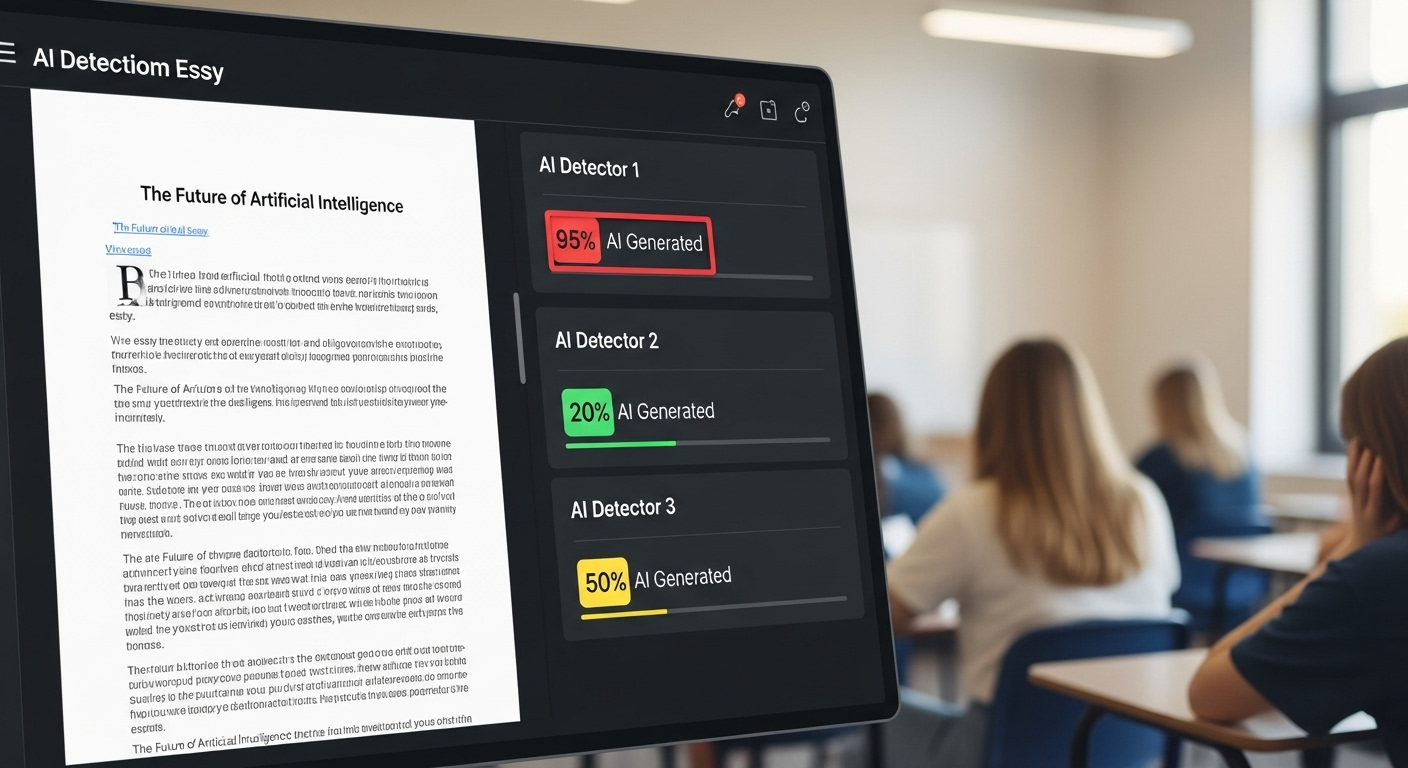
AI detection tools don’t identify authorship. They estimate likelihood.
Under the hood, detection software analyzes linguistic patterns, sentence structure, and probability distributions that resemble known AI-generated text.
The output is a score, not a verdict. One tool might flag an essay as “likely AI-generated” while another rates the same text as human-written. Conflicting results are common, not exceptional.
Accuracy drops sharply once a student edits, rewrites, or partially authors the text themselves. Hybrid writing breaks most detection systems.
Non-native English patterns further complicate things, and high-performing human writers are frequently misflagged, especially when their writing is clear, consistent, and grammatically tight.
What AI detection tools do:
- Probability scoring, not proof
- Pattern similarity analysis
- Section-level flagging
What they do not do:
- Confirm intent or authorship
- Access writing process or drafts
- Understand context or learning history
False positive rates are a known problem. That’s why most educators treat detection tools as signals, not evidence.
What Writing Signals Raise Red Flags for Teachers?
Sometimes it’s not what’s wrong with an essay. It’s what’s missing.
AI-generated content tends to arrive fully polished, almost suspiciously so. Perfect grammar. Clean transitions. No hesitation. Yet beneath that surface, teachers often notice a lack of developmental thinking. Ideas don’t wander. They don’t struggle. They don’t revise themselves mid-paragraph the way human thinking usually does during the writing process.
Another signal shows up in tone. Many AI essays sit in a neutral, academic middle ground. Safe. Careful. Bloodless. There’s little risk-taking, no sharp turns, no course-specific vocabulary that signals real engagement with lectures, discussions, or readings. The writing could belong to almost any class. Or any student.
Fabricated citations raise the loudest alarm. Generative AI models are known to hallucinate sources, quotes, or page numbers. When references don’t exist, concern shifts quickly from suspicion to verification.
Common red flags teachers watch for:
- Uniform sentence structure repeated across paragraphs
- Predictable transitions and formulaic phrasing
- Vague evidence that sounds researched but isn’t
- Absence of personal voice, reflection, or position
None of this proves AI use. But together, these patterns invite closer scrutiny.
Why AI Detection Software Alone Isn’t Reliable

Detection software feels authoritative. The dashboards. The percentages. The labels. But the science underneath is far less settled than the interface suggests.
Large language models are fundamentally non-deterministic. The same prompt can generate different outputs across sessions, versions, or even seconds apart.
As AI writing grows more human-like, detection accuracy declines rather than improves. Edited or partially written AI text further degrades reliability, producing wildly different results across tools.
False positives are not edge cases. High-performing students, English learners, and students with strong command of structure are disproportionately flagged.
That raises serious academic integrity and equity concerns. Institutions have learned, sometimes the hard way, that a false accusation carries reputational and legal risk.
Because of this, many universities explicitly prohibit detector-only decisions. AI detection systems are now treated as indicators, not evidence. A signal. Not a verdict.
How Teachers Actually Verify Authorship Today
Verification has quietly shifted from “gotcha” moments to pattern analysis over time.
Teachers compare drafts. They review version history and timestamps when platforms allow it.
They look at how ideas evolved across weeks, not just how they appear in the final submission. In-class writing samples serve as baselines, offering a snapshot of a student’s natural writing style under normal conditions.
Oral explanation has become especially valuable. Asking a student to explain their argument, sources, or reasoning often reveals whether the work reflects genuine understanding or surface-level assembly. Consistency matters more than polish.
Common authorship verification practices include:
- Draft history and revision comparison
- In-class writing baselines
- Oral defenses or follow-up questions
- Style continuity across assignments
This mosaic approach reduces false accusations while preserving academic integrity.
Why “Definitive Proof” of AI Use Is So Hard to Claim
Because the idea of a clean line no longer matches reality.
AI-generated text is probabilistic, not fixed. Large language models don’t produce identical outputs from the same prompt.
Students increasingly edit AI-generated drafts manually, blending their own writing with suggested phrasing. Hybrid authorship is now common, even when use policies are unclear.
Detection tools don’t see the writing process. They don’t know which sentences were drafted first, which were revised, or which reflect original thought. They analyze a final snapshot stripped of context.
That’s why definitive proof is rare. Most cases remain probabilistic, not conclusive. Responsible institutions acknowledge this uncertainty instead of pretending it doesn’t exist.
And honestly, that restraint may be the most human part of the system left.
The Real Risk: False Positives and Broken Trust
The sharpest danger isn’t that AI slips past detection. It’s that a student gets flagged when nothing dishonest actually happened.
False positives from AI detection systems are now well documented across education. A probability score gets misread as proof. A rushed decision turns into an accusation.
What follows is rarely clean. Appeals. Grievances. Meetings with administrators. Sometimes, formal academic misconduct proceedings that linger far longer than the original assignment ever should have.
The damage goes beyond paperwork. Trust erodes. Students become guarded. Teachers become wary. Classroom dynamics shift from collaboration to quiet suspicion, and that tension affects learning far more than any single essay ever could.
Worse still, disciplinary errors tend to land unevenly. English learners, first-generation students, and those with non-standard writing styles are disproportionately flagged by AI detection tools. That reality has pushed many institutions to step back.
Increasingly, schools are moving toward evidence-based review frameworks, where suspicion triggers verification, not punishment. The goal is clarity. And fairness. Not a win-loss outcome.
How Teachers Are Redesigning Assignments to Reduce AI Misuse

Instead of chasing detection scores, many educators are changing the game entirely.
Assignment design has become the first line of defense. Process matters more than polish now. Teachers are breaking large submissions into visible stages, making the learning process harder to outsource and easier to understand.
Reflection has become central. When students explain how they arrived at an idea, not just what the idea is, misuse becomes both less tempting and easier to spot.
Personalization plays a role too. Prompts tied to class discussions, lived experience, or local context don’t translate cleanly through generic AI tools.
Common redesign strategies include:
- Draft milestones submitted over time
- Reflection logs explaining decisions and revisions
- Oral explanations or in-class writing components
- Personalized prompts tied to specific course moments
These approaches strengthen critical thinking while quietly reducing AI misuse. No detectors required.
Why Open Conversations About AI Matter More Than Detection
When expectations around AI use are vague, students guess. Some guess wrong. Clear guidelines, discussed openly, reduce misuse far more effectively than punitive enforcement ever has. Students are more likely to comply when they understand why boundaries exist, not just where they’re drawn.
Open conversations also support ethical AI literacy. Students learn when AI use is appropriate, when it crosses a line, and how to engage responsibly with powerful tools they’ll encounter long after graduation.
Punitive-only approaches tend to backfire. They increase adversarial behavior, encourage concealment, and damage trust. Dialogue does the opposite. It normalizes questions, encourages disclosure, and keeps the focus on learning rather than enforcement.
In classrooms where AI is discussed openly, misuse rates drop. That pattern is repeating itself across institutions.
Where TrustEd Fits Into This New Reality
This is precisely where TrustEd was designed to operate.
TrustEd doesn’t try to guess whether text is AI-generated. It doesn’t assign probability scores or pretend to offer certainty where none exists. Instead, it focuses on authorship verification—grounded in evidence, context, and human review.
By combining writing history, submission patterns, and instructor-led evaluation, TrustEd helps institutions verify originality without relying on fragile detection signals.
That approach dramatically reduces false positives and supports decisions that are defensible, fair, and aligned with academic integrity policies.
TrustEd reinforces:
- Verification over detection
- Human-led judgment over automation
- Fairness-first workflows over punitive shortcuts
- Trust preservation over suspicion
The Takeaway
AI detection tools are imperfect by design. They surface signals, not truths. Treating them as verdicts creates more harm than clarity.
Human judgment remains central. Verification beats accusation every time. And institutions that balance academic integrity with fairness are better positioned to navigate what comes next.
The future isn’t about catching students. It’s about protecting learning, trust, and credibility in environments where AI is simply part of the landscape now.
If your institution is ready to move beyond fragile detection and toward defensible authorship verification, explore how TrustEd helps reduce false accusations, strengthen academic integrity, and preserve trust where it matters most.
Frequently Asked Questions (FAQs)
1. Can AI detection tools definitively prove that an essay was written by AI?
No. AI detection tools provide probability-based estimates rather than definitive proof of authorship. They analyze writing patterns and linguistic signals, but human review, writing history, and contextual evaluation are still necessary for reliable academic integrity decisions.
2. How common are false positives in AI essay detection?
False positives are increasingly common in AI essay detection, especially among high-performing writers and non-native English speakers. Because AI detectors rely on pattern recognition instead of confirmed authorship, authentic student writing can sometimes be incorrectly flagged as AI-generated
3. Why do detection tools struggle with hybrid or edited writing?
AI detection tools struggle with hybrid writing because students often revise, edit, or combine AI-generated text with their own work. These mixed writing patterns reduce detection accuracy and make it difficult for systems to distinguish between assisted writing and authentic authorship.
4. Can university prove you used AI?
Universities rarely rely on AI detection scores alone to prove AI use. Most institutions combine writing analysis, draft history, in-class work, citation checks, and instructor review to evaluate whether submitted work reflects authentic student authorship.
5. How are schools responding to the limitations of AI detection?
6. Why is my writing detected as AI?
Writing may be flagged as AI-generated because of highly consistent grammar, predictable sentence structure, repetitive phrasing, or formal academic tone. High-performing writers and non-native English speakers are also more likely to experience false positives from AI detection tools.
