

What’s the Difference Between Zero Trust & Least Privilege?
Zero Trust continuously verifies every user, device, and access request before granting access, while least privilege limits users to only the permissions needed for their role. Organizations often combine both models to strengthen security, and platforms like Apporto support these strategies through secure browser-based remote access and centralized access management.
Security once relied on a simple assumption. If someone was inside the company network, they were trusted. That assumption no longer holds. Today’s organizations operate across cloud platforms, remote environments, and distributed teams, which means the traditional perimeter around network security has largely disappeared.
At the same time, cyber threats continue to grow in both scale and sophistication. Data breaches, credential theft, and insider threats have become common concerns for security teams responsible for protecting sensitive data. Every user account, device, and access request represents a potential entry point if controls are not carefully managed.
This growing complexity forces organizations to rethink how user access is granted and monitored. Strong access management has become essential to maintaining a reliable security model.
That is where two widely discussed approaches enter the conversation: zero trust vs least privilege.
In this blog, you will explore what these security models mean, how they differ, and why combining them is becoming essential for protecting modern systems and sensitive data.
What Is the Principle of Least Privilege and Why Does It Matter?
The principle of least privilege is one of the most practical ideas in modern access management. At its core, the concept is simple. Every user receives only the minimum permissions required to perform their job. Nothing more. Nothing unnecessary.
This approach follows a clear “need-to-know” mindset. If someone does not require access to a system, application, or dataset to complete their work, that access should not exist. Limiting permissions in this way helps organizations reduce exposure to security risks and protects sensitive systems from unnecessary interaction.
Least privilege access also helps prevent a common problem known as privilege creep, where user accounts slowly accumulate more permissions than needed over time. Without proper controls, these excessive privileges can create opportunities for security breaches or misuse.
How the Least Privilege Principle Controls User Access?
The principle of least privilege strengthens security through several practical safeguards:
- Users receive minimum access rights required for their role.
- It helps prevent privilege escalation attacks that attempt to gain higher permissions.
- Limiting access reduces the risk of insider threats.
- Fewer permissions mean a smaller attack surface for cyber threats.
- Sensitive systems and data remain protected from unnecessary access.
Least privilege is commonly enforced using role based access control (RBAC), attribute based access control (ABAC), and just-in-time access, which temporarily grants privileges only when required.
What Is Zero Trust Security and How Does It Work?
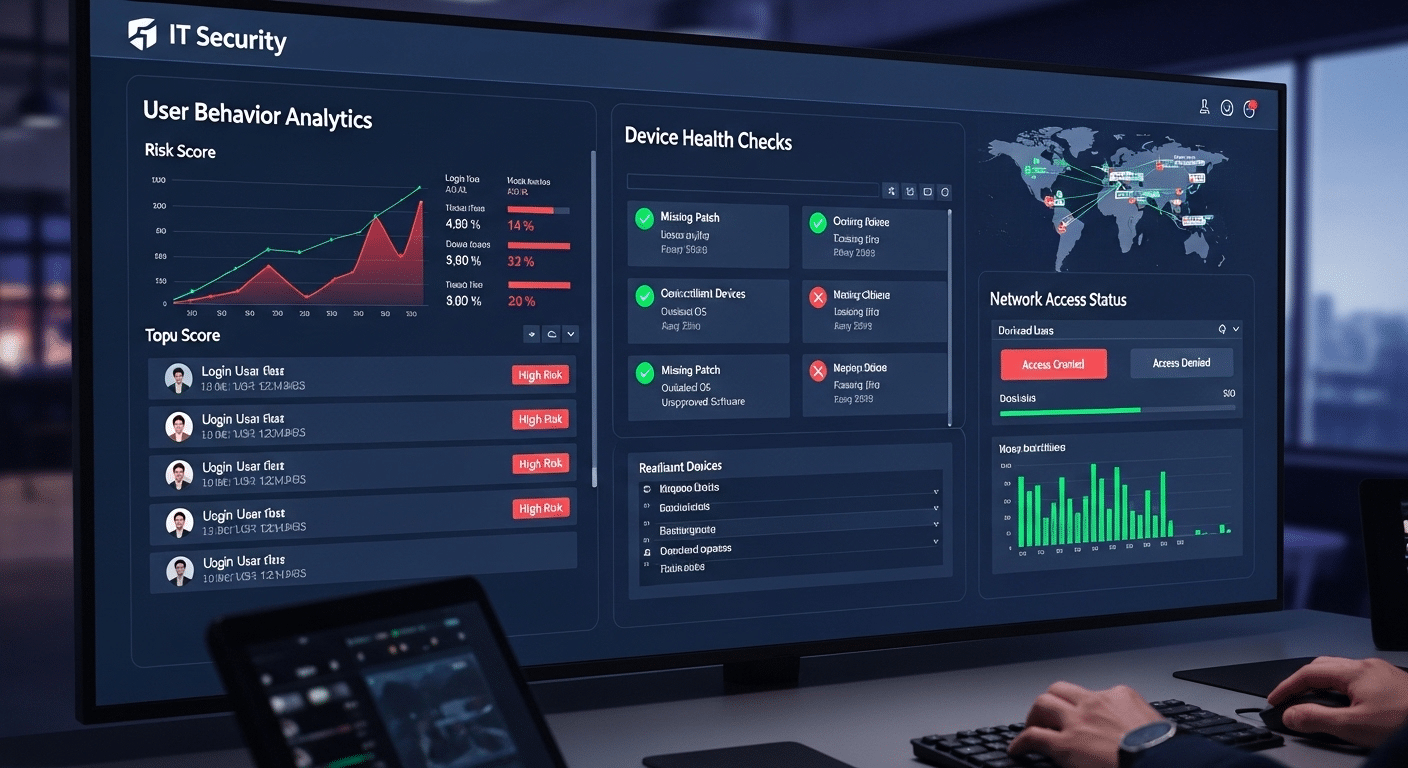
If the principle of least privilege focuses on how much access a user should have, zero trust security asks a different question “should access be granted at all?”. This is where the modern idea of Zero Trust begins.
Zero trust security is built on a simple but powerful principle, “never trust, always verify.” Instead of assuming that users inside a network are safe, this security model treats every access request as potentially risky. Whether a user is inside the office or working remotely, the system verifies identity, device health, and context before granting access.
A zero trust architecture relies on several layers of verification. Identity checks confirm who the user is. Device health validation ensures the device connecting to the system is secure and up to date. Multi-factor authentication adds another level of protection by requiring more than just a password. At the same time, continuous verification monitors user behavior even after login.
Core Components of a Zero Trust Architecture
Zero trust security relies on several core controls working together:
- Identity verification before granting network access
- Multi-factor authentication (MFA) for privileged accounts
- Continuous monitoring of user behavior and access events
- Network segmentation to limit lateral movement
- Device health validation before granting access
Together, these controls support zero trust network access (ZTNA), which replaces traditional perimeter-based trust security by verifying every connection, every time.
What’s the Difference Between Zero Trust & Least Privilege?
At first glance, zero trust vs least privilege can seem like competing security ideas. In reality, they solve different parts of the same problem. Both aim to control access and reduce risk, but they operate at different levels within a security model.
Zero Trust focuses primarily on authentication and verification. Every time a user, device, or application tries to connect to a system, the request must be verified. Identity, device health, and context are evaluated before any access is granted. Trust is never assumed, even for users already inside the network.
Least Privilege, on the other hand, focuses on authorization and permissions. Once a user has been verified, the system determines what that user is allowed to do. Access rights are restricted so users receive only the minimum permissions necessary to perform their tasks.
Zero Trust vs Least Privilege
| Security Aspect | Zero Trust | Least Privilege |
|---|---|---|
| Core goal | Continuous verification | Limit permissions |
| Security level | Organization-wide architecture | Permission management |
| Focus | Identity and device trust | User access rights |
| Access approach | Verify every access request | Grant only minimal permissions |
| Security impact | Prevent unauthorized entry | Limit damage after entry |
How Do Zero Trust and Least Privilege Work Together?

It is easy to assume that zero trust and least privilege represent competing approaches to security. In practice, they are designed to complement each other. Each addresses a different stage of the access process, and together they create a stronger defense against modern cyber threats.
Zero Trust focuses on verifying access before it happens. Every request is evaluated using identity checks, device validation, and behavioral signals. This step determines whether a user or device should be allowed to enter the system at all.
Least Privilege takes over after that verification step. Once access is approved, permissions are carefully restricted so the user can only interact with the systems and data required for their role. Even trusted users operate within clearly defined limits.
Why Security Teams Combine Both Models?
Security teams often integrate trust and least privilege controls to strengthen access control mechanisms across their environment:
- Zero Trust verifies user identity and device health before granting entry.
- Least Privilege ensures minimum permissions after verification.
- Combined controls help reduce the overall attack surface.
- These protections help prevent lateral movement across systems.
- Limited permissions help contain damage if an account becomes compromised.
Together, these strategies form a robust security framework, ensuring that access is both carefully verified and tightly controlled across modern infrastructure.
Why Traditional Network Security Models Are No Longer Enough?
For many years, network security relied on a simple perimeter model. If a user or device connected from inside the company network, it was generally trusted. Firewalls and internal controls protected the outer boundary, while everything inside the network operated under assumed trust.
That model worked when systems were centralized and employees worked from a single office environment. Today, the structure of technology has changed. Cloud environments host critical applications. Teams operate from different locations.
Organizations manage hybrid infrastructure that connects on-premise systems with cloud platforms and distributed applications. In this environment, relying on network location as a sign of trust is no longer reliable.
Remote access has become routine for employees, partners, and contractors. At the same time, cyber threats have evolved. Credential theft allows attackers to appear as legitimate users. Insider threats may originate from accounts that already exist inside the network. When access depends on location rather than verification, these risks grow quickly.
Modern security strategies now focus on identity, context, and continuous monitoring. Instead of assuming trust network access, organizations increasingly require secure remote access systems that verify every connection and access request.
When Should Organizations Start with Least Privilege First?

For many organizations, the least privilege principle is often the most practical place to begin strengthening security. Unlike large architectural changes, implementing least privilege access does not always require major infrastructure updates. In many cases, the process starts with something much simpler, reviewing who has access to what.
Security teams typically begin with a detailed access audit. This audit examines existing user accounts, permissions, and roles across systems. It often reveals that many users have more access than they actually need. Reducing those permissions to minimum access levels can immediately lower risk without disrupting daily operations.
Another advantage is that least privilege can often be introduced through updated policies and permission management rather than new hardware. Because of this, organizations can see meaningful improvements in their security posture fairly quickly.
Why Least Privilege Is Often the First Security Step?
Implementing least privilege delivers several early benefits:
- Identifies excessive permissions and dormant accounts during access audits.
- Reduces the likelihood of insider threats.
- Helps limit privilege escalation attacks.
- Strengthens the organization’s overall security posture.
By restricting permissions first, organizations create a strong foundation that later supports a broader Zero Trust architecture.
When Should Organizations Implement Zero Trust First?
While many organizations begin their security journey with the least privilege principle, there are situations where Zero Trust architecture must be prioritized from the start. Some environments face higher levels of risk, stricter regulatory requirements, or more complex infrastructure, making traditional security controls insufficient.
Organizations that manage large volumes of sensitive data often fall into this category. Financial institutions, healthcare providers, and government agencies must protect highly valuable information from both external cyber threats and internal misuse. In these environments, relying on partial access controls may not provide enough protection.
Highly regulated industries also benefit from implementing Zero Trust early. Compliance standards frequently require strict monitoring, identity verification, and strong access controls across all systems. A comprehensive security framework built around Zero Trust can help meet these requirements while improving visibility across the organization.
Large distributed networks present another challenge. Companies with global teams, remote workers, cloud services, and hybrid infrastructure cannot rely on a single network boundary. Instead, continuous monitoring, identity verification, and layered security controls become essential to managing access safely across complex environments.
Practical Steps to Implement Zero Trust and Least Privilege

Understanding the concepts behind Zero Trust and the principle of least privilege is only the first step. The real value appears when organizations translate these ideas into practical security controls. While a full Zero Trust architecture may take time to implement, many foundational improvements can begin immediately.
A good starting point is visibility. Security teams need a clear view of who has access to which systems, applications, and data. Without that visibility, it becomes difficult to enforce proper access controls or identify unnecessary permissions.
Once access is mapped, organizations can gradually tighten permissions, strengthen identity verification, and monitor how users interact with critical systems.
These changes do not require a complete overhaul on day one. Instead, they often begin with small but meaningful adjustments to security policies, identity controls, and monitoring practices.
Steps Security Teams Can Take Today
Organizations can begin strengthening access control by taking several practical steps:
- Conduct a full audit of user access and permissions across systems and applications.
- Remove unnecessary access rights that exceed a user’s role or responsibilities.
- Implement multi-factor authentication to protect high-value accounts and systems.
- Introduce just-in-time access so privileged permissions are granted only when needed.
- Monitor user behavior and access events across critical systems.
Through continuous monitoring, security teams can detect unusual access requests, track how users interact with resources, and quickly respond to suspicious activity before it escalates into a security incident.
How Modern Platforms Help Enforce Zero Trust Access?

Implementing strong access control strategies such as Zero Trust architecture and the principle of least privilege often requires the right technology foundation. As organizations adopt cloud platforms, hybrid infrastructure, and remote work environments, traditional network tools can struggle to keep up. This is where modern secure access platforms play an important role.
These platforms help enforce identity verification before granting access to systems and applications. Instead of relying on network location, access decisions are based on who the user is, the device being used, and the context of the access request. This approach aligns closely with the principles of Zero Trust, where every connection must be verified before access is granted.
Modern platforms also simplify access management across distributed systems. Administrators can manage permissions, enforce security policies, and monitor access events through centralized controls. This helps organizations maintain a consistent security framework even as their infrastructure grows more complex.
Solutions like Apporto demonstrate how secure remote access can be delivered through a browser-based model. By eliminating the need for complex VPN configurations and providing secure remote application access, platforms like Apporto help organizations extend Zero Trust principles while simplifying infrastructure management.
Final Thoughts
When organizations evaluate zero trust vs least privilege, it may seem like a decision between two competing security approaches. In reality, they are most effective when used together. Each model addresses a different layer of access control, and combining them creates stronger protection against modern cyber threats.
For many organizations, implementing the principle of least privilege is the logical starting point. By reducing unnecessary permissions and enforcing minimum access, security teams can quickly lower risk and strengthen their security posture.
From there, organizations can gradually expand toward a full Zero Trust architecture, introducing continuous verification, stronger identity controls, and improved monitoring across systems.
Together, these strategies create layered protection. Zero Trust verifies every access request, while least privilege ensures users can only access what they truly need.
Frequently Asked Questions (FAQs)
1. What is the difference between Zero Trust and Least Privilege?
Zero Trust focuses on verifying every access request before granting entry to a system. Least Privilege focuses on limiting what a verified user can do after access is granted. Together, they control both authentication and authorization within a modern security model.
2. Is Least Privilege part of Zero Trust architecture?
Yes. Least Privilege is often considered a foundational element within Zero Trust architecture. Zero Trust verifies identity and device context, while the principle of least privilege ensures users receive only the minimum permissions required to perform their tasks.
3. Which should organizations implement first?
Many organizations start with the principle of least privilege because it is easier to implement and requires fewer infrastructure changes. Conducting access audits and reducing unnecessary permissions can quickly improve security posture before expanding toward a full Zero Trust strategy.
4. How does Zero Trust protect against insider threats?
Zero Trust reduces insider risk by continuously verifying user identity, device health, and behavior before granting access. Even internal users must pass authentication checks, which helps detect suspicious activity and prevent unauthorized access to sensitive systems or data.
5. Can Zero Trust work without Least Privilege?
Technically it can, but it would be incomplete. Zero Trust verifies who is requesting access, but without least privilege controls, verified users could still receive excessive permissions. Combining both ensures that access is verified and strictly limited.
