
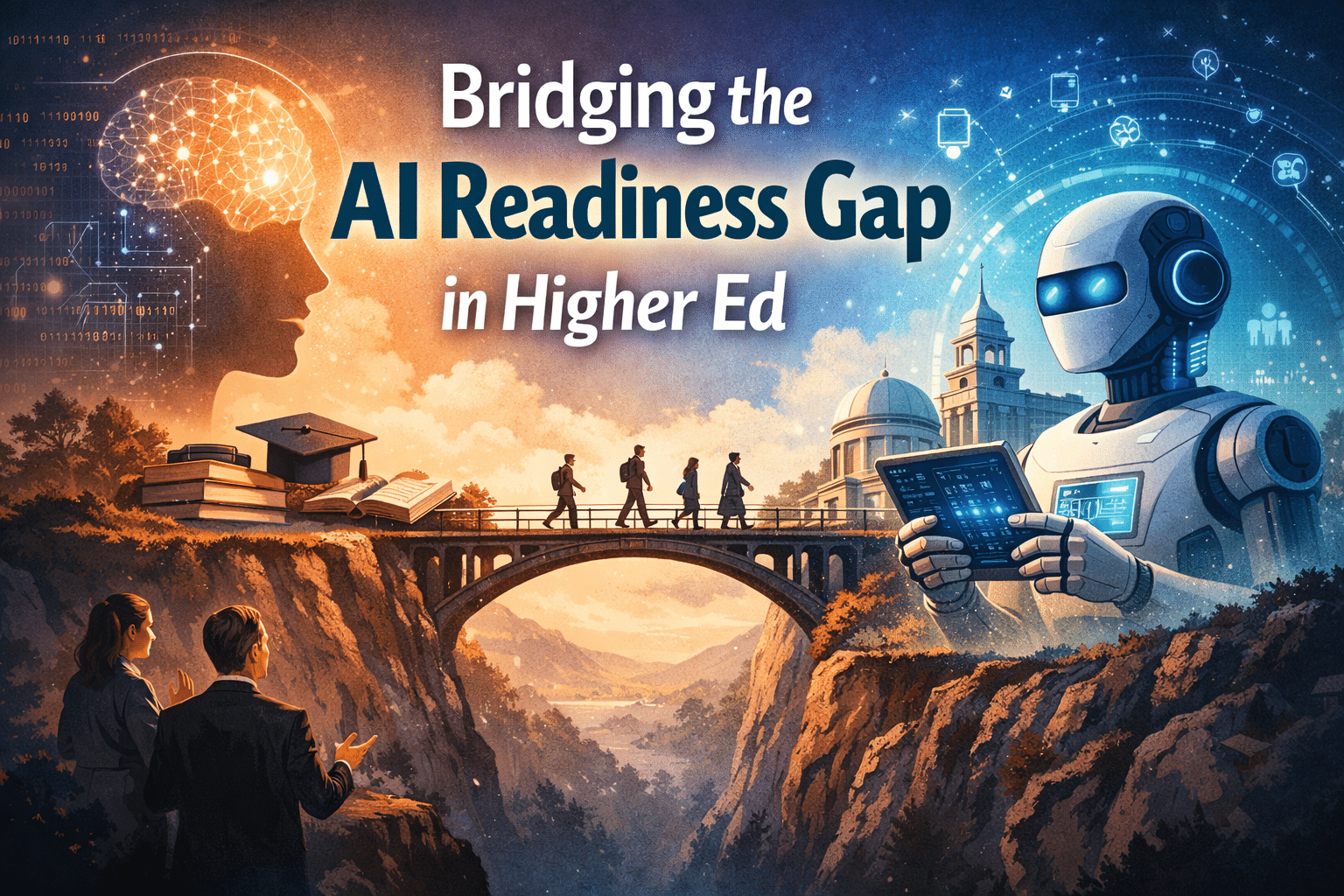
Artificial intelligence is no longer an emerging issue for higher education. It is already reshaping teaching, learning, assessment, student support, and institutional planning. What is striking is not whether AI has arrived. It has. What matters now is how unevenly institutions are responding to it.
That is the central tension in higher education today. Leaders across the sector increasingly recognize that AI literacy will matter for student success, workforce readiness, and long-term institutional competitiveness. At the same time, many campuses are still operating in a pilot mindset. They are experimenting with tools, discussing policy, and reacting to new risks, but they have not yet built the coordinated strategy required to move from curiosity to capability.
This gap between adoption and readiness matters more than it might seem.
On many campuses, AI use is already widespread among students and increasingly common among faculty. But in practice, ownership is fragmented. One department may be actively redesigning assignments for an AI-enabled environment while another is still debating whether AI should be allowed at all. IT may be reviewing vendors and security requirements, while academic leadership is separately discussing pedagogy and integrity. The result is motion without alignment.
That kind of fragmentation creates real institutional risk. Students encounter inconsistent expectations from class to class. Faculty are left to interpret policy on their own. Technology decisions get made without enough pedagogical context. Governance discussions lag behind actual behavior. And when institutions operate this way for too long, AI stops being a strategic initiative and becomes a patchwork of local decisions.
The good news is that many leaders are beginning to see the problem more clearly. The institutions making the most progress are not simply adopting more tools. They are building readiness across multiple fronts at once. They understand that AI is not just a technology question. It is a governance question, a pedagogy question, an integrity question, and an infrastructure question.
That broader view is essential because AI is touching the full academic lifecycle. It affects how instruction is designed, how students create work, how learning is assessed, and how institutions demonstrate fairness, rigor, and trust. A campus cannot solve that with a single policy memo or a one-time pilot.
Instead, leaders need to think in terms of institutional readiness.
Readiness starts with clarity. Who owns AI strategy? Is there a cross-functional governance structure that includes academic affairs, IT, compliance, teaching and learning, and student support? Are decisions being made in a coordinated way, or are they still happening in parallel silos? These questions may sound operational, but they shape the student and faculty experience more than any individual tool ever will.
Readiness also requires a practical framework. Institutions need a way to assess their strengths and gaps across pedagogy, technology, governance, assessment, and AI literacy. Without that, it is easy to overestimate progress based on isolated wins. A successful pilot in one program is valuable, but it is not the same as institutional readiness. For leaders looking for a broader view of where the sector stands today, the 2026 State of AI in Higher Education offers independent insights drawn from higher education leaders across North America and EMEA.
This is where many campuses are at an inflection point. They do not need to have everything figured out. In fact, waiting for perfect clarity is one of the biggest strategic mistakes institutions can make right now. What they need is a structure for learning and iteration. The most effective approach is to start with clear governance, pilot with purpose, evaluate what works, and expand with consistency.
For leadership teams, that means shifting the core question. Instead of asking, “Should we use AI?” the more useful question is, “How do we adopt AI in a way that is aligned with our academic values, operational realities, and long-term mission?”
That shift changes everything.
It moves the conversation beyond hype and fear. It helps institutions focus on building systems rather than reacting to symptoms. It encourages leaders to connect academic integrity with assessment design, connect AI literacy with student success, and connect procurement decisions with governance and compliance. Most importantly, it positions the institution to lead rather than simply catch up.
Higher education is still early in this journey. But the sector has already moved past the point where AI can be treated as a temporary disruption. The institutions that will be strongest over the next several years are not necessarily the ones moving fastest on every tool. They are the ones building the clearest foundation for responsible, coordinated, and adaptable adoption.
The pilot phase has served a purpose. It helped campuses learn, experiment, and surface real concerns. But now the stakes are higher. Students need coherent expectations. Faculty need integrated support. Leaders need governance models that match the scale of the challenge.
AI may be accelerating, but maturity will not happen automatically. Institutions have to build it deliberately. And the sooner they treat AI readiness as a strategic priority, the better positioned they will be to shape the future of learning on their own terms. To explore the leadership survey findings, key trends, and recommendations in more depth, download the full report here.
