

What’s the Difference Between Copyleaks and Apporto TrustEd?
Apporto TrustEd and Copyleaks serve different academic integrity needs. Apporto TrustEd uses integrity analytics, writing behavior, and contextual signals to help educators evaluate student work, while Copyleaks focuses on AI detection and plagiarism checking. The right choice depends on whether institutions need broader integrity insights or content detection.
Generative AI has changed how students create, edit, and research content, making AI-generated writing and AI-assisted work increasingly common in education. That has also made academic integrity harder to evaluate with a single tool.
AI detectors and plagiarism detection systems can provide useful signals, but a score alone does not establish who wrote a piece of work or how much AI assistance was involved.
Copyleaks and Apporto Trusted approach this problem from different directions. Copyleaks focuses on AI detection and plagiarism checking, while Apporto Trusted emphasizes broader integrity analytics and student-work patterns.
In this comparison, you’ll examine their accuracy, false positives, privacy, workflows, and institutional value, while keeping an important question in view: how much can any detection result actually prove?
What Are Copyleaks and Apporto Trusted, and What Does Each Platform Actually Do?

Copyleaks and Apporto TrustEd both address academic integrity, but they operate at different points in the process. Copyleaks is built around AI detection and plagiarism checking. Its Copyleaks AI detector analyzes submitted text for statistical patterns associated with AI-generated content, helping educators identify writing that may have been produced or assisted by generative AI. It also provides plagiarism detection, making it useful when institutions need to examine originality and potential AI use within student work.
Apporto TrustEd takes a broader integrity-focused approach. Rather than functioning as an AI content detector, it focuses on integrity analytics and writing behavior patterns. That distinction matters. Apporto does not analyze text or check for plagiarism, so it should not be treated as a direct replacement for Copyleaks when the specific requirement is AI or plagiarism detection.
The practical difference is therefore less about choosing one universal winner and more about understanding the job each platform performs. Copyleaks gives educational institutions dedicated detection capabilities, while Apporto TrustEd contributes additional context around academic integrity and student behavior. Used appropriately, these approaches can address different needs within a broader integrity workflow. If you also want to compare other AI detection and plagiarism-checking platforms, explore copyleaks alternatives
Platform Overview Comparison
| Feature | Apporto TrustEd | Copyleaks |
|---|---|---|
| Primary purpose | Integrity analytics and writing behavior analysis | AI detection and plagiarism checking |
| Best for | Broader academic integrity monitoring | Detecting potential AI-generated content and plagiarism |
| AI detection | Not a text-based AI detector | Dedicated Copyleaks AI detector |
| Plagiarism detection | Does not check for plagiarism | Plagiarism detection |
| Academic integrity | Focuses on integrity analytics and behavioral context | Supports integrity workflows through detection and originality checks |
| Student work analysis | Examines integrity-related writing behavior patterns | Analyzes submitted text for AI and plagiarism indicators |
| Best fit | Institutions seeking broader integrity context | Institutions needing dedicated AI and plagiarism detection tools |
How Does Copyleaks Detect AI-Generated Text, and How Reliable Are Its Results?
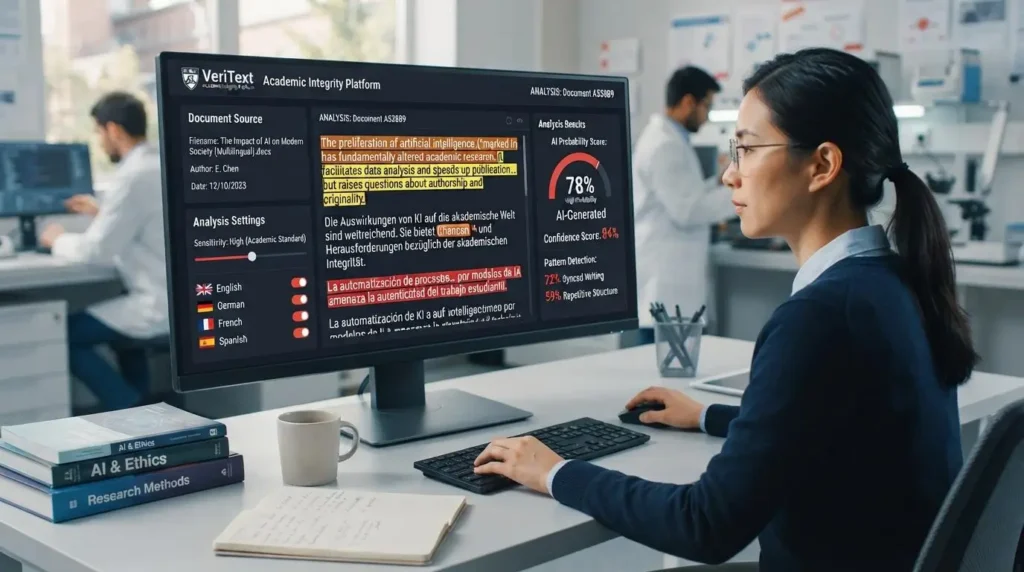
The Copyleaks AI detector evaluates writing for patterns associated with AI-generated text rather than determining authorship with certainty. Its AI detection system analyzes characteristics of language produced by AI writing tools and different AI models, using statistical patterns to estimate whether content appears machine-generated. Copyleaks analyzes text using perplexity and token distribution, two measures that can help distinguish patterns commonly associated with generated writing.
According to Copyleaks, its AI detector can identify AI-generated writing with claimed accuracy of up to 99%, while reporting under 1% false positives on its evaluation corpus. It also supports AI detection in more than 30 languages and provides adjustable sensitivity settings. The system can identify content associated with tools such as ChatGPT, while presenting results through probability scores and sentence-level highlights. some main points include:
- Detection accuracy: Copyleaks claims 99% accuracy.
- False positives: It reports under 1% on its evaluation corpus.
- Language coverage: AI content detection supports more than 30 languages.
- Sensitivity: Adjustable settings allow users to control detection behavior.
- Results: Probability scores and highlighted sentences show where AI-like patterns may appear.
What Does a Copyleaks AI Detection Result Actually Tell You?
A Copyleaks result should be treated as an indicator, not definitive proof. The AI score represents a probability score based on detected statistical patterns. Flagged sentences can show which portions of the AI text contributed to the result, giving teachers, editors, and other reviewers specific areas to examine.
That distinction matters. AI detection tools estimate whether writing resembles machine-generated content, but a score alone cannot establish authorship. Human review remains important before making final decisions, particularly when an evaluation could affect students, writers, or published content.
Why Can AI Detection Produce False Positives, and How Should Educators Interpret Them?

False positives are one of the biggest limitations to consider when using AI checkers. An AI detection result should not be treated as definitive proof that human-written text was produced by an AI system. Detection accuracy can vary based on writing style, content length, language, and how heavily the material has been edited.
Short content can be particularly difficult for detection tools to evaluate reliably because there is less writing available for the system to analyze. Rewritten content can create another complication, since substantial editing may alter the patterns that an AI detector looks for. Even real human writing can sometimes resemble machine-generated text.
Language background is another important consideration. Non-native English speakers may face higher false positive rates because certain grammatical and stylistic patterns can be interpreted incorrectly. In one cited evaluation, Copyleaks reportedly misclassified 61% of non-native English essays as AI-written.
Keep these points in mind when interpreting results:
- False positive rate: No AI checker should be assumed to be perfect.
- Content length: Short writing may provide limited evidence for reliable detection.
- Rewritten content: Heavy editing can challenge detection systems.
- Human content: Genuine student writing can still receive an AI-generated flag.
- Language: Non-native English writing may require additional caution.
- Context: An AI score should be considered alongside other evidence.
What Should You Check Before Treating an AI Score as Evidence?
An AI score becomes more useful when considered alongside the student’s broader work. Check draft history to see how the assignment developed, compare writing consistency with previous assignments, and ask the student to explain their reasoning or respond to follow-up questions about the work.
Previous assignments can provide useful context too. Most importantly, educators should apply human review and consider the assignment context before reaching a conclusion. A detector can flag text for further examination, but the final judgment should not rest on a probability score alone.
How Does Apporto TrustEd Approach Academic Integrity Differently?
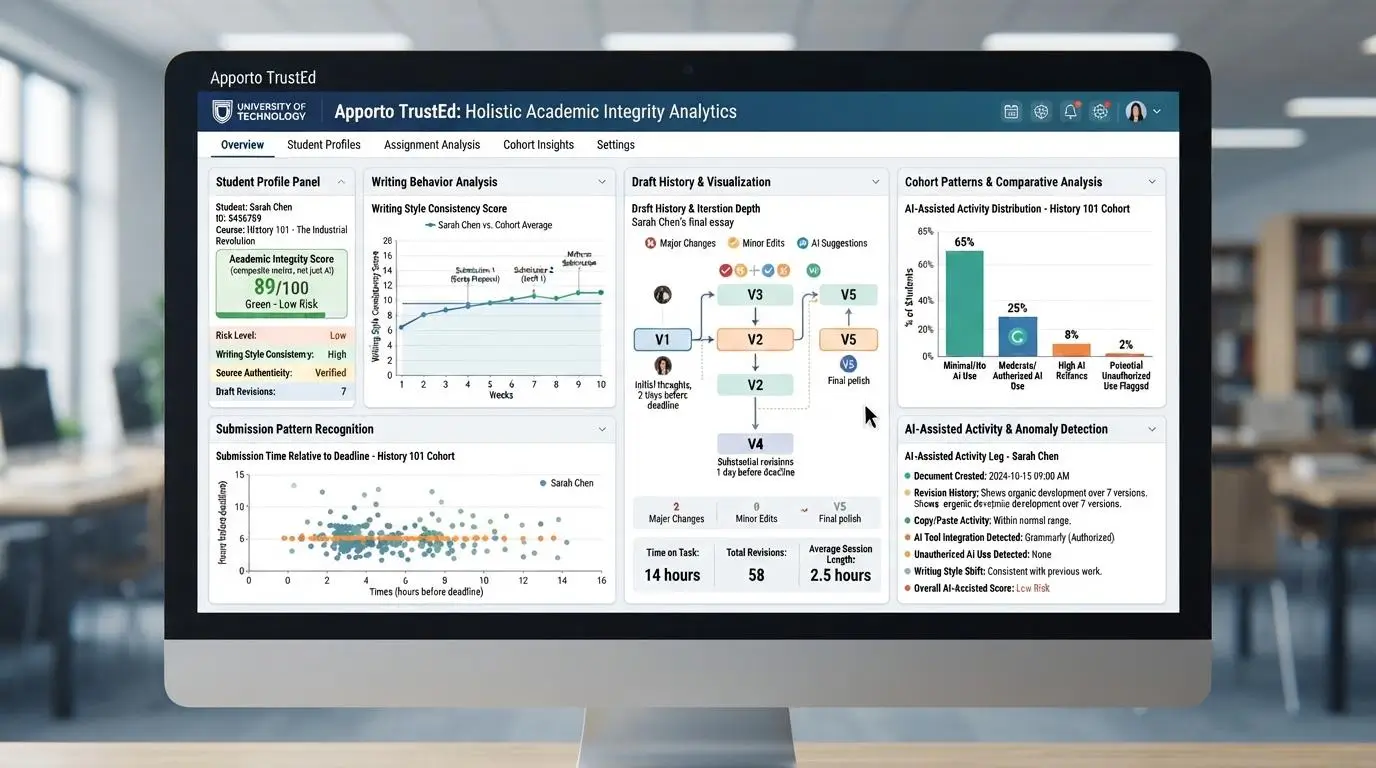
Apporto TrustEd takes a broader approach to academic integrity by focusing on integrity analytics, writing behavior patterns, cohort context, and evidence around how student work develops. Rather than relying on an AI score alone, TrustEd is designed to surface behavior signals and give educators context for reviewing potential AI use.
Apporto describes the system as monitoring AI-assisted behavior through user and cohort analysis while allowing instructors to retain control over interpretation and final decisions.
That distinction matters because the final text tells only part of the story. Draft history, submission patterns, writing consistency, and the context of a specific assignment can provide additional evidence about authorship.
Educators can also use human review, including follow-up questions, to confirm whether a student understands the work they submitted. Apporto’s own guidance emphasizes process-based verification and human judgment rather than treating automated detection as conclusive.
| Integrity Area | Apporto TrustEd | Copyleaks |
|---|---|---|
| Writing behavior | Analyzes writing behavior and user/cohort signals | Focuses on text-based detection |
| AI detection | Behavior-based integrity signals | AI detection |
| Plagiarism checking | Not provided | Plagiarism detection |
| Draft history | Used as contextual evidence | Not the primary focus |
| Human review | Instructor-led interpretation and decision-making | Results can support review |
| Academic integrity workflow | Broader verification and integrity analytics | AI and plagiarism checking |
Which Platform Provides Better Support for Academic Integrity Decisions?
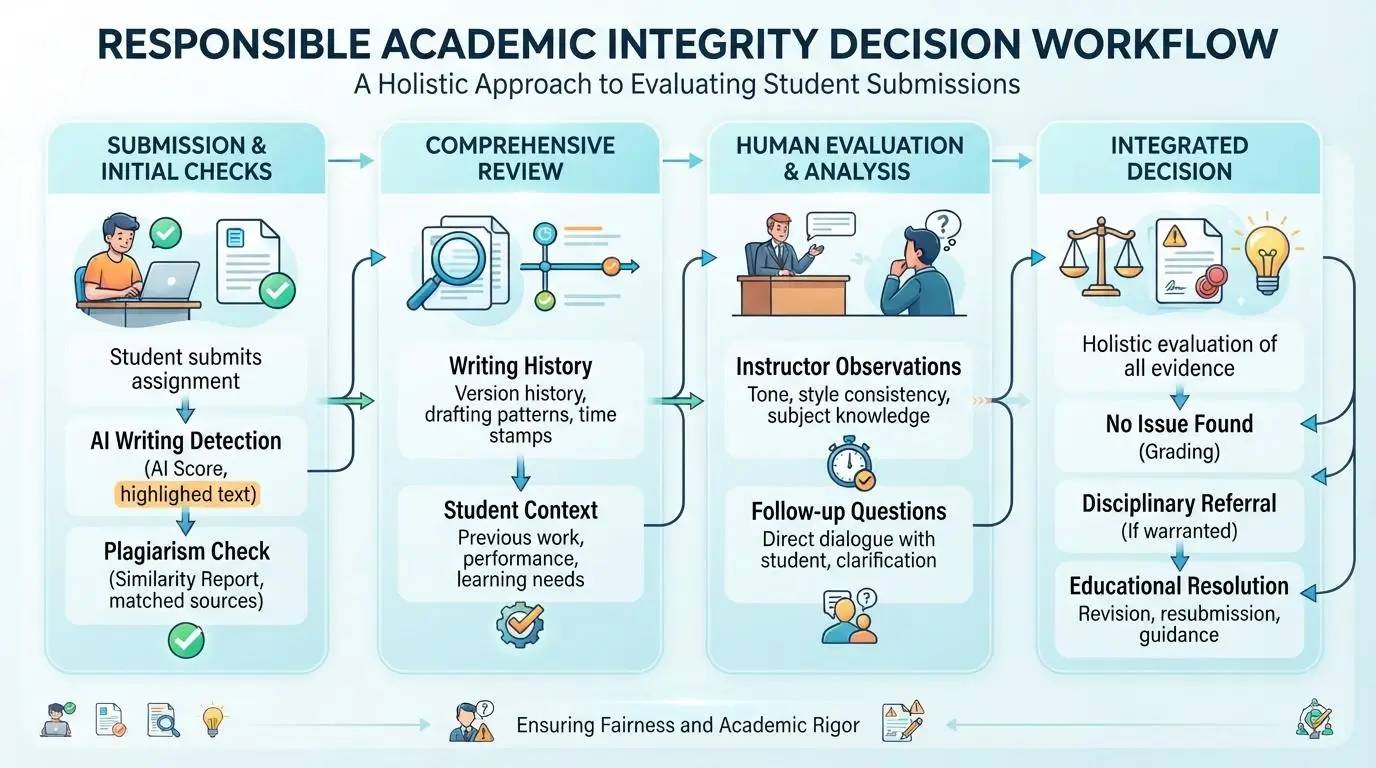
For academic institutions, the question is less about finding a single definitive detector and more about building a sound review process. AI detectors provide probability scores, not definitive conclusions about authorship. Educators and teachers should therefore treat AI-generated content detection as one piece of evidence when evaluating student work, particularly when the decision could affect grades, disciplinary outcomes, or academic standing.
Apporto TrustEd takes a broader approach by adding writing behavior and process-based signals to the review. Draft history can show how an assignment developed, while writing behavior can provide additional context around how the final submission was produced.
Copyleaks, by contrast, focuses on analyzing submitted text for AI-generated writing and plagiarism. These approaches serve different purposes, so the stronger option depends on the evidence an institution needs. For a related comparison of research-oriented similarity checking and broader integrity analytics, explore iThenticate vs Apporto TrustEd. For high-stakes decisions, educators should consider:
- AI detection results: Treat scores as indicators rather than proof.
- Plagiarism results: Check whether submitted work overlaps with existing sources.
- Version history: Review how the document developed over time.
- Student writing patterns: Compare the work with previous submissions.
- Assignment requirements: Consider what tools or AI assistance were permitted.
- Follow-up questions: Ask students to explain key ideas or their approach.
- Instructor observations: Include knowledge of the student’s normal writing and learning process.
- Human review: Keep educators involved in the final assessment.
What Evidence Should Educators Consider?
Responsible AI use requires proportional interpretation. A single detector result should rarely determine the outcome on its own. Combining multiple signals can provide a more comprehensive AI check, particularly when academic papers, internal documents, or intellectual property are involved.
Draft history, writing behavior, plagiarism results, and instructor observations can collectively give educators a stronger basis for making final decisions while preserving appropriate human oversight.
How Do Copyleaks and Apporto Differ in Privacy, Security, and Institutional Trust?

When academic institutions handle student data, academic papers, internal documents, or intellectual property, privacy and security become central to platform selection. Copyleaks emphasizes document security, encryption, privacy, and compliance, including GDPR, SOC 2, and SOC 3 certifications. It also supports large-scale institutional workflows and offers security controls designed for organizations processing substantial volumes of content.
Apporto approaches security from a different operational perspective. Its cloud desktop infrastructure is built around Zero Trust principles, with identity and device verification, least-privilege access, and session controls. Apporto also supports separated customer environments and encryption for data at rest and in transit.
The distinction is important. Copyleaks is primarily securing content that passes through an AI and plagiarism detection platform, while Apporto’s security model is centered on protecting the broader computing environment in which institutional applications and student activities operate. Apporto has also been recognized in the 2025 Gartner Magic Quadrant for Desktop as a Service.
Security and Trust Comparison
| Security Area | Apporto TrustEd | Copyleaks |
|---|---|---|
| Data privacy | Designed around controlled institutional environments and data separation | Privacy-focused platform with GDPR compliance |
| Regulatory compliance | Supports institutional data protection requirements | SOC 2, SOC 3, GDPR, PCI DSS, and NIST RMF alignment |
| Document security | Secure cloud environments and encrypted institutional data | Encryption at rest and in transit, including AES-256 |
| Data residency | Supports regional and dedicated cloud deployment requirements | EU infrastructure available for European data processing |
| Session security | Zero Trust access controls and isolated computing sessions | Restricted network access, authentication, and monitoring |
| Institutional security | Broader secure virtual desktop and education infrastructure | Secure AI and plagiarism detection infrastructure |
| Best fit | Institutions securing applications, desktops, and learning environments | Organizations evaluating content, AI use, and plagiarism |
Both platforms address institutional trust, but they solve different security problems. For responsible AI adoption, the more appropriate choice depends on whether your priority is protecting the computing environment or securing and evaluating submitted content.
Which Platform Fits Better Into an Educational Institution’s Existing Workflow?

Workflow integration can determine whether an integrity tool becomes a practical part of daily teaching or another system educators have to manage separately. Copyleaks is designed to fit into existing academic workflows through learning management systems, APIs, and other integrations.
This allows institutions to incorporate AI detection and plagiarism checks into processes that already handle assignments and student work. Its ability to process large volumes also makes it suitable for institutions managing substantial amounts of digital content.
Apporto TrustEd serves a broader institutional technology environment. Instead of focusing exclusively on submitted content, it can support the wider infrastructure in which educators and students access applications and complete academic work. That distinction matters when designing a single workflow for academic institutions with varied technology requirements.
Educators may also use multiple detection tools when reviewing AI-assisted content, particularly when an assignment raises questions about authorship or policy compliance. The workflow should ultimately reflect the institution’s specific assignment requirements and academic integrity policies.
Workflow Comparison
| Workflow Feature | Apporto TrustEd | Copyleaks |
|---|---|---|
| LMS integration | Supports broader institutional technology environments | Integrates with LMS platforms |
| API access | Broader institutional technology integration | API access for detection workflows |
| Large-volume processing | Designed for scalable institutional environments | Supports large volumes of content |
| Student work review | Provides broader integrity and workflow context | Evaluates submitted content |
| AI detection workflow | Uses integrity-focused signals and broader context | AI detection and plagiarism checking |
| Institutional deployment | Suited to broader institutional technology infrastructure | Suited to content detection across academic workflows |
| Best fit | Institutions seeking broader technology and integrity workflows | Institutions integrating content detection into existing systems |
The practical choice depends on what your institution wants the workflow to accomplish. Copyleaks is a natural fit when detection needs to sit directly inside assignment and content-review processes. Apporto TrustEd is better suited to institutions looking at academic integrity within a broader technology environment.
Which Solution Is More Trustworthy for AI Detection and Academic Integrity?

The answer to Copyleaks vs Apporto TrustEd depends on what you need the system to accomplish. If you need a direct AI content detector alongside plagiarism checking, Copyleaks is the more relevant comparison.
It is built specifically to evaluate potentially AI-generated content and identify source overlap. Copyleaks claims 99% AI detection accuracy and reports under 1% false positives on its evaluation corpus, although those figures should be understood within the company’s stated testing conditions.
Apporto TrustEd takes a different route. Its emphasis is on integrity analytics, writing behavior, and institutional safeguards rather than positioning a single AI score as the final answer. That makes it relevant when your goal extends beyond detecting AI content to understanding the broader context surrounding student work.
A high AI score does not, by itself, prove misconduct. Human-written content can sometimes be flagged, and responsible AI use requires educators to consider multiple forms of evidence before reaching a conclusion.
Trustworthiness Comparison
| Trust Factor | Apporto TrustEd | Copyleaks |
|---|---|---|
| AI detection | Integrity-focused signals and behavioral context | Direct AI content detection |
| Detection accuracy | Focuses on broader integrity evidence | Claims 99% accuracy under its evaluation conditions |
| False-positive considerations | Uses contextual evidence beyond a detector score | Reports under 1% false positives on its evaluation corpus |
| Academic integrity | Integrity analytics and institutional safeguards | AI detection and plagiarism checking |
| Human oversight | Central to interpreting integrity signals | Important when reviewing detection results |
| Institutional safeguards | Focuses on broader institutional integrity processes | Security, privacy, and content evaluation controls |
| Best fit | Institutions seeking broader integrity assessment | Users needing direct AI detection and plagiarism checking |
Ultimately, the best AI detector is not necessarily the platform that produces the highest score. Trustworthiness comes from using detection accuracy, context, safeguards, and human oversight together.
For direct AI detection, Copyleaks has the clearer role. For a broader academic integrity approach, Apporto TrustEd offers a different model centered on institutional context and responsible decision-making.
Which Platform Offers Better Long-Term Value for Educational Institutions?

Long-term value depends on more than the initial cost of an AI tool or paid plan. Educational institutions need to consider how easily a platform can be deployed, how well it fits existing workflows, and whether it can continue supporting changing academic integrity requirements. Copyleaks provides AI detection and plagiarism capabilities within institutional workflows, while API access can support larger, scalable implementations.
Apporto TrustEd approaches the problem from a broader institutional infrastructure perspective, addressing integrity and technology needs beyond a single detection function. That broader scope can matter for institutions looking to build sustainable systems rather than add another isolated tool.
Support and scalability also influence long-term value. A platform should be practical to implement, manageable for educators, and capable of supporting institutional growth without creating unnecessary complexity. More importantly, implementation quality matters. Automated detection works best when combined with clear academic policies, appropriate human review, and responsible AI practices.
For academic integrity, a single detector should never become the sole basis for a disciplinary or academic decision. The strongest long-term approach combines automated tools with contextual evidence and educator judgment.
In that sense, the better investment is the solution that supports your institution’s broader goals while remaining flexible enough to adapt as AI use in education continues to evolve.
Why Is Apporto TrustEd the Better Choice for Responsible Academic Integrity?
Academic integrity in the age of AI requires more than an AI score or a flagged sentence. Apporto TrustEd takes a broader approach by using integrity analytics and writing behavior patterns to provide additional context around student work. This can help institutions make better-informed decisions instead of treating automated AI signals as conclusive evidence.
For higher education, that distinction matters. Faculty can consider contextual evidence alongside human review, assignment requirements, and version history when evaluating how student work was produced. This approach supports responsible AI use because final decisions remain grounded in human judgment rather than depending entirely on automated detection.
Apporto TrustEd also provides an institutional approach to integrity, giving educators a framework for examining student behavior while maintaining appropriate faculty oversight and institutional safeguards. It does not analyze text or perform plagiarism checks, so it serves a different role from dedicated AI detection platforms such as Copyleaks.
When the priority is broader context, responsible interpretation, and human decision-making, Apporto TrustEd offers a compelling approach to academic integrity. Try Apporto TrustEd
Frequently Asked Questions (FAQs)
1. Is Copyleaks better than Apporto Trusted for AI detection?
Copyleaks is more directly suited to AI detection because its platform specifically evaluates potentially AI-generated text and plagiarism. Apporto TrustEd takes a broader academic integrity approach, using integrity analytics and contextual signals rather than relying primarily on an AI detection score.
2. What is the biggest difference between Copyleaks and Apporto Trusted?
The main difference is their approach. Copyleaks focuses on content-level AI detection and plagiarism checking, while Apporto TrustEd focuses on broader integrity analytics, writing behavior, and institutional safeguards to help educators evaluate student work within its context.
3. How accurate is the Copyleaks AI detector?
Copyleaks claims 99% AI detection accuracy and reports under 1% false positives on its evaluation corpus. These figures reflect its stated evaluation conditions, so results should still be interpreted carefully and supported with human review before making important academic decisions.
4. Can Copyleaks detect AI-generated text in multiple languages?
Yes. Copyleaks states that its AI detection supports more than 30 languages. This can make the platform useful for multilingual educational environments, although detection performance can vary depending on the language, writing characteristics, AI model, and evaluation methodology.
5. Can AI detection tools produce false positives?
Yes. AI detection tools can incorrectly classify human-written content as AI-generated. False positives may be more concerning with short content, heavily rewritten text, or writing from non-native English speakers, so educators should consider additional evidence before reaching a conclusion.
6. Does Apporto Trusted check for plagiarism?
No. Apporto TrustEd does not perform plagiarism checks or analyze submitted text for source overlap. Its approach centers on integrity analytics, writing behavior, and contextual evidence. If plagiarism detection is required, you would need a separate plagiarism detection solution.
7. Should educators rely on an AI detector score to prove AI use?
No. An AI detector score should be treated as one piece of evidence rather than definitive proof of AI use. Educators should also consider draft history, previous assignments, writing patterns, assignment requirements, follow-up questions, and direct human review.
8. Which platform is better for academic integrity?
The stronger choice depends on your institutional needs. Copyleaks is better suited to direct AI detection and plagiarism checking, while Apporto TrustEd provides a broader integrity-focused approach using behavioral and contextual signals. For high-stakes decisions, human oversight remains essential.
