
What Is Academic Integrity in the Age of AI?
Academic integrity in the age of AI means using artificial intelligence responsibly while maintaining honesty, originality, and transparency in academic work. Universities can protect academic integrity through clear AI policies, responsible assessments, and tools like Apporto TrustEd that provide writing-process evidence to support fair academic misconduct reviews.
A well-written assignment used to tell instructors quite a bit about a student’s understanding. You could look at the arguments, research, and explanations and get a reasonable idea of what they’d learned. These days, that’s not so straightforward.
Generative AI can explain complicated topics, organize research, develop arguments, write code, and produce entire essays within seconds. Some students use these tools to understand their coursework better. Others may let AI handle work they’re supposed to complete themselves.
That leaves universities with a tricky question: How do you protect academic integrity without treating every student who uses AI as a potential cheater?
Banning AI tools might seem like an easy answer, but enforcing such bans is difficult. And AI detectors? They’re far from foolproof.
Clear academic policies, fair assessments, and a better understanding of how students complete their work are becoming essential. This guide explores how universities can address these challenges while encouraging responsible AI use and protecting honest learning.
What Does Academic Integrity Mean in the Age of AI?

Academic integrity in the age of AI means being honest, fair, responsible, and transparent about how artificial intelligence is used in academic work.
It’s built on six principles: honesty, trust, fairness, respect, responsibility, and courage. Students are expected to follow these values, acknowledge AI assistance when required, and demonstrate what they’ve genuinely learned.
Those principles still matter. The tricky part is figuring out how they apply when AI can contribute to almost every stage of an assignment.
Universities now need clearer boundaries between getting useful help and letting technology do the work students are supposed to complete themselves.
How Has Generative AI Changed Traditional Academic Honesty?
Generative AI can write essays, produce code, summarize research, and build convincing arguments without copying directly from published sources. That creates a problem for traditional plagiarism checks. A student might write an assignment independently, use AI to polish a few paragraphs, or have it generate most of the content. The finished documents could look remarkably similar.
So, checking for copied material only tells part of the story. Educators also need to consider how the assignment came together and what the student contributed.
Why Does Academic Integrity Still Matter When AI Tools Are Everywhere?
Academic integrity helps universities award qualifications that genuinely reflect students’ knowledge and abilities. If students receive grades for work they don’t understand, those grades lose some of their meaning. There’s another concern, too. Research, writing, critical thinking, and problem-solving take practice.
AI can make studying easier, but students still need to wrestle with difficult questions themselves. That’s often where meaningful learning happens.
What Is the Difference Between Academic Integrity and Academic Misconduct?
Academic integrity is about the values that guide honest learning and responsible academic work. Academic misconduct happens when someone breaks university rules, such as plagiarizing, using unauthorized assistance, arranging contract cheating, or misrepresenting another person’s work as their own.
Using AI isn’t automatically dishonest. The important questions are whether it’s allowed, how much assistance was involved, and whether the student has been transparent about it.
Why Is Generative AI Creating New Academic Integrity Challenges?

A few prompts are now enough to produce an essay, summarize research, or write programming code. Work that once took students hours can sometimes be generated in seconds.
For universities, that’s a real concern. Generative AI tools can produce assignments that look remarkably similar to independently written work. And when the final result looks convincing, figuring out how much the student actually understands becomes much harder.
How Can AI-Generated Content Blur the Line Between Original Work and Assistance?
Asking AI to explain a confusing topic is quite different from asking it to write an entire assignment. But there’s plenty of middle ground. Students might brainstorm with AI, build an outline, rewrite paragraphs, or use it to develop arguments. Some of that can genuinely help with learning. Other uses may go against university rules.
Things get complicated when AI is involved throughout the writing process. Which ideas came from the student? How much work did they actually do?
Clear, assignment-specific guidelines help answer these questions by explaining what’s allowed, what needs disclosure, and what students must complete themselves.
Why Can’t Traditional Plagiarism Detection Identify Every AI-Generated Assignment?
Traditional plagiarism detection software looks for similarities between submitted assignments and existing material, including websites, journals, and published documents. Here’s the catch. Generative AI doesn’t necessarily copy those sources word for word.
It can produce entirely new sentences and arguments, meaning an assignment written largely by AI could still receive a low similarity score. AI writing detectors try to identify machine-generated text by analyzing writing patterns instead.
But they’re not foolproof either. Their findings can be inaccurate, so a detection score alone isn’t enough to establish academic misconduct.
Can Over-Reliance on AI Weaken Critical Thinking and Learning?
Yes. When students depend too heavily on AI, they risk missing the practice needed to develop critical thinking and problem-solving skills. Think about what happens when AI handles the research, reasoning, and writing. The assignment gets finished, sure. But has the student actually understood the topic? Not necessarily.
That’s why the learning process deserves attention alongside the final submission. Educators need opportunities to see how students develop ideas, work through difficult questions, and demonstrate what they know without AI doing the thinking for them.
How Common Is AI Use Among University Students?

AI is already part of how many university students study. Some use it to understand difficult topics, while others turn to it for writing, research, or completing assignments. Of course, using AI doesn’t automatically mean someone is cheating. What matters is how they’re using it.
But just how common has AI become in higher education? Research from the UK’s Higher Education Policy Institute (HEPI) gives us a pretty clear picture.
| Research Source | Finding | What It Means |
|---|---|---|
| HEPI Survey 2025 | 92% reported using AI in some form | AI was widely used among UK undergraduates |
| HEPI 2025 | 88% used generative AI for assessments | AI-assisted coursework had become common |
| HEPI Survey 2026 | 95% reported using AI | Student adoption continued growing |
| HEPI 2026 | 94% used generative AI for assessed work | Clear assignment rules are increasingly important |
The 2025 HEPI survey included 1,041 full-time UK undergraduates, while the 2026 survey surveyed 1,054. Both were conducted by Savanta.
Why Are Students Using AI for Academic Work?
The reasons are fairly practical. Students want to save time, understand confusing topics, summarize lengthy readings, and get help organizing their ideas.
Some also use AI to improve their writing or prepare for exams. In HEPI’s 2025 survey, 51% mentioned saving time, while 50% wanted to improve the quality of their work. These uses can support learning. The concern begins when AI completes work students are expected to do independently.
Does Frequent AI Use Automatically Mean More Academic Dishonesty?
No. High AI usage doesn’t automatically translate into more academic misconduct. There’s a difference between using AI openly for permitted study support and submitting unauthorized AI-generated work as your own.
Students don’t always agree on where that boundary sits, either. For universities, understanding these different attitudes matters. Clear academic policies can help students make better decisions without treating every use of AI as suspicious.
What Types of AI Use Count as Academic Misconduct?

Using AI for an assignment isn’t necessarily dishonest. It depends on what you’re asking the tool to do and, more importantly, what your university allows.
A professor might permit AI for brainstorming but expect students to write their arguments independently. Another course could have stricter rules. So where does useful assistance become academic misconduct?
Here’s a breakdown of common AI activities and the concerns they can raise.
| AI Use | Usually Acceptable When Permitted | Potential Integrity Concern |
|---|---|---|
| Explaining Concepts | Understanding difficult course topics | Letting AI replace independent learning |
| Brainstorming | Exploring research questions and ideas | Claiming AI-generated arguments as original thinking |
| Outlining | Organizing your own ideas | Using an AI-written outline without required disclosure |
| Grammar Assistance | Fixing grammar and improving clarity | Allowing extensive rewriting beyond permitted limits |
| Research Assistance | Finding topics and sources to investigate | Submitting fabricated or unverified references |
| Coding Help | Understanding errors and algorithms | Presenting AI-generated code as your own |
| Essay Generation | Studying approved practice examples | Submitting entire AI-written assignments |
| Data Analysis | Using approved tools for analysis | Fabricating results or misrepresenting findings |
Is Using ChatGPT or Another AI Tool Always Cheating?
No. Using ChatGPT or similar AI tools doesn’t automatically count as cheating. Many universities permit AI assistance for tasks such as explaining concepts, brainstorming, or correcting grammar.
The important part is following your course’s rules. If an instructor requires independent writing, using AI to generate the assignment could violate those expectations. And when disclosure is required, students need to explain how they used the tool.
When Does AI-Assisted Academic Work Become Misrepresentation?
Misrepresentation happens when students claim credit for work they didn’t independently produce, contrary to academic requirements.
That could mean submitting AI-written arguments, research analysis, or entire papers without permission or required acknowledgment. Using unauthorized AI assistance during exams can also count as academic misconduct.
The central question is fairly simple: Does the submitted work accurately reflect what the student contributed and understands? If not, there’s an academic integrity concern worth examining.
How Is AI-Related Misconduct Different From Traditional Plagiarism and Contract Cheating?
Traditional plagiarism involves using someone else’s words or ideas without proper acknowledgment. Contract cheating usually means arranging for another person or service to complete academic work on your behalf.
AI-related misconduct is different because the material may be newly generated rather than copied from an existing source. These problems can overlap, though. A paper might contain unauthorized AI-generated paragraphs alongside improperly cited research. In each case, the concern comes back to academic honesty and accurately representing who completed the work.
How Can Students Use Generative AI Without Violating Academic Integrity?

Using generative AI responsibly is becoming a skill students need to learn. But knowing what’s allowed isn’t always easy, particularly when different courses have different rules.
Before turning to AI for help, check your instructor’s guidelines. Can you use it to brainstorm? Is grammar assistance permitted? Do you need to disclose its involvement?
Getting those details clear early can save you trouble later.
What Are Acceptable Ways to Use AI for Learning and Research?
AI can be a useful study companion, provided it doesn’t take over the work you’re expected to do yourself.
Here are some ways students can use it:
- Concept Clarification: Get a simpler explanation of something you don’t understand.
- Brainstorming: Explore possible research topics and questions.
- Study Support: Generate quizzes, flashcards, and revision exercises.
- Writing Preparation: Organize ideas you’ve already developed.
- Language Assistance: Improve grammar and clarity within course rules.
- Coding Guidance: Understand programming errors and work through problems.
- Research Planning: Find topics and potential sources worth investigating.
Just remember, permission matters. An activity that’s fine for one assignment may be restricted in another.
How Should Students Acknowledge AI Assistance in Assignments?
If AI helped you complete an assignment, be upfront about it when disclosure is required. Your university might ask you to name the tool, explain what you used it for, or include a short AI use statement. For instance, you could mention that AI helped structure your outline, while the research and writing were completed independently.
Requirements vary, so check the relevant guidelines rather than assuming. And one important detail: acknowledging AI use doesn’t make prohibited assistance acceptable.
Why Must Students Verify AI-Generated Research and References?
AI can sound remarkably convincing, even when the information is wrong. It might invent journal articles, mix up authors, misrepresent findings, or produce statistics that have no reliable source behind them.
That’s a problem when you’re writing an academic paper. Check references against original studies, trusted journals, or academic databases. Don’t assume a citation is genuine just because it looks properly formatted.
Ultimately, you’re responsible for what you submit. AI can help with academic research, but checking the facts and understanding the evidence remain your job.
Why Do Universities Need Clear Academic Integrity Policies for AI?

AI rules can get confusing pretty quickly. One professor might allow students to use ChatGPT for writing assistance, while another doesn’t permit it at all. Even students at the same university can end up following completely different expectations.
And broad instructions like “Use AI responsibly” don’t always help. What does responsible use actually mean for a particular assignment?
A clear academic integrity policy takes away much of that guesswork. Students know what’s expected, and educators have consistent standards for addressing potential misconduct.
What Should an Academic Integrity Policy Say About Generative AI?
A useful policy needs to go beyond simply telling students not to cheat.
It should explain:
- Permitted and Prohibited Uses: Which AI activities are allowed and which cross the line.
- Assignment Restrictions: When AI assistance is limited or completely off-limits.
- Disclosure Requirements: How students should acknowledge AI contributions.
- Accuracy: Who’s responsible for checking AI-generated information.
- Data Privacy: What information students can safely share with AI tools.
- Authorship: What counts as independent academic work.
- Investigation Procedures: How suspected misconduct is reviewed and appealed.
- Consequences: What happens when a violation is confirmed.
Specific examples help students understand these rules in practice.
How Can Instructors Explain AI Rules Clearly in the Syllabus?
Your syllabus is a good place to make AI expectations clear from the beginning. You might allow students to brainstorm ideas or correct grammar with AI but require them to develop their arguments independently.
Explain which activities need disclosure and what students must complete themselves. These boundaries should match each assignment’s learning objectives. When expectations are clearly documented, students have less room for confusion, and faculty have a fairer basis for reviewing possible violations.
Should Universities Ban AI or Teach Responsible Use?
A blanket AI ban might sound straightforward, but it’s not always practical. Some assessments genuinely require students to work without assistance. Others can benefit from teaching students how to use AI critically and responsibly.
Universities need room for both approaches. Australia’s Tertiary Education Quality and Standards Agency (TEQSA) discusses institutional responses built around people, processes, and educational practices.
The aim is to give students the skills to use AI appropriately while keeping academic standards clear and enforceable.
Why Is AI Literacy Essential for Academic Integrity?

Just because students know how to use ChatGPT doesn’t mean they understand how to use AI responsibly. That’s where AI literacy comes in. It means knowing how artificial intelligence works, questioning the information it produces, recognizing its limitations, and understanding when its use needs to be disclosed.
As AI becomes part of everyday university life, these skills matter more than ever. Students need to know when technology is helping them learn and when it’s doing too much of the work for them.
What AI Skills Should University Students Learn?
Knowing how to write a prompt is useful, but there’s quite a bit more to AI literacy.
Students should develop skills such as:
- Understanding AI: Learn how generative AI creates responses and why mistakes happen.
- Spotting Errors: Recognize incorrect information and made-up claims.
- Checking Sources: Verify references against reliable academic research.
- Prompt Engineering: Write clear questions and instructions.
- Knowing AI’s Limits: Understand that confident answers aren’t always correct.
- Protecting Data: Keep personal details and sensitive research information private.
- Disclosing AI Use: Follow university rules for acknowledging assistance.
- Thinking Independently: Question AI responses instead of taking everything at face value.
These skills help students use AI without losing confidence in their own judgment.
How Can Universities Teach Ethical Decision-Making Around AI?
Lectures about responsible AI use are helpful, but students also need hands-on practice. Universities can offer workshops, orientation sessions, and classroom activities built around actual coursework. For example, students could compare AI-generated answers, spot invented references, or discuss when using AI might break assignment rules.
Working through these questions helps students understand the difference between acceptable assistance and academic dishonesty. It also gives them a chance to make mistakes and learn from them before those mistakes affect their grades.
Why Should AI Literacy Be Part of the Curriculum?
AI skills are becoming useful in many professions, so students need opportunities to develop them during university. But access to training hasn’t always kept up.
The HEPI Student Generative AI Survey 2025 found that only 36% of surveyed UK undergraduates had received institutional training in AI skills, even though 92% reported using AI.
That’s a considerable gap. Teaching AI literacy across the curriculum can help students use these tools confidently while developing the subject knowledge, critical thinking, and independent judgment they’ll still need.
Can AI Detection Tools Reliably Identify AI-Generated Writing?

AI detection tools can make an educated guess about whether something was written by AI. But can they tell you for certain who wrote an assignment? No.
These tools aren’t always accurate, and universities shouldn’t rely on their scores alone when investigating academic misconduct.
There’s also a difference between plagiarism checkers, which look for copied content, and AI detectors, which analyze writing patterns.
How Do AI Writing Detectors Work?
AI writing detectors examine patterns in text using machine learning and statistical analysis.
They look at things like sentence structure, word choices, and how predictable the writing appears. Some also compare these patterns with examples of human and AI-generated content.
Based on that analysis, the software produces an AI-likelihood score. Sounds useful, right? The problem is that these scores are predictions, not proof.
A high score doesn’t confirm AI use. Equally, a low score doesn’t guarantee that a student wrote everything independently.
Why Do AI Detection Tools Produce False Positives and False Negatives?
AI detectors can get things wrong in two ways:
- False Positives: Human-written assignments are mistakenly flagged as AI-generated.
- False Negatives: AI-generated writing goes undetected.
These mistakes can happen with edited content, shorter assignments, or writing that combines human and AI contributions. Accuracy also differs between detection tools and the AI models they’re tested against.
For universities, both errors create problems. An innocent student could face suspicion, while unauthorized AI-generated work might pass unnoticed. That’s why a detection score needs context before anyone draws conclusions.
Can Students Evade AI Detection Through Paraphrasing?
Yes. AI-generated writing can sometimes escape detection when it’s paraphrased, substantially edited, or mixed with human-written text. That makes it difficult for detection software to judge where the writing actually came from.
The Tertiary Education Quality and Standards Agency (TEQSA) warns that an AI detection score alone isn’t enough to support an academic misconduct allegation. Other evidence is needed. So, when a detector flags an assignment, universities need to investigate carefully rather than assume the software has the final answer.
Why Can AI Detectors Unfairly Flag Non-Native English Speakers?

AI detectors don’t always get it right. Sometimes, they flag assignments written entirely by students as AI-generated, even when no AI was involved.
This raises serious fairness concerns, particularly for international students and those who speak English as an additional language. And research suggests the problem deserves attention.
What Does Research Say About AI Detector Bias?
A 2023 Stanford University study found that seven AI detectors incorrectly classified an average of 61.22% of 91 TOEFL essays written by non-native English speakers as AI-generated.
Even more concerning, at least one detector flagged 89 of those 91 essays. Now, that doesn’t mean every AI detector makes mistakes at the same rate. The findings came from particular tools and writing samples tested in 2023.
Researchers suggested that simpler vocabulary and more predictable sentence patterns could partly explain the results. But straightforward writing isn’t evidence of cheating. And students shouldn’t face suspicion simply because English isn’t their first language.
How Can False Accusations Affect Students?
Imagine spending days working on an assignment, only to have your writing flagged as AI-generated. For students, that can be stressful and frustrating. A false accusation may lead to disciplinary investigations, damage to their reputation, or worries about their academic future.
Non-native English speakers may face additional difficulties if their writing style is repeatedly treated as suspicious. There’s a trust issue here, too. Students who worry about being wrongly accused may start questioning whether the assessment process is fair.
What Should Universities Do Instead of Relying on Detection Scores?
Universities need to look beyond a single AI detection score. Assignment drafts, revision histories, writing-process records, and student explanations can provide a fuller picture of how work was completed.
Students should also have a fair chance to explain their approach. Tools such as Apporto TrustEd can support this process by providing writing-history information and behavioral evidence for faculty review.
Still, unusual writing patterns aren’t proof of misconduct. The aim should be a fair, evidence-based review, not a decision based on what an algorithm suspects.
How Can Universities Investigate Suspected AI Misconduct Fairly?

Spotting something unusual in a student’s assignment is one thing. Proving academic misconduct is another. A high AI detection score or an unexpected writing pattern might raise concerns, but neither tells you for certain that a student broke the rules.
Universities need a fair process that considers the evidence, follows established procedures, and gives students a chance to explain their work.
Here’s how that process can work:
1. Identify the Concern: Record what seems unusual and which academic integrity rule may have been violated.
2. Preserve Relevant Evidence: Keep authorized assignment records, drafts, research notes, and supporting documents.
3. Review How the Work Developed: Look at available revisions, sources, and writing history to understand how the assignment came together.
4. Consider Other Explanations: Account for permitted AI assistance, grammar tools, language support, and different writing habits.
5. Hear the Student’s Side: Give students a reasonable opportunity to explain their approach and respond to concerns.
6. Follow University Procedures: Involve the appropriate academic staff and apply established investigation rules.
7. Document the Decision: Record the evidence, reasoning, outcome, and available appeal options.
Why Should AI Detection Scores Never Be the Only Evidence?
AI detectors make predictions based on writing patterns. They don’t actually know who wrote an assignment. And those predictions can be wrong. Even a high AI detection score needs supporting evidence before anyone can reasonably conclude that misconduct occurred.
Universities should consider assignment requirements, available writing records, and the student’s explanation. A fair decision needs more than an algorithm’s estimate, particularly when a student’s academic record could be affected.
How Can Faculty Review Student Work Without Making Unfair Accusations?
Start with questions, not accusations. Faculty should use neutral language, follow consistent review criteria, and give students room to explain their work.
Privacy and accessibility needs matter, too. Platforms such as Apporto TrustEd can provide writing-process information and contextual evidence to help educators examine potential concerns.
But these findings still need human interpretation. Ultimately, authorized university staff should make decisions based on the available evidence and institutional policies, while protecting students’ rights throughout the process.
Why Is the Student’s Writing Process Important for Academic Integrity?

A finished assignment can tell you plenty about the quality of a student’s work. What it can’t always tell you is how that work came together.
Some students spend days researching, developing arguments, and rewriting drafts. Others might submit AI-generated content after making only a few changes.
That’s why the writing process matters. Looking at how an assignment developed can give educators a better understanding of the student’s contribution.
What Can Drafts and Revision Histories Reveal About Student Work?
Good academic writing rarely happens in one sitting. Students research, make notes, draft ideas, change their minds, and revise what they’ve written. Drafts and document histories can help educators follow that development.
You might see when a student added new arguments, corrected mistakes, or reorganized sections after further research. Of course, everyone writes differently. Some students plan extensively before typing, while others revise as they go.
An unusual editing pattern isn’t automatically suspicious. These records are useful, but they need context before anyone draws conclusions.
How Is Process-Based Evaluation Different From Checking the Final Submission?
Traditional assessment usually concentrates on the finished assignment. Is the argument convincing? Are the sources reliable? Does the work meet the requirements?
Process-based evaluation goes a little further. It considers how students developed their ideas, selected sources, and improved their writing along the way.
That information can help educators provide better feedback and review potential integrity concerns.
The Tertiary Education Quality and Standards Agency (TEQSA) recommends verifiable version histories and writing-process records to strengthen assessment integrity.
Can Writing Behavior Provide Better Context Than AI Detection Alone?
Yes, writing behavior can offer context that a detection score misses. Revision patterns, large text insertions, and comparisons with earlier assignments may help educators understand how work developed.
Apporto TrustEd, for example, examines writing activity alongside individual writing history and cohort patterns. Still, these are indicators, not proof of cheating. Educators need to interpret them carefully.
How Can Authentic Assessment Reduce AI-Related Academic Misconduct?

Authentic assessment focuses on what students can actually do with their knowledge, rather than how much information they can remember. That matters when AI can produce convincing answers in seconds.
By asking students to apply concepts, solve practical problems, and explain their decisions, universities can get a clearer picture of what they’ve learned.
What Makes an Assessment Authentic in the Age of AI?
An authentic assessment connects classroom learning to practical tasks or professional situations. Instead of answering questions that AI could easily handle, students might work through course-specific problems, complete projects, or explain their research decisions.
Take engineering education. Students could be asked to design a solution and defend the choices they made along the way. The aim is to assess the skills students are supposed to develop.
A polished final answer is useful, but understanding the reasoning behind it can tell educators much more.
Which Assessment Formats Encourage Independent Thinking?
There’s no single assessment format that works for every subject. Still, some approaches give students more room to demonstrate their own thinking.
These include:
- Oral Presentations: Explain ideas and defend conclusions.
- Staged Research Projects: Complete work through planned checkpoints.
- Reflective Journals: Discuss decisions, challenges, and learning.
- Practical Demonstrations: Apply knowledge to specific tasks.
- Supervised Assessments: Demonstrate skills under controlled conditions.
- Engineering Projects: Work through technical problems and explain solutions.
- Draft-to-Final Submissions: Show how writing develops over time.
- Group Projects: Document each student’s contribution.
The best choice depends on what the course is trying to teach and assess.
Can Authentic Assessments Completely Prevent AI Misuse?
No. Even thoughtfully designed assignments can’t eliminate unauthorized AI use. A 2025 study published in the British Journal of Educational Technology examined assessments at two UK universities and found that authentic tasks alone didn’t reliably prevent or reveal generative AI involvement.
Students can still use AI to help complete complex projects. That’s why universities need additional safeguards, including clear AI rules, staged checkpoints, appropriate supervision, and opportunities for students to demonstrate their understanding independently.
How Should Universities Redesign Assessments for the AI Era?
When AI can write essays, solve equations, and produce working code in seconds, universities have to rethink what their assignments are actually measuring. A well-written answer doesn’t always tell you how much a student understands.
But banning AI from every assessment isn’t necessarily practical either. Some tasks need independent effort, while others can test how well students use AI and evaluate its output. It comes down to choosing the right assessment approach for the skills you’re trying to measure.
When Should AI Use Be Allowed, Restricted, or Required?
That depends on the purpose of the assignment. If students are demonstrating basic knowledge, working without AI might be necessary. But if you’re teaching AI literacy, using the technology could be part of the assessment itself.
Here’s how the rules might differ:
| Assessment Approach | Appropriate AI Rules | Main Purpose |
|---|---|---|
| Independent Skills Assessment | AI restricted or prohibited | Check individual knowledge |
| AI-Assisted Research Assignment | Allowed with disclosure | Evaluate research and AI judgment |
| Practical Application Project | Controlled AI use | Assess real problem-solving skills |
| AI Literacy Assignment | AI required with documentation | Test responsible and effective AI use |
How Can Universities Assess Both the Process and the Final Result?
A finished assignment shows what students produced. But how did they get there?
That’s worth examining. Universities can use checkpoints, annotated drafts, reflective statements, and oral discussions to understand how students develop their work.
Asking students to explain research choices or walk through their reasoning can reveal understanding that isn’t always visible in the final submission. This gives educators a fuller picture of both the work and the learning behind it.
Why Should Different Programs Have Different Assessment Rules?
Different subjects call for different kinds of evidence. Engineering students may need to demonstrate technical problem-solving. Mathematics relies on reasoning, while humanities and creative writing place greater emphasis on interpretation and original expression.
Health-related programs may require supervised practical assessments. Academic research demands reliable methods and evidence.
Universities should give departments flexibility to set suitable AI rules while keeping academic honesty, transparency, and fairness consistent across the institution.
How Does Generative AI Affect Academic Research and Intellectual Honesty?

Generative AI is finding its way into academic research, and it’s easy to see why. It can summarize lengthy studies, organize research ideas, improve writing, generate code, and help with data analysis.
Useful? Certainly. But researchers still need to be careful. Academic research depends on accurate findings, trustworthy sources, and honest reporting.
When AI contributes to your work, you’re responsible for checking what it produces and acknowledging its involvement when required.
Can Generative AI Fabricate Academic Sources and Research Findings?
Yes, and sometimes the results look surprisingly convincing. Generative AI can invent journal articles, mix up author names, produce questionable statistics, or describe research findings that don’t match the original study.
Even a made-up reference can look legitimate, complete with a journal title, publication date, and author details. That’s particularly risky when preparing literature reviews or academic papers.
Before including any AI-suggested source, check that the publication actually exists. Look it up in academic databases, trusted journals, or the original publisher’s website. AI can point you toward useful research. It can’t take responsibility for verifying it.
What Are the Ethical Boundaries for AI-Assisted Research Writing?
Using AI for academic writing isn’t automatically unethical. Grammar corrections, language improvements, and organizing research notes may be perfectly acceptable, depending on your institution’s rules.
The problem starts when researchers present fabricated findings, unchecked analysis, or AI-generated arguments as their own original research.
Disclosure matters, too. Different universities and scholarly publishers have their own requirements for acknowledging AI assistance. What one international journal permits, another may restrict.
Before submitting your work, check those guidelines carefully. Whatever tools you use, the accuracy and integrity of the final research remain your responsibility.
How Can Researchers Protect Confidential Data When Using AI Tools?
Not every research document belongs in an AI chatbot. Unpublished findings, participant records, sensitive datasets, and proprietary information may require special protection.
Some third-party AI services store or process uploaded material under terms that don’t meet university requirements. Before sharing confidential research, check your institution’s policies and the platform’s privacy safeguards.
Protecting sensitive information is part of responsible research, just like checking sources and reporting findings accurately.
How Can Universities Protect Student Privacy During Academic Integrity Reviews?

Investigating academic misconduct sometimes means looking beyond the assignment itself. Universities may need to examine writing histories, document revisions, or activity records to understand how students completed their work.
That information can be helpful. But it also raises a fair question: How much student data should universities collect?
Clear boundaries matter. Institutions need to know what they’re monitoring, who can see the information, and how long it’s kept.
What Student Data Might Integrity Monitoring Tools Collect?
Different academic integrity platforms collect different types of information. Depending on the tool, that could include assignment files, submission times, document revisions, typing activity, editing patterns, and course records.
Some platforms also track how writing develops throughout an assignment. But more information doesn’t necessarily mean better decisions.
Before adopting any monitoring tool, universities should understand exactly what it records and why that data is needed. The aim should be collecting relevant evidence, not tracking every student activity simply because the technology allows it.
What Safeguards Should Universities Require?
Privacy and security deserve close attention when choosing academic integrity technology.
Important safeguards include:
- Access Controls: Keep student records limited to authorized staff.
- Secure Storage: Protect information through encryption and suitable security measures.
- Data Retention: Set clear rules for storing and deleting records.
- Student Transparency: Explain what’s collected and why.
- Data Usage Limits: Prevent unrelated uses of student information.
- Vendor Reviews: Check the provider’s privacy and security practices.
- Accessibility: Accommodate different learning and accessibility needs.
- Fair Reviews: Provide transparent investigation and appeal procedures.
How Can Institutions Balance Academic Integrity With Student Trust?
Students deserve to know what’s being monitored and how that information might be used. Excessive surveillance can damage trust, even when universities have legitimate concerns.
UNESCO’s guidance on generative AI in education and research emphasizes privacy and human-centered educational technology.
Apporto TrustEd states that student data isn’t used to train its models and offers security documentation for institutional review.
Universities should still verify retention policies, access permissions, and privacy requirements before adoption. Good oversight should protect academic integrity without compromising students’ rights.
What Role Should Faculty Play in Maintaining Academic Integrity With AI?

Academic integrity isn’t something universities can leave entirely to students. Faculty, researchers, and administrators all have a responsibility to keep academic standards meaningful.
Teachers, though, are often the first people students turn to when they’re unsure about using AI. And while technology can flag potential problems, it can’t replace an educator’s judgment or a proper conversation about how an assignment was completed.
How Can Teachers Encourage Academic Honesty Without Creating Fear?
Students need to know what’s allowed before they can be expected to follow the rules. Teachers can make that easier by explaining acceptable AI use, sharing examples of prohibited assistance, and keeping expectations consistent.
It also helps to make questions welcome. If students feel that simply mentioning ChatGPT will make them look suspicious, they’re less likely to ask for guidance.
Fear of being wrongly accused can weaken trust, too. Rather than making every conversation about catching cheaters, educators can focus on helping students understand responsible AI use and the value of doing their own work.
Why Should Faculty Be Trained to Evaluate AI-Assisted Work?
AI is changing how assignments are completed, and faculty need practical training to keep up. That means understanding what generative AI can do, where it makes mistakes, and why detection scores aren’t always trustworthy.
Educators should also know how to interpret writing histories and other supporting evidence without jumping to conclusions. Training in assessment design and fair misconduct investigations matters just as much.
Without proper guidance, two instructors could review similar cases and reach very different conclusions. Consistent training helps make academic integrity decisions more informed and fair.
How Can Universities Build a Culture of Intellectual Honesty?
A culture of academic honesty takes more than a policy document. Universities can encourage departments to agree on AI expectations, involve students in discussions, and offer practical workshops on ethical AI use.
Faculty can set an example by being transparent about AI assistance in their own work. Fair investigation procedures matter, too. Above all, intellectual honesty should be part of everyday teaching, not something students only hear about when an academic misconduct case comes up.
What Technology Can Help Universities Protect Academic Integrity?
Universities have plenty of tools to help protect academic integrity. The tricky part is knowing what each one can actually do.
Some check assignments for copied material. Others look for AI-generated writing, track document changes, or help manage assessments under controlled conditions.
They’re useful, but none can tell you with complete certainty that a student completed an assignment independently. Here’s how the main options compare:
| Technology | What It Does | Where It Falls Short |
|---|---|---|
| Plagiarism Detection Software | Checks for similarities with existing sources | Can miss newly generated AI text |
| AI Writing Detectors | Estimates whether text resembles AI writing | Can produce false positives and miss AI-generated content |
| Version History Tools | Records document changes and revisions | May not capture the complete writing process |
| Writing-Process Analytics | Examines typing, drafting, and editing activity | Unusual patterns don’t automatically mean cheating |
| Learning Management Systems | Stores assignment instructions and submissions | Offers limited insight into work completed elsewhere |
| Secure Assessment Tools | Restricts access to certain resources during exams | Can’t confirm every aspect of independent work |
| Oral Reviews | Lets educators question students about their understanding | Takes time and requires consistent evaluation |
| Integrity Evidence Dashboards | Brings relevant records together for review | Still depends on educator judgment |
Some platforms bring several of these capabilities together. For instance, Apporto TrustEd examines writing behavior, individual writing history, and cohort patterns to give educators more context when reviewing potential academic misconduct.
That can be more informative than looking at an AI detection score alone. Still, the findings need careful interpretation. Ultimately, technology works best alongside clear academic policies, well-designed assessments, and experienced educators.
The point isn’t to flag as many assignments as possible. It’s to understand how students completed their work and make fair decisions when genuine concerns arise.
How Does Apporto TrustEd Help Universities Protect Academic Integrity?
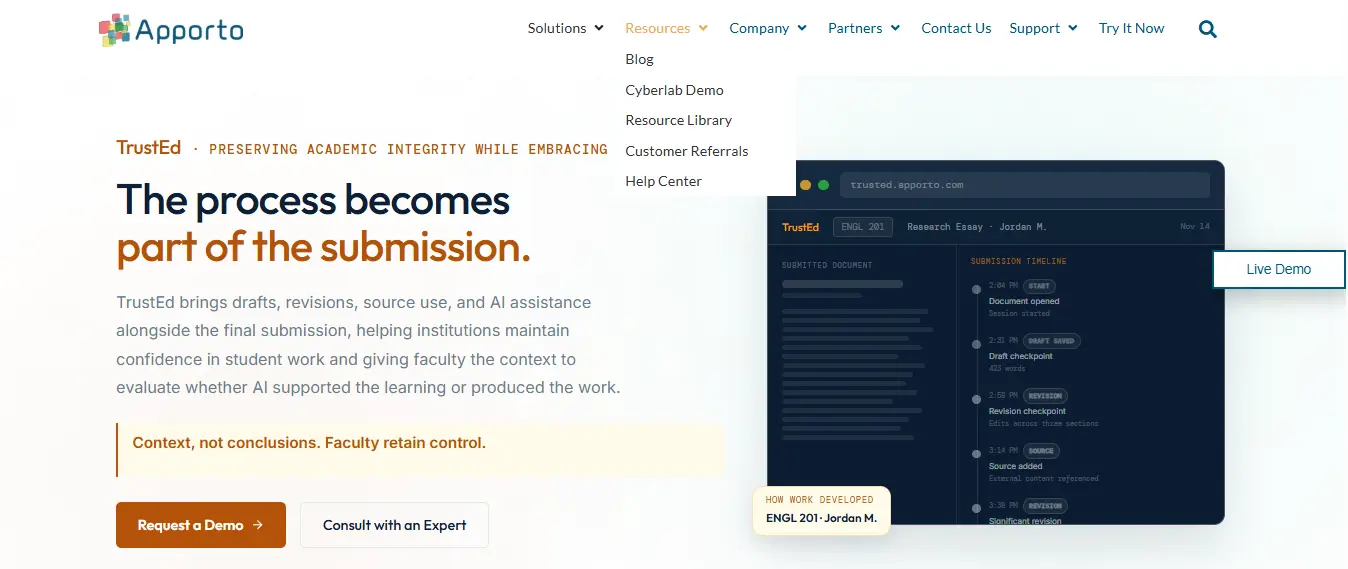
Apporto TrustEd helps universities get a clearer picture of how students complete their assignments, from the first draft to the final submission.
Instead of relying entirely on AI detection scores, it looks at writing activity, revisions, and other indicators that can provide context about a student’s work. That gives educators more information to work with when something seems unusual, without automatically assuming misconduct.
How Does TrustEd Analyze Student Writing Behavior and Authorship?
TrustEd examines how student assignments develop within supported academic tools.
Some of its main features include:
- Writing-Process Monitoring: Records supported writing and editing activity.
- Revision History: Shows how drafts and sections change over time.
- Source Tracking: Provides context about referenced material and pasted content.
- Assignment Timelines: Helps educators follow the development of an assignment.
- AI-Assistance Indicators: Highlights signals that may deserve closer attention.
- Contextual Evidence: Connects writing activity with relevant assignment expectations and patterns.
These details can help faculty understand the work behind a submission, rather than relying on the finished document alone.
How Does TrustEd Help Faculty Review Potential Academic Misconduct?
When an assignment raises concerns, faculty need more than a suspicious-looking score. TrustEd lets instructors examine available revision records, significant text insertions, writing activity, and AI-assistance indicators.
That additional context can help them decide which questions need asking. Still, an unusual writing pattern isn’t proof of cheating. Educators must consider student explanations, review the evidence carefully, and follow university procedures before making decisions.
Why Is TrustEd Relevant for Institution-Wide Academic Integrity Policies?
Universities need consistent academic integrity standards, even when individual courses have different AI rules.
TrustEd supports faculty-defined expectations and workflows with learning management systems such as Canvas, Moodle, Brightspace, and Anthology. Apporto also provides privacy, security, and accessibility information for institutional review.
Universities should verify integrations, permissions, and compliance requirements before adopting the platform. The aim is to support fair academic integrity decisions while keeping educators in control.
How Can Universities Build a Strong Academic Integrity Strategy for the Age of AI?
Protecting academic integrity in the age of AI takes more than updating university rules or installing detection software.
You need a plan that brings together students, faculty, and administrators. Clear expectations matter, but so do fair assessments, proper training, and sensible ways of reviewing potential misconduct.
So, where should universities start? Here are eight practical steps:
1. Review Existing Academic Integrity Policies: Look at your current rules. Do they explain acceptable AI assistance, disclosure requirements, and what counts as unauthorized AI-generated work? Identify anything that needs clarification.
2. Define AI Use Categories: Make it clear when students can use AI, when its use is restricted, and which assignments require completely independent work.
3. Develop AI Literacy Programs: Give students opportunities to learn how AI works, check generated information, recognize ethical boundaries, and make responsible decisions.
4. Redesign Vulnerable Assessments: Consider staged assignments, practical projects, oral explanations, and independent skills checks that make student understanding easier to evaluate.
5. Establish Evidence-Based Review Procedures: Don’t rely on AI detection scores alone. Examine relevant writing records, assignment requirements, and student explanations before reaching conclusions.
6. Protect Student Privacy and Fairness: Review how monitoring tools collect information, address accessibility needs, and account for possible bias against non-native English speakers.
7. Support and Train Faculty: Help instructors understand AI tools, design suitable assessments, and handle suspected misconduct fairly.
8. Monitor and Improve Policies: Pay attention to student feedback, reported incidents, appeal outcomes, and whether existing rules are actually working.
The Tertiary Education Quality and Standards Agency (TEQSA) offers useful guidance on academic integrity policies, assessment practices, and AI-related risks.
Tools such as Apporto TrustEd can also support faculty reviews by providing contextual writing evidence. But success isn’t about catching more students. It’s about creating fair assessments, building trust, and making sure students genuinely learn.
Final Thoughts
AI is here to stay in higher education. The challenge now is making sure students learn to use it responsibly without losing the value of independent work.
That’s easier said than done. AI can produce convincing assignments, and detection tools aren’t always reliable. Universities need clearer policies, better assessment methods, and fair ways to investigate concerns.
Looking at how students develop their work can also tell educators more than an AI detection score alone. Apporto TrustEd supports this approach by providing writing-process information and contextual evidence that faculty can review before making decisions.
The aim isn’t to make students afraid of AI. It’s to protect academic honesty while helping them develop the skills and judgment they’ll need beyond university.
Looking for a more informed approach to academic integrity? Explore Apporto TrustEd and see how it can support fair, evidence-based reviews at your institution.
Frequently Asked Questions (FAQs)
1. What Is Academic Integrity in the Age of AI?
Academic integrity in the age of AI means being honest about how you use artificial intelligence in your academic work. Students should follow university rules, acknowledge AI assistance when required, and make sure their submissions reflect their own understanding and contributions.
2. Is Using AI for University Assignments Considered Cheating?
No, using AI for assignments isn’t automatically cheating. Many universities allow it for brainstorming, studying, or organizing research. Problems arise when students submit unauthorized AI-generated work or fail to disclose assistance that their instructor requires them to acknowledge.
3. Can AI Detectors Prove That a Student Cheated?
No, AI detectors can’t prove that a student cheated. They can mistakenly flag human-written assignments or overlook AI-generated content. Universities need supporting evidence, student explanations, and fair review procedures before deciding whether academic misconduct actually occurred.
4. How Can Students Use AI Without Violating Academic Integrity?
Students can use AI for permitted activities such as explaining difficult concepts, brainstorming ideas, or preparing practice questions. The important part is checking assignment rules, verifying AI-generated information, and being transparent about assistance when required.
5. How Can Universities Prevent AI-Related Academic Misconduct?
Universities can reduce AI-related misconduct by setting clear rules, teaching AI literacy, and designing assignments that encourage independent thinking. Reviewing how students develop their work and handling potential violations fairly can also help protect academic honesty.
6. Why Is Process-Based Assessment Important in the Age of AI?
Process-based assessment helps educators see how students actually complete their assignments. Drafts, revisions, research notes, and explanations of their reasoning can reveal learning that a finished paper alone might not show, giving instructors more context when reviewing academic work.
