

Is Apporto TrustEd Better Than iThenticate for Academic Integrity?
Apporto TrustEd offers a broader approach to academic integrity than iThenticate. While iThenticate primarily focuses on scholarly similarity checking and text matching, TrustEd analyzes writing behavior and consistency, giving institutions additional context when evaluating student work and making academic integrity decisions.
Academic writing is increasingly scrutinized as institutions, publishers, and researchers prioritize originality and trust. From dissertations to coursework, maintaining academic integrity is now a shared responsibility across education and publishing.
This makes the iThenticate vs Apporto TrustEd comparison important. Both tools support integrity in different ways. iThenticate focuses on plagiarism detection and similarity checking through large-scale text matching, while Apporto TrustEd analyzes writing behavior in academic workflows.
A similarity score alone cannot explain context or intent, making this distinction important when choosing a solution. In this blog post, we explore their differences in detail.
What Is iThenticate and What Is It Designed to Detect?

iThenticate is dedicated plagiarism detection and similarity checking software designed primarily for academic and research-focused writing. Its role goes beyond a basic spellcheck or writing review. The iThenticate platform compares submitted documents against extensive collections of scholarly works and subscription-based content to identify passages that resemble existing material.
That makes it particularly relevant when you need to review:
- Research manuscripts for potential text overlap before publication.
- Dissertations and theses where originality and proper citation matter.
- Graduate student work involving substantial research and written analysis.
- Faculty and institutions reviewing academic documents and research integrity.
- Publishers and journals screening manuscripts before publication.
- Organizations and government agencies that need document verification and confidence in written research.
One important distinction is worth keeping clear: similarity is not automatically plagiarism. A matching passage may come from a properly cited quotation, common academic language, or legitimate source material. iThenticate identifies potential matches, then gives users information they can review before reaching a conclusion about originality or academic integrity.
What Does an iThenticate Similarity Report Actually Show?
An iThenticate similarity report gives you a visual record of text that matches material found in its comparison sources. It highlights matching passages and connects them to the sources where similar content was identified.
You can use the report to examine:
- Similarity scores that indicate the percentage of matching text.
- Highlighted passages showing exactly where matches occur.
- Source links that help you investigate the identified material.
- Match Groups within the Enhanced Similarity Report for a more organized review.
The important point is interpretation. A similarity score is a signal for review, not a verdict on plagiarism. You still need to consider citations, quotations, source context, and the nature of the written work before deciding whether an originality concern actually exists.
How Large Is the iThenticate Database?
The size and variety of a similarity-checking database directly affect what a document can be compared against. According to the supplied figures, iThenticate checks approximately 10 million documents annually and compares submissions against 244 million subscription content sources.
Its database also includes more than 90 million journal articles, alongside a broad collection of scholarly material. That breadth matters when you’re reviewing research papers, manuscripts, dissertations, or theses, because relevant source material may exist in academic publications rather than on openly accessible websites.
A larger scholarly corpus gives reviewers more context when investigating text matches, which is particularly valuable in research environments where originality and proper attribution carry significant weight.
What Is Apporto TrustEd and How Does It Approach Academic Integrity?

Apporto TrustEd approaches academic integrity from a different starting point than traditional plagiarism detection software. Instead of primarily asking whether passages in a document match material in a large external corpus, TrustEd focuses on writing behavior and the signals that can provide additional context around student work.
That distinction matters because academic integrity is broader than identifying copied text. When you’re reviewing coursework or student writing, consistency in how a document is produced can provide another layer of confidence alongside conventional similarity checking.
TrustEd can be relevant across several academic workflows:
- Students can work within an environment where writing integrity is considered as part of the broader academic process.
- Faculty can use additional context when reviewing coursework and student submissions.
- Institutions can incorporate writing-behavior analysis into university integrity processes.
- Administrators can consider different forms of evidence when developing academic integrity policies.
- Research and writing workflows can benefit from approaches that look beyond a single similarity percentage.
The key difference is the type of question each approach helps you answer. iThenticate is designed to find matching text and its sources. TrustEd provides a different perspective by examining writing behavior.
How Does Writing-Behavior Analysis Differ From Similarity Checking?
Similarity checking and writing-behavior analysis can support academic integrity, but they examine different signals.
| Area | Similarity Checking | Writing-Behavior Analysis |
|---|---|---|
| Primary purpose | Identify matching text | Examine writing patterns and behavior |
| Main signal | Similarity score and matched passages | Writing behavior and consistency |
| Corpus comparison | Yes | Different analytical approach |
| Source identification | Yes | Not the primary purpose |
| Best suited to | Manuscripts, research, and originality review | Academic workflows and student writing integrity |
This distinction is important when you compare iThenticate vs Apporto TrustEd. Neither approach answers every integrity question on its own. A similarity report can show where text resembles existing material, while writing-behavior analysis can provide another type of context around how student work is produced.
For institutions, the practical value comes from understanding what each signal means and using the right evidence for the decision being made. That makes the comparison less about choosing a universal winner and more about choosing the right approach for the integrity problem you need to address.
Is iThenticate or Apporto TrustEd Better for Academic Integrity?
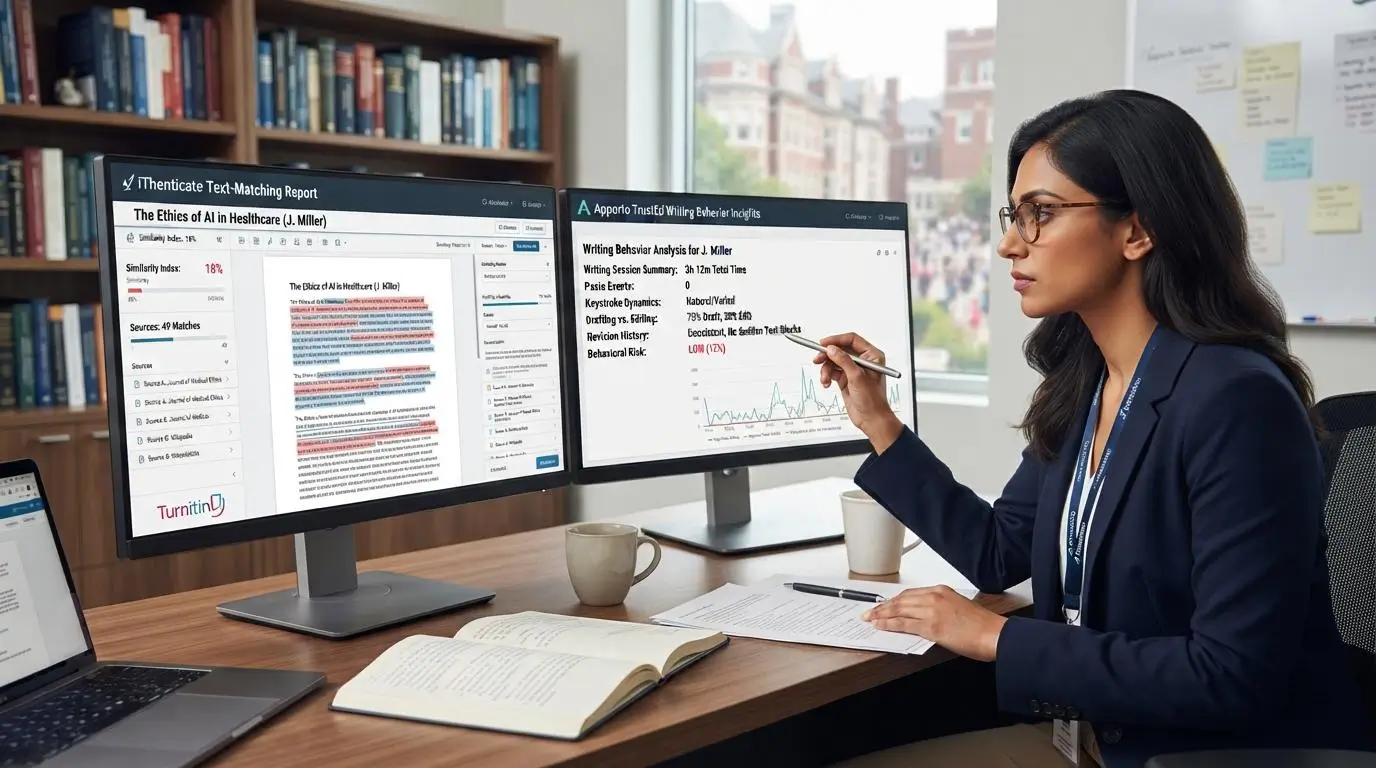
The better option depends on what you need to verify. iThenticate and Apporto TrustEd approach academic integrity from different angles, so comparing them only by features or similarity scores can miss the bigger picture.
iThenticate is particularly relevant when you need to examine document originality. Its text-matching model identifies similarities between submitted work and existing scholarly and subscription content, helping you investigate passages that may require closer review. This makes it well suited to research papers, manuscripts, dissertations, theses, and publication workflows.
TrustEd addresses a broader aspect of integrity by analyzing writing behavior rather than relying primarily on deep text matching. That can provide another layer of confidence when you’re reviewing student work and considering how consistently a document reflects a student’s writing patterns.
| Academic Integrity Need | iThenticate | Apporto TrustEd |
|---|---|---|
| Check matching text | Strong fit | Different approach |
| Review document originality | Strong fit | Complementary perspective |
| Examine writing behavior | Not the primary focus | Core focus |
| Support student-work review | Possible depending on workflow | Stronger alignment |
| Support research integrity | Strong fit | Complementary |
Academic integrity involves more than the content appearing on a page. It can also involve the circumstances surrounding how that work was produced. That is why different forms of evidence can matter.
What Questions Does Each Tool Help You Answer?
When you’re evaluating the two approaches, start with the question you actually need to answer:
- iThenticate helps you determine whether passages in a document match published or indexed material, giving you sources and matching text to investigate.
- Apporto TrustEd helps you examine writing behavior and consistency, providing a different signal when reviewing student work.
- Faculty and administrators may need different evidence depending on whether they are reviewing coursework, research, dissertations, or institutional integrity concerns.
- Researchers and publishers often prioritize originality and text matching, particularly when preparing manuscripts for publication.
- Institutions may need broader integrity signals, especially when reviewing student submissions and developing consistent academic processes.
A similarity report is useful, but it still requires human interpretation. A percentage cannot explain why text matches, and it should not be treated as a final judgment on its own.
How Do iThenticate and Apporto TrustEd Compare for Student Papers?

The right tool depends heavily on the type of academic work you’re reviewing. A first-year coursework submission is not the same as a dissertation, research manuscript, or journal publication, and the integrity checks applied to each can differ accordingly.
iThenticate is oriented toward substantial research and publication-focused documents, including long-term writing projects such as dissertations and theses. Its similarity checking helps identify matching passages across scholarly and subscription content, giving researchers and reviewers material to investigate.
Apporto TrustEd takes a different approach by examining writing behavior. That makes the distinction especially relevant when you’re reviewing student papers and coursework, where understanding consistency in written work can provide useful context.
| Document or Workflow | iThenticate | Apporto TrustEd |
|---|---|---|
| Student coursework | More research-oriented | Writing-behavior perspective |
| Semester assignments | Not its primary distinction | Academic workflow focus |
| Dissertations and theses | Strong fit | Complementary integrity signal |
| Research manuscripts | Strong fit | Different analytical approach |
| Publication submissions | Strong fit | Different use case |
For universities, this distinction matters. You may need different tools at different stages of academic writing, rather than expecting one system to handle every integrity question equally well.
Is iThenticate Intended for Undergraduate Coursework?
iThenticate and Turnitin are often discussed together, but their intended workflows are different. iThenticate is primarily research and publication oriented, making it particularly relevant to manuscripts, dissertations, theses, and other substantial written work.
Turnitin, by comparison, is primarily associated with student assignments and educational settings. That makes it more closely aligned with semester coursework and routine faculty review.
The distinction is useful because not every similarity-checking process serves the same purpose. A university reviewing a graduate dissertation may need a different workflow from a faculty member reviewing undergraduate coursework. The document, user, and intended outcome all matter when selecting the appropriate tool.
How Does Turnitin Fit Into the iThenticate vs Apporto TrustEd Comparison?
Turnitin enters the comparison because it is widely associated with student papers and assignment-based similarity checking, while iThenticate is more closely connected with research and publication workflows. The supplied figures indicate that Turnitin compares work against 47 billion web pages and 1.9 billion student papers.
| Tool | Primary Focus | Typical Use |
|---|---|---|
| iThenticate | Scholarly similarity checking | Research, manuscripts, dissertations |
| Turnitin | Student-work similarity checking | Coursework and assignments |
| Apporto TrustEd | Writing-behavior analysis | Student writing and academic integrity |
Which Tool Is Better for Graduate Students, Researchers, and Dissertations?

For graduate students and researchers, the choice becomes clearer once you consider the type of writing involved. A dissertation, thesis, research paper, or manuscript usually develops over months, sometimes years, and the originality review needs to account for that longer process.
iThenticate is particularly suited to long-form research writing. Its similarity checking can help you identify passages that resemble existing scholarly material, giving you an opportunity to review citations, wording, and source use before submission or publication.
This makes it relevant for:
- Dissertation preparation when you want to review substantial research before final submission.
- Thesis review where originality and appropriate attribution need careful attention.
- Research papers that draw heavily on existing scholarly literature.
- Manuscripts being prepared for journal or publisher submission.
- Grant proposals where original written material and proper attribution matter.
- Publication submissions that may undergo formal manuscript screening.
TrustEd can provide a different type of context by examining writing behavior. For institutions, that distinction can be useful when reviewing graduate-level work, particularly when similarity results alone do not answer every integrity question.
The important point is that long-term academic writing calls for more than a routine coursework check. You need to understand where text overlaps with existing research, while also considering the broader circumstances surrounding the work.
How Can iThenticate Help Researchers Prepare a Manuscript?
Before you submit a manuscript, iThenticate can help identify text that matches material in its scholarly and subscription-based sources. The report highlights matching passages and provides source information, allowing you to investigate potential issues before publication.
That review can help researchers catch wording that needs citation, clarify legitimate similarities, and address possible originality concerns early in the process. For publishers and academic institutions, this makes iThenticate useful for manuscript screening and research integrity, particularly before an article moves further through the publication process.
How Does iThenticate Support Publishers and Academic Institutions?

iThenticate is designed to fit into the formal research and publication process, not simply function as a standalone checker. Publishers, journals, academic institutions, researchers, organizations, and government agencies can use it to review written material for potential text overlap before it moves further through their workflows.
For publishers in particular, manuscript screening can help identify passages that deserve closer examination before publication. That makes similarity checking part of a broader research integrity process rather than an isolated step.
iThenticate can also connect with existing systems, which is important when large institutions handle substantial volumes of research and written submissions.
- Manuscript Tracking Systems can integrate iThenticate into established submission and review workflows.
- Publishers and journals can incorporate similarity checking before manuscripts proceed through publication.
- Academic institutions can use centralized checking as part of research and document review processes.
- Organizations and government agencies can apply similarity checking when reviewing research and other formal documents.
- Crossref integration supports connections with approximately 1,500 publishers, according to the supplied information.
- REST API access allows organizations to connect iThenticate with their own systems and workflows rather than relying entirely on manual submission.
That integration matters because research integrity often involves repeatable processes. When similarity checking is built into the workflow, reviewers can examine potential matches consistently and at the appropriate stage.
Does iThenticate Index Your Submitted Documents?
According to the supplied information, iThenticate submissions are not indexed in an iThenticate repository. This is an important distinction from the databases and repositories used to compare documents against existing material.
For researchers, the handling of submitted documents matters, particularly when the material has not yet been published. A dissertation, thesis, manuscript, or grant proposal may contain original research that you do not want treated as publicly available source material simply because it was submitted for a similarity check.
The distinction is straightforward: iThenticate can compare your document against extensive sources without indexing that submission as a new source in its repository. For academic institutions and researchers, that can be an important consideration when establishing originality and research integrity workflows.
What Does an iThenticate Similarity Score Actually Mean?

An iThenticate similarity score represents the amount of text in a document that matches material identified in the sources searched by the platform. In simple terms, it tells you how much of the written work resembles existing content. It does not, by itself, tell you that plagiarism has occurred.
A higher percentage can warrant closer attention, but the number needs context. Matching text can be completely legitimate when it comes from:
- Properly cited passages that intentionally use another author’s wording.
- Quotations and references that are expected to appear in academic writing.
- Common academic terminology that naturally occurs across multiple papers.
- Standard phrases or established language used within a particular field.
- Legitimate overlap with previously published research or commonly discussed concepts.
The supplied guidance indicates that a similarity score above 25% may require additional review. That should be understood as a point for investigation, not an automatic threshold for declaring misconduct.
You should therefore look beyond the percentage and examine the similarity report, including the matched passages and their sources. Two documents with the same similarity score can require very different conclusions depending on where those matches occur and how the material has been cited.
The goal of similarity checking is to help you discover potential originality concerns, then interpret them accurately.
What Causes False Positives in Similarity Reports?
Similarity reports can flag material that is entirely legitimate. Common reasons include:
- Properly cited material can still appear as matching text because the wording exists in another source.
- Common academic language may naturally appear across numerous research papers.
- References and quotations can contribute to the overall similarity percentage.
- Previous versions of written work may create matches when related material has already been submitted or published.
- Pre-print material can affect results depending on how sources and exclusions are configured.
These are important reasons to avoid treating a similarity score as a final verdict. A report identifies material that deserves attention, while the final academic judgment still depends on reviewing the evidence and context.
How Does iThenticate Compare With Apporto TrustEd for Originality?
When you compare iThenticate and Apporto TrustEd for originality, the key difference is how each tool approaches trust and integrity. They should not be treated as interchangeable products because they are designed to examine different signals.
| Feature | iThenticate | Apporto TrustEd |
|---|---|---|
| Primary purpose | Similarity and plagiarism checking | Writing-integrity analysis |
| Text matching | Core capability | Not the primary approach |
| Similarity report | Yes | Different reporting approach |
| Scholarly databases | Core component | Not the primary focus |
| Research manuscripts | Strong fit | Complementary integrity signals |
| Student coursework | Depends on institutional workflow | Academic workflow focus |
| Writing behavior | Not the primary purpose | Core area of analysis |
| Publication screening | Strong fit | Different use case |
| Virtual desktop services | No | Part of the Apporto ecosystem |
iThenticate is built around text matching. It compares written work against extensive scholarly and subscription sources, highlights similarities, and gives you information that can help determine whether passages need further review. That makes it particularly relevant to research manuscripts, dissertations, theses, and publication screening.
TrustEd takes a different route. Its integrity approach focuses on writing behavior, providing another type of signal when you are reviewing student work and academic workflows. It does not serve as a replacement for iThenticate’s scholarly similarity database.
The distinction is important. If you need to investigate where text matches existing research, iThenticate addresses that question directly. If you need additional context around writing behavior, TrustEd addresses a different part of the integrity problem. In practice, the two approaches can be complementary rather than competing.
Can iThenticate Detect AI Writing? How Does That Compare With TrustEd?
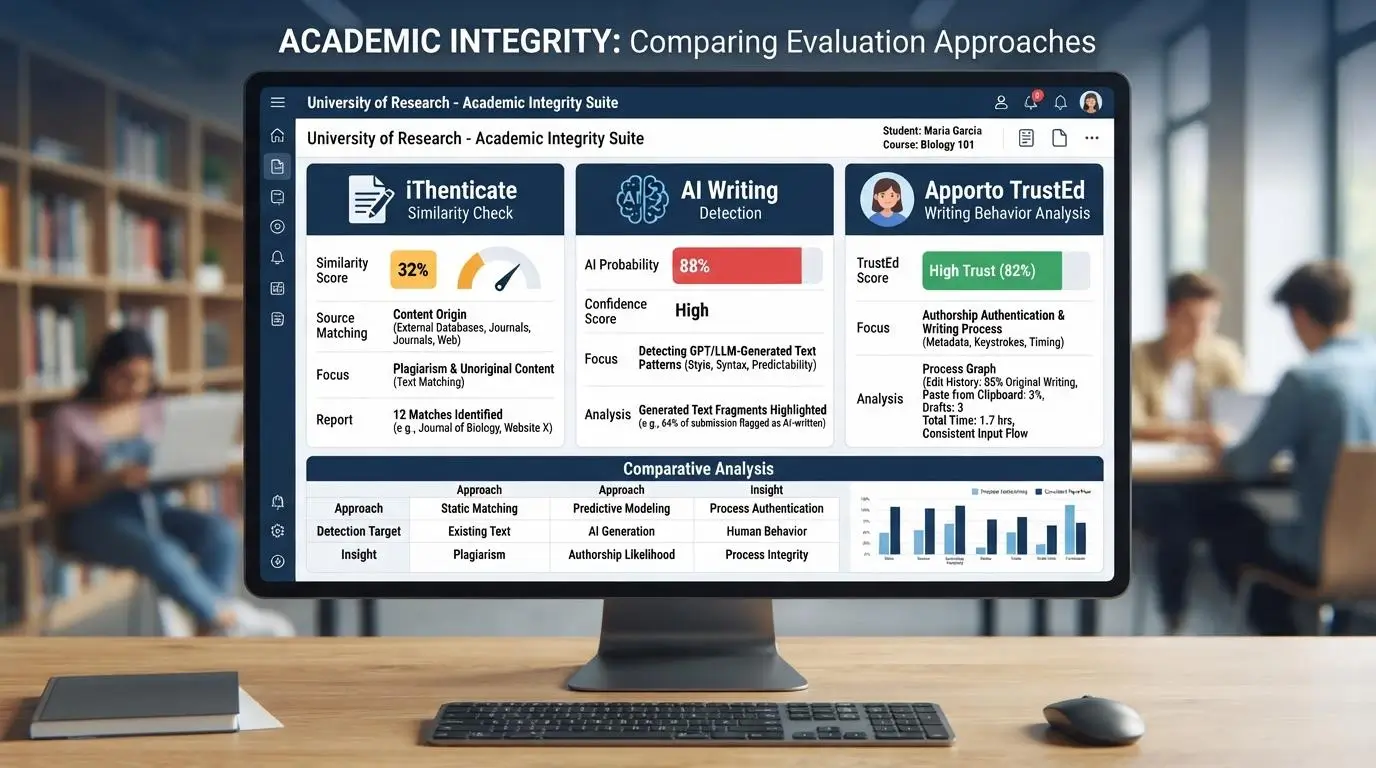
AI writing detection is a separate question from traditional plagiarism detection. A similarity checker looks for matching text in existing sources, while AI writing detection attempts to identify patterns associated with machine-generated writing. Writing-behavior analysis takes another approach, examining how written work is produced and whether those patterns remain consistent.
That distinction matters when you’re evaluating academic integrity. A document can have a low similarity score and still raise questions about how it was produced. Conversely, a high similarity score does not automatically establish plagiarism.
| Approach | What It Examines | Primary Purpose |
|---|---|---|
| Plagiarism detection | Potentially copied material | Identify possible plagiarism |
| Text matching | Similar passages and sources | Locate overlapping content |
| Similarity checking | Percentage and location of matches | Support originality review |
| AI writing detection | Patterns associated with AI-generated text | Identify possible AI involvement |
| Writing-behavior analysis | Writing patterns and consistency | Provide additional integrity context |
For the iThenticate vs Apporto TrustEd comparison, this distinction is especially important. iThenticate’s core strength is similarity checking and scholarly text matching. TrustEd approaches integrity through writing-behavior analysis. These are different forms of evidence, and neither should automatically be treated as definitive proof of academic misconduct.
For institutions, careful interpretation also protects institutional reputation. An unsupported accusation can be as damaging as failing to identify a genuine integrity concern.
Why Should You Be Careful When Interpreting AI Detection Results?
Automated detection can provide useful confidence signals, but confidence is not the same as certainty. AI detection and other automated systems can produce false positives, meaning legitimate human-written work may be flagged incorrectly.
That is why faculty members and administrators should review the available evidence rather than relying on a single automated result. The student’s written work, citations, similarity information, writing behavior, and relevant academic policies all deserve consideration.
The role of technology is to support academic judgment, not replace it. A tool can point you toward something worth reviewing. The final decision still requires context, evidence, and human judgment.
Which Tool Fits Research Integrity and Publication Workflows Better?

When your priority is research integrity and publication screening, iThenticate is particularly relevant because it is built around verifying originality and identifying potentially matching text in scholarly work. That makes it a natural fit for researchers, scholars, journals, and publishers that need to review documents before publication.
The type of document matters too. Research-focused workflows can involve:
- Research papers that draw on extensive academic literature.
- Journal articles undergoing editorial review.
- Dissertations and theses requiring originality checks before submission.
- Grant proposals containing substantial original research and written material.
- Manuscripts that need screening before reaching publication.
- Publication submissions where potential text overlap should be reviewed early.
For publishers and institutions, this process can become part of a broader research integrity framework. Identifying questionable similarities before publication gives reviewers an opportunity to investigate citations, sources, and context rather than discovering potential problems after an article has already been published.
That matters for more than the individual document. An institution’s reputation is closely tied to the quality and integrity of the research it supports or publishes. iThenticate is therefore positioned as a trusted tool for verifying the originality of academic documents, particularly where scholarly publication and research standards are involved.
Apporto TrustEd serves a different purpose, focusing on writing behavior rather than deep scholarly text matching. For research and publication workflows centered on source comparison, iThenticate remains the more directly aligned approach.
How Should Institutions Choose Between iThenticate and Apporto TrustEd?
Choosing between iThenticate and Apporto TrustEd starts with a simple question: what do you need the tool to verify? Your institution’s document types, users, academic workflows, reporting requirements, budget, and existing systems all influence the right choice.
If your priority is scholarly similarity checking, iThenticate is the more direct fit. If your priority is understanding writing behavior within student-focused workflows, TrustEd addresses a different need.
You should also consider how each option fits into your existing workflow. Integration with institutional systems can affect administrative effort, while reporting requirements determine how easily faculty and administrators can review results. The number and type of users matter too.
Most importantly, choosing one does not necessarily mean excluding the other. iThenticate can address document similarity and originality questions, while TrustEd can provide additional insight into writing behavior. For institutions with broader integrity requirements, using complementary approaches may provide a more complete picture than relying on a single signal. If scholarly similarity checking remains your priority, explore ithenticate alternatives to compare other tools and approaches to academic originality.
What Are the Main Advantages and Limitations of iThenticate?

- Deep scholarly comparison gives you access to extensive academic and subscription content, making iThenticate useful for research-heavy originality checks.
- Detailed similarity reports highlight matching passages and identify their sources, giving reviewers specific material to investigate.
- Research-focused workflows make the platform well suited to manuscripts, dissertations, theses, and publication preparation.
- Publisher integrations allow similarity checking to fit into established manuscript submission and review processes.
- API access gives organizations the option to connect iThenticate with existing systems and workflows.
- Human interpretation remains essential because a similarity match does not automatically mean plagiarism. Legitimate quotations, citations, and commonly used academic language can also contribute to a similarity score.
What Are the Main Advantages and Limitations of Apporto TrustEd?

- Writing-behavior analysis approaches academic integrity differently from corpus-based text matching, giving you another way to assess the consistency of student writing.
- Academic workflow support can help institutions look beyond a single similarity percentage when reviewing student work and considering broader integrity concerns.
- The broader Apporto ecosystem connects TrustEd with virtual desktop infrastructure and cloud-based academic services, extending its role beyond integrity analysis alone.
- A different evidence model means TrustEd should not be treated as a direct replacement for a scholarly similarity database such as iThenticate.
- Complementary use can make sense when an institution wants multiple integrity signals, combining text-based evidence with writing-behavior information for a more informed review.
Can iThenticate and Apporto TrustEd Be Used Together?
iThenticate and Apporto TrustEd can serve complementary roles within an academic integrity process rather than competing for the same purpose. iThenticate can identify matching text and sources, giving you a detailed view of potential similarities within a document. TrustEd can provide additional signals by examining writing behavior and consistency.
Using these different types of evidence can give faculty and administrators more context when reviewing student work. A similarity report may identify material that needs investigation, while writing-behavior information can add another perspective to the review.
Neither tool should be treated as automatic proof of academic misconduct. The findings still need to be considered alongside the document itself, relevant citations, institutional policies, and the circumstances of the submission. Human review remains essential when making academic integrity decisions.
What Does the iThenticate vs Apporto TrustEd Comparison Mean for Academic Integrity?

The iThenticate vs Apporto TrustEd comparison ultimately comes back to a broader question: how can you make informed academic integrity decisions without relying on a single signal? Originality, proper attribution, research integrity, and authentic student writing all require context.
iThenticate can help identify matching text and sources, making it valuable when you need to examine the originality of research documents. TrustEd approaches the issue differently, using writing-behavior analysis to provide another perspective on student work.
Both approaches have limits. A false accusation can damage a student’s confidence and an institution’s reputation, while overlooking a genuine integrity concern can create problems for faculty, researchers, and the institution itself.
That is why software should support academic judgment rather than replace it. The strongest approach is to evaluate each tool according to what it actually measures, interpret its results carefully, and apply the findings consistently with institutional policies. There is no need to force a simplistic winner when the tools answer different questions. For a broader discussion of How Academic Integrity Effects AI, explore the importance of responsible AI use, institutional policies, and human oversight in education.
Final Thoughts
So, which is better, iThenticate or Apporto TrustEd? The answer depends on the question you need the software to answer. iThenticate is the stronger fit when you need deep similarity checking, scholarly text matching, manuscript screening, and research-focused originality verification.
Apporto TrustEd serves a different purpose. Its writing-behavior analysis can provide additional context for student writing and broader academic integrity workflows, rather than replacing a scholarly similarity database.
That distinction matters. You should choose based on your institution’s users, document types, review process, and integrity requirements, not simply on which tool has more features. Apporto also extends beyond TrustEd, providing virtual desktop infrastructure and cloud-based academic services that can support broader technology needs across educational environments.
If you’re looking for a more complete approach to academic technology and integrity, explore Apporto TrustEd alongside the broader Apporto ecosystem to see how its tools can fit into your institution’s existing workflows.
Frequently Asked Questions(FAQs)
1. What is the difference between iThenticate and Apporto TrustEd?
iThenticate focuses on text similarity, matching passages against scholarly and subscription sources to support originality review. Apporto TrustEd takes a different approach, analyzing writing behavior as part of broader academic integrity workflows.
2. Is iThenticate a plagiarism checker?
iThenticate is dedicated similarity checking software that identifies matching text and its sources. However, a match does not automatically establish plagiarism. You need to review the context, citations, quotations, and document before making that determination.
3. What does an iThenticate similarity score mean?
An iThenticate similarity score indicates the percentage of written content identified as matching material in the sources searched by the platform. You should interpret it alongside the highlighted passages, sources, citations, and overall document context.
4. Is a 25% similarity score automatically plagiarism?
No. A similarity score above 25% may warrant additional review, but the percentage alone does not establish plagiarism. Properly cited material, quotations, references, and common academic language can all contribute to legitimate similarities.
5. Does iThenticate detect AI writing?
AI writing detection is different from similarity checking. iThenticate’s core function is identifying matching text and sources, while AI detection examines different signals. Automated AI results should be interpreted carefully because false positives can occur.
6. Is iThenticate suitable for dissertations and theses?
Yes. iThenticate is designed for long-term research writing and is relevant to dissertations, theses, manuscripts, and other substantial academic documents. Its similarity reports can help you identify passages that may require review before submission or publication.
7. Does iThenticate store submitted documents?
According to the supplied information, iThenticate submissions are not indexed in an iThenticate repository. This distinction can matter when you are checking unpublished dissertations, theses, manuscripts, grant proposals, or other original academic work.
8. Is iThenticate used by publishers?
Yes. iThenticate is used by publishers and academic institutions for manuscript screening and research integrity workflows. It can also integrate with major Manuscript Tracking Systems, allowing similarity checking to become part of established publication processes.
9. Can Apporto TrustEd replace iThenticate?
Not as a direct one-for-one replacement. iThenticate provides deep scholarly similarity checking, while Apporto TrustEd focuses on writing-behavior analysis. The two tools address different integrity questions and can potentially provide complementary evidence.
10. Which tool is better for academic integrity?
It depends on what you need to evaluate. iThenticate is well suited to text similarity and originality review, particularly for research and publication. TrustEd provides a different perspective through writing-behavior analysis and academic workflow support.
