
What Is the Best iThenticate Alternative for Academic Institutions?
Apporto TrustEd is a leading iThenticate alternative for institutions seeking a broader, context-driven approach to academic integrity. It combines integrity analytics, writing-behavior insights, and institutional workflows to help educators make informed decisions beyond a single similarity or AI-detection score.
Academic writing has a peculiar problem: two papers can contain the same phrase for perfectly legitimate reasons, yet a similarity report can make that overlap look suspicious at first glance. The real value of a plagiarism checker lies in helping you understand those matches, not simply producing a percentage.
iThenticate has long served researchers, academic publishers, and institutions for scholarly similarity checking. But your needs may extend further, perhaps you want AI writing detection, multilingual plagiarism detection, individual access, citation support, or a more accessible price.
In this blog post, you’ll explore the leading iThenticate alternatives and compare their accuracy, databases, features, pricing, integrations, and suitability for different academic workflows.
How Did We Evaluate These iThenticate Alternatives?
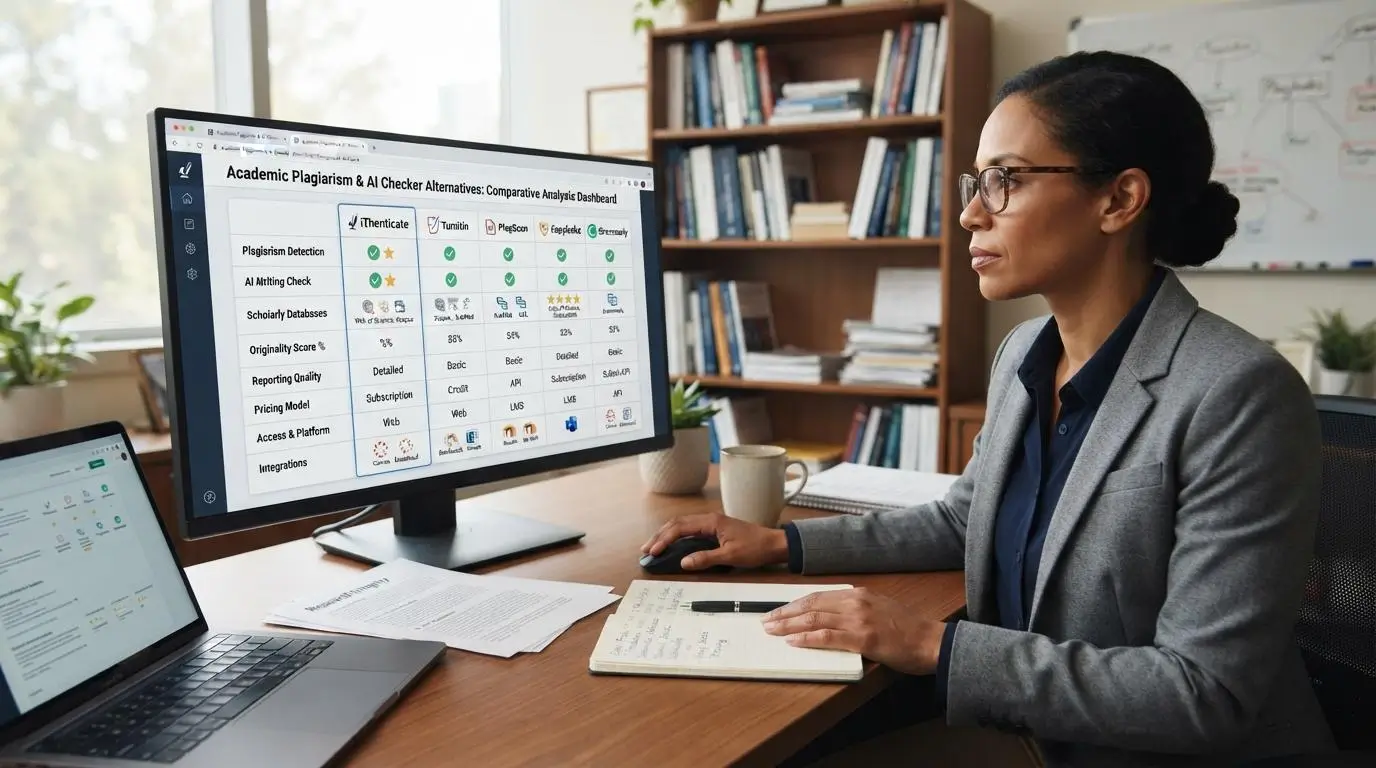
Choosing an iThenticate alternative depends on what you need to check and who will use the results. Researchers and publishers may prioritize scholarly databases and academic integrity, while students and individual writers may care more about accessibility, transparent pricing, citation support, or convenient online checking.
Universities often need a wider combination of features, including AI detection, multilingual support, security, and institutional workflows. The evaluation therefore considers how each platform handles plagiarism checking, AI writing detection, originality, reporting, access, pricing, and practical use across academic environments.
Which Plagiarism Detection Features Matter Most?
A useful plagiarism checker should do more than flag matching words. Strong plagiarism detection tools should identify exact matches, recognize paraphrased content, and search a relevant database for potentially unoriginal material.
Plagiarism detection can help detect plagiarism, but similarity scores require human interpretation to determine whether matches represent problematic plagiarized content.
This matters for academic papers, student papers, and submitted text, where missing citations or legitimate shared language can affect results. Features supporting originality and identifying possible self plagiarism also add value.
How Important Are AI Detection, Citations, and Writing Support?
AI detection and plagiarism detection measure different things. An AI detector estimates whether writing resembles AI generated or machine-produced text, while plagiarism checking looks for overlap with existing sources.
For that reason, AI detection tools should complement rather than replace traditional checking. Useful writing features can also include citation generation, tools that flag missing citations, and grammar assistance for identifying grammatical errors.
An AI content detector can help evaluate AI content, while broader AI tools may support writing and research. False positives remain an important consideration.
Which Platform Offers the Best Long-Term Value?
Long-term value is not determined by price alone. Free tools, including free Turnitin alternatives, can be useful when you need occasional checks, while a free version may provide enough access for individual users. Other platforms use purchase credits, word-based limits, subscriptions, or custom pricing for institutional access.
Compare how many words you can process, whether an account is required, and whether you can upload a document directly online. Institutional users may also need LMS integration, support, security, and scalable software. Ultimately, long-term value depends on accuracy, access, features, and intended use.
Quick Comparison of the Best iThenticate Alternatives
Choosing an iThenticate alternative depends on what you need to verify. Some platforms are built for universities and scholarly publishing, while others are better suited to individual researchers, students, writers, or content teams.
The differences can be substantial across plagiarism databases, AI detection, multilingual support, citation features, free access, pricing, and institutional integrations. Similarity checking and AI detection also serve different purposes, so the strongest option for your workflow may not be the one with the longest feature list.
| Platform | Best For | Plagiarism Detection | AI Detection | Free Access | Individual Access | Ideal Users |
|---|---|---|---|---|---|---|
| Apporto TrustEd | Academic integrity | Integrity-focused | Integrity-focused | Custom | Contact | Institutions |
| Copyleaks | Plagiarism & AI detection | Advanced | Advanced | Limited | Yes | Schools & content teams |
| Compilatio | Academic plagiarism checking | Advanced | Available | Limited | Yes | Universities & publishers |
| Ouriginal | Academic integrity | Advanced | Available | Contact | Limited | Educational institutions |
| GPTZero | AI writing detection | Good | Advanced | Yes | Yes | Educators & students |
| Originality.ai | Content originality | Advanced | Advanced | Limited | Yes | Publishers & writers |
| StrikePlagiarism | Academic integrity | Advanced | Available | Contact | Limited | Universities |
| Pangram | AI detection | Limited | Advanced | Contact | Yes | Writers & organizations |
Best iThenticate Alternatives (A Detailed Overview)
1. Apporto TrustEd
Overview
Apporto TrustEd approaches Academic Integrity and AI from a broader perspective than a conventional plagiarism checker. Instead of relying on a single score to evaluate student papers or suspected AI use, it emphasizes integrity analytics, writing behavior, and institutional context. This gives educators additional evidence when reviewing student work.
Highlights
- Focuses on academic integrity and responsible AI use
- Uses writing behavior as part of the broader review process
- Supports human review and contextual decision-making
- Designed around institutional workflows
- Helps educators examine student work beyond a single detection result
Best For
Apporto TrustEd is best suited to academic institutions that want a broader integrity workflow for evaluating student writing and potential AI use. It can be particularly useful when educators need contextual evidence before making decisions about academic work.
Limitations
It should not be viewed as a direct replacement for a traditional plagiarism detector because its emphasis is broader integrity analytics and institutional context rather than conventional text-matching. For a detailed comparison of these different approaches to academic integrity, explore Ithenticate Vs Apporto Trusted
Pricing
Pricing is institution-focused and depends on the required deployment and services. For universities and schools, the relevant comparison is therefore the overall value of the integrity workflow rather than a simple individual subscription price.
2. Copyleaks
Overview:
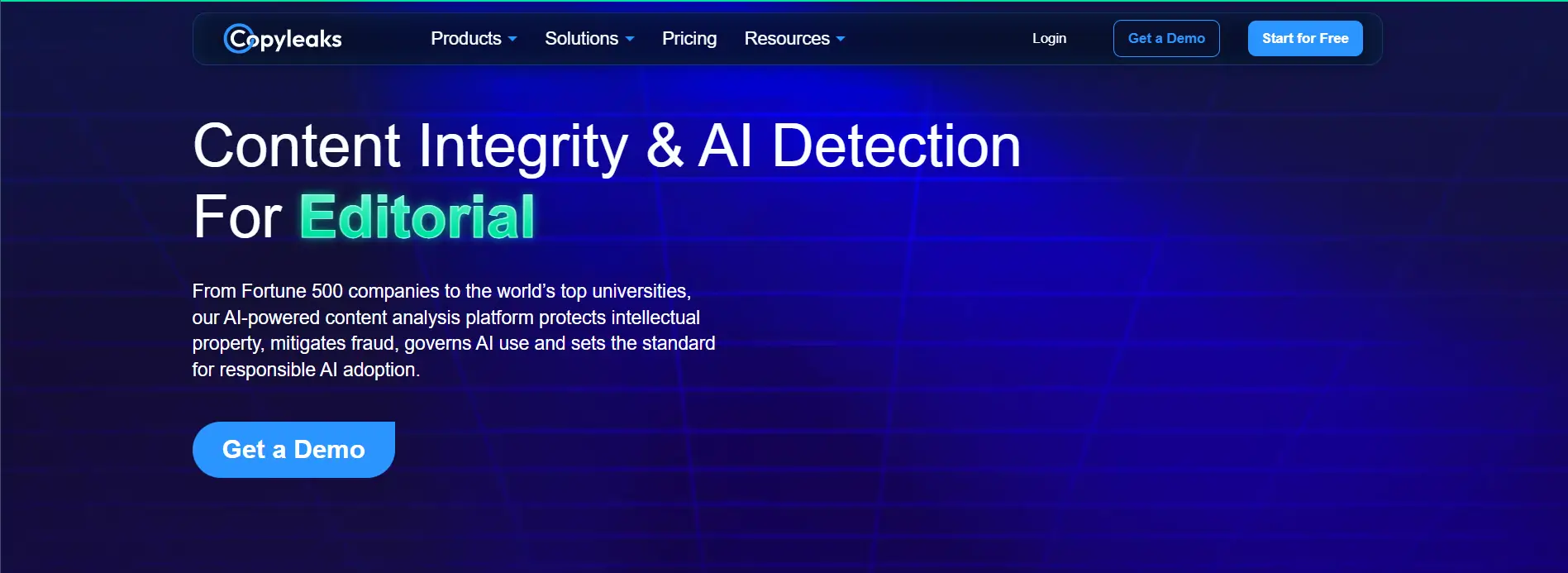
Copyleaks combines a powerful plagiarism checker with AI detection, making it a practical option when you want to evaluate both originality and potentially AI-generated content in the same workflow. Its broad database coverage supports academic, publishing, and content-focused use cases.
Copyleaks is particularly notable for its ability to identify less obvious similarities. Its matching technology can detect paraphrased content across multiple languages, which can be useful when simple word-for-word comparison is not enough.
Highlights
- Plagiarism detection across more than 60 trillion websites
- Sophisticated matching for paraphrased content
- Support for more than 100 languages
- AI detection for AI-generated text
- LMS integration and API capabilities
- Designed to support originality checks at scale
Best For
Copyleaks works well for schools, publishers, content teams, and organizations that need plagiarism detection and AI checks together. Its integrations can also make it easier to incorporate checking into existing academic or content workflows.
Limitations
The platform offers a broad feature set, so individual users looking only for occasional plagiarism checking may find some capabilities unnecessary.
Pricing
Pricing varies according to usage and selected features. For organizations processing large volumes, the relevant value comes from combining extensive databases, multilingual checking, AI detection, LMS integration, and API access in one platform.
3. Compilatio
Overview
Compilatio is an academic-focused plagiarism detection platform designed to help institutions evaluate submitted work for originality. Its emphasis on academic integrity makes it relevant to universities, educators, and organizations that need structured plagiarism checking across student papers and other academic documents.
Compilatio is widely used by universities and publishing houses as a direct alternative to Turnitin, making it particularly relevant when institutional requirements extend beyond occasional individual checks. Its reporting approach can help educators identify similarities and review potentially problematic sections rather than treating every match as evidence of misconduct.
Highlights:
- Designed for academic institutions and educational workflows
- Supports plagiarism detection and originality checking
- Provides reports to help educators interpret similarities
- Suitable for institutional use across academic submissions
- Relevant to universities and publishing environments
Best For
Compilatio is best suited to universities, academic institutions, and publishing houses that need structured plagiarism detection and originality checks as part of an established academic integrity process.
Limitations
Its institutional orientation may make it less appealing to individual users who simply want an inexpensive, occasional plagiarism check.
Pricing
Pricing depends on the selected service and institutional requirements. For organizations, the overall value comes from combining plagiarism detection, reporting, originality assessment, and support for established academic workflows rather than focusing only on the cost of an individual check.
4. Ouriginal
Overview
Ouriginal is an institution-focused plagiarism checker designed to support academic integrity across universities, schools, and other educational organizations. Its core purpose is similarity checking, helping educators review academic papers, student submissions, and other documents for potentially unoriginal material.
Ouriginal fits naturally into environments where plagiarism checking is part of an established academic process. Instead of treating originality as an occasional task, institutions can incorporate similarity reviews into their broader submission and assessment workflows. This makes it relevant for educators managing large numbers of students and academic documents.
Highlights
- Designed for institutional plagiarism detection
- Supports similarity checking across academic submissions
- Helps educators review originality
- Suited to university and school workflows
- Supports structured evaluation of student work
Best For
Ouriginal is best suited to universities, schools, and educational institutions that need consistent plagiarism detection across student submissions and academic workflows. It can be particularly useful when similarity checking needs to form part of an institution’s wider academic integrity process.
Limitations
Its institutional focus may be less suitable for individual researchers or writers seeking a simple, consumer-oriented plagiarism check.
Pricing
Pricing depends on institutional requirements and deployment. For schools and universities, value is better assessed through workflow fit, originality checking, institutional support, and the ability to manage submissions consistently rather than through an individual subscription price.
5. GPTZero
Overview
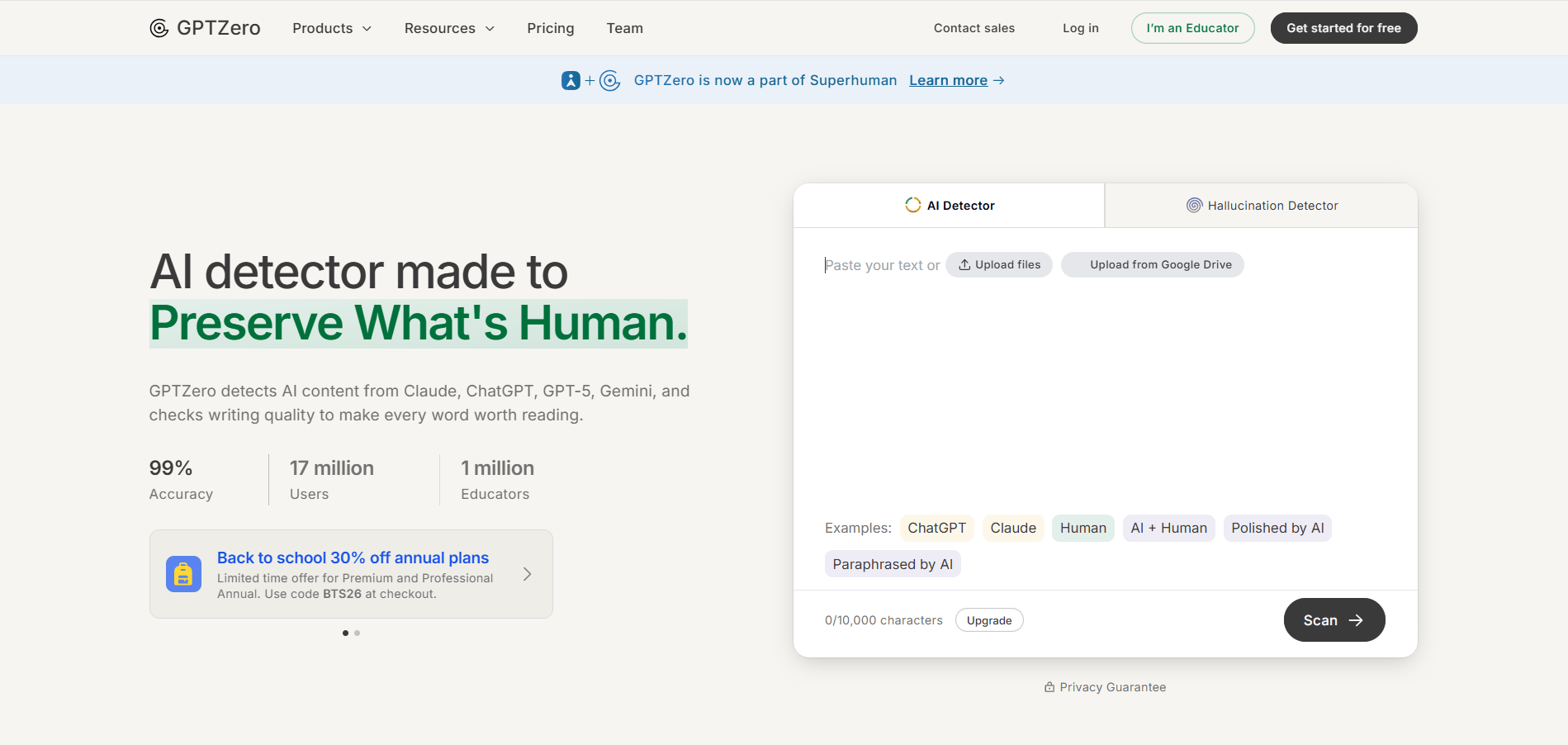
GPTZero is primarily an AI detector rather than a direct replacement for scholarly similarity databases such as iThenticate. Its main purpose is AI writing detection, helping teachers and educators assess whether submitted work may contain AI-generated content. That makes it particularly relevant as AI-assisted writing becomes more common in education.
For students, the platform can provide another way to examine writing before submission, while teachers can use its results as one part of a broader academic integrity review. False positives remain an important consideration with any AI detector, so a result should not automatically be treated as proof that content was produced by AI. Comparing the result with writing history and other evidence provides better context.
Highlights
- Focused on AI-generated content detection
- Designed with education and educators in mind
- Supports reports for reviewing detection results
- Useful for evaluating student submissions
- Offers a free version for individual users
Best For
GPTZero is best suited to students, teachers, and educational users who primarily need AI detection rather than comprehensive scholarly plagiarism checking.
Limitations
It is not a like-for-like replacement for a scholarly similarity database, so institutions requiring extensive plagiarism detection may need an additional plagiarism checker.
Pricing
GPTZero offers a free version, with additional access and features available through paid options.
6. Originality.ai
Overview
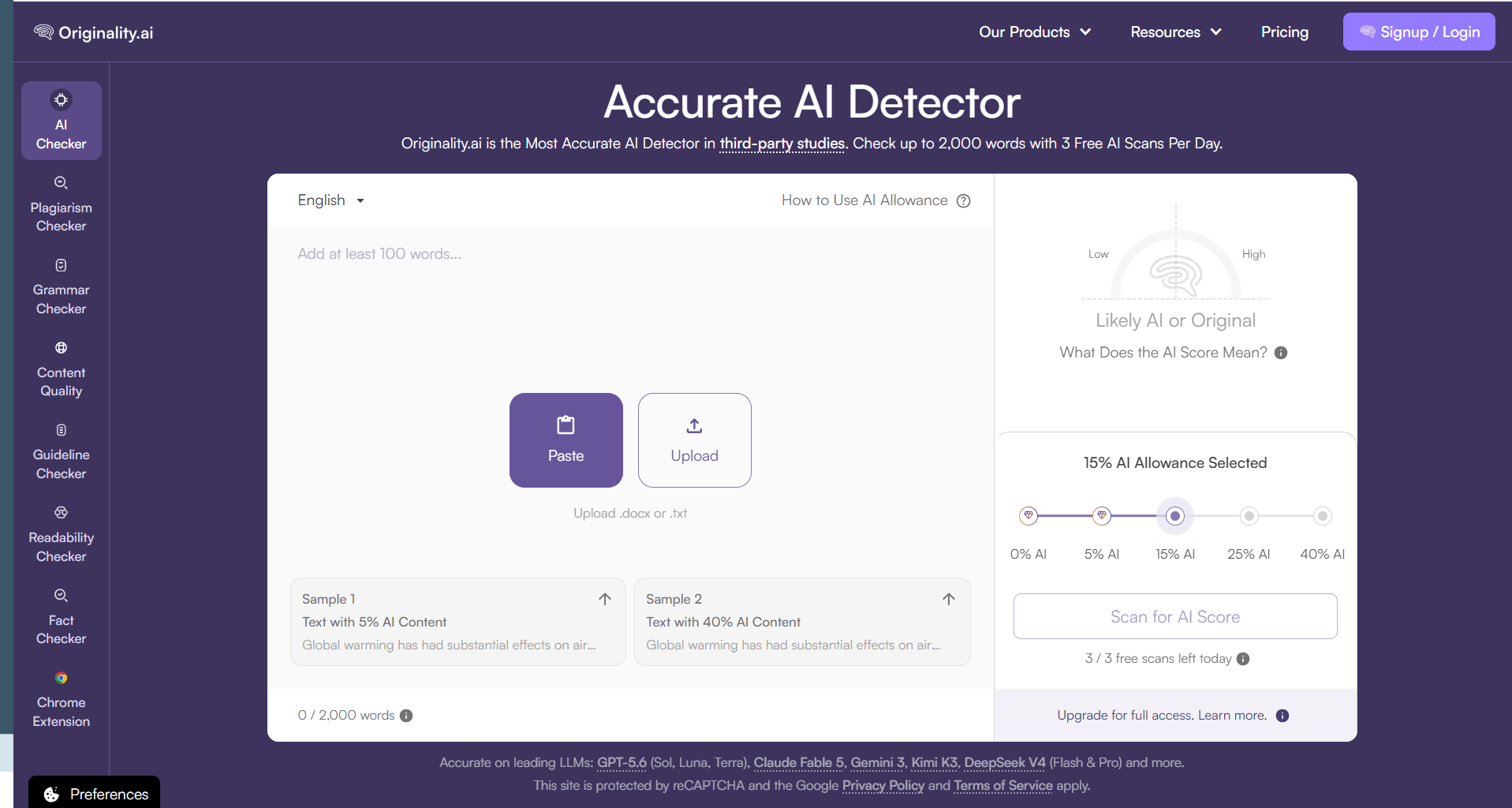
Originality.ai combines a plagiarism checker with AI detection, giving publishers and writers a single platform for evaluating content originality. This combination is useful when you need to examine both potential source overlap and writing that may have been produced or assisted by AI. It is particularly relevant to content teams managing large volumes of written material.
The platform’s plagiarism cross-reference capabilities make it relevant when originality extends beyond checking for obvious copied passages. For academic papers, publishers can use plagiarism results as an initial signal for further review, while its AI detection can provide additional information about potentially AI-generated writing. As with other detection platforms, results should be interpreted carefully rather than treated as definitive proof of authorship.
Highlights
- Combines plagiarism detection with AI detection
- Supports content originality workflows
- Provides reports for reviewing detection results
- Useful for publishers and professional writers
- Plagiarism cross-reference capabilities help identify matching content
Best For
Originality.ai is best suited to publishers, writers, and content teams that want AI detection and plagiarism checking within one content originality workflow.
Limitations
Users seeking only scholarly plagiarism checking may find its broader content-focused feature set less tailored to institutional academic workflows.
Pricing
Pricing varies by plan and usage. For content-focused users, value depends on the combination of plagiarism checking, AI detection, reporting, and detection accuracy rather than any single feature.
7. StrikePlagiarism
Overview
StrikePlagiarism is an institution-oriented plagiarism detection solution designed to support academic integrity across universities and other educational organizations. Its focus on plagiarism detection and similarity checking makes it relevant for reviewing student submissions, academic papers, and other institutional documents where originality matters.
The platform is most relevant when plagiarism checking needs to operate as part of an established institutional process rather than as a standalone service for occasional users. Educators can use similarity results to identify passages that warrant closer examination, while institutions can incorporate those checks into their broader approach to academic integrity and responsible assessment.
Highlights
- Designed for academic institutions and educational workflows
- Supports plagiarism and similarity checking
- Helps evaluate originality in academic submissions
- Provides reports for reviewing detected similarities
- Fits broader academic integrity processes
Best For
StrikePlagiarism is best suited to universities, schools, and educational institutions that need structured plagiarism detection for student work and academic papers.
Limitations
Its institutional orientation may make it less convenient for individual writers or researchers looking for a simple, consumer-focused plagiarism checker.
Pricing
Pricing depends on institutional requirements, access arrangements, and selected services. For educational organizations, its long-term value is better judged by workflow compatibility, reporting, originality checking, and institutional support than by the price of an individual scan.
8. Pangram
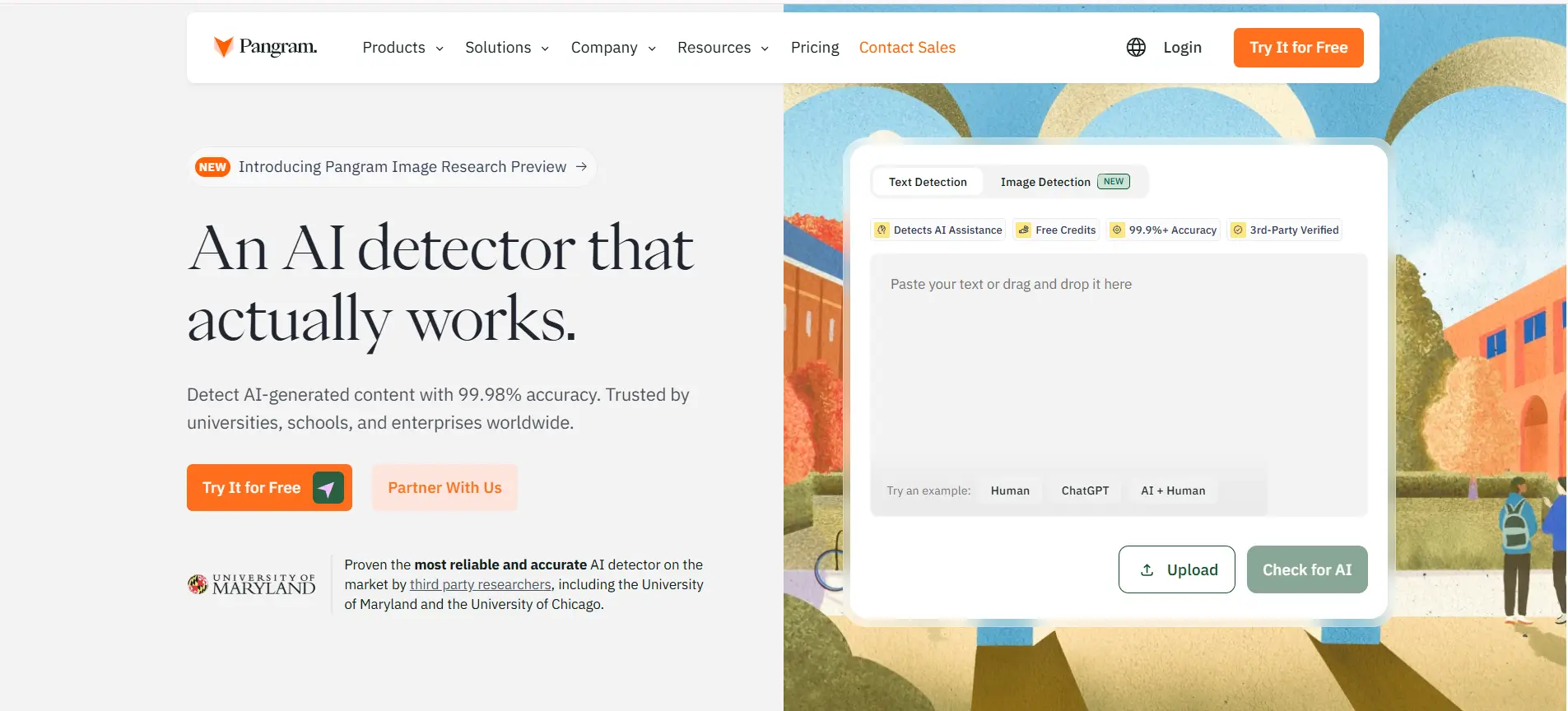
Overview
Pangram is primarily an AI detector designed to evaluate whether writing resembles AI-generated content. Unlike traditional scholarly plagiarism platforms, its core emphasis is AI writing detection, making it a more focused option for organizations, publishers, and writers concerned with identifying potentially AI-generated material.
Pangram can be useful when the main question is whether content appears to have been produced by an AI system rather than whether it matches existing academic sources. However, false positives remain an important consideration. Human-written content can sometimes display patterns that resemble generated writing, so detection results should provide a starting point for review rather than serve as a final conclusion.
Highlights
- Focuses on AI-generated content detection
- Uses multiple AI models to evaluate writing
- Designed for content and writing evaluation
- Emphasizes detection accuracy
- Can help identify potentially AI-assisted material
- Relevant when comparing different AI detection approaches
Best For
Pangram is best suited to writers, organizations, publishers, and teams primarily seeking AI detection and content evaluation rather than traditional scholarly plagiarism checking.
Limitations
It is not designed to replace a comprehensive academic plagiarism database, making it less suitable when source similarity and scholarly originality are the primary requirements.
Pricing
Pricing depends on the selected access and usage requirements. For users focused on AI detection accuracy, value should be assessed alongside coverage, reporting, and the platform’s ability to evaluate different AI models.
Which iThenticate Alternative Is Best for Academic Plagiarism Checking?
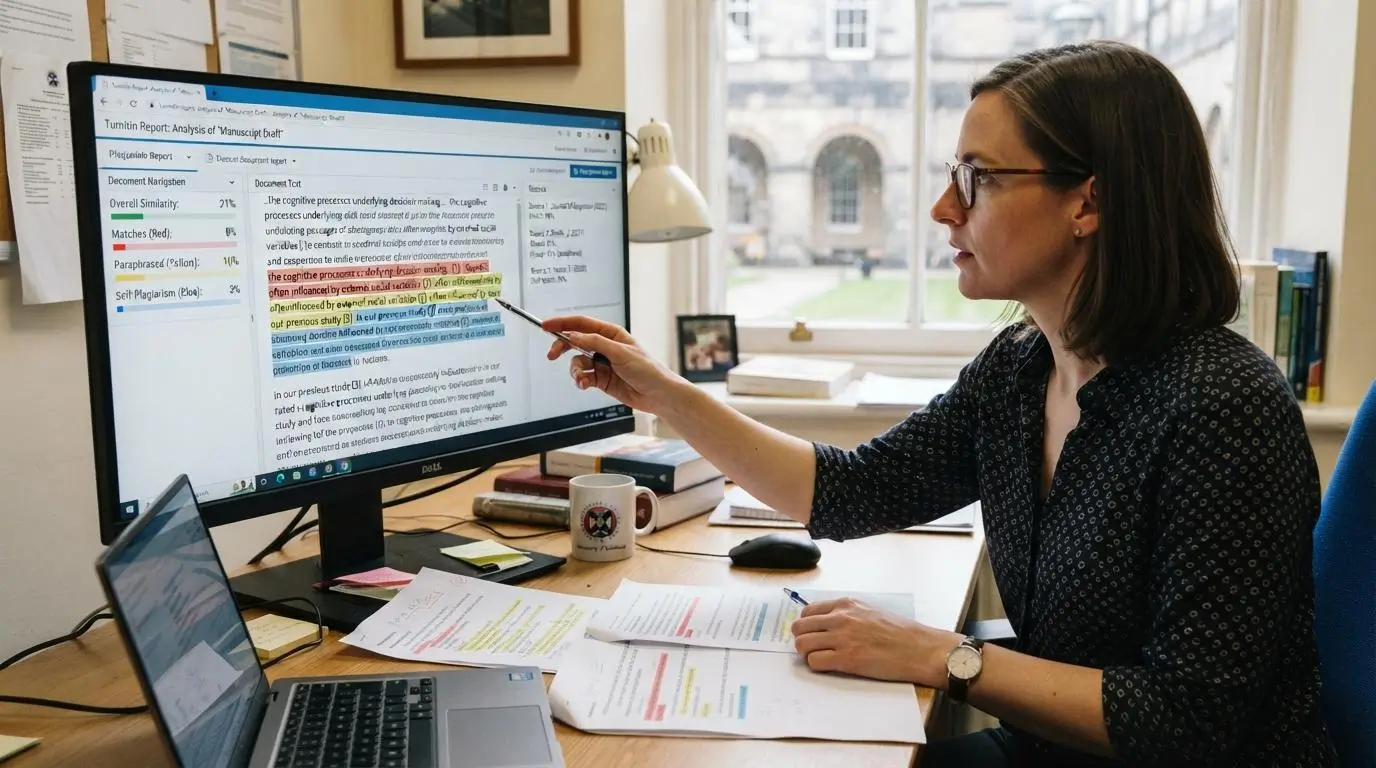
Scholarly plagiarism checking demands more than a generic online plagiarism detector. Academic papers often contain standard terminology, cited material, technical phrases, and references that can produce legitimate similarities. A useful system therefore needs broad database coverage, reliable matching, and reports that help you distinguish meaningful overlap from harmless matches. Exact matches matter, but so does identifying paraphrased content, missing citations, and possible self-plagiarism.
For researchers and publishers, the connection to scholarly databases is especially important. Crossref Similarity Check is powered by iThenticate and screens manuscripts against the global scholarly record, reinforcing why iThenticate remains strongly associated with peer-reviewed journal publishing.
Which Platforms Stand Out?
- Apporto TrustEd: Takes a broader academic integrity approach, using contextual and behavioral evidence rather than functioning as a conventional text-matching plagiarism checker.
- Compilatio: A strong institutional option, particularly for universities and publishing houses seeking structured plagiarism detection.
- Copyleaks: Stands out for sophisticated, multilingual plagiarism detection, including matching for paraphrased content.
- Ouriginal: Suited to institutional academic integrity workflows and similarity checking across student submissions.
- StrikePlagiarism: Focuses on university-oriented plagiarism checking and academic originality.
The right choice ultimately depends on your purpose. If you need scholarly similarity checking for manuscripts, database depth and source coverage should carry considerable weight.
If your priority is institutional student submissions, workflow integration and reporting may matter more. And if AI writing is also a concern, choosing a platform that combines plagiarism detection with AI detection can reduce the need to manage separate tools.
Which iThenticate Alternatives Offer AI Detection?
Plagiarism detection and AI writing detection answer different questions. A plagiarism checker searches submitted text for overlap with existing sources, while an AI content detector estimates whether writing resembles AI-generated text. That distinction matters when evaluating academic work, since similarity does not prove AI use, and an AI score does not establish authorship.
| Platform | AI Detection | Best Use |
|---|---|---|
| Apporto TrustEd | Integrity-focused | Institutional academic integrity |
| Copyleaks | Advanced | AI and plagiarism detection |
| GPTZero | Advanced | Education and AI writing detection |
| Originality.ai | Advanced | Content originality |
| Pangram | Advanced | AI detection |
Copyleaks, GPTZero, Originality.ai, and Pangram are the more direct choices when AI detection is the primary requirement. Apporto TrustEd takes a different approach, focusing on broader integrity signals and institutional context.
Other tools add useful AI-focused capabilities. Paperpal’s AI Detector identifies AI-written and human-written text, while Quetext’s AI detection provides sentence-level scoring.
Winston AI checks against known language models, and Grammarly’s AI detection focuses on minimizing false positives. These tools can complement traditional plagiarism checking, but AI detection results should still be reviewed alongside context and other evidence.
How Do You Choose the Right iThenticate Alternative?

Choosing an iThenticate alternative starts with a deceptively simple question: what exactly do you need to verify? A researcher checking an academic paper may need a deep similarity database, while a university may need plagiarism detection, AI detection, reporting, and institutional workflows. Individual users have different priorities again.
Do You Need Scholarly Plagiarism Checking, AI Detection, or Both?
Start by separating plagiarism detection from AI detection. They overlap in academic integrity workflows, but they do not measure the same thing. A plagiarism checker looks for similarity between submitted text and material already available in its sources. An AI detector estimates whether writing resembles AI-generated text.
For academic papers and student papers, scholarly similarity checking may therefore deserve the most attention, particularly when originality and proper attribution are central concerns. AI detection can add another layer when your institution has policies around AI-assisted writing.
Consider what evidence you actually need. Human written content can sometimes produce AI-related signals, just as legitimate quotations can create similarity matches. Neither result automatically establishes misconduct. A sensible workflow treats similarity, AI detection, originality, and other evidence as separate signals that contribute to a broader academic integrity review.
Which Database, Language, and Matching Capabilities Should You Prioritize?
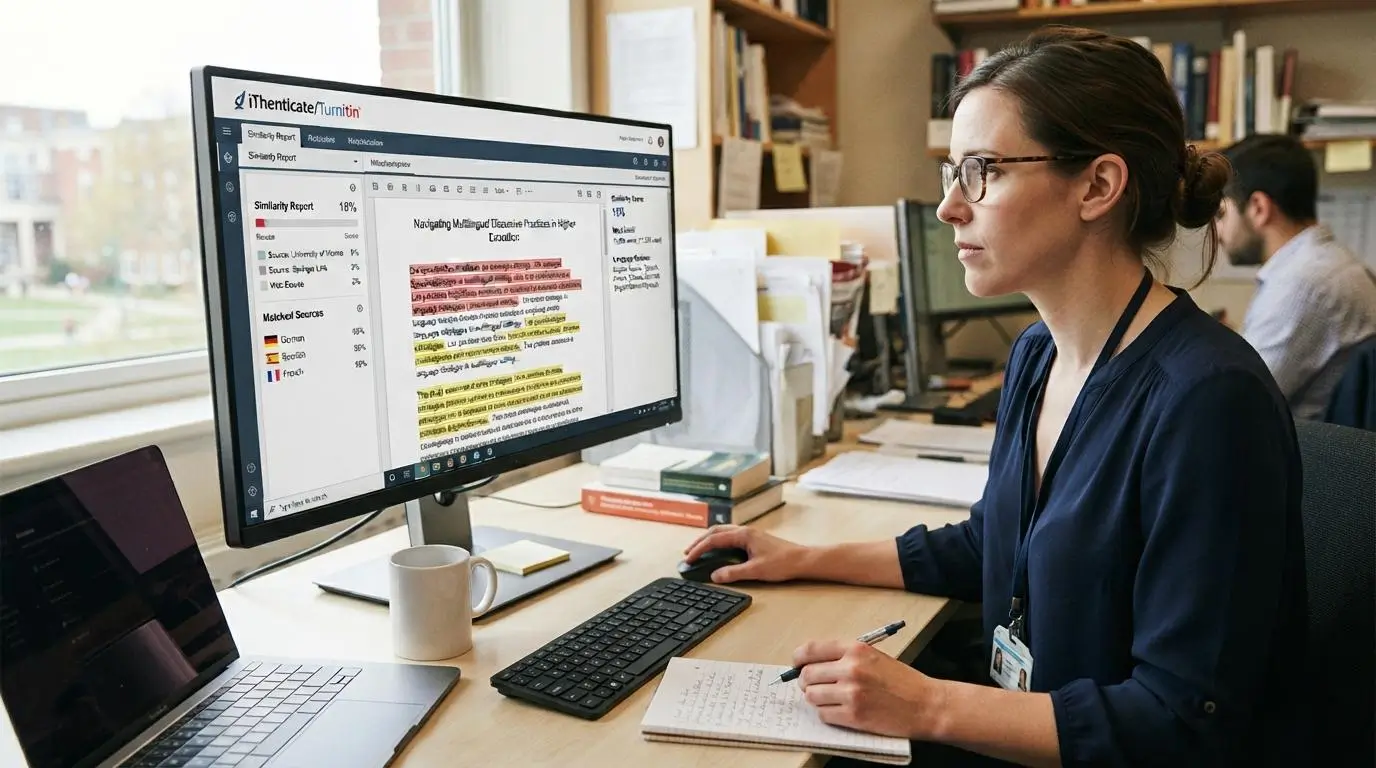
Database coverage can make a noticeable difference in plagiarism detection. A platform may find a match only if the relevant source exists within the material it can search. That means you should examine coverage across the internet, scholarly sources, web pages, and other databases rather than assuming every tool searches the same material.
Matching capabilities matter too. Exact matches are relatively straightforward, but sophisticated detection can also identify paraphrased content and less obvious similarities. Language coverage deserves similar attention if you work with international students or multilingual documents. Copyleaks supports sophisticated matching across more than 100 languages, while Paperpal scans against 100 billion web pages and 200 million articles. Scribbr uses Turnitin’s database for plagiarism checking.
Also consider practical limits such as the number of words you can process and how reports present detected matches. Broad coverage is useful, but the quality of the final interpretation still depends on how clearly the platform presents its findings.
How Important Are Pricing, Free Access, and Individual Use?
Pricing becomes more complicated when you compare platforms serving completely different audiences. Free tools can work well for occasional checks, and a free version gives individual users an opportunity to evaluate a service before committing to paid access. Some free Turnitin alternatives use word limits, while others operate through purchase credits or subscriptions.
For individual users, compare the number of words included, whether an account is required, and what reports or features remain available without payment. Transparent pricing can make budgeting easier, while custom pricing is more common when institutions need larger deployments, administrative controls, or specialized support.
Do not assume free means sufficient, though. A free tool may be perfectly adequate for an occasional document but less practical for repeated academic submissions. Institutions should also consider administrative access, integrations, security, and support alongside the headline price. The useful comparison is what you receive for the money and how well the platform fits your actual workflow.
Which iThenticate Alternative Offers the Best Long-Term Value?

There is no universal winner because long-term value depends on the type of work you need to evaluate. Apporto TrustEd is positioned for broader institutional academic integrity, while Copyleaks combines multilingual plagiarism detection with AI detection. Compilatio is particularly relevant to universities and publishing houses, and Ouriginal fits institutional plagiarism workflows.
For AI-focused requirements, GPTZero specializes in AI writing detection, while Pangram centers on AI detection and content evaluation. Originality.ai combines content originality checking with AI detection, making it relevant to publishers and writers. StrikePlagiarism is geared toward academic institutions and plagiarism checking.
Your requirements should determine the balance. If you manage student work, LMS integration and institutional reporting may matter more than individual access. If you handle academic papers for publishing, database coverage and similarity checking may take priority. Multilingual organizations may place greater weight on language coverage, while individual researchers may prefer straightforward access and pricing.
The strongest long-term choice is therefore the platform that fits your academic integrity process, not simply the one with the largest feature list. A useful solution should support accurate review, clear reports, responsible AI use, and practical workflows as your needs grow.How Do You Choose the Right iThenticate Alternative?
Choosing an iThenticate alternative starts with a deceptively simple question: what exactly do you need to verify? A researcher checking an academic paper may need a deep similarity database, while a university may need plagiarism detection, AI detection, reporting, and institutional workflows. Individual users have different priorities again.
Final Verdict
The strongest iThenticate alternative depends on the workflow you need to support. Apporto TrustEd stands out as the broader institutional option for organizations prioritizing academic integrity, contextual review, and institutional workflows.
Copyleaks is a strong choice for advanced plagiarism detection and multilingual AI detection, while Compilatio suits universities and publishing houses. Ouriginal fits institutional plagiarism workflows, and GPTZero focuses on AI writing detection. Originality.ai is well suited to content originality, while StrikePlagiarism serves academic institutions and Pangram focuses on AI detection.
For individual students, the right choice may differ again. Explore the platforms that best match your academic integrity, research, publishing, or student-review requirements, then choose based on the evidence and workflow you actually need.
Frequently Asked Questions (FAQs)
1. What are the best iThenticate alternatives in 2026?
The leading iThenticate alternatives include Apporto TrustEd, Copyleaks, Compilatio, Ouriginal, GPTZero, Originality.ai, StrikePlagiarism, and Pangram. Each serves different needs, from academic plagiarism detection and institutional integrity to AI writing detection and individual student checking.
2. Which iThenticate alternative is best for academic papers?
For academic papers, Compilatio, Copyleaks, Ouriginal, StrikePlagiarism are strong options. Your choice should depend on database coverage, similarity checking, reporting, language support, and whether you need individual access or an institutional workflow.
3. Which plagiarism checker is best for researchers?
Copyleaks is a strong choice for researchers who need sophisticated plagiarism detection and multilingual matching. Compilatio and Ouriginal are better aligned with institutional workflows. Database coverage and matching capabilities should guide your final decision.
4. Are there free iThenticate alternatives?
Yes. Several free iThenticate alternatives provide limited or occasional checking. Quetext offers a free plan for up to 1,000 words monthly, Paperpal’s free plan allows up to 7,000 words per month.
5. Which iThenticate alternative is best for AI detection?
GPTZero and Pangram are focused strongly on AI detection, while Copyleaks and Originality.ai combine AI detection with plagiarism checking. The best choice depends on whether you need dedicated AI writing detection or a broader originality workflow that also examines source similarity.
6. Can plagiarism checkers detect paraphrased content?
Some can. Copyleaks is particularly focused on sophisticated matching and can detect paraphrased content across more than 100 languages. However, detection results indicate similarity rather than automatically proving plagiarism, so researchers and educators should review the matched sources and surrounding context.
7. What should you look for when choosing an iThenticate alternative?
Compare database coverage, plagiarism detection, AI detection, multilingual support, reports, pricing, word limits, integrations, and individual or institutional access. You should also consider your specific academic integrity requirements. Similarity and AI scores need human interpretation, so clear reporting and responsible review are important.
