

What Are the Best Copyleaks Alternatives for AI Detection and Plagiarism Checking?
Apporto TrustEd, Turnitin, GPTZero, Winston AI, and Pangram are leading Copyleaks alternatives for AI detection and plagiarism checking. Apporto TrustEd is particularly suited to schools and institutions, combining AI detection, plagiarism support, detailed reporting, LMS integrations, security, and academic integrity workflows.
With AI-written text becoming harder to distinguish from human written content, relying on a single checker is no longer enough. Copyleaks is widely used for checking both AI-generated content and plagiarism, helping you assess whether writing is original or potentially machine-produced.
However, many users now look for Copyleaks alternatives that offer better detection accuracy, lower pricing, multilingual support, detailed reporting, free scanning options, or stronger workflow integrations.
AI detection estimates whether text resembles AI-generated content, while plagiarism detection identifies overlap with existing sources. This guide compares leading alternatives based on accuracy, features, pricing, integrations, security, usability, and overall value.
How Did We Evaluate These Copyleaks Alternatives?

The right evaluation criteria depend heavily on who is using the platform and why. Schools may place greater weight on academic integrity, LMS integrations, reporting, and security, while writers, publishers, and content teams may care more about originality, AI detection accuracy, multilingual support, ease of access, and cost.
Each platform was therefore considered across detection capabilities, plagiarism checking, reporting, language coverage, integrations, pricing, and usability. The goal is to distinguish tools that simply produce a score from those that provide useful information you can actually interpret and act on.
Which AI Detection and Plagiarism Features Matter Most?
A strong AI detection tool should evaluate AI content, including potentially AI-generated and human written content, while providing useful context around its findings. AI detection estimates whether text resembles AI-generated writing, whereas plagiarism checking looks for matching material across existing databases.
A reliable AI detector should balance detection accuracy with a low risk of false positives. Originality also matters, particularly when an AI text review forms part of a broader plagiarism platform.
How Important Are Reports, Languages, Integrations, and Security?
Practical features can determine how useful a detector becomes after the initial scan. A detailed report makes detection results easier to understand, while multi language support extends the platform’s usefulness across different users and institutions.
LMS integrations can simplify workflows for schools, teachers, and students, while an API may help teams connect detection with existing systems. Strong security also matters when sensitive documents are uploaded. Support for Google tools and other integrations can further reduce friction for teams managing large volumes of content.
Which Platform Offers the Best Long-Term Value?
Price provides only part of the picture. A completely free or free alternative may be ideal for occasional users, particularly when free checks are available without requiring a subscription or sign-up. However, writers and content teams with higher volumes may need paid plans that offer broader access, advanced reports, integrations, or higher usage limits.
When comparing pricing, consider the actual cost per check, word limits, features, and workflow requirements rather than the headline price alone. Long-term value depends on accuracy, features, access, and intended use rather than price alone.
Quick Comparison of the Best Copyleaks Alternatives
AI detection and plagiarism platforms can differ substantially in their intended users and core capabilities. Some are built around academic integrity, while others serve writers, publishers, educators, or content teams.
Free access, reporting, multilingual support, plagiarism checking, and detection accuracy also vary, so a quick comparison can help you narrow the options before reviewing each platform in detail.
| Platform | Best For | AI Detection | Plagiarism Detection | Free Access | Reports | Ideal Users |
|---|---|---|---|---|---|---|
| Apporto TrustEd | Education & AI detection | Advanced | Advanced | Custom | Detailed | Schools & institutions |
| Turnitin | Academic integrity | Advanced | Advanced | No | Detailed | Schools & universities |
| GPTZero | Educator-focused detection | Advanced | Good | Yes | Detailed | Teachers & educators |
| Winston AI | AI & plagiarism detection | Advanced | Advanced | Limited | PDF reports | Schools & content teams |
| Pangram | AI detection accuracy | Advanced | Limited | Contact | Detailed | Writers & organizations |
Best Copyleaks Alternatives (A Complete Overview)
1. Apporto TrustEd
Overview
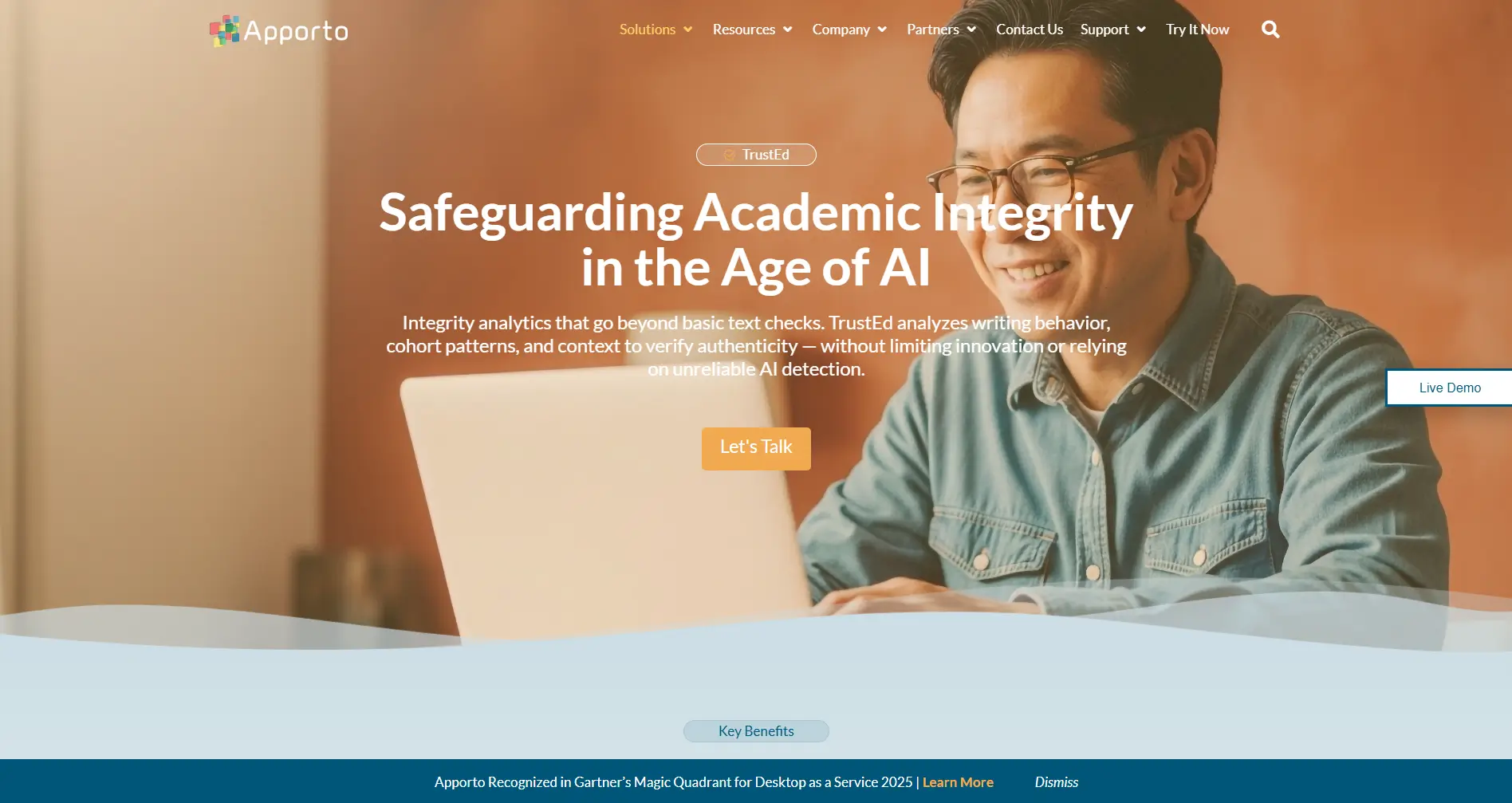
Apporto TrustEd takes an education-first approach to content verification, giving institutions a structured way to evaluate AI detection, plagiarism, and originality within academic work. Rather than treating detection as an isolated check, the platform supports Academic integrity in the age of AI through workflows that involve students, teachers, administrators, and institutional policies.
This makes it particularly relevant for schools that need content evaluation to work consistently across courses and departments.
For educators, detailed reports provide additional context around submitted work, helping teachers review potential AI-generated material or plagiarism without relying solely on a single score.
Its institutional focus also makes security an important part of the overall experience, particularly when schools are processing student assignments and other sensitive academic content.
LMS integrations can further reduce friction by bringing integrity checks closer to the systems educators already use for teaching and assessment.
Highlights
- AI detection and plagiarism checking for education
- Detailed reporting for content evaluation
- LMS integrations for academic workflows
- Institutional security and scalable deployment
- Supports broader academic integrity processes
Best For:
Schools and educational institutions seeking centralized AI detection, plagiarism checking, and academic integrity support.
Limitations:
Its institution-oriented approach may offer more functionality than an individual writer or occasional user needs.
Pricing:
Pricing is customized according to institutional requirements, deployment scope, and selected services.
2. Turnitin
Overview
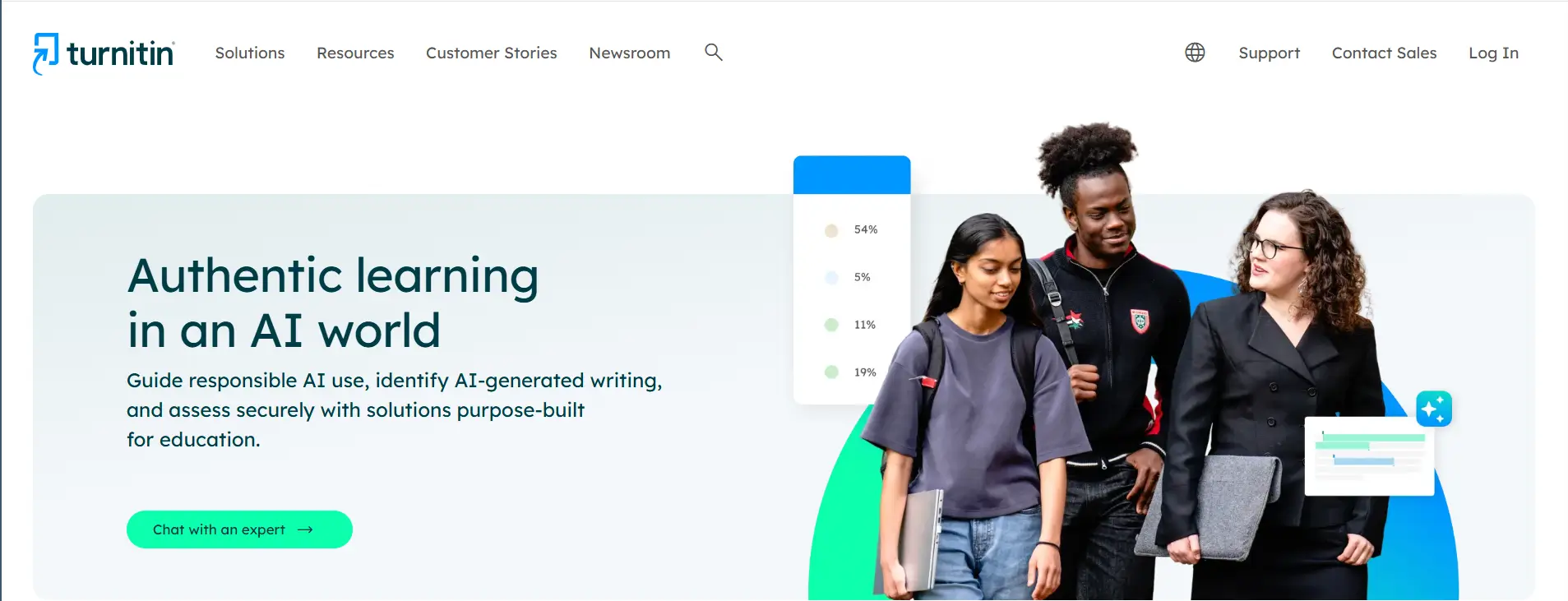
Turnitin is a widely recognized plagiarism platform used by academic institutions to evaluate student submissions for originality. Its database-based approach compares submitted work against extensive sources, helping teachers and administrators identify potentially matching material while supporting broader academic integrity policies. For students, the platform can provide feedback that encourages more careful citation and original writing.
Turnitin has also expanded beyond traditional plagiarism checking. The company added AI detection features in 2023, giving institutions another way to evaluate whether submitted text may resemble AI-generated writing.
Its combination of plagiarism checking and AI detection makes it a comprehensive option for schools and universities that need multiple forms of content review. Like other detection systems, its results should be interpreted as indicators rather than absolute proof of how text was created. For readers evaluating originality-checking tools for academic research and publishing, explore iThenticate alternatives
Highlights
- Established plagiarism detection for academic institutions
- AI detection alongside originality checking
- Extensive databases for comparing submitted content
- Detailed reports for educators and administrators
- Supports institutional academic integrity workflows
Best For:
Schools, colleges, and universities that need established plagiarism detection combined with AI content evaluation.
Limitations:
Its institution-focused model may be less practical for individual writers or casual users seeking simple, low-cost checks.
Pricing:
Turnitin pricing is typically not publicly listed and generally targets institutions rather than individual users.
3. GPTZero
Overview
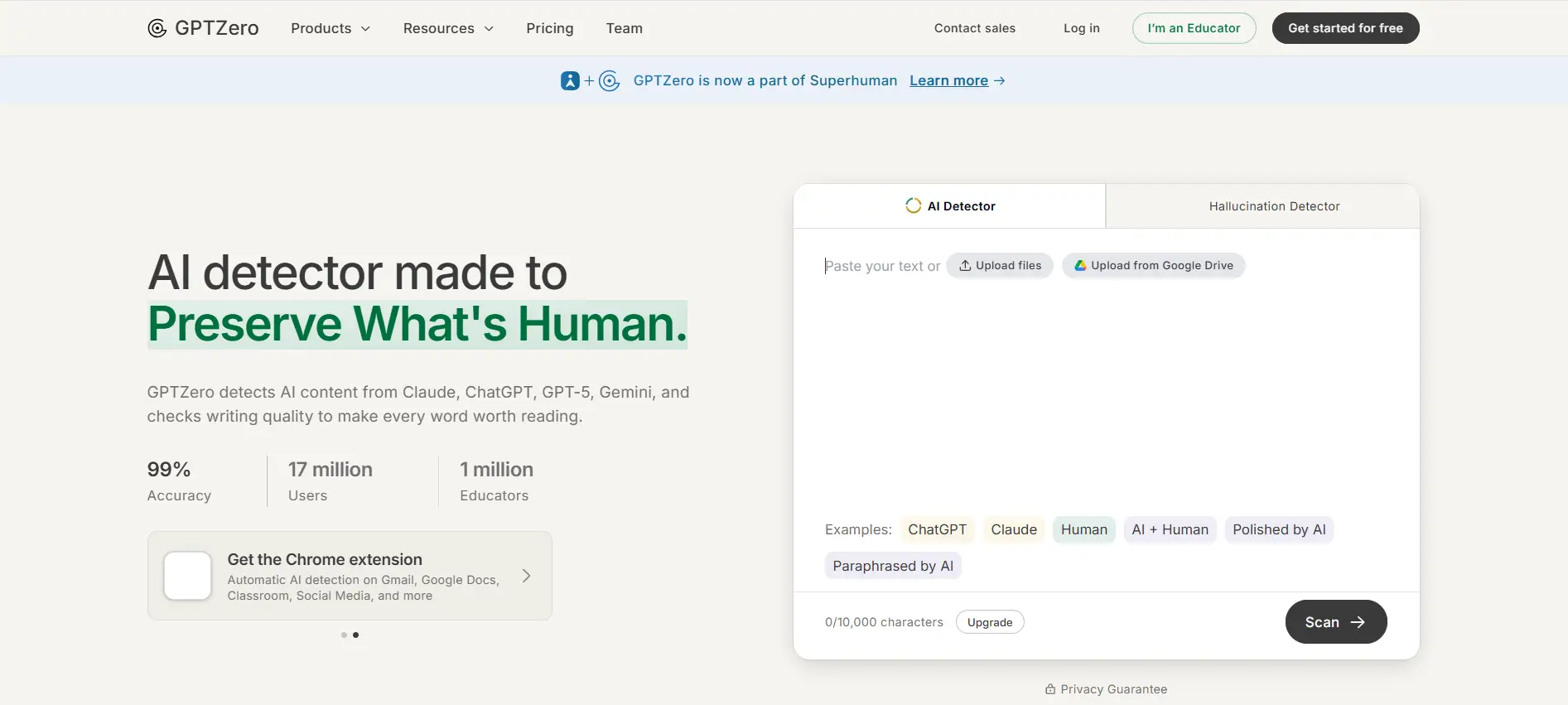
GPTZero is an AI detector built with education in mind, making it particularly relevant for educators, teachers, and students who need to evaluate potentially AI-generated content. Its focus on educational use gives schools a practical way to incorporate AI detection into existing academic workflows without treating the technology as a standalone tool. GPTZero is designed specifically for educators with integrations, helping institutions connect detection with the systems they already use.
The platform also provides reports that give users more context around detection results, which can be useful when reviewing assignments or investigating originality concerns. Detection accuracy remains an important consideration with any AI detector, since results can vary depending on the writing, model, and circumstances. GPTZero therefore works best as one part of a broader review process rather than a final judgment on authorship.
Highlights
- AI detection designed specifically for education
- Integrations for educator workflows
- Reports for reviewing AI-generated content
- Useful for teachers and students
- Accessible free tier for individual users
Best For:
Educators and schools looking for an education-focused AI detector with integrations and accessible reporting.
Limitations:
AI detection results can produce uncertainty, so educators should consider context and supporting evidence alongside the platform’s findings.
Pricing:
GPTZero provides a generous free tier for non-institutional users, making it easier to test the platform before considering expanded plans or institutional features.
4. Winston AI
Overview
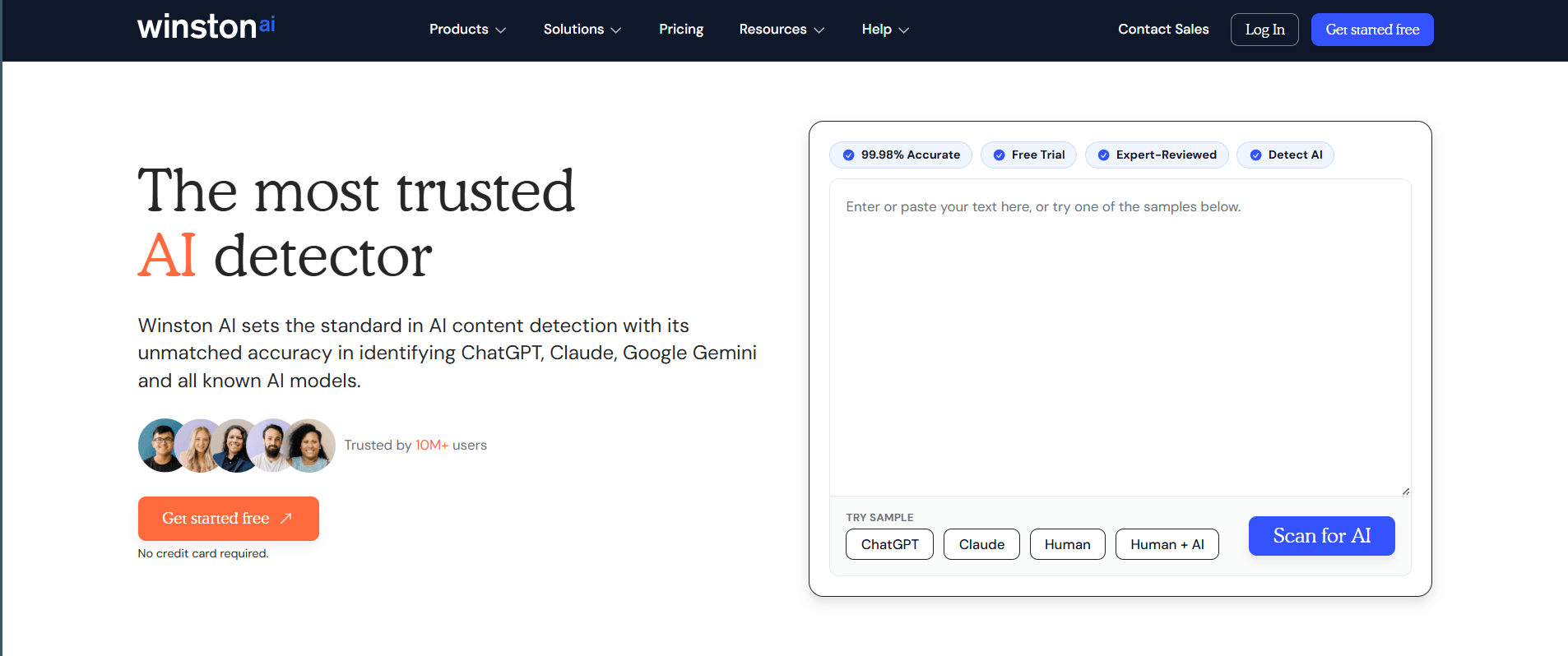
Winston AI combines AI detection with a built-in plagiarism checker, making it useful when you need to examine both potentially generated writing and originality in the same workflow.
The platform is designed for writers, schools, publishers, and content teams that want a more complete view of submitted content. Its reporting tools add useful context to detection results, rather than leaving you with a simple percentage and little explanation.
A notable feature is its detailed report system, including professional PDF reports that can be shared or retained for documentation. Winston AI also supports multi language detection, which broadens its usefulness for organizations working with different languages and audiences. Its bundled approach means you can check for plagiarism alongside AI-generated text without moving between separate tools.
Highlights
- AI detection and integrated plagiarism checker
- Professional PDF reports for documentation
- Detailed detection results
- Multi language support
- Designed for writers, schools, and content teams
Best For:
Schools, writers, and content teams that want AI detection and plagiarism checking within one platform.
Limitations:
Detection results should still be reviewed alongside context, since no AI detection system can guarantee perfect accuracy across every type of writing.
Pricing:
Winston AI uses paid plans for expanded access, with available features and usage depending on the selected subscription.
5. Pangram
Overview
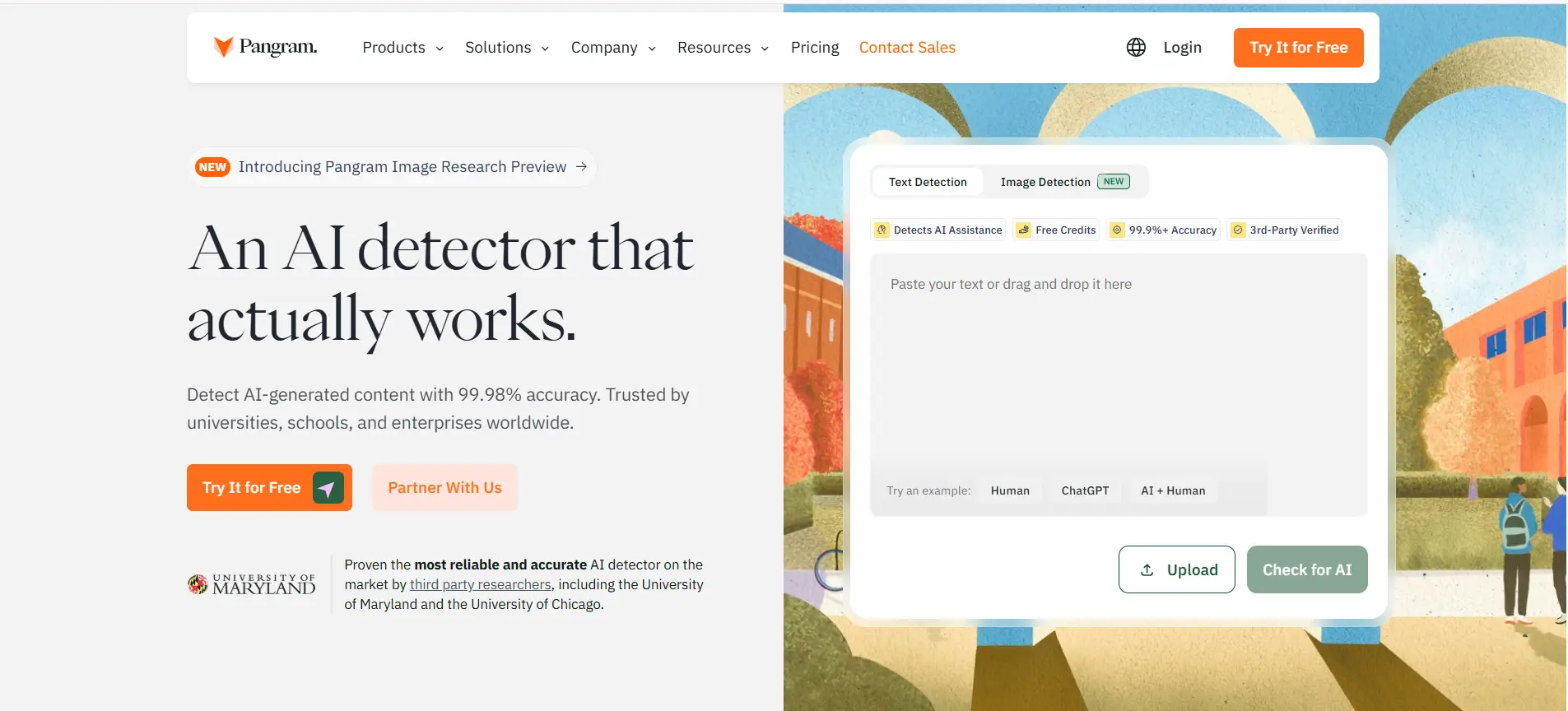
Pangram focuses primarily on AI detection, helping users evaluate whether AI text resembles machine-generated content. Its emphasis on detection accuracy makes it relevant to writers, publishers, educators, and organizations concerned about originality.
Rather than relying on a single indicator, Pangram uses multiple detection models to assess writing, giving users another way to examine potentially AI-generated material before making decisions about its use.
A major consideration with any AI detector is consistency. Results can vary depending on the type of writing, the AI model involved, and the methodology used for testing. In the cited comparison data, Pangram Labs achieved a 100% pass rate for AI-generated text.
That result is useful as a benchmark, but it should not be treated as a universal measure of performance. Detection accuracy can vary across AI detectors, so results should be interpreted carefully, particularly when false positives could affect students, writers, or publishing decisions.
Highlights
- Focused AI detection capabilities
- Multiple detection models for evaluating AI text
- Emphasis on detection accuracy and originality
- Useful for writing and content evaluation
- Can support comparisons across different AI detection tools
Best For:
Writers, organizations, and teams that prioritize AI detection and content originality.
Limitations:
AI detection remains probabilistic, so results should be reviewed alongside context rather than treated as definitive proof.
Pricing:
Pricing depends on the selected plan and usage requirements.
How Do You Choose the Right Copyleaks Alternative?

Choosing a Copyleaks alternative starts with identifying what you actually need to verify. A school evaluating student work may prioritize academic integrity and LMS integrations, while a writer or publisher may care more about originality, detection accuracy, multilingual support, and cost.
The distinction matters because AI detection and plagiarism checking solve different problems. Once you understand that difference, comparing features, access, reporting, and pricing becomes much easier.
Do You Need AI Detection, Plagiarism Checking, or Both?
Before choosing an AI detector, determine whether your main concern is AI detection, plagiarism, or both. These technologies measure different things. AI detection estimates whether writing resembles AI-generated text, while plagiarism checking looks for overlap with existing sources. A strong plagiarism platform can therefore support originality checks even when AI detection is not required.
If your priority is identifying potentially AI-generated content, look for detection tools that explain their findings clearly rather than relying only on a percentage. For plagiarism, database coverage and matching sources matter more. Accuracy is important in both cases, particularly because false positives can create unnecessary concerns around human written work.
Your primary purpose should determine which capability receives the most weight. A tool that evaluates AI text effectively may not necessarily provide the strongest plagiarism coverage, and vice versa. The distinction is simple, but it can save you from paying for features you don’t actually need.
Which Features Should Schools, Teachers, and Content Teams Prioritize?

Once the core purpose is clear, examine how the platform fits into your existing workflow. Schools and teachers may need integrations that let them evaluate students’ submissions without repeatedly moving between separate systems. LMS integrations can simplify that process, while an API can connect detection features with other institutional software.
For content teams and writers, document handling, reporting, and workflow flexibility may matter more. A detailed report can make detection results easier to review and communicate, particularly when several people need to examine the same content. Security is equally important when platforms process student assignments, unpublished documents, or other sensitive material.
Reliable support can also reduce friction when a team encounters technical problems or needs help interpreting results. Multilingual capability becomes especially valuable for international schools, publishers, and organizations working across different languages. The best feature set is therefore the one that fits your actual workflow, not simply the longest list of capabilities.
How Important Are Pricing, Free Access, and Usage Limits?
Pricing deserves a closer look because a low headline cost doesn’t necessarily mean lower total spending. A completely free or free alternative can be useful for occasional checks, particularly when you only need basic detection. A free tier also gives you an opportunity to test a platform before committing money to a subscription.
However, frequent users may quickly encounter limits on free checks, document length, reports, or other features. Paid plans can provide broader access, higher usage allowances, integrations, and more detailed reporting.
When comparing pricing, look beyond the monthly figure and consider how many words or documents you can actually process for the cost. Check whether an account is sign up required, whether free access expires, and which features remain available without payment.
Free access can be useful for occasional users, but paid plans should provide meaningful advantages over free alternatives. Compare usage limits rather than looking only at the advertised monthly price.
Which Copyleaks Alternative Offers the Best Long-Term Value?
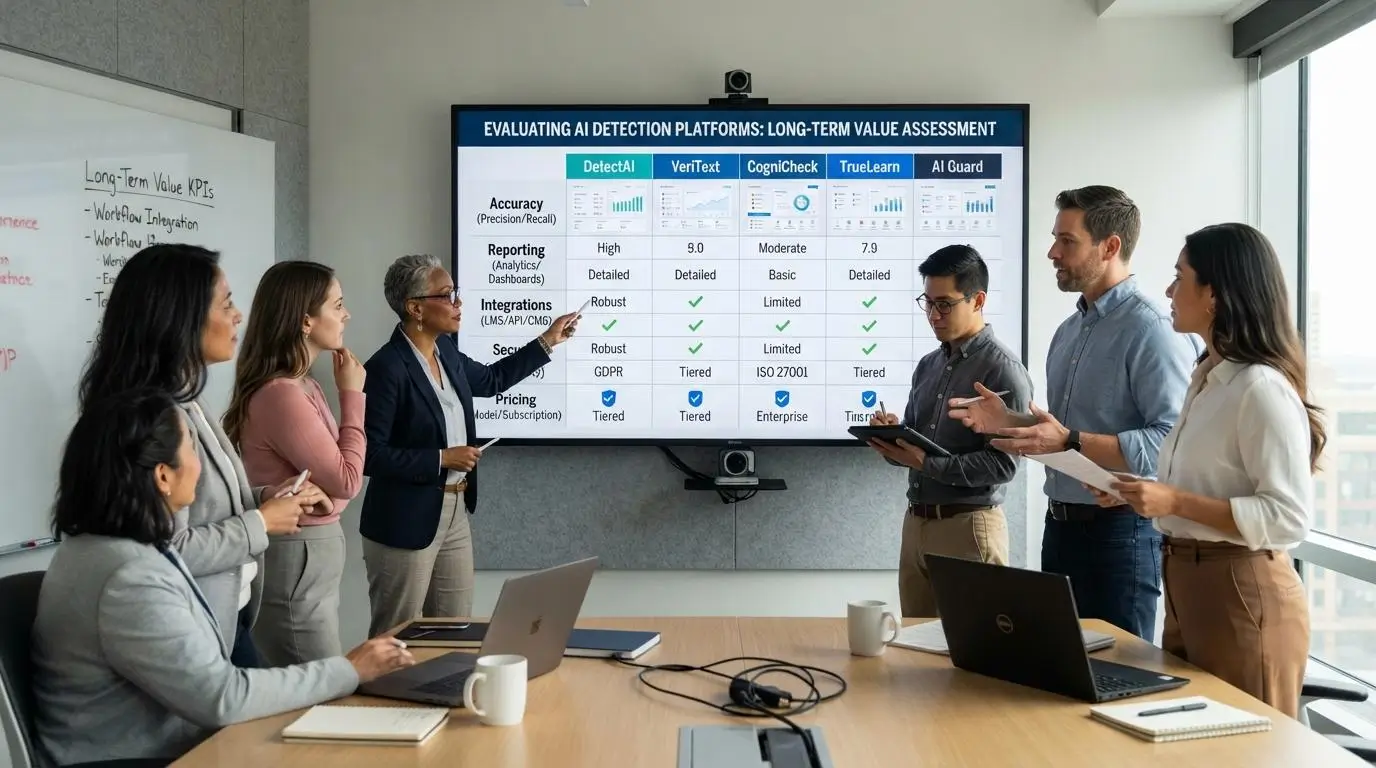
The strongest option depends on where you plan to use it. Apporto TrustEd is positioned for institutional education, with an emphasis on academic integrity workflows, security, detailed reporting, and LMS integrations. Turnitin remains a strong choice for established academic plagiarism detection and institutional originality workflows. For a closer look at how Copyleaks and Apporto compare in AI detection, plagiarism checking, and institutional workflows, explore Copyleaks Vs Apporto Trusted
For educators seeking dedicated AI detection, GPTZero offers an education-focused approach with integrations and accessible reporting. Winston AI combines AI detection with plagiarism checking and professional PDF reports, making it useful for schools, writers, and content teams. Pangram places greater emphasis on AI detection accuracy and content evaluation.
When comparing these platforms, consider the full combination of detection capabilities, reporting, security, integrations, pricing, and free access rather than one headline feature. No detector should be treated as an infallible verdict.
AI detection estimates whether writing resembles AI-generated text, so results can produce false positives and should be considered alongside context and other evidence. That principle matters most when detection results could influence academic, professional, or publishing decisions.
Final Thoughts
The best Copyleaks alternative depends on your priorities, but Apporto TrustEd stands out as the strongest overall solution for education-focused organizations. Its emphasis on AI detection, plagiarism support, security, LMS integrations, detailed reporting, and scalable academic integrity workflows makes it well suited to institutional use.
Turnitin remains a strong choice for established academic plagiarism detection, while GPTZero is particularly relevant for educators seeking AI detection. Winston AI combines AI detection with plagiarism checking and professional reports, and Pangram focuses on AI detection accuracy and content evaluation.
If your school or institution needs a more connected approach to academic integrity and content evaluation, explore Apporto TrustEd to see how its education-focused workflows can support educators, students, and institutional teams.
Frequently Asked Questions(FAQs)
1. What are the best Copyleaks alternatives in 2026?
The leading Copyleaks alternatives include Apporto TrustEd, Turnitin, GPTZero, Winston AI, and Pangram. Each platform has different strengths, from academic integrity and plagiarism checking to educator-focused AI detection, detailed reporting, and AI detection accuracy.
2. Which Copyleaks alternative is best for schools and universities?
Apporto TrustEd is a strong choice for education-focused organizations because it combines AI detection, plagiarism support, security, LMS integrations, detailed reports, and scalable academic integrity workflows. Turnitin is also well established among schools and universities for plagiarism detection and academic integrity.
3. Which AI detector is most accurate?
No AI detector can guarantee perfect accuracy in every situation. The supplied comparison data places Copyleaks, Originality.ai, Turnitin, Pangram, and Winston AI among the stronger performers, with accuracy varying according to models, languages, text types, and testing methodology.
4. Are there completely free Copyleaks alternatives?
Yes, several alternatives provide free access. Reilaa offers unlimited free AI detection without a subscription, while GPTZero provides a generous free tier for non-institutional users. Some other tools also provide free checks without requiring an account, although features and limits vary.
5. Which Copyleaks alternative also checks plagiarism?
Turnitin and Winston AI both combine AI detection with plagiarism checking. Apporto TrustEd also supports AI detection and plagiarism workflows for educational institutions. This combination can be useful when you need to evaluate both potential AI-generated writing and overlap with existing sources.
6. Does GPTZero offer a free plan?
Yes. GPTZero provides a generous free tier for non-institutional users, making it accessible for educators, students, and individuals who want to evaluate AI-generated content without immediately purchasing a paid subscription. Institutional requirements may call for expanded features or access.
7. Does Winston AI provide plagiarism detection?
Yes. Winston AI includes a plagiarism checker alongside its AI detection capabilities. It also provides professional PDF reports and supports multilingual detection, making it useful for schools, writers, publishers, and content teams that need combined originality and AI-content evaluation.
8. What should you look for when choosing a Copyleaks alternative?
Consider AI detection accuracy, plagiarism coverage, false-positive risk, reporting, language support, security, LMS integrations, pricing, usage limits, and ease of use. Your intended purpose should guide the decision, since academic institutions may need different capabilities from writers or content teams.
