
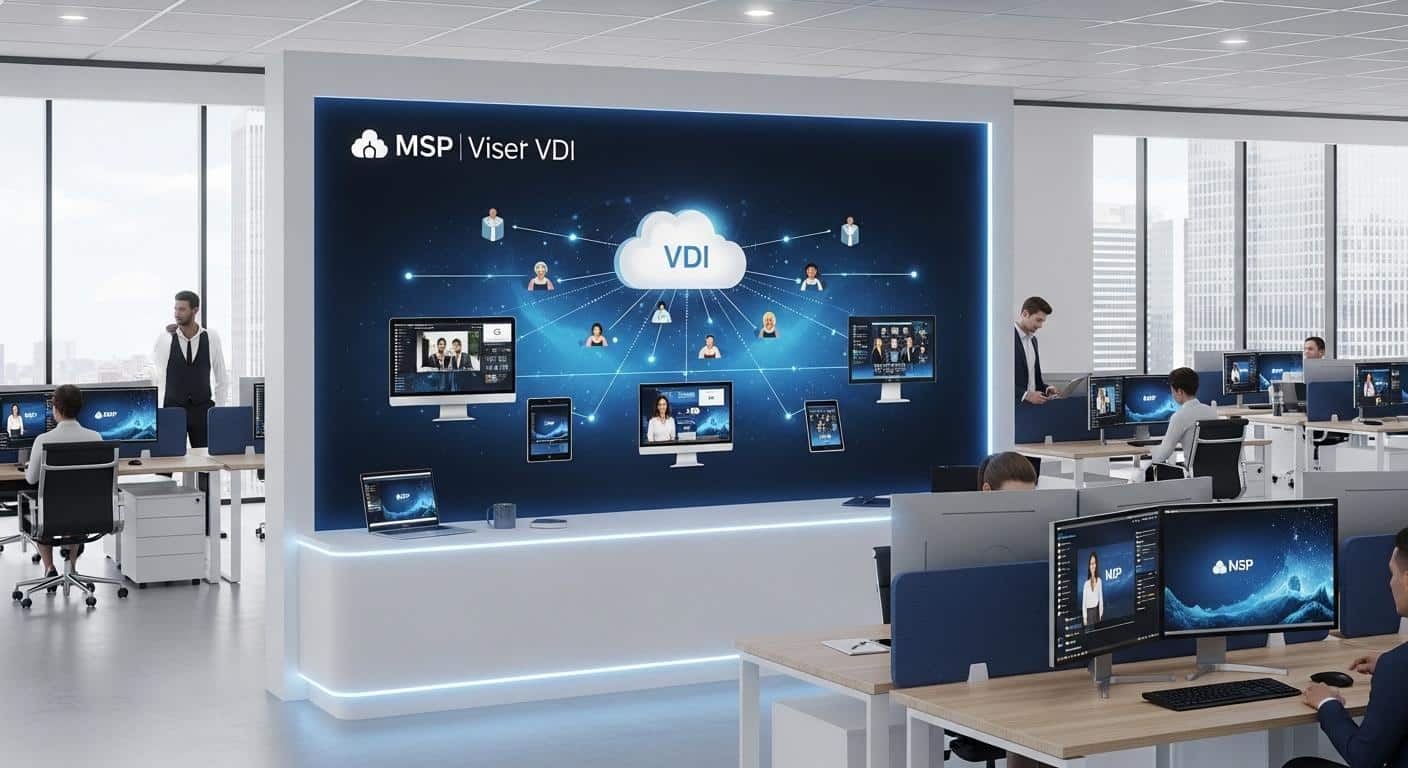
What Is the Best White Label VDI Provider for MSPs and Cloud Service Providers?
White label VDI providers enable MSPs and cloud service providers to deliver virtual desktops under their own brand without building infrastructure from scratch. Leading options include Apporto, V2 Cloud, and Thinfinity Workspace, offering varying levels of scalability, security, branding flexibility, and management simplicity.
Virtual desktops are becoming a core service for organizations that need secure remote access and flexible work environments. As demand for cloud VDI grows, MSPs and cloud providers are increasingly looking for white label solutions they can offer under their own brand.
Building a traditional virtual desktop infrastructure from scratch can be costly, complex, and difficult to scale. Many businesses instead prefer platforms that provide predictable costs, simplified management, and room for growth.
This guide reviews the best white labelled VDI providers based on scalability, security, branding options, ease of management, and overall value.
How Did We Select the Best White Labelled VDI Providers?
The white label VDI market includes everything from fully managed desktop platforms to highly customizable infrastructure solutions. While many vendors promise flexibility and scalability, the reality is that their capabilities can vary considerably. Some focus on helping MSPs launch services quickly, while others prioritize enterprise-grade security, compliance, or infrastructure control.
To build this list, each provider was evaluated through the lens of both service providers and end customers. The goal was not simply to identify feature-rich platforms, but to highlight solutions that help businesses deliver reliable virtual desktops under their own brand while maintaining profitability and operational efficiency.
Particular attention was given to security, scalability, infrastructure flexibility, customer support quality, ease of administration, and pricing transparency. Providers that balanced strong technology with simplified operations scored highest.
Evaluation Criteria
- Branding Flexibility: Ability to deliver a true white label solution that can be customized and marketed under your own brand.
- Security & Compliance: Support for multi factor authentication, data encryption, access controls, enhanced security measures, and protection of sensitive data.
- Scalability: Ability to support rapid customer growth without infrastructure bottlenecks or performance limitations.
- Operational Simplicity: Reduced management burden compared to traditional VDI, allowing teams to focus on core business activities.
- Customer Support: Availability of dedicated support resources to assist with deployment, troubleshooting, and ongoing operations.
- Pricing Transparency: Clear pricing structures that help avoid unexpected costs while improving long-term planning.
Quick Comparison Table: Which White Label VDI Provider Fits Your Business Best?
Selecting a white label VDI platform is rarely just a technology decision. It affects how quickly you can launch services, how much operational effort your team invests, and how effectively you can grow your customer base over time.
Some providers prioritize rapid deployment and ease of management. Others focus on infrastructure flexibility, enterprise security, or support for specialized workloads. The table below provides a high-level comparison of the leading white labelled VDI providers before we examine each platform in more detail.
| Provider | Best For | Deployment Model | White Label Support | Standout Feature |
|---|---|---|---|---|
| Apporto | Browser-based VDI delivery | Cloud | Full | Browser-based access |
| V2 Cloud | MSP scalability | Cloud | Full | Rapid deployment |
| Thinfinity Workspace | Secure application delivery | Hybrid | Full | Web-based workspace |
| vDesk.works | MSP desktop services | Cloud | Full | Multi-tenant platform |
| Cloudalize | Graphics-intensive workloads | Cloud | Partial | GPU-enabled desktops |
| Anunta | Managed VDI services | Managed Service | Partial | End-to-end management |
| Dizzion | Enterprise virtual desktops | Cloud | Partial | Compliance focus |
| Parallels RAS | Application publishing | Hybrid | Limited | Virtual apps delivery |
| OrionVM | Infrastructure providers | Cloud | Full | Service provider platform |
Each platform approaches scalability, security, management, and branding differently. The right choice depends on your business model, customer requirements, and long-term growth strategy.
Best White Labeled VDI solution (A Completed Breakdown)
1. Apporto (Best White Labelled VDI Provider for Browser-Based Desktop Delivery)

Overview
For MSPs and cloud service providers, one of the biggest challenges in virtual desktop delivery is reducing complexity without sacrificing performance or flexibility. Apporto addresses that challenge through a cloud-native platform that delivers virtual desktops directly through a web browser. Instead of requiring endpoint software installations or dedicated desktop clients, users can access their environments through simple browser access from virtually any device.
This approach can significantly reduce deployment friction for service providers while making desktop services easier for customers to adopt. Because the platform is designed for cloud VDI delivery, infrastructure management is simplified, allowing providers to focus more on customer growth and service differentiation rather than backend maintenance.
Another notable advantage is Apporto’s white label model. Providers can deliver services under their own brand, creating a consistent customer experience while maintaining ownership of client relationships.
Highlights
- Browser-Based Access: Users can launch virtual desktops through a web browser without installing additional software or desktop clients.
- White Label Branding: MSPs and service providers can fully customize the platform and deliver services under their own brand.
- Cloud-Native Infrastructure: Built on modern cloud infrastructure that supports scalability, simplified administration, and efficient resource allocation.
- Support for Specialized Applications: Enables delivery of resource-intensive software and specialized applications that may not run efficiently on local devices.
Best For
Apporto is best suited for MSPs, educational institutions, cloud providers, and organizations seeking a streamlined white label VDI solution. It is particularly valuable when rapid deployment, browser-based delivery, and simplified management are priorities.
Limitations
Organizations that require extensive control over underlying infrastructure components may find some traditional VDI platforms offer deeper backend customization options.
Pricing
Apporto offers custom pricing based on deployment size, infrastructure requirements, application workloads, and support needs. Providers typically work directly with Apporto to develop a solution aligned with their business model and growth objectives.
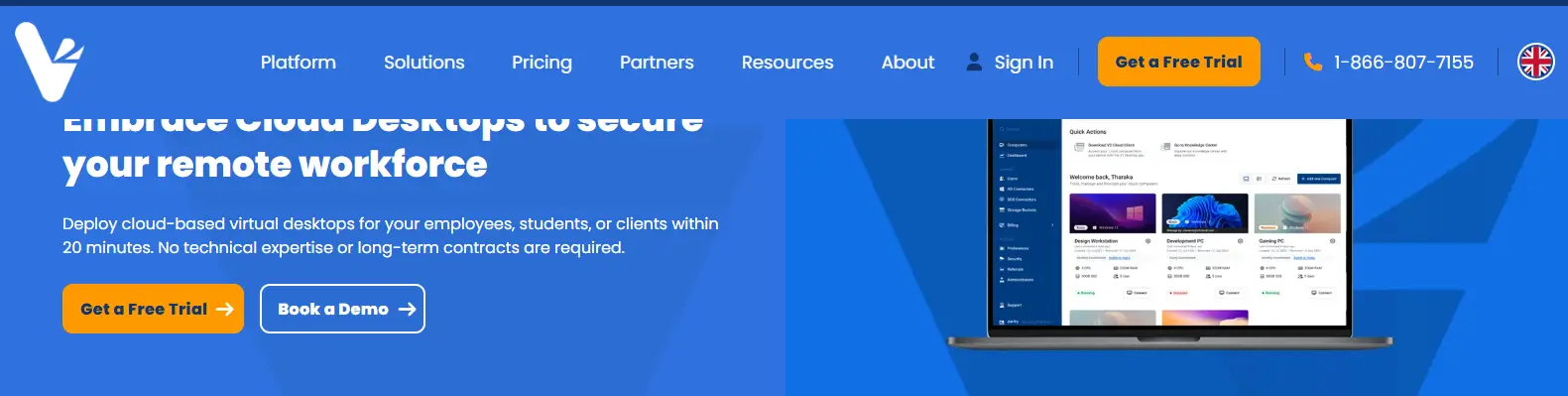
2. V2 Cloud (Best White Labelled VDI Provider for MSP Scalability)
Overview
As managed service providers grow, scalability becomes more than a technical consideration. It becomes a business requirement. Adding new customers should not trigger lengthy infrastructure projects, complex procurement cycles, or unpredictable operational costs. V2 Cloud positions itself as a platform designed to remove much of that friction.
The service focuses on delivering cloud-hosted desktops that can be provisioned quickly and managed through a streamlined interface. This makes it particularly attractive for MSPs that need to onboard customers efficiently while maintaining consistent service delivery. Rather than building and maintaining a traditional VDI environment, providers can leverage V2 Cloud’s infrastructure and concentrate on customer acquisition, support, and service expansion.
One of the platform’s biggest advantages is its ability to scale alongside business growth. New users can be added rapidly, helping providers respond to changing client requirements without investing heavily in additional infrastructure.
Highlights
- Rapid Provisioning: Virtual desktops can be deployed in just a few minutes, allowing providers to onboard customers and users quickly.
- White Label Platform: Supports branding customization so MSPs can deliver desktop services under their own company identity.
- Multi-Tenant Management: Enables administrators to manage multiple customer environments from a centralized platform.
- Predictable Pricing: Subscription-based pricing models help providers forecast costs more accurately and reduce financial surprises.
Best For
V2 Cloud is best suited for MSPs, IT service providers, and growing businesses that prioritize scalability, fast deployment, and operational simplicity. It works particularly well for organizations serving multiple customers across different industries.
Limitations
Organizations seeking extensive infrastructure customization or deep integration with highly specialized enterprise environments may find some traditional VDI providers offer greater flexibility. Advanced customization options can be more limited than self-managed platforms.
Pricing
V2 Cloud uses subscription-based pricing with costs determined by desktop configurations, resource allocations, storage requirements, and the number of active users. Its predictable pricing structure helps providers plan growth without dealing with large upfront investments or unpredictable costs.
3. Thinfinity Workspace (Best White Labelled VDI Provider for Secure Remote Access)
Overview
For many organizations, the challenge is not simply delivering virtual desktops. It is providing secure access to business applications and workspaces across a growing number of devices, locations, and users. Thinfinity Workspace approaches this challenge through a web-based platform that emphasizes accessibility, security, and deployment flexibility.
Rather than relying exclusively on traditional desktop clients, Thinfinity Workspace enables users to access applications and desktop resources through a browser. This can simplify deployment while reducing the management burden associated with endpoint software installations. For MSPs and service providers, that often translates into faster onboarding and fewer support requests.
The platform also supports hybrid deployment models, allowing organizations to bridge cloud and on-premises resources. This flexibility can be valuable for businesses that need to modernize desktop delivery without completely replacing existing infrastructure.
Highlights
- Web-Based Workspace: Provides browser-based access to desktops and applications without requiring complex local installations.
- Secure Access Controls: Includes security features designed to enable secure access to corporate resources while protecting sensitive systems and data.
- Application Delivery: Supports delivery of Windows applications and business resources to users across various devices and operating environments.
- Hybrid Deployment Support: Allows organizations to combine cloud resources with existing infrastructure, supporting hybrid workforces and gradual modernization strategies.
Best For
Thinfinity Workspace is best suited for MSPs, cloud providers, and organizations that need secure remote access to applications and desktops while maintaining flexibility in how services are deployed. It is particularly valuable for businesses supporting hybrid workforces and distributed teams.
Limitations
Organizations seeking a fully managed desktop platform may need additional infrastructure planning and administrative expertise. Some advanced virtualization capabilities may also depend on the underlying environment and deployment model selected.
Pricing
Thinfinity Workspace offers custom pricing based on deployment requirements, user counts, infrastructure needs, and support services. Providers typically work directly with Cybele Software to determine licensing and implementation costs that align with their business objectives.
4. vDesk.works (Best White Labelled VDI Provider for Multi-Tenant MSP Operations)
Overview
Managing virtual desktops for a single organization is one thing. Managing desktops for dozens or even hundreds of customers is an entirely different challenge. MSPs need a platform that simplifies administration while maintaining separation between customer environments. This is where vDesk.works focuses much of its value.
The platform is designed specifically with service providers in mind, offering tools that help MSPs deliver desktop services at scale. Rather than creating separate management processes for every client, administrators can oversee multiple environments through a centralized interface. This can reduce operational overhead while improving consistency across deployments.
White labeling is also a core part of the platform’s strategy. Providers can present services under their own brand, helping strengthen customer relationships and reinforce their position as the primary service provider. For growing MSPs, maintaining that ownership of the customer experience can be just as important as the underlying technology itself.
Highlights
- Multi-Tenant Management: Enables providers to manage multiple customer environments from a single platform while maintaining appropriate separation between tenants.
- White Label Services: Allows MSPs to deliver desktops and related services under their own brand identity.
- Desktop Provisioning: Simplifies the deployment of new desktops, helping providers onboard customers and users more efficiently.
- Centralized Administration: Provides a unified management console for monitoring, configuration, and operational oversight.
Best For
vDesk.works is best suited for MSPs, hosting providers, and cloud service businesses that need to manage large numbers of customer environments efficiently. It is particularly valuable for organizations offering recurring desktop services across multiple clients.
Limitations
Organizations looking for highly customized enterprise virtualization architectures may find some larger VDI platforms offer broader infrastructure flexibility. Advanced integrations may also require additional configuration depending on the deployment model.
Pricing
vDesk.works offers custom pricing based on customer volume, desktop requirements, infrastructure consumption, and support needs. Providers typically work directly with the company to develop a pricing structure that aligns with their services portfolio and growth objectives.
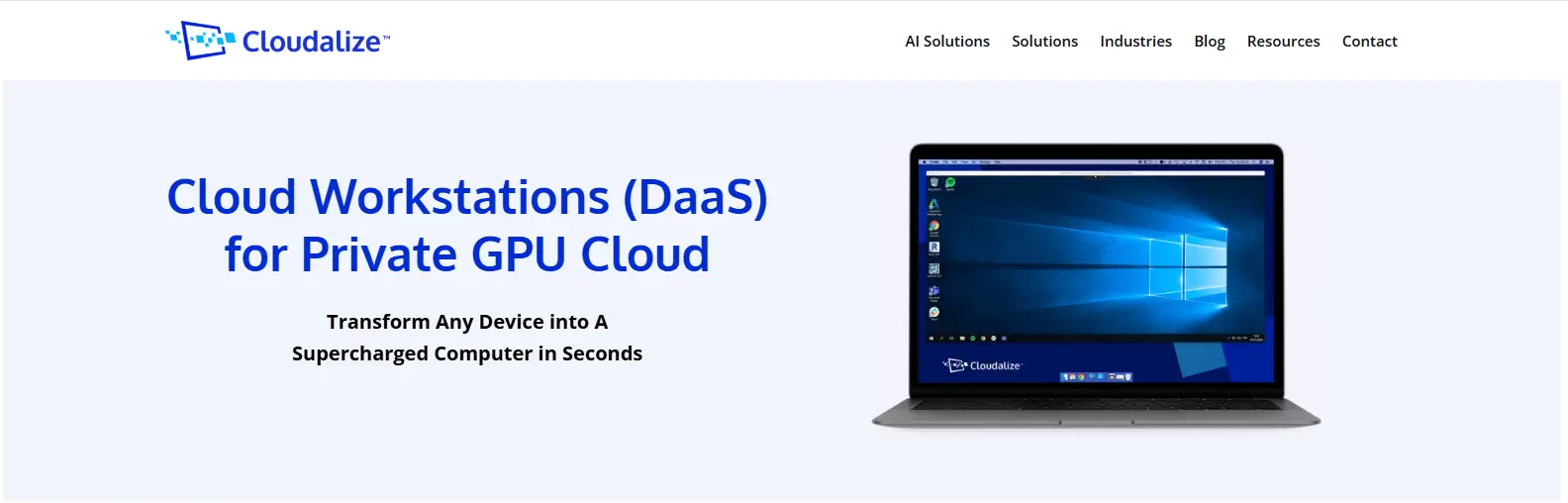
5. Cloudalize (Best White Labelled VDI Provider for Graphics-Intensive Workloads)
Overview
Not all virtual desktops are used for standard office applications. Some organizations need to deliver demanding workloads such as CAD software, 3D modeling tools, engineering applications, video production platforms, and data visualization environments. These workloads place far greater demands on infrastructure and often expose performance issues that traditional desktop platforms struggle to handle.
Cloudalize is designed to address this challenge through GPU-powered virtual desktops delivered from the cloud. By leveraging specialized cloud infrastructure, the platform enables organizations to provide high-performance virtual environments without requiring users to own expensive workstations. This can be particularly valuable for service providers supporting design firms, engineering companies, architects, and other graphics-intensive industries.
The platform also allows organizations to centralize resources while providing secure remote access to applications and data from virtually any location. For businesses supporting distributed teams, that flexibility can significantly improve operational efficiency.
Highlights
- GPU-Accelerated Desktops: Delivers virtual desktops powered by graphics processing units, helping support demanding workloads and visualization applications.
- Cloud-Based Delivery: Uses cloud infrastructure to provide scalable desktop resources without requiring large hardware investments.
- Secure Remote Access: Enables users to access desktops and applications securely from a variety of locations and devices.
- Scalable Infrastructure: Resources can be expanded as business requirements grow, supporting both small teams and larger deployments.
Best For
Cloudalize is best suited for engineering firms, architecture companies, media organizations, product design teams, and other businesses supporting power users who rely on graphics-intensive applications. It is particularly valuable when high-performance computing must be delivered remotely.
Limitations
Organizations focused primarily on standard productivity applications may find the platform’s specialized capabilities unnecessary. GPU-enabled resources can also increase overall costs compared to traditional desktop environments.
Pricing
Cloudalize offers custom pricing based on desktop specifications, GPU requirements, storage needs, user counts, and support services. Costs generally vary according to performance requirements and the scale of deployment.
6. Anunta (Best White Labelled VDI Provider for Managed Desktop Services)

Overview
For many MSPs and cloud providers, the biggest challenge is not delivering virtual desktops. It is managing everything that comes afterward. Monitoring performance, applying updates, handling support requests, maintaining security policies, and ensuring uptime can quickly consume valuable resources. Anunta addresses this challenge through a managed service approach that reduces operational burden while maintaining service quality.
Rather than requiring providers to manage every aspect of the environment internally, Anunta delivers end-to-end desktop services backed by dedicated support and operational expertise. This allows organizations to focus more on customer relationships, business growth, and service expansion instead of day-to-day infrastructure management.
The platform is particularly appealing to businesses that want to offer white-labelled desktop services without building a large internal VDI operations team. By outsourcing many administrative responsibilities, providers can often improve efficiency while maintaining a consistent customer experience.
Highlights
- Managed Service Model: Anunta handles much of the operational workload, including monitoring, maintenance, and platform management.
- 24/7 Support: Provides around-the-clock support services to help resolve issues quickly and maintain service availability.
- Desktop Lifecycle Management: Covers provisioning, updates, optimization, maintenance, and retirement of desktop environments.
- Compliance Assistance: Supports organizations that must meet regulatory and security requirements through governance and data security controls.
Best For
Anunta is best suited for MSPs, cloud providers, healthcare organizations, financial services firms, and businesses seeking a cost effective way to deliver managed desktop services. It is particularly valuable when internal resources are limited and operational simplicity is a priority.
Limitations
Organizations that prefer full control over infrastructure architecture and desktop operations may find the managed service model less flexible than self-managed VDI platforms. Customization options can also depend on the service package selected.
Pricing
Anunta offers custom pricing based on user counts, infrastructure requirements, support levels, compliance needs, and service scope. Providers typically work directly with Anunta to build a solution that aligns with their customers, services portfolio, and long-term growth objectives.
7. Dizzion (Best White Labelled VDI Provider for Compliance-Focused Organizations)
Overview
For organizations operating in highly regulated industries, desktop delivery is about far more than convenience. Security, compliance, governance, and business continuity often take priority over almost everything else. A single misconfiguration can expose sensitive data, create audit challenges, or increase operational risk. Dizzion has built its platform around addressing these concerns.
The company focuses on delivering secure virtual desktops designed to support industries with strict regulatory requirements, including healthcare, financial services, government, and legal organizations. By centralizing desktop environments and data, Dizzion helps reduce endpoint risks while simplifying security management across distributed workforces.
Another area where the platform stands out is resilience. Compliance requirements often extend beyond security controls and include business continuity planning. Dizzion incorporates disaster recovery capabilities and centralized management tools that help organizations maintain availability while meeting governance objectives.
Highlights
- Compliance Controls: Supports organizations that must meet regulatory requirements through policy enforcement, governance tools, and auditing capabilities.
- Enhanced Security: Includes security features designed to protect sensitive data through centralized management, access restrictions, and layered protection mechanisms.
- Disaster Recovery Support: Helps organizations maintain business continuity through backup, recovery, and infrastructure resilience capabilities.
- Centralized Desktop Management: Provides administrators with a unified platform for managing desktops, policies, users, and security configurations.
Best For
Dizzion is best suited for healthcare organizations, financial institutions, government agencies, legal firms, and businesses that operate under strict compliance requirements. It is particularly valuable when data security, governance, and operational resilience are top priorities.
Limitations
Organizations seeking lightweight desktop deployments or lower-cost solutions may find the platform’s enterprise-grade compliance capabilities more extensive than necessary. Advanced governance features can also increase implementation complexity compared to simpler VDI platforms.
Pricing
Dizzion offers custom pricing based on compliance requirements, user volumes, infrastructure resources, security controls, support levels, and deployment scope. Organizations typically work directly with Dizzion to develop a solution aligned with their operational, regulatory, and business needs.
8. Parallels RAS (Best White Labelled VDI Provider for Virtual Applications and Desktops)
Overview
Not every organization needs a full desktop virtualization environment for every user. In many cases, employees only require access to specific business applications. Delivering those applications efficiently, while maintaining security and administrative simplicity, is where Parallels Remote Application Server (RAS) excels.
Parallels RAS focuses on providing virtual applications and desktops through a platform designed to be easier to deploy and manage than many traditional VDI solutions. This balance between functionality and simplicity has made it a popular choice among MSPs, hosting providers, and organizations looking to modernize application delivery without introducing excessive complexity.
The platform also supports hybrid deployments, allowing businesses to combine cloud resources with existing infrastructure. For organizations transitioning from on-premises environments, this flexibility can help reduce disruption while extending the value of previous technology investments.
Highlights
- Virtual Application Delivery: Enables organizations to publish Windows applications and deliver them securely without requiring a complete desktop environment.
- Hybrid Deployments: Supports both cloud-based and on-premises resources, allowing organizations to build deployment models that align with business and technical requirements.
- Simplified Administration: Provides centralized management tools that help administrators manage users, policies, applications, and desktops more efficiently.
- Multi-Platform Access: Allows users to access applications and desktops from various devices and operating systems, improving workforce flexibility.
Best For
Parallels RAS is best suited for MSPs, mid-sized organizations, educational institutions, and businesses that need a practical way to deliver Windows applications and virtual desktops. It is particularly valuable when application delivery is a higher priority than full desktop virtualization.
Limitations
While Parallels RAS offers strong application publishing capabilities, it may not provide the same depth of enterprise-scale customization, analytics, or advanced management features found in some larger VDI platforms. Complex environments may require additional planning and integration work.
Pricing
Parallels RAS uses a subscription-based licensing model. Pricing varies according to user counts, deployment size, infrastructure requirements, support services, and software features, making it suitable for organizations with a range of budgets and operational needs.
9. OrionVM (Best White Labelled VDI Provider for Infrastructure Service Providers)

Overview
Some white label VDI platforms focus primarily on end-user desktop delivery. OrionVM takes a different approach by emphasizing infrastructure flexibility and service provider enablement. The platform is designed for businesses that want to build, customize, and deliver cloud services under their own brand while maintaining greater control over the underlying environment.
This makes OrionVM particularly attractive to hosting providers, cloud operators, telecom companies, and MSPs that already have technical expertise and want a platform capable of supporting a broader portfolio of services. Rather than offering a narrowly defined desktop solution, OrionVM provides a foundation that can support virtual desktops alongside other cloud offerings.
Its infrastructure-centric approach also gives providers more flexibility in how resources are allocated and managed. For organizations seeking to differentiate their services and maintain operational control, that can be a significant advantage.
Highlights
- Service Provider Platform: Built specifically for service providers that want to deliver cloud-based desktops and related services under their own brand.
- Infrastructure Flexibility: Supports a variety of deployment models and resource configurations, allowing providers to tailor environments to customer requirements.
- Automation Capabilities: Includes automation tools that help streamline provisioning, management, and operational workflows.
- White Label Enablement: Allows providers to customize branding and deliver services as part of their own product portfolio.
Best For
OrionVM is best suited for hosting companies, cloud service providers, telecom operators, and MSPs that want greater control over cloud infrastructure while maintaining the ability to offer branded virtual desktop services. It is particularly valuable for organizations with existing technical expertise and long-term growth plans.
Limitations
Compared to turnkey VDI solutions, OrionVM may require more technical involvement during deployment and ongoing management. Organizations looking for a fully managed desktop platform may find simpler alternatives more suitable for their needs.
Pricing
OrionVM offers custom pricing based on infrastructure consumption, resource allocation, storage requirements, support services, and deployment scale. Providers typically work directly with OrionVM to create a pricing model aligned with their business objectives, customer base, and service offerings.
How Do You Choose the Right White Label VDI Provider for Your Business?

Choosing a white label VDI provider is about more than comparing feature lists. The platform you select will influence how you deliver services, support customers, manage costs, and differentiate your business over the long term. Some providers prioritize rapid deployment and simplicity, while others focus on infrastructure control, compliance, or advanced customization.
The right choice depends on your business model, technical resources, customer expectations, and growth objectives. Before committing to a platform, it helps to evaluate four key areas.
How Important Is Branding and Customer Ownership?
For many MSPs and cloud providers, maintaining ownership of the customer relationship is one of the biggest reasons to adopt a white label solution in the first place.
If customers primarily interact with another company’s branding, it becomes more difficult to build long-term loyalty and distinguish your services from competitors. A strong white label platform helps reinforce your value while keeping the customer experience consistent.
Consider the following:
- Full White Labeling: Can the platform be fully branded with your logo, domain, and visual identity?
- Customer Experience Control: Do customers interact with your brand throughout the service lifecycle?
- Own Brand Delivery: Can you package desktops and related services as part of your own portfolio?
- Long-Term Differentiation: Will the platform help your business stand out in a crowded market?
The strongest white label providers make your business visible while keeping the underlying technology largely invisible.
What Security and Compliance Features Do You Need?
Security remains one of the most important factors in any virtual desktop deployment. Because VDI centralizes data and applications, a properly configured environment can significantly improve protection. At the same time, weak security controls can expose sensitive systems and customer data.
When evaluating providers, focus on:
- Multi-Factor Authentication: Adds an additional layer of protection beyond passwords.
- Data Encryption: Helps protect data both in transit and at rest.
- Access Controls: Granular permissions allow administrators to control who can access specific resources.
- Compliance Requirements: Industries such as healthcare, finance, and government may require support for specific regulatory frameworks.
Strong security capabilities should be built into the platform rather than treated as optional add-ons.
Should You Choose Cloud VDI, Hybrid VDI, or On-Premises Infrastructure?
Deployment model selection often has a direct impact on cost, scalability, and operational complexity.
- Cloud VDI typically offers the fastest deployment and greatest flexibility. Resources can be scaled quickly, and providers avoid much of the infrastructure management burden associated with traditional VDI. Cloud-based environments can also reduce costs through features such as auto-suspending idle desktops.
- Hybrid Deployments combine cloud resources with existing infrastructure. This approach can be useful for organizations that need to maintain certain workloads on-premises while benefiting from cloud scalability.
- On-Premises VDI provides greater control but often requires significant upfront investment in servers, storage, networking, and virtualization technology. Scaling can be slower due to procurement and deployment requirements.
When comparing options, consider both immediate needs and future growth expectations.
How Much Operational Complexity Can Your Team Manage?
Not every organization wants to manage infrastructure at the same level. Some providers prefer complete control, while others prioritize simplicity and operational efficiency.
Ask yourself:
- Fully Managed Services: Would a provider like Anunta reduce administrative overhead and allow your team to focus on growth?
- Infrastructure Ownership: Do you require direct control over cloud infrastructure and virtualization technology?
- Scalability Requirements: Can the platform support customer growth without introducing significant management challenges?
- Long-Term Cost Management: Will operational expenses remain predictable as your business expands?
The best white label VDI provider is not necessarily the one with the most features. It is the one that aligns with your technical capabilities, customer expectations, and long-term business strategy while keeping complexity at a manageable level.
What Are the Biggest Benefits of White Label VDI Compared to Building Your Own VDI Stack?

Building a virtual desktop infrastructure from the ground up can give organizations complete control, but that control often comes with substantial costs and ongoing responsibilities. Traditional VDI environments require investment in servers, storage, networking, virtualization technology, licensing, monitoring tools, and specialized expertise. For many MSPs and cloud providers, the challenge is not deploying VDI once, it is maintaining and scaling it efficiently over time.
White label VDI offers a more practical and cost effective alternative. Instead of spending months building infrastructure and managing complex environments, providers can leverage established platforms and focus on delivering value to customers under their own brand.
Some of the most significant benefits include:
- Faster Time to Market: Launch desktop services quickly without lengthy procurement cycles, infrastructure planning, or deployment projects.
- Reduced Upfront Investment: Avoid the significant upfront investment typically required for servers, storage systems, licensing, and specialized VDI expertise.
- Higher Profit Margins: White-labelled platforms allow MSPs to package and resell services while maintaining ownership of customer relationships and recurring revenue streams.
- Simplified Infrastructure Management: Providers reduce operational complexity by relying on platforms that handle much of the backend infrastructure and maintenance workload.
- Improved Scalability: New users and customers can often be added rapidly without the hardware limitations and licensing challenges associated with traditional VDI environments.
- Enhanced Security: Many platforms include built-in security features such as multi-factor authentication, encryption, access controls, and centralized data management that help reduce risks and strengthen compliance.
For most service providers, the biggest advantage is focus. Rather than dedicating resources to managing infrastructure, you can concentrate on growing your customer base, improving services, and creating long-term business value.
Conclusion
The best white labelled VDI provider depends on the type of services you plan to offer, the customers you support, and the level of operational responsibility your team wants to assume. Some platforms prioritize simplicity and speed, while others focus on infrastructure flexibility, security, or specialized workloads.
If browser-based desktop delivery is your priority, Apporto stands out with its cloud-native architecture and ability to deliver virtual desktops directly through a web browser. For MSPs focused on rapid customer growth and operational scalability, V2 Cloud offers one of the most straightforward deployment experiences.
Organizations that place a premium on secure remote access and application delivery should consider Thinfinity Workspace, while vDesk.works remains a strong option for providers managing multiple customer environments through a multi-tenant platform.
Businesses supporting graphics-intensive applications may find Cloudalize particularly compelling due to its GPU-enabled virtual desktops. Meanwhile, providers seeking a fully managed approach can benefit from Anunta’s end-to-end service model and dedicated operational support.
Ultimately, the right platform is the one that aligns with your branding strategy, security requirements, scalability goals, and long-term business objectives.
Looking for a browser-based white label VDI platform that combines scalability, simplified management, and branded desktop delivery? Explore Apporto and discover how you can launch secure virtual desktop services under your own brand while reducing infrastructure complexity.
Frequently Asked Questions (FAQs)
1. What is the best white labelled VDI provider in 2026?
The best white labelled VDI provider depends on your business goals. Apporto is a leading choice for browser-based desktop delivery, while V2 Cloud excels in scalability. Thinfinity Workspace, vDesk.works, and Anunta also offer strong options for different service provider requirements.
2. How does white label VDI work for MSPs?
White label VDI allows MSPs to deliver virtual desktops under their own brand while leveraging a third-party platform’s infrastructure and technology. This approach helps providers launch services faster, reduce operational overhead, and maintain ownership of customer relationships.
3. Is cloud VDI better than traditional VDI?
Cloud VDI is often easier to deploy and scale than traditional VDI. It reduces infrastructure management responsibilities and avoids significant upfront investment in hardware. Traditional VDI may offer greater control, but it typically requires more expertise, resources, and ongoing maintenance.
4. Which white label VDI provider offers the most scalability?
V2 Cloud is widely recognized for its scalability and ease of deployment. Its cloud-based architecture allows providers to add users quickly without navigating hardware procurement cycles, making it well suited for MSPs experiencing rapid customer growth.
5. What security features should a white label VDI platform include?
A strong white label VDI platform should include multi-factor authentication, data encryption, access controls, centralized management, secure access capabilities, and compliance support. These security features help protect sensitive data while reducing risks associated with endpoint devices.
6. How much does a white label VDI solution cost?
Pricing varies depending on infrastructure requirements, user counts, storage needs, support services, and platform capabilities. Some providers offer predictable subscription pricing, while others use consumption-based models. Most vendors provide custom quotes based on specific business requirements.
