

What Is the Difference Between Apporto PowerGrader and Edcite?
Apporto PowerGrader and Edcite serve different assessment needs. Apporto PowerGrader is designed for AI-assisted grading of essays and programming assignments in higher education, while Edcite focuses on interactive K–12 assessments. Choose PowerGrader for faster, rubric-based grading and Edcite for classroom quizzes, formative assessment, and student engagement.
Choosing an assessment platform isn’t as straightforward as it used to be. Some tools promise faster grading. Others focus on building engaging classroom activities and collecting meaningful student data. At first glance, they can seem interchangeable, but that’s rarely the case.
Apporto PowerGrader and Edcite were built with different priorities, different users, and different teaching environments in mind. One emphasizes AI-assisted grading for higher education, while the other helps K-12 teachers create interactive, standards-aligned assessments.
In this blog, you’ll compare their AI capabilities, assessment features, feedback quality, integrations, grading workflows, and ideal use cases, helping you determine which platform best supports your teaching and learning goals.
What Are Apporto PowerGrader and Edcite & How Do They Differ?

Apporto PowerGrader and Edcite both appear to solve the same problem. They help educators evaluate student learning through technology. Look a little closer, though, and you’ll find that each platform serves a very different purpose within the teaching process.
Apporto PowerGrader is an AI-assisted grading tool designed specifically for higher education. It helps instructors evaluate essays, programming assignments, and other text-based submissions more efficiently by generating rubric-aligned scores and detailed feedback.
Instead of replacing instructor judgment, the AI assists with the initial evaluation, allowing educators to review, adjust, and approve grades before they are released. This approach reduces time spent grading while maintaining consistency and academic standards.
Edcite, on the other hand, is a comprehensive assessment platform built primarily for K-12 classrooms. It enables teachers to create interactive assignments, quizzes, exit tickets, and benchmark assessments that align with Common Core and state standards.
With more than 180,000 ready-to-use assessment items and over 60 technology-enhanced question types, Edcite emphasizes classroom engagement, formative assessment, and real-time insight into student understanding rather than AI-assisted grading.
The distinction becomes even clearer when you consider how each platform fits into your teaching workflow. PowerGrader supports the grading stage by helping you evaluate complex written work faster and with greater consistency. Edcite supports instruction before grading, giving teachers tools to create assessments, collect responses, and identify learning gaps as lessons progress.
Ultimately, your choice depends on the educational environment and assessment goals. If you primarily teach in higher education and spend significant time grading essays or written assignments, PowerGrader is purpose-built for that workflow.
If you teach in a K-12 classroom and want an interactive assessment platform that keeps students engaged while providing immediate classroom data, Edcite offers a broader instructional toolkit.
Platform Overview Comparison
| Feature | Apporto PowerGrader | Edcite |
|---|---|---|
| Primary purpose | AI-assisted grading for written and programming assignments | Interactive assessment platform for classroom instruction |
| Best for | Higher education instructors | K-12 teachers and school districts |
| AI functionality | AI-generated scoring, rubric-aligned feedback, instructor review | Automated scoring for supported question types, real-time assessment insights |
| Assessment focus | Essays, programming assignments, and text-based assessments | Formative assessments, quizzes, exit tickets, and benchmark testing |
| Student engagement | Personalized grading feedback after submission | Interactive activities, gamified question types, and immediate feedback |
| Assignment support | Essays, written responses, coding assignments, rubric-based grading | Multiple choice, short answers, drag-and-drop, matching, multimedia, and 60+ interactive question types |
| Higher education | Purpose-built for colleges and universities | Limited, primarily designed for K-12 |
| K-12 support | Can be used selectively but not the primary audience | Core focus, widely adopted across more than 30,000 schools |
How Does Each Platform Use Artificial Intelligence to Improve Assessment?

Artificial intelligence is becoming a valuable teaching assistant, but its role depends on the platform you choose. While both Apporto PowerGrader and Edcite use automation to simplify assessment, they apply it in different ways. One focuses on improving grading accuracy and efficiency, while the other emphasizes faster classroom assessment and instructional insights.
Apporto PowerGrader is an AI-assisted grading tool built to evaluate essays, programming assignments, and other text-based submissions. After a student submits an assignment, the platform generates AI-powered scores based on instructor-defined rubrics and provides criterion-specific, rubric-aligned feedback for each response.
Importantly, the AI does not assign the final grade on its own. Instructors review every recommendation, make adjustments when needed, and approve grades before students receive feedback. This keeps educators in control while significantly reducing repetitive grading tasks.
Edcite approaches assessment differently. Instead of focusing on long-form grading, it automates scoring for question types such as multiple choice and other objective assessments where instant evaluation is possible.
Teachers receive immediate classroom data and can quickly identify learning gaps, making it easier to adjust instruction before moving to the next lesson. For subjective responses, educator review remains an essential part of the process.
Although their workflows differ, both platforms demonstrate the same principle: AI works best when it supports educators rather than replacing them. Automation handles repetitive tasks, while teachers continue making instructional and grading decisions that require professional judgment.
AI Capability Comparison
| AI Capability | Apporto PowerGrader | Edcite |
|---|---|---|
| Primary AI role | AI-assisted grading for essays, programming assignments, and other text-based submissions | Automated scoring and assessment support for objective question types |
| AI-generated scores | Generates rubric-based scores that instructors review before releasing the final grade | Automatically scores eligible question types where applicable |
| Feedback quality | Provides detailed, rubric-aligned, criterion-specific feedback for every submission | Delivers instant feedback and performance insights for supported assessments |
| Instructor involvement | Instructors review, edit, and approve AI recommendations before assigning final grades | Teachers review subjective responses and oversee assessment results |
| Assessment workflow | Streamlines grading by reducing repetitive evaluation while maintaining instructor control | Accelerates classroom assessment with immediate scoring and real-time student data |
| Best use of AI | Improving grading consistency and reducing time spent evaluating written work | Supporting formative assessment, classroom instruction, and rapid student feedback |
Which Platform Supports More Assignment Types and Assessments?

The range of assignments a platform supports has a direct impact on how you teach and assess learning. Some educators primarily evaluate essays and written responses, while others rely on quizzes, exit tickets, and interactive activities to measure student understanding throughout a lesson. This is where Apporto PowerGrader and Edcite take different approaches.
Apporto PowerGrader is designed for instructors who spend most of their time grading essays, programming assignments, and other text-based assignments.
Its AI-assisted grading engine works best with complex responses that require rubric-based evaluation and detailed feedback, making it especially valuable in higher education.
Edcite offers much broader assessment variety for K-12 classrooms. Teachers can create quizzes, benchmark assessments, exit tickets, and Common Core-aligned activities using more than 60 technology-enhanced question types.
These interactive assessments support continuous classroom instruction while giving educators immediate insight into student performance. As a result, Edcite is better suited for formative assessment and everyday classroom engagement rather than evaluating lengthy written work.
Assignment Comparison
| Assignment Type | Apporto PowerGrader | Edcite |
|---|---|---|
| Essays | Purpose-built with AI-assisted grading and rubric-based feedback | Limited support, not a primary focus |
| Multiple choice | Limited support | Fully supported with automatic scoring |
| Short answers | Supports rubric-based evaluation of written responses | Supported for formative and classroom assessments |
| Programming assignments | Designed to evaluate coding assignments | Not supported |
| Interactive assessments | Limited | 60+ technology-enhanced question types |
| Exit tickets | Not a core feature | Built for quick classroom checks and formative learning |
| Quizzes | Basic assignment support | Comprehensive quiz creation and assessment tools |
Which Platform Delivers Better Feedback and Grading Quality?

Effective assessment goes beyond assigning a score. The quality of feedback you provide often has a greater impact on student learning than the final grade itself. Although both Apporto PowerGrader and Edcite help educators evaluate student work, they deliver feedback at different stages of the learning process and with different objectives.
Apporto PowerGrader is built around rubric-based grading for essays, programming assignments, and other text-based responses. Its AI-assisted grading engine analyzes student submissions against instructor-defined criteria, generating detailed, criterion-specific feedback for every rubric category.
Instead of simply identifying correct or incorrect answers, it explains how student work aligns with expectations. Instructors can review every AI-generated score, edit comments, use a comment library where appropriate, and approve the final grade before feedback is released. This review process helps maintain grading consistency while ensuring every evaluation reflects instructor judgment.
Edcite focuses on immediate feedback during the assessment experience. Students can receive instant results on automatically scored question types, allowing them to recognize mistakes and improve understanding while instruction is still in progress.
This approach works particularly well for quizzes, formative assessments, and classroom activities where quick responses help teachers adjust lessons in real time. Since Edcite is designed primarily for objective and interactive assessments, its feedback is generally less detailed than the rubric-based evaluation provided for complex writing assignments.
The difference ultimately comes down to timing and depth. If your goal is to deliver comprehensive, personalized feedback after students submit essays or written work, PowerGrader offers a more robust grading workflow.
If you want students to receive immediate feedback during classroom assessments so instruction can adapt quickly, Edcite provides the faster assessment experience.
Feedback Comparison
| Feedback Feature | Apporto PowerGrader | Edcite |
|---|---|---|
| Personalized feedback | AI-generated, criterion-specific feedback tailored to each submission | Limited, primarily automated feedback for supported question types |
| Rubric-aligned grading | Instructor-defined rubrics with AI-assisted evaluation | Supports assessment scoring but not AI-driven rubric grading for essays |
| Immediate feedback | Feedback provided after instructor review and grade approval | Instant feedback for automatically scored assessments |
| Comment library | Supports reusable instructor comments to improve grading efficiency | Limited comment functionality |
| Instructor approval | AI recommendations require instructor review before the final grade is released | Teacher oversight for subjective responses and assessment review |
| Best for | Detailed grading of essays, writing, and programming assignments | Fast classroom feedback, formative assessments, quizzes, and interactive learning |
Which Platform Saves More Time for Teachers and Instructors?

One of the biggest reasons educators adopt assessment technology is to reduce the time spent on repetitive grading. Reviewing essays, providing meaningful feedback, and assigning consistent scores can quickly consume hours that could otherwise be devoted to lesson planning, student support, or curriculum development. The more complex the assignment, the greater the workload becomes.
For written assignments, Apporto PowerGrader delivers the larger productivity advantage. Research shows that manually grading a single essay can take 15 to 30 minutes, making large classes particularly time-intensive.
PowerGrader uses AI-assisted grading to evaluate essays and other text-based submissions against instructor-defined rubrics, generating scores and detailed feedback that instructors review before approving the final grade.
This streamlined workflow reduces repetitive work while keeping educators in complete control of grading decisions. Instead of starting every evaluation from scratch, you spend more time refining feedback than creating it.
Edcite improves efficiency in a different way. Its automated scoring capabilities are designed for quizzes, exit tickets, multiple-choice questions, and other classroom assessments.
Teachers receive instant results and performance data, allowing them to identify learning gaps without manually reviewing every response. Although subjective answers still require educator review, the platform simplifies formative assessment and reduces administrative effort throughout daily instruction.
Both platforms improve faculty productivity, but they address different bottlenecks. PowerGrader reduces the time required to evaluate complex written submissions, while Edcite accelerates classroom assessment and data collection. The better choice depends on where your teaching workload is greatest.
Which Platform Offers Better Assessment Data and Reporting?

Assessment data is most valuable when it helps you make better instructional decisions. Beyond assigning grades, modern assessment platforms collect evidence of student performance, highlight learning gaps, and provide reports that support both classroom instruction and administrative planning. Apporto PowerGrader and Edcite both offer reporting capabilities, but they prioritize different types of data.
Apporto PowerGrader focuses on grading analytics tied to student submissions. As instructors review AI-generated evaluations, they gain consistent insight into rubric performance, grading patterns, and student progress across written assignments.
This makes it easier to monitor learning outcomes, identify recurring challenges, and maintain fair, data-informed assessment practices in higher education.
Edcite places greater emphasis on real-time classroom insights. Teachers receive instant data as students complete quizzes, exit tickets, and formative assessments, allowing them to adjust instruction before misconceptions become larger problems.
Schools and districts can also use common assessment reporting to compare performance across classrooms, helping administrators monitor instructional effectiveness and student achievement over time.
If your priority is evaluating complex written work with meaningful grading data, PowerGrader provides the information needed to support consistent assessment. If you want immediate classroom performance data and broader reporting for instructional planning, Edcite offers a more comprehensive reporting environment.
Reporting Comparison
| Reporting Feature | Apporto PowerGrader | Edcite |
|---|---|---|
| Student data | Tracks performance across essays, programming assignments, and text-based submissions | Collects real-time performance data across quizzes, assessments, and classroom activities |
| Reports | Rubric-based grading reports and submission insights | Comprehensive classroom, school, and district reporting |
| Instant results | Available after instructor review and grade approval | Immediate results for automatically scored assessments |
| Assessment analytics | Focuses on grading consistency, rubric performance, and learning outcomes | Provides real-time analytics, performance tracking, and common assessment insights |
| Administrative reporting | Best suited for instructor-level grading analysis | Supports school and district administrators with broader assessment reporting |
Which Platform Fits Better into Your Existing Teaching Workflow?

An assessment platform should fit naturally into the systems you already use. If instructors have to manage separate logins, transfer grades manually, or learn entirely new processes, even powerful features can become frustrating.
Both Apporto PowerGrader and Edcite are designed to simplify teaching workflows, but they support different educational environments.
Apporto PowerGrader is built with higher education in mind. It integrates directly with Canvas, allowing instructors to receive assignment submissions, evaluate student work, and synchronize grades without leaving their existing course environment.
Grade passback eliminates manual data entry, while instructor review ensures every final grade reflects academic judgment before being released. This creates a familiar workflow with minimal disruption for faculty.
Edcite is designed for K-12 schools and districts that manage assessments across multiple classrooms. The platform supports Single Sign-On (SSO), making access easier for teachers and students while reducing administrative overhead.
Its deployment model also works well for multiple schools, enabling administrators to manage common assessments, classroom data, and instructional resources from a centralized platform. This improves consistency across schools while making implementation easier at the district level.
Ultimately, the better workflow depends on where you teach. PowerGrader integrates seamlessly into higher education grading processes, while Edcite provides the flexibility and administrative controls needed for large K-12 implementations.
Workflow Comparison
| Workflow Feature | Apporto PowerGrader | Edcite |
|---|---|---|
| Canvas integration | Direct integration for assignment submissions and grading | Supports LMS connectivity but Canvas integration is not its primary focus |
| Grade passback | Automatic grade synchronization with Canvas | Limited grade synchronization depending on LMS configuration |
| Single Sign-On | Supports institutional authentication | Single Sign-On for teachers, students, and administrators |
| Multi-school deployment | Best suited for colleges and universities | Designed for district-wide and multi-school implementation |
| Best fit | Higher education instructors seeking a streamlined grading workflow | K-12 teachers, schools, and districts managing classroom assessments and instructional data |
How Do Pricing and Long-Term Value Compare?

Pricing is often one of the final factors in choosing an assessment platform, but long-term value matters just as much. Beyond subscription costs, you should consider how much time the platform saves, how easily it fits into your existing systems, and the impact it has on teaching efficiency and student outcomes.
Neither Apporto PowerGrader nor Edcite publicly lists standard pricing for all institutions. Instead, both primarily use custom pricing based on factors such as institution size, licensing requirements, and implementation needs. This allows schools and universities to purchase plans that align with their enrollment, users, and instructional goals.
From a value perspective, Apporto PowerGrader delivers its strongest return by reducing grading workload for higher education instructors.
Less time spent evaluating essays and programming assignments means more time for teaching, mentoring, and course development. Edcite, meanwhile, provides value through interactive assessments, real-time classroom data, and district-wide reporting that support efficient instruction across K-12 schools.
Ultimately, the better investment depends on your educational environment. If your priority is AI-assisted grading and faculty productivity, PowerGrader offers stronger long-term value. If your focus is classroom assessment, instructional data, and school-wide implementation, Edcite is the better fit.
Pricing Comparison
| Pricing Area | Apporto PowerGrader | Edcite |
|---|---|---|
| Pricing model | Custom institutional pricing | Custom pricing for schools and districts |
| Free plan | No publicly available free plan | Limited free access available for educators to explore the platform |
| Enterprise licensing | Institution-wide licensing for colleges and universities | District and school-wide licensing options |
| Best fit | Higher education institutions seeking AI-assisted grading and grading efficiency | K-12 schools and districts focused on interactive assessments and classroom reporting |
Why Is Apporto PowerGrader the Better Choice for AI-Assisted Grading?
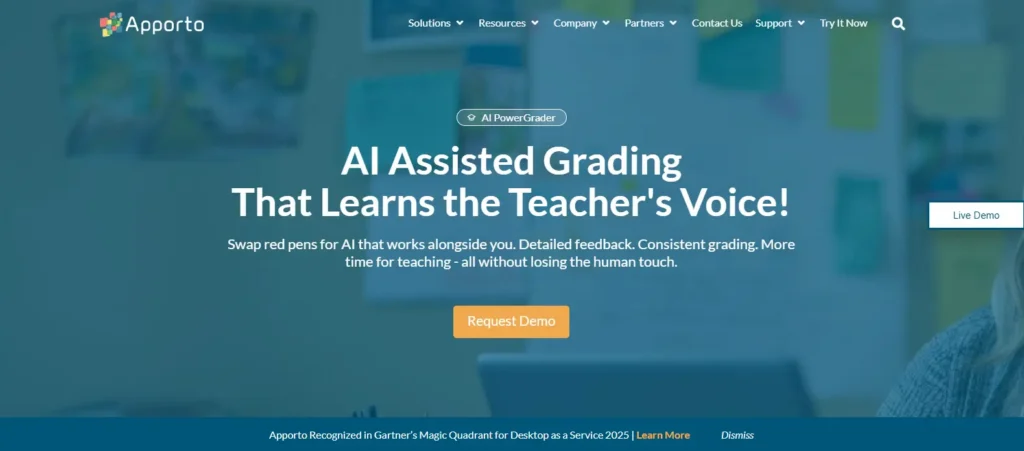
If your primary goal is to make grading faster without sacrificing quality, Apporto PowerGrader stands out as the stronger choice. Unlike general assessment platforms that focus on quizzes and classroom activities, PowerGrader is purpose-built for evaluating essays, programming assignments, and other text-based submissions in higher education.
Its AI-assisted grading engine generates rubric-aligned scores and personalized feedback while keeping instructors in complete control of the grading process.
Instead of replacing academic judgment, the platform supports it. Every AI-generated evaluation can be reviewed, refined, and approved before the final grade is released, helping maintain consistency across large classes while reducing repetitive grading tasks.
Combined with direct Canvas integration and grade synchronization, PowerGrader fits naturally into existing teaching workflows and improves faculty efficiency without adding unnecessary complexity.
If you regularly assess written assignments and want to spend less time grading while delivering meaningful, consistent feedback, PowerGrader provides the specialized tools to achieve that. Try Apporto PowerGrader
Frequently Asked Questions (FAQs)
1. Is Apporto PowerGrader better than Edcite?
It depends on your educational goals. Apporto PowerGrader is better for AI-assisted grading, rubric-based evaluation, and grading essays or programming assignments in higher education. Edcite is stronger for interactive classroom assessments, quizzes, and formative learning in K-12 schools.
2. What is the biggest difference between Apporto PowerGrader and Edcite?
The biggest difference is their primary purpose. Apporto PowerGrader is an AI-assisted grading tool designed to evaluate written assignments with instructor oversight, while Edcite is an assessment platform focused on creating interactive, standards-aligned classroom activities and measuring student understanding.
3. Which platform is better for grading essays and written assignments?
Apporto PowerGrader is the better choice for grading essays and other text-based assignments. It generates AI-assisted, rubric-aligned feedback, allowing instructors to review and approve scores before releasing final grades. Edcite is better suited for quizzes and classroom assessments than long-form writing evaluation.
4. Is Edcite a good assessment platform for K-12 schools?
Yes. Edcite is built specifically for K-12 education and supports Common Core-aligned instruction, benchmark assessments, quizzes, exit tickets, and more than 60 technology-enhanced question types. It also provides real-time classroom data to help teachers monitor student progress and adjust instruction.
5. Can Apporto PowerGrader integrate with Canvas?
Yes. Apporto PowerGrader integrates directly with Canvas, allowing instructors to receive assignment submissions, evaluate student work, and synchronize grades through grade passback. This reduces manual administrative work while keeping grading within an existing course workflow.
6. Which platform saves teachers more grading time?
Apporto PowerGrader saves more time when grading essays, programming assignments, and other written submissions by automating much of the evaluation process while preserving instructor review. Edcite improves efficiency by automatically scoring quizzes and objective assessments, making daily classroom assessment faster.
7. Does Edcite support interactive assessments and Common Core standards?
Yes. Edcite supports interactive assessments aligned with Common Core and state standards. Teachers can create quizzes, exit tickets, benchmark assessments, and classroom activities using more than 60 technology-enhanced question types that encourage participation and provide immediate performance insights.
8. Which platform is the better choice for higher education institutions?
For higher education, Apporto PowerGrader is the stronger choice. It is purpose-built for college and university instructors who need AI-assisted grading, rubric-based feedback, Canvas integration, and efficient evaluation of essays, programming assignments, and other complex written assessments.
