

What Is the Best Originality AI Alternative?
Apporto TrustEd is a strong Originality AI alternative for educational institutions that need more than AI and plagiarism detection. It focuses on academic integrity through contextual review, writing behavior, integrity analytics, and human judgment, helping educators evaluate student work within its broader academic context.
An originality check can answer one question while leaving another completely open. A piece of writing may contain no obvious source matches, yet still raise questions about whether AI was involved. Originality.ai addresses both concerns through AI detection and plagiarism checking, but it may not suit every workflow.
You might need broader language support, a more generous free tier, different pricing, stronger academic features, or simpler access. AI detection estimates whether writing resembles AI-generated content, while plagiarism scanning identifies similarities with existing sources. Both require careful interpretation, especially with paraphrased or formal academic writing.
In this blog post, you’ll compare seven Originality AI alternatives across accuracy, pricing, free access, plagiarism detection, reporting, usability, multilingual support, and workflow fit.
How Did We Evaluate These Originality AI Alternatives?

To compare Originality AI alternatives fairly, we looked at several factors that can materially change the usefulness of a detection platform. Detection accuracy comes first, but it is only one part of the picture. A tool also needs to handle different types of writing, provide understandable results, and fit the way you actually work.
The evaluation considers AI detection, false positives, plagiarism checking, language coverage, testing methodology, pricing, free access, usability, and scalability. We also considered who each platform is designed for. A student, content manager, SEO agency, publisher, and educational institution may reach very different conclusions about the same tool.
Which AI Detection Features Matter Most?
The first factor is the quality and usefulness of the AI detection itself. We considered how each AI detector handles AI-generated text, AI-generated content, AI writing, and AI written text, along with how results are presented.
A useful detection tool should make its detection score understandable rather than leaving you with an unexplained percentage. We also considered false positives, particularly where human written text or paraphrased content may be incorrectly flagged.
How Important Are Accuracy, Language Coverage, and Testing Methodology?
Accuracy needs to be considered alongside the conditions under which it was measured. We looked at available testing, including own testing, independent comparisons, and the stated testing methodology.
Language coverage also matters because results can vary across multilingual content, formal academic writing, and writing from non-native English speakers. Comparing other AI detectors using consistent samples provides a more meaningful basis for judging detection performance.
Which Platform Offers the Best Practical Value?
Finally, we considered what you receive for the price. That includes a free tier, free version, free checks, unlimited usage, word limits, and the features available through paid plans. We also looked at public pricing, usability, access, and whether a platform can scale with your workload.
A free tool may make sense for occasional checks, while writers, content teams, and institutions may need broader capabilities as usage increases.
Quick Comparison of the Best Originality AI Alternatives
The alternatives vary quite a bit in who they serve and what they are built to do. Some lean toward academic writing, while others are better suited to publishers, writers, SEO agencies, or content teams.
AI detection, plagiarism scanning, language coverage, free access, and detection accuracy also differ, so the strongest option depends on what you need to check and how often you need to check it.
Originality AI Alternatives Comparison Table
| Platform | Best For | AI Detection | Plagiarism Checking | Free Access | Key Strength |
|---|---|---|---|---|---|
| Apporto TrustEd | Academic integrity | Integrity-focused | Integrity-focused | Custom | Contextual institutional review |
| Winston AI | AI & plagiarism detection | Advanced | Advanced | Limited | Document and content checking |
| GPTZero | Education | Advanced | Limited | Yes | Sentence-level educator analysis |
| Turnitin | Academic writing | Advanced | Advanced | No | Academic similarity checking |
| Copyleaks | AI & plagiarism detection | Advanced | Advanced | Limited | Multilingual detection and integrations |
| Pangram | AI detection | Advanced | Limited | Yes | AI text detection |
| ZeroGPT | Free AI detection | Advanced | Limited | Yes | High-volume free access |
7 Best Originality AI Alternatives (A Complete Overview)
1. Apporto TrustEd
Overview
Apporto TrustEd takes a broader approach to Academic Integrity and AI than a conventional AI detector. Rather than reducing a student’s work to an AI score, it emphasizes contextual evidence that can help educators understand how the work was produced. This makes it particularly relevant when AI use needs to be considered alongside the wider academic context.
The distinction matters because an AI detection result does not establish authorship on its own. Reviewing writing behavior and other available evidence can give educators a more complete basis for assessing academic work.
Highlights
- Supports institutional academic integrity workflows
- Emphasizes human review and contextual evidence
- Considers writing behavior and student work
- Addresses AI use within academic settings
- Encourages responsible AI practices
- Designed for educational institutions
Best For
Apporto TrustEd is best suited to educational institutions, instructors, and educators that want integrity-focused workflows built around contextual review rather than relying exclusively on automated detection.
Limitations
It is not positioned as a conventional standalone AI detector or plagiarism database. If your primary requirement is source matching or traditional plagiarism scanning, you may need a dedicated detection platform alongside it.
Pricing
Apporto TrustEd uses an institution-focused approach to access and pricing. Its value is better assessed through academic integrity workflows, contextual evidence, human review, and responsible AI support than through an individual per-scan cost.
2. Winston AI
Overview
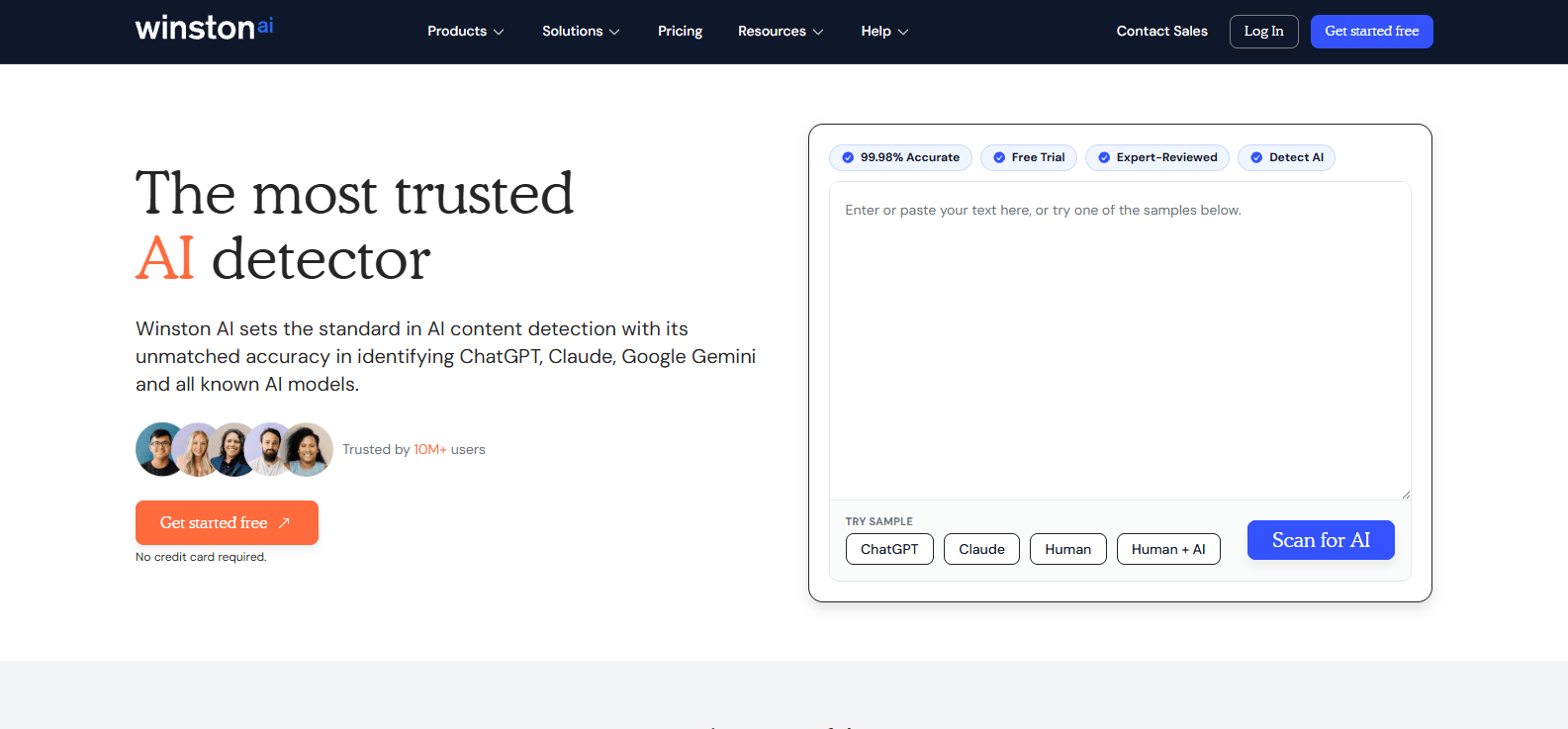
Winston AI combines AI detection with plagiarism scanning, giving you two ways to examine written content within the same workflow. It can assess potentially AI-generated content while also helping identify similarities with existing material, making it relevant when content originality involves more than one question.
That combination can be useful when you need to examine both potentially AI-generated material and existing source overlap. Human written content can still produce unexpected detection results, so detection accuracy should be considered alongside the surrounding context rather than treated as definitive proof of authorship.
Highlights
- Combines AI detection with plagiarism checking
- Provides reports for reviewing results
- Supports document analysis
- Includes optical character recognition for document scanning
- Supports multiple languages
- Designed for written content and originality checks
Best For
Winston AI is a practical option for writers, publishers, content teams, and educational users who want AI detection and plagiarism checking together. Its document-focused capabilities can also make it useful for organizations reviewing different types of submitted content.
Limitations
Users primarily interested in academic similarity checking may want to compare its database coverage and institutional features with platforms specifically designed for academic environments.
Pricing
Pricing depends on the selected access and usage requirements. When comparing Winston AI, consider its AI detection, plagiarism scanning, reports, multilingual capabilities, and document handling alongside the overall cost.
3. GPTZero
Overview
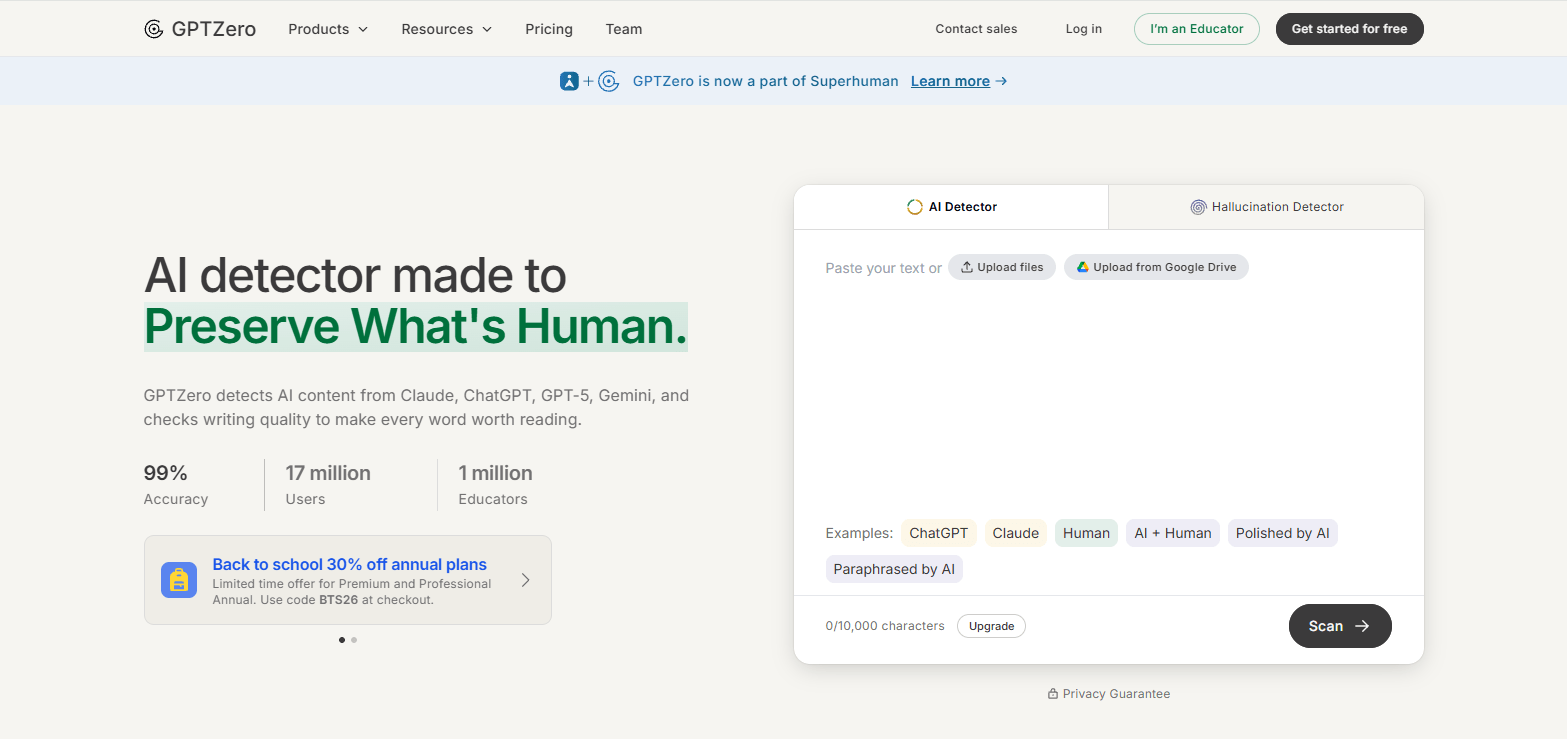
GPTZero is an AI detector with a particularly strong connection to education and academic writing. It is designed to help educators and students examine whether submitted writing contains patterns associated with AI-generated text. That makes it a focused Originality.ai alternative when AI writing detection is the primary requirement.
The sentence-level approach can make a detection result easier to examine because you can see which portions of the text contributed to the overall result. GPTZero claims 99.3% accuracy in controlled tests, although accuracy figures should always be considered alongside the testing conditions used to produce them. Human-written text can also be flagged, so an AI score should not be treated as conclusive evidence. If you’re comparing other tools with similar capabilities, explore GPTZero alternatives for additional AI detection and academic integrity solutions.
Highlights
- Designed with educators and students in mind
- Provides sentence-level analysis
- Offers reports for reviewing detection results
- Includes a free tier
- Evaluates writing for patterns associated with AI-generated content
- Useful for academic writing workflows
Best For
GPTZero is best suited to educators, students, and academic institutions that want dedicated AI writing detection with accessible reporting and analysis.
Limitations
It is more specialized in AI detection than traditional plagiarism checking. If you need extensive source matching or comprehensive plagiarism scanning, you may need another platform alongside GPTZero.
Pricing
GPTZero offers a free tier, making it accessible for users who need occasional AI checks. Paid access may be more appropriate when you require greater usage, reporting, or institutional capabilities.
4. Turnitin
Overview
Turnitin is built primarily around academic writing, plagiarism checking, and similarity analysis, which makes it a different kind of Originality.ai alternative. Its established role in academic institutions is especially relevant when you need to review student papers, research, and formal academic submissions against a substantial academic database.
Turnitin’s strength is its academic focus. Rather than treating AI detection as the entire evaluation, institutions can use similarity checking alongside other evidence when reviewing submitted work. The supplied testing data indicates that Turnitin’s AI detection allows 15% of AI content to pass undetected, illustrating why detection results should be interpreted carefully, particularly with formal academic writing.
Highlights
- Specializes in academic similarity checking
- Supports plagiarism and originality review
- Designed for academic institutions
- Used to examine student papers and research
- Includes AI detection capabilities
- Supports broader academic integrity workflows
Best For
Turnitin is best suited to universities, educators, researchers, and academic institutions that prioritize established academic similarity checking and structured academic integrity processes.
Limitations
Its institutional orientation can make it less convenient for individual users seeking a simple, inexpensive AI detection check.
Pricing
Turnitin generally operates through institutional access rather than a conventional consumer subscription. When evaluating it against Originality.ai, consider database coverage, academic workflows, reporting, AI detection, and institutional requirements alongside cost.
5. Copyleaks
Overview
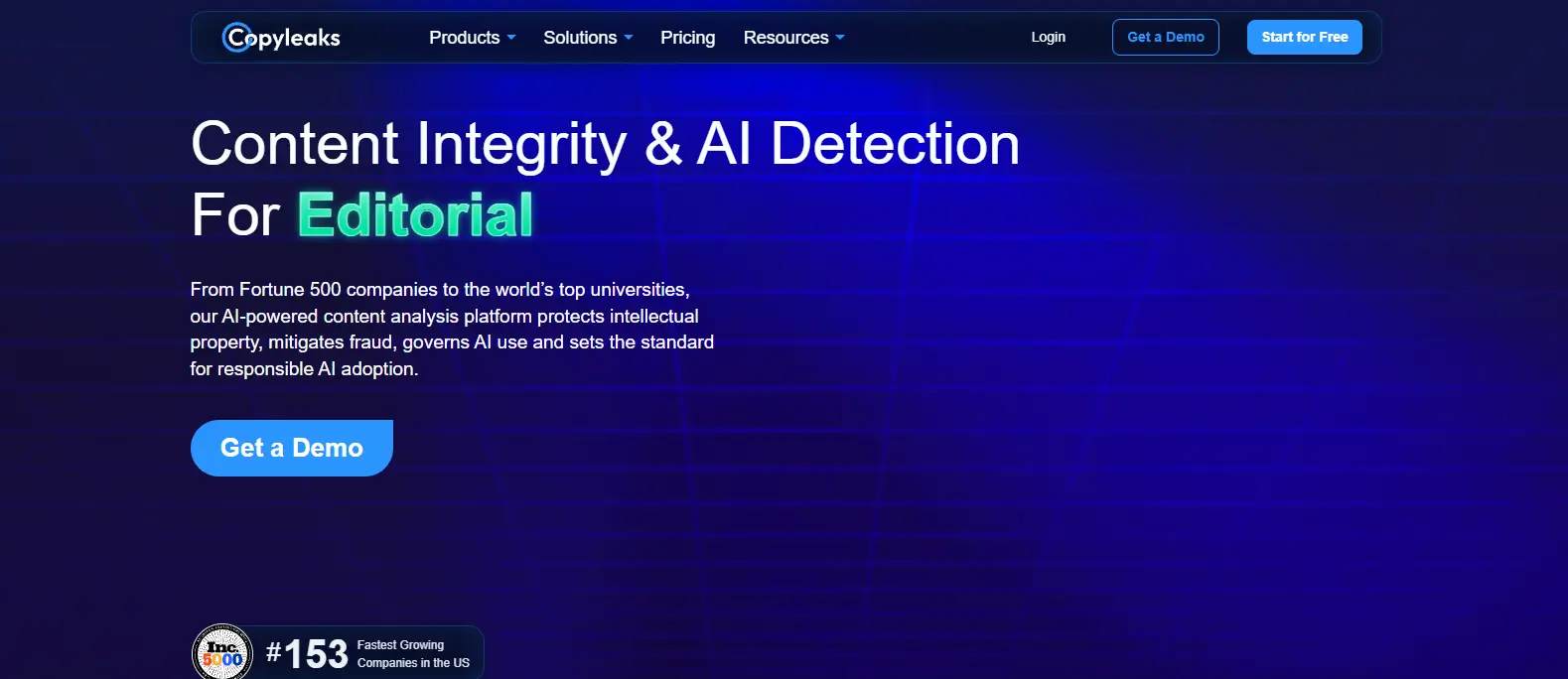
Copyleaks is one of the stronger Originality.ai alternatives when you need AI detection and plagiarism detection within the same workflow. It is designed for organizations that want to examine AI-generated content while also scanning writing for similarities with existing sources, giving originality review a broader scope.
Its language coverage is particularly useful when content is produced across different markets or academic settings. Copyleaks states that its AI detection supports over 30 languages, while the supplied facts report over 99% accuracy in AI detection. Those figures provide useful context, although detection accuracy should always be considered alongside the testing methodology behind the claim.
Highlights
- Combines AI detection with plagiarism scanning
- Supports more than 30 languages for AI content detection
- Provides plagiarism detection for written content
- Offers API capabilities for connected workflows
- Relevant to academic institutions and content teams
- Designed for broader originality checking
Best For
Copyleaks is well suited to academic institutions, content teams, publishers, and organizations that need AI detection and plagiarism checking to coexist rather than managing separate tools.
Limitations
Its broader feature set may be more than you need if your only requirement is an occasional AI check. Users should also evaluate the available integrations, usage requirements, and reporting features against their workflow.
Pricing
The supplied information does not specify a current consumer price for this comparison. Evaluate Copyleaks based on its AI detection, plagiarism scanning, language coverage, API capabilities, and overall originality requirements when comparing its cost with other platforms.
6. Pangram
Overview
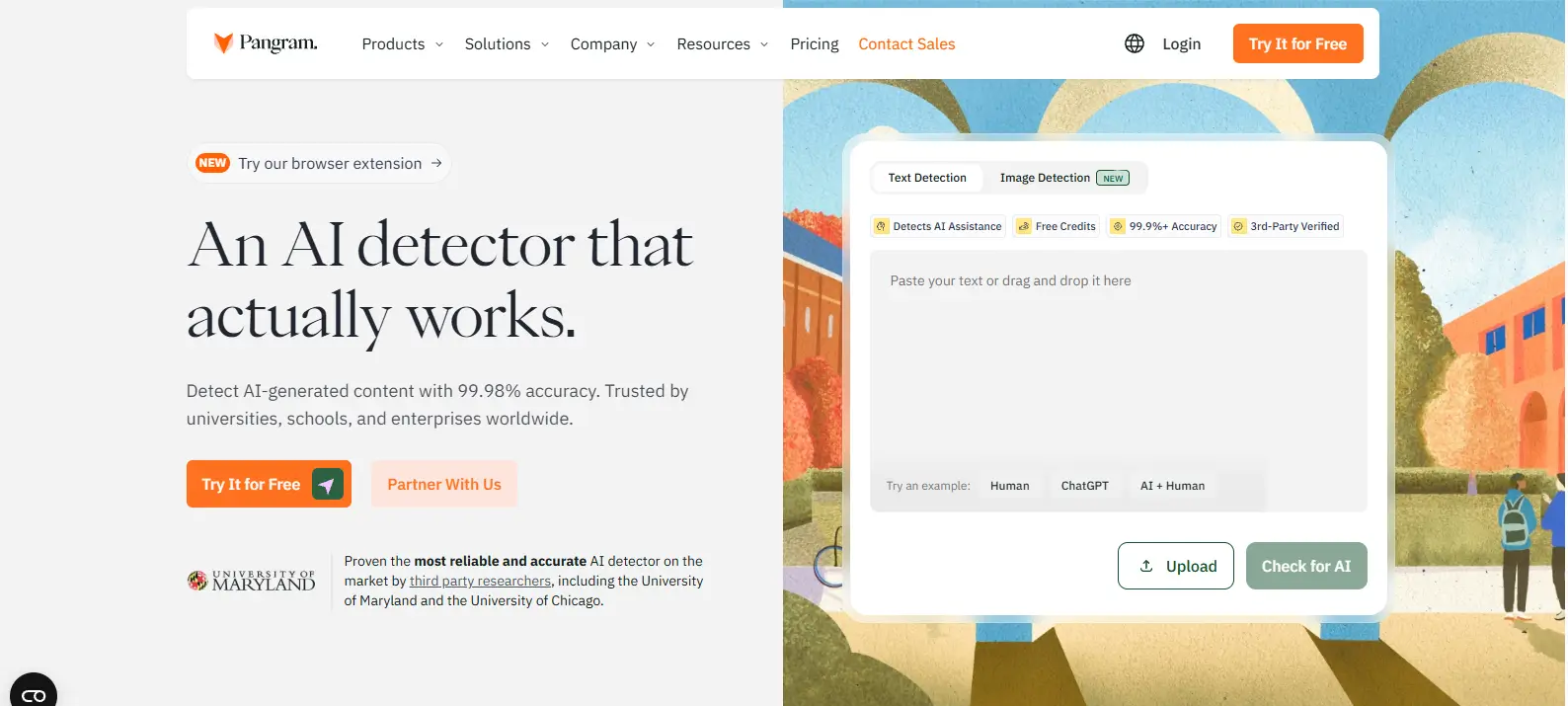
Pangram takes a more focused approach to AI detection, making it an Originality.ai alternative worth considering when your main concern is identifying AI-generated text. Rather than positioning itself primarily as a traditional plagiarism checker, it concentrates on evaluating writing for patterns associated with AI-generated and human-written content.
Its multilingual coverage is useful when your content does not stay within a single language. Pangram Labs supports over 20 languages for AI detection, while its free allowance provides five scans each day. The supplied testing data also reports a 100% pass rate for AI text, although that figure should be understood within the specific testing methodology rather than treated as a universal measure of detection accuracy.
Highlights
- Focuses primarily on AI detection
- Supports more than 20 languages
- Offers 5 free scans per day
- Evaluates AI-generated text and AI writing
- Provides a practical option for content teams
- Can be used to examine human-written content
Best For
Pangram is best suited to writers and content teams that primarily need AI detection across multilingual content.
Limitations
Pangram’s stronger focus is AI detection rather than traditional plagiarism checking. If you need extensive plagiarism scanning or source similarity analysis, another platform may be a better fit.
Pricing
Pangram offers 5 free scans per day, providing a useful starting point for occasional checking. For heavier workloads, compare its paid access, detection performance, language coverage, and reporting capabilities against your content requirements.
7. ZeroGPT
Overview
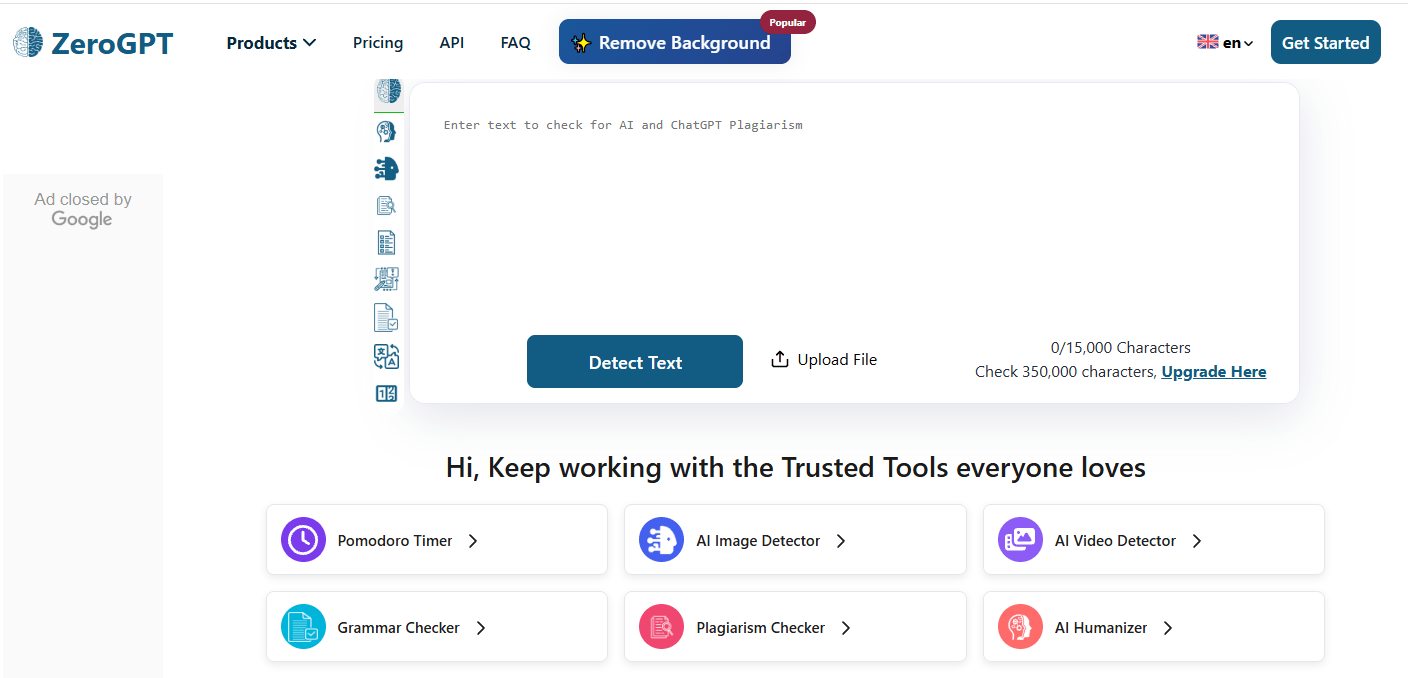
ZeroGPT takes a straightforward approach to free AI detection, making it appealing when you want to check AI-generated content without committing to a paid platform. Its accessible setup suits users who need a quick AI checker for writing, assignments, articles, or other content.
The main attraction is simplicity. If your priority is running a free check without needing an extensive academic or enterprise workflow, ZeroGPT can cover that basic requirement. The 10,000-word monthly allowance also gives you enough room for repeated checks without immediately moving to a paid plan.
Highlights
- Provides free AI detection
- Offers a free version for regular checking
- Allows up to 10,000 words per month for free AI detection
- Designed for straightforward content analysis
- Useful for students and writers
- Provides an accessible option for occasional checks
Best For
ZeroGPT is best suited to students, writers, and individual users who want accessible AI detection without a complicated setup or substantial upfront cost.
Limitations
Its free-first positioning may not be ideal for organizations that need advanced reporting, institutional integrations, plagiarism detection, or large-scale content workflows. Detection results should also be interpreted carefully because AI detection is an estimate, not definitive proof of authorship.
Pricing
ZeroGPT allows 10,000 words per month for free AI detection, making it a practical choice when free access and straightforward checking matter most. For heavier usage, compare its available paid options and features with the requirements of your workflow.
How Do You Choose the Right Originality AI Alternative?

Choosing an alternative becomes easier when you stop treating every detector as the same kind of product. Some platforms are built around academic similarity checking, others focus on AI detection, and some combine both. The right option depends on what you need to establish, who will use it, and how the results will fit into your existing workflow.
Do You Need AI Detection, Plagiarism Checking, or Both?
Start by separating the two questions. AI detection estimates whether written content resembles AI-generated content, while plagiarism checking or plagiarism scanning looks for textual similarity with existing sources. One concerns how the AI text may have been produced; the other concerns originality and potential source overlap. That distinction matters when evaluating content authenticity.
Turnitin specializes in academic similarity checking, making it particularly relevant when source matching is the priority. Copyleaks and Winston AI, by comparison, combine AI detection with plagiarism checking. If you need both capabilities, a combined platform can make the review process simpler.
Which Platform Fits Academic and Formal Writing Best?
For academic writing, the surrounding context matters considerably. Turnitin is the strongest fit when academic similarity checking, student writing, research, and institutional plagiarism review are central requirements. GPTZero is more focused on AI detection for educators and students, while Apporto TrustEd takes a broader academic integrity approach that includes contextual review.
Copyleaks is useful when an academic institution wants AI detection and plagiarism detection together. Formal academic writing deserves particular care, though. Detection systems can produce false positives, and a result should not automatically become a conclusion about a student’s work. Human review remains important when evaluating plagiarism or suspected AI use. . For a direct comparison of content detection and contextual academic integrity, explore Originality Ai Vs Apporto Trusted
How Important Are Free Plans, Word Limits, and Public Pricing?
Cost becomes easier to compare when you look beyond the headline subscription. ZeroGPT provides 10,000 free words monthly, while Pangram Labs offers five free scans per day. Copyleaks costs $9.99 for 25,000 words per month, according to the supplied pricing information.
For contextual market comparison, Undetectable AI charges $19 for 20,000 words per month, although it is not one of the primary alternatives covered here. Check whether a free plan includes the features you actually need, because unlimited usage can still mean limited reporting or functionality. Word limits, free checks, paid plans, public pricing, access, and overall detection accuracy should all be considered together.
Which Platform Offers the Best Balance for Content Teams?
The best balance depends on what your content team needs to accomplish. Apporto TrustEd makes more sense when institutional academic integrity is central. Winston AI combines AI and plagiarism checking, while GPTZero is particularly suited to education and AI writing detection.
Turnitin remains focused on academic similarity checking, and Copyleaks offers a broader combination of multilingual AI detection and plagiarism checking. Pangram is more narrowly centered on AI detection, with false-positive considerations worth examining, while ZeroGPT emphasizes accessible free AI detection.
For content managers, writers, SEO agencies, publishers, and small teams, practical factors such as processing speed, public pricing, ease of use, and the ability to scale can matter just as much as detection features. The strongest choice is therefore the platform that matches your audience, writing type, workload, workflow, and evidence requirements, rather than simply the tool with the highest advertised score.
Final Verdict
There is no single winner for every workflow. Apporto TrustEd stands out for broader academic integrity, while Winston AI is a strong choice for combined AI and plagiarism checking. GPTZero suits education, Turnitin remains focused on academic similarity checking, and Copyleaks offers multilingual AI and plagiarism detection.
Pangram is better suited to dedicated AI detection, while ZeroGPT stands out for accessible free AI detection. Your final choice should consider detection accuracy, language coverage, access, plagiarism checking, workflow fit, and pricing, rather than relying on one score.
If academic integrity and contextual review are priorities, try Apporto TrustEd alongside the other options, then compare the platforms and choose the solution that best fits your writing, academic, publishing, or content workflow.
Frequently Asked Questions(FAQs)
1. What are the best Originality AI alternatives in 2026?
The strongest Originality AI alternatives include Apporto TrustEd, Winston AI, GPTZero, Turnitin, Copyleaks, Pangram, and ZeroGPT. Each serves a different purpose, from academic integrity and similarity checking to multilingual AI detection, combined plagiarism checking, and free AI content detection.
2. Which Originality AI alternative is best for academic writing?
Turnitin is the strongest option when academic similarity checking is the priority. Apporto TrustEd is better suited to broader academic integrity and contextual review, while GPTZero focuses on AI writing detection for educators and students. Your choice depends on the evidence you need.
3. Which AI detector is most accurate?
No single AI detector can be considered universally the most accurate because results depend on the testing methodology, writing sample, language, and type of content. Supplied testing reports vary across tools, so detection accuracy claims should be compared carefully rather than treated as directly equivalent.
4. Are there free Originality AI alternatives?
Yes. ZeroGPT provides 10,000 words per month for free AI detection, while Pangram Labs offers five free scans per day. GPTZero also provides a free tier. Free access can work well for occasional checks, although features and usage limits vary.
5. Which Originality AI alternative also checks plagiarism?
Copyleaks and Winston AI both combine AI detection with plagiarism checking. Copyleaks is particularly useful when you need multilingual AI detection and broader integrations, while Winston AI combines AI content analysis with plagiarism scanning and document-focused capabilities.
6. Does GPTZero offer a free tier?
Yes. GPTZero offers a free tier, making it accessible to students and educators who need AI writing detection without immediately committing to a paid plan. It also provides sentence-level analysis, which can help educators examine which parts of submitted writing contributed to a detection result.
7. How accurate are AI detection tools?
AI detection tools can produce false positives and may struggle with paraphrased, edited, hybrid, or formal academic writing. Results can also vary for non-native English speakers. For that reason, an AI score should be treated as a signal for further review, not definitive proof.
8. What should you look for when choosing an Originality AI alternative?
Consider detection accuracy, false-positive rates, language coverage, plagiarism checking, reporting, pricing, word limits, integrations, and ease of use. You should also consider your audience and workflow. Academic institutions may prioritize similarity checking and integrity controls, while content teams may value speed, access, and scalability.
