

What Are the Best Feedback Fruits Alternatives?
Apporto PowerGrader is a powerful alternative to Feedback Fruits, combining AI-assisted assessment, personalized feedback, customizable rubrics, and seamless LMS integration. Designed for higher education, it helps educators streamline grading, improve student feedback, and scale assessment workflows without disrupting existing teaching environments.
Collaborative learning has grown well beyond traditional peer review. Today, educators expect platforms that encourage active learning, support group member evaluation, deliver automated feedback, enable social annotation, and integrate seamlessly with learning management systems.
With Feedback Fruits tools being phased out at many institutions, finding a reliable replacement has become a priority for maintaining engaging classroom experiences and effective assessment workflows.
In this guide, you’ll discover the best Feedback Fruits alternatives, comparing each platform based on collaboration features, peer assessment quality, LMS compatibility, scalability, pricing, and overall value.
Whether your focus is higher education, K-12 instruction, or hybrid learning, this comparison will help you identify the solution that best fits your teaching goals and student needs.
How Did We Tested These Feedback Fruits Alternatives?

The best collaborative learning platform depends on how you teach and what you expect students to achieve. Some institutions prioritize peer review to improve writing and critical thinking, while others focus on group assignments, active learning activities, or collaborative annotation that keeps students engaged throughout a course.
Universities may also need scalable assessment tools that work across large classes without creating additional administrative work.
For this comparison, each platform was evaluated using the criteria that matter most in real classrooms. That includes the quality of peer assessment, collaboration features, ease of implementation, LMS compatibility, scalability, user experience, and overall value.
We also considered how well each solution supports instructors, encourages meaningful participation, and fits into existing teaching workflows.
Rather than comparing feature lists alone, this guide looks at how effectively each platform helps you create engaging learning experiences while supporting long-term instructional goals.
How Well Does the Platform Support Peer Review and Collaborative Learning?
Effective peer review goes beyond exchanging comments. The strongest platforms encourage collaborative learning through structured peer evaluations, group assignments, and group member evaluation that promotes accountability.
These learning activities create more opportunities for interaction while helping students develop critical thinking and communication skills. Well-designed peer assessment tools encourage structured feedback instead of surface-level responses, making collaboration more meaningful.
As a result, group evaluation becomes a valuable part of the learning process, improving both student engagement and the quality of teamwork.
Which Features Help Educators Manage Learning Activities More Efficiently?
The best platforms simplify classroom management while giving educators, instructors, and teachers the flexibility to design engaging assignments. Automated feedback reduces repetitive administrative work, allowing more time for meaningful instruction.
Well-designed assessment workflows save time by streamlining grading, feedback, and progress tracking, while flexible learning design supports a wide range of teaching strategies.
Features such as organized grades, customizable activities, and centralized feedback also improve classroom engagement without adding unnecessary complexity.
Which Platform Delivers the Best Long-Term Value?
A platform’s long-term value depends on more than its price. Strong LMS integration with systems like Canvas helps institutions manage courses more efficiently while providing students with reliable online access from a fully integrated environment.
This is especially important for hybrid learning, where consistency across platforms matters. Security and accessibility also play an important role in university adoption, ensuring both instructors and students can work confidently.
Ultimately, LMS integration simplifies course management, and long-term value comes from reliable support, scalability, and features that continue meeting institutional needs over time.
Quick Comparison of the Best Feedback Fruits Alternatives
The right Feedback Fruits alternative depends on the type of learning experience you want to create. Some platforms specialize in peer assessment and group collaboration, while others focus on AI-assisted grading, interactive learning, annotation, or digital assessment.
Before exploring each solution in detail, use the table below to compare their core strengths, LMS integration, ideal users, and pricing at a glance.
| Platform | Best For | Core Strength | LMS Integration | Ideal Users | Pricing |
|---|---|---|---|---|---|
| Apporto PowerGrader | AI-assisted assessment and feedback | AI grading, personalized feedback, and scalable assessment | Canvas, Blackboard, Moodle, D2L Brightspace | Higher education institutions | Custom pricing tailored to institutional requirements. |
| BuddyCheck | Group member evaluation | Peer evaluation and teamwork assessment | LMS compatible | K-12 schools and higher education | Contact the vendor for custom pricing. |
| Canvas Peer Review | Canvas-native peer review | Rubric-based peer assessment | Native Canvas integration | Canvas users | Included with eligible Canvas subscriptions. |
| Moodle Workshop | Moodle peer assessment | Structured peer review workflows | Native Moodle integration | Moodle institutions | Included with Moodle at no additional cost. |
| Perusall | Collaborative annotation | Social reading and active learning | Canvas, Blackboard, Moodle | Schools and universities | Free plan available, institutional plans offered. |
| H5P | Interactive learning content | Interactive learning activities | Broad LMS compatibility | Educators and instructional designers | Free to use, premium hosting services available. |
| Crowdmark | Digital grading | Assignment grading and instructor feedback | Canvas, Moodle, Blackboard | Higher education | Custom pricing based on institutional needs. |
| Hypothesis | Social annotation | Collaborative document annotation | Major LMS platforms | Schools and universities | Free individual plan, enterprise options available. |
| Peerceptiv | Peer assessment | Reliable peer grading and structured feedback | LMS compatible | Higher education | Custom pricing for institutions. |
| Kritik | Structured peer assessment | AI-assisted peer grading | Major LMS platforms | Colleges and universities | Custom pricing based on deployment requirements. |
Feedback Fruits Alternatives (A Complete Overview)
1. Apporto PowerGrader
Overview
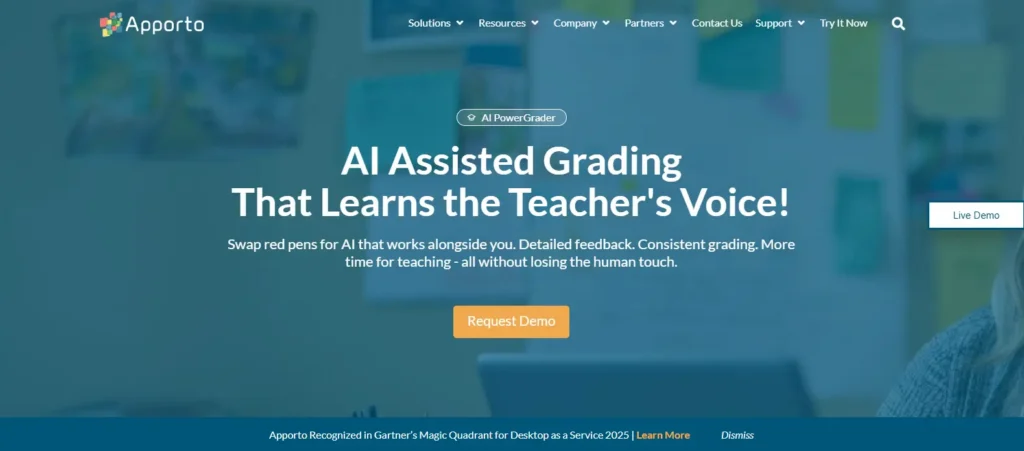
Apporto PowerGrader is an AI-assisted assessment platform built to help higher education institutions modernize grading without sacrificing instructional quality. Instead of simply automating scores, it combines AI-powered evaluation with instructor oversight to deliver personalized feedback that helps students understand their strengths and areas for improvement. This approach allows instructors to spend less time on repetitive grading tasks while maintaining consistency across large classes.
The platform integrates with leading learning management systems, including Canvas, Blackboard, Moodle, and D2L Brightspace, making it easy to fit into existing learning workflows.
Because everything is managed within familiar LMS environments, educators can create assignments, review submissions, provide feedback, and manage grades without switching between multiple tools. This seamless LMS integration also simplifies course administration for departments managing numerous courses and instructors.
Highlights
- AI-assisted assessment with customizable grading rubrics
- Personalized feedback that supports student learning and improvement
- Seamless LMS integration with major higher education platforms
- Scalable assessment for courses of all sizes
- Streamlined learning workflows that improve grading efficiency
Best For:
Universities and colleges looking to improve grading efficiency while delivering consistent, high-quality feedback at scale.
Limitations:
Primarily designed for AI-assisted assessment and grading rather than dedicated peer review or collaborative annotation activities.
Pricing:
Custom pricing based on institutional size, deployment requirements, and feature needs.
2. BuddyCheck
Overview
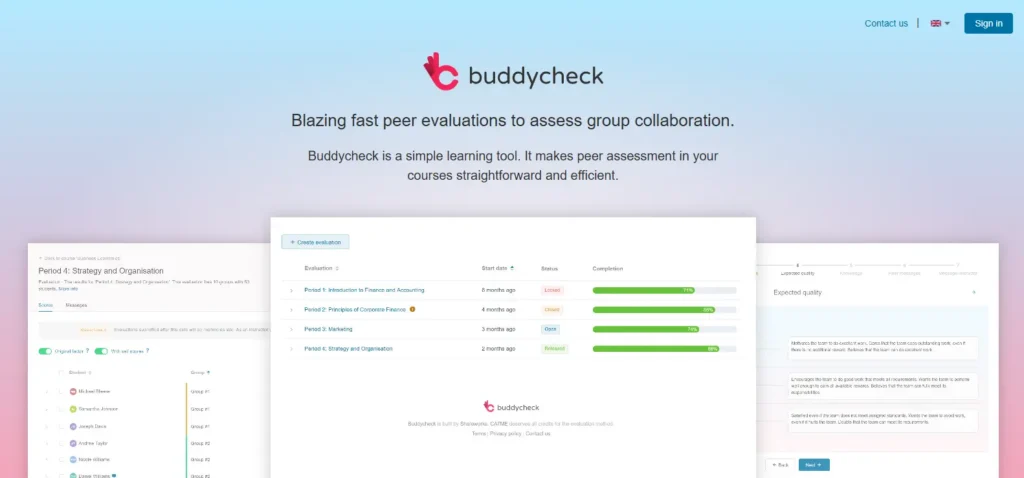
BuddyCheck is designed to improve accountability in group assignments by giving students a structured way to evaluate each other’s contributions. Instead of relying solely on the final project outcome, the platform collects peer evaluations that help instructors understand how each group member participated throughout the assignment. This creates a fairer assessment process while encouraging students to contribute consistently to team projects.
The platform focuses on teamwork and collaboration by making peer feedback a regular part of the learning experience. Students evaluate communication, participation, reliability, and overall contribution, giving instructors valuable insights that are often difficult to measure through traditional grading alone. These evaluations can also identify imbalances within groups early, allowing instructors to intervene before issues affect project outcomes.
Highlights
- Structured group member evaluation for team-based learning
- Peer evaluations that promote fairness and individual accountability
- Easy integration with existing LMS environments
- Customizable evaluation criteria for different group assignments
- Reporting tools that help instructors monitor team performance
Best For:
Schools, colleges, and universities that regularly use group projects and want a more transparent way to measure individual contributions.
Limitations:
BuddyCheck specializes in teamwork assessment and peer evaluations, but it does not provide AI-assisted grading, collaborative annotation, or broader active learning features found in some other platforms.
Pricing:
Contact BuddyCheck for institution-specific pricing based on deployment requirements and the number of users.
3. Canvas Peer Review
Overview
Canvas Peer Review is a practical option for institutions already using the Canvas learning management system. Built directly into Canvas, it enables instructors to incorporate peer review into existing assignments without requiring additional software or complex setup. Because the feature is part of the LMS, students can submit work, review classmates’ assignments, and receive feedback from a single, familiar interface.
One of its biggest strengths is its support for rubric-based peer feedback, which helps create a more consistent and transparent evaluation process. Instructors can assign reviewers automatically or manually, define review deadlines, and use rubrics to guide meaningful feedback.
This structured approach not only improves the quality of peer review but also encourages students to think critically about assessment criteria. As students evaluate one another’s work, they gain a deeper understanding of course expectations while increasing classroom participation and engagement.
Highlights
- Built directly into Canvas for seamless course management
- Supports rubric-based peer feedback for consistent evaluations
- Automatic or manual reviewer assignment
- Integrated assignment and grading workflows
- Encourages student engagement through structured peer review
Best For:
Schools and universities that use Canvas and want a simple, native solution for incorporating peer review into classroom assignments.
Limitations:
Canvas Peer Review focuses on basic peer assessment within the Canvas ecosystem and lacks advanced features such as AI-assisted feedback, collaborative annotation, or dedicated group member evaluation.
Pricing:
Included with eligible Canvas subscriptions, making it a cost-effective option for existing Canvas users.
4. Moodle Workshop
Overview
Moodle Workshop is a built-in peer assessment tool that helps educators create structured peer review activities without installing additional software. Built into Moodle, it allows instructors to manage the entire assessment process, from assignment submission and peer allocation to grading and feedback, within a single learning environment. This native integration makes it a practical choice for institutions that already rely on Moodle for course delivery.
One of Moodle Workshop’s greatest strengths is its ability to support structured peer review workflows. Instructors can configure assessment phases, define grading rubrics, assign reviewers manually or automatically, and combine peer scores with instructor evaluations.
Because it supports peer assessment workflows, the tool encourages students to evaluate work against clear criteria, promoting more thoughtful feedback and deeper engagement with course material. It also gives educators flexibility to design learning activities that align with different teaching methods, whether the goal is improving writing, encouraging collaboration, or reinforcing subject knowledge through peer assessment.
Highlights
- Built into Moodle with no additional software required
- Supports structured peer review and peer assessment workflows
- Configurable grading rubrics and assessment phases
- Automatic or manual reviewer assignment
- Flexible learning activities for a variety of disciplines
Best For:
Schools and universities that use Moodle and want an integrated solution for managing peer assessment and grading within existing courses.
Limitations:
Moodle Workshop requires initial setup and configuration, and its interface can feel less intuitive than some dedicated peer review platforms.
Pricing:
Included with Moodle, making it a cost-effective option for institutions already using the LMS.
5. Perusall
Overview
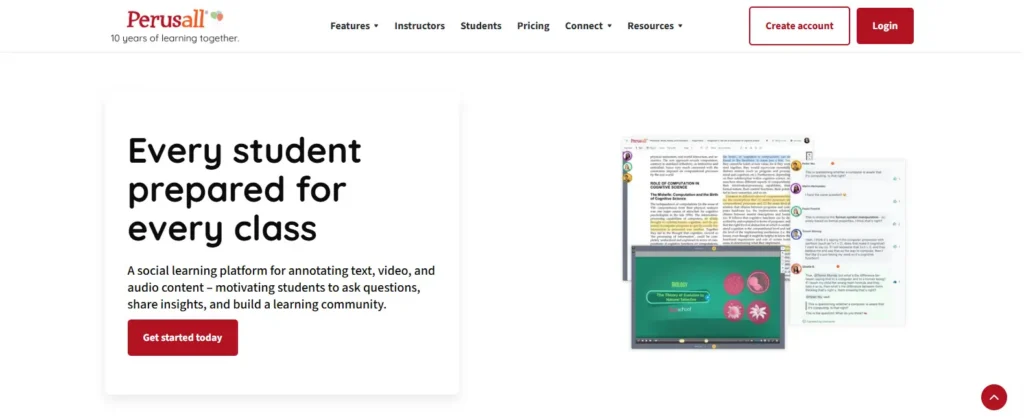
Perusall is a collaborative learning platform that transforms reading and viewing assignments into interactive learning experiences. Rather than having students study independently, it encourages them to engage with course content by discussing ideas directly within the material. This approach promotes active learning and helps instructors understand how students interact with assigned resources before class discussions or assessments.
A defining feature of Perusall is its social annotation capabilities. Students collaboratively annotate documents, videos, and images, allowing them to ask questions, respond to classmates, and build on one another’s ideas in context.
These ongoing conversations make study materials more engaging while encouraging deeper comprehension and critical thinking. Because discussions happen alongside the content itself, instructors can identify misconceptions early and guide learning more effectively. This makes Perusall a strong platform for social annotation, particularly for courses that rely heavily on reading, multimedia resources, and collaborative discussion.
Highlights
- Collaborative annotation for documents, videos, and images
- Promotes active learning through in-context discussions
- Encourages meaningful engagement with study materials
- Integrates with major learning management systems
- Analytics that help instructors monitor student participation
Best For:
Schools and universities that want to increase student engagement through collaborative reading, annotation, and discussion.
Limitations:
Perusall is designed primarily for annotation and collaborative learning rather than AI-assisted grading, structured peer assessment, or group member evaluation.
Pricing:
Offers a free version for many courses, with institutional plans available for schools and universities requiring broader deployment and administrative features.
6. H5P
Overview
H5P is an open-source platform that helps educators create interactive content to make online learning more engaging and participatory. Instead of relying on static course materials, instructors can build quizzes, interactive videos, presentations, drag-and-drop exercises, timelines, and many other learning activities that encourage students to actively participate throughout a lesson. Its flexibility makes it a popular choice for schools, colleges, and training organizations looking to enrich both in-person and online instruction.
One of H5P’s biggest advantages is its wide variety of interactive learning activities that can be embedded directly into many learning management systems and websites. Educators can customize content to match different teaching styles while incorporating formative assessment throughout a course.
Immediate feedback helps students identify knowledge gaps as they progress, making learning more engaging and self-directed. Because the platform supports reusable content, instructors can update activities over time instead of recreating them for every class, improving both efficiency and classroom engagement.
Highlights
- Create interactive content without advanced programming skills
- Extensive library of learning activities for different subjects
- Supports formative assessment with instant feedback
- Compatible with major learning management systems
- Reusable content that saves educators time
Best For:
Educators and instructional designers who want to build interactive online learning experiences that improve classroom engagement and student participation.
Limitations:
H5P focuses on interactive content creation and assessment rather than dedicated peer review, AI-assisted grading, or structured group member evaluation.
Pricing:
The core H5P platform is free and open source, while premium hosting and enterprise services are available through authorized providers.
7. Crowdmark
Overview
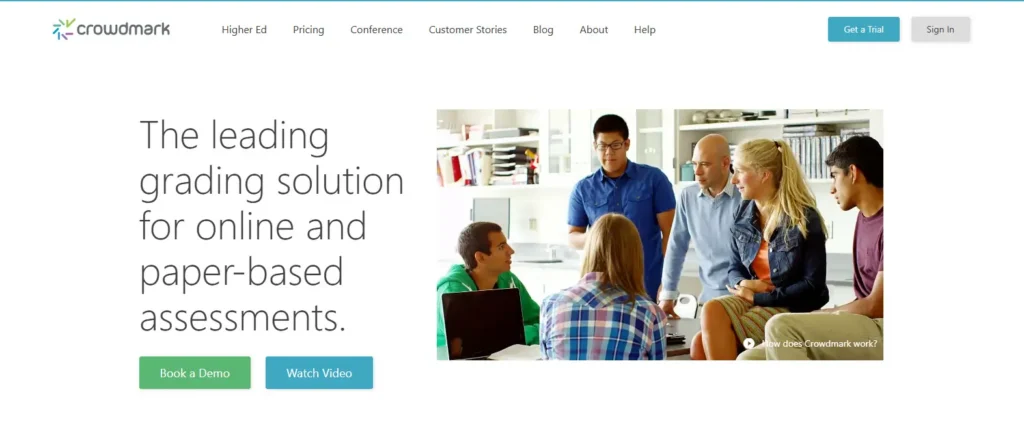
Crowdmark is a cloud-based assessment platform built to simplify digital grading for colleges and universities. It enables instructors to collect, grade, and return assignments through a centralized workflow, making it especially useful for courses with large enrollments. By replacing paper-based processes with a streamlined online system, Crowdmark helps institutions improve grading consistency while reducing administrative effort.
The platform is designed to support efficient grading workflows without compromising the quality of instructor feedback. Educators can annotate submissions, reuse comments, apply grading rubrics, and collaborate with teaching assistants during the assessment process.
These features help maintain consistent grading across multiple evaluators while significantly reducing the time spent reviewing assignments. Because everything is managed digitally, instructors can monitor grading progress, access student submissions from anywhere, and return feedback more quickly.
Crowdmark also integrates with several leading learning management systems, making it easier to fit into existing higher education teaching environments.
Highlights
- Cloud-based digital grading for streamlined assessment
- Annotation tools and reusable comments for faster feedback
- Rubric-based grading to improve consistency
- Collaborative grading workflows for instructors and teaching assistants
- Integration with major learning management systems
Best For:
Higher education institutions that need an efficient platform for managing large volumes of assignments and delivering timely, consistent feedback.
Limitations:
Crowdmark focuses on instructor-led assessment and digital grading rather than peer review, collaborative annotation, or AI-assisted evaluation.
Pricing:
Custom pricing is available based on institutional requirements, course volume, and deployment needs.
8. Hypothesis
Overview
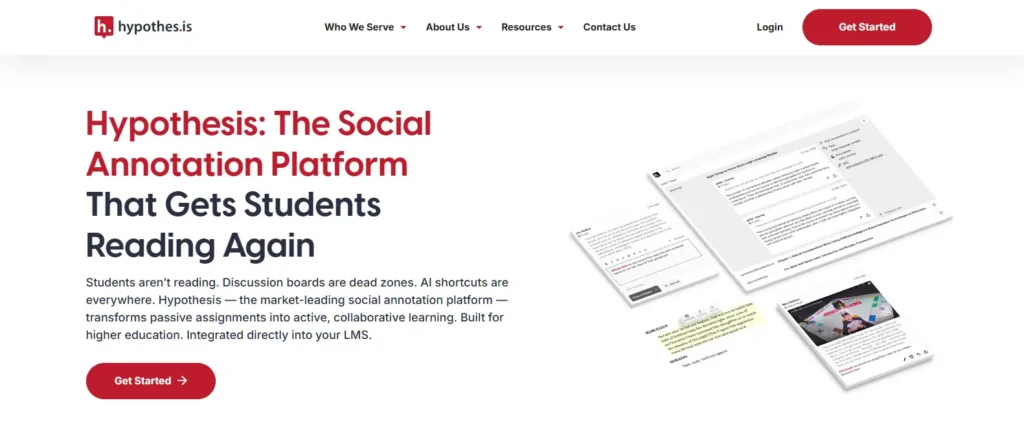
Hypothesis is a collaborative annotation platform that encourages students to engage with course materials through shared discussion and in-context feedback. Rather than separating conversations from the learning content, it allows students and instructors to annotate directly on readings, research articles, websites, and other digital resources. This approach creates a more interactive learning experience while helping students develop stronger analytical and communication skills.
A key strength of Hypothesis is its support for collaborative annotation for documents and social reading. Students can highlight passages, ask questions, respond to classmates, and build meaningful discussions alongside the text itself.
These conversations promote critical thinking by encouraging learners to evaluate ideas, compare perspectives, and support their opinions with evidence. Instructors can also participate by guiding discussions, clarifying concepts, and identifying areas where additional instruction is needed. Because annotations remain connected to the original content, learning becomes more contextual, collaborative, and engaging.
The platform integrates with major learning management systems, making it easy to incorporate online collaboration into existing courses without disrupting established teaching workflows.
Highlights
- Collaborative annotation for documents, articles, and web content
- Supports social reading and interactive classroom discussion
- Encourages critical thinking through evidence-based conversations
- Integrates with major learning management systems
- Helps increase student engagement with assigned readings
Best For:
Schools and universities looking to promote online collaboration, discussion, and deeper engagement with course materials.
Limitations:
Hypothesis specializes in annotation and discussion but does not offer AI-assisted grading, structured peer assessment, or advanced group member evaluation features.
Pricing:
A free plan is available for individual users, while enterprise and institutional plans include additional administration, integration, and support features.
9. Peerceptiv
Overview
Peerceptiv is a peer assessment platform developed to make peer grading more consistent, reliable, and meaningful in higher education. Instead of treating peer review as an informal classroom activity, it uses structured evaluation processes that help students assess one another’s work against defined criteria. This approach improves grading quality while encouraging students to take an active role in the learning process.
One of Peerceptiv’s biggest strengths is its emphasis on reliable peer grading. The platform uses calibration and multiple reviews to improve the accuracy of peer evaluations, giving instructors greater confidence in student-generated assessments. As students review assignments, they also learn to evaluate evidence, apply rubrics, and provide constructive feedback.
This process naturally encourages critical thinking, strengthens analytical skills, and helps students better understand the standards used to assess their own work. Instructors can monitor participation, review evaluation quality, and incorporate peer assessment into existing grading strategies, making the platform well suited for large classes where meaningful feedback is difficult to deliver at scale.
Highlights
- Structured peer assessment with reliable peer grading
- Multiple reviewer model to improve grading consistency
- Encourages critical thinking through evidence-based evaluations
- Detailed feedback that supports continuous learning
- LMS-compatible for streamlined course management
Best For:
Higher education institutions looking to scale peer assessment while maintaining reliable grading and meaningful student engagement.
Limitations:
Peerceptiv focuses on peer assessment and grading rather than collaborative annotation, interactive content creation, or AI-assisted instructor grading.
Pricing:
Custom pricing is available for institutions based on deployment size, integrations, and support requirements.
10. Kritik

Overview
Kritik is a platform designed specifically for peer assessment, helping educators create structured peer review experiences that improve both learning outcomes and grading consistency. Rather than relying on informal peer feedback, it guides students through a defined evaluation process where they assess classmates’ work using instructor-created rubrics. This structured approach encourages thoughtful reviews while helping students develop stronger analytical and evaluation skills.
A standout feature of Kritik is its use of AI-assisted peer assessment to improve the quality of evaluations. The platform uses AI to help evaluate grading accuracy, identifying inconsistencies and encouraging students to provide fair, evidence-based assessments.
Combined with structured feedback workflows, this helps instructors scale peer review in large classes without sacrificing quality. Students benefit from reviewing multiple submissions, receiving feedback from classmates, and reflecting on their own work, while instructors gain better visibility into participation and assessment quality. The result is a collaborative learning environment where peer review becomes an active part of the educational process rather than a one-time classroom exercise.
Highlights
- AI-assisted peer assessment with grading accuracy analysis
- Structured feedback guided by customizable rubrics
- Designed specifically for peer assessment and collaborative learning
- Supports scalable peer review for large courses
- LMS integration for streamlined course management
Best For:
Colleges and universities that want to combine AI-supported grading accuracy with structured peer review and meaningful student collaboration.
Limitations:
Kritik focuses primarily on peer assessment and feedback rather than collaborative annotation, interactive content creation, or instructor-led AI grading.
Pricing:
Custom pricing is available for institutions based on enrollment, implementation requirements, and support needs.
Which Feedback Fruits Alternative Is Right for You?

Choosing the right Feedback Fruits alternative starts with understanding your instructional goals. While every platform in this comparison supports teaching and learning in some way, they are designed to solve different challenges.
Some focus on structured peer review, others encourage active participation through collaborative annotation, and several specialize in digital grading or AI-assisted assessment.
The best choice depends on your classroom environment, preferred teaching methods, and the level of support your institution requires.
Do You Need Better Peer Review, Active Learning, or AI-Assisted Assessment?
Not every classroom has the same priorities, which is why different instructional goals require different platforms. If your objective is to improve writing quality and collaborative learning, a dedicated peer review platform may be the best fit.
If you want students to participate more actively during lessons, platforms that support active learning through annotation, interactive content, or discussion can create richer learning experiences.
It’s also important to remember that active learning extends beyond peer review. Interactive learning activities, collaborative discussions, and timely feedback all contribute to stronger student engagement and deeper understanding.
Meanwhile, AI-assisted assessment platforms help automate repetitive grading tasks and generate personalized feedback that supports learning. However, AI can support educators without replacing instructional judgment, allowing instructors to maintain oversight while improving assessment efficiency.
Which Features Should Educators and Institutions Prioritize?
When comparing platforms, focus on features that improve both teaching effectiveness and the student experience. Educators, instructors, and teachers should look for solutions that support custom workflows, simplify assessment, and encourage meaningful collaboration throughout group assignments and classroom activities. A flexible platform should adapt to different course formats instead of forcing every instructor into the same process.
Flexible workflows adapt to different teaching styles, making it easier to support discussion-based courses, project-based learning, or traditional assessments. Institutions should also evaluate security, accessibility, and vendor support before making a long-term investment.
Security and institutional support matter for long-term adoption, particularly when handling student data across multiple departments. Finally, collaboration tools should encourage meaningful participation by helping students contribute thoughtfully rather than simply completing required tasks.
How Important Are LMS Integration, Ease of Use, and Pricing?
Even the most feature-rich platform can be difficult to adopt if it doesn’t fit your existing technology stack. Strong LMS integration with systems such as Canvas allows instructors to create assignments, manage grades, and review submissions without leaving their primary teaching environment. Fully integrated tools simplify course management, reducing administrative work while creating a smoother experience for both students and instructors.
Ease of implementation is equally important. Easy implementation increases adoption because educators spend less time learning new software and more time focusing on teaching. Institutions should also compare pricing alongside functionality.
Free options suit individuals, enterprise plans suit institutions, so the right choice depends on your deployment size, support requirements, and long-term goals. When evaluating value, consider integration, scalability, and ongoing support rather than subscription cost alone.
Which Feedback Fruits Alternative Offers the Best Long-Term Value?
The best long-term solution depends on the outcomes you want to achieve. If your priority is AI-assisted assessment with scalable higher education workflows, Apporto PowerGrader stands out for its personalized feedback, grading efficiency, and seamless LMS integration.
For group member evaluation and team accountability, BuddyCheck is a strong choice. Canvas Peer Review is ideal for institutions already using Canvas, while Moodle Workshop offers a native peer assessment solution for Moodle users.
If collaborative annotation is your priority, Perusall and Hypothesis both excel at encouraging discussion around course materials, with Perusall offering broader social learning features and Hypothesis specializing in document annotation.
H5P is best for creating interactive learning activities, while Crowdmark streamlines digital grading for higher education.
Peerceptiv delivers reliable peer grading that promotes critical thinking, and Kritik combines structured peer review with AI-assisted peer assessment to improve grading accuracy. By matching platform strengths to your instructional goals, you can choose a solution that continues to deliver value as your courses and institution evolve.
Final Verdict
The best Feedback Fruits alternative depends on your instructional goals. Platforms like Canvas Peer Review, Moodle Workshop, Peerceptiv, and Kritik excel at peer review and structured assessment, while Perusall and Hypothesis strengthen collaborative learning through annotation and discussion.
H5P stands out for interactive learning activities, BuddyCheck improves group member evaluation, and Crowdmark streamlines digital grading for higher education.
Since schools, colleges, and universities often have different teaching priorities, selecting the right platform means balancing functionality, scalability, and ease of use.
For institutions seeking the most complete solution, Apporto PowerGrader stands out by combining AI-assisted assessment, personalized feedback, scalable grading workflows, and seamless LMS integration.
If you’re ready to modernize assessment while improving grading efficiency and student outcomes, Apporto PowerGrader is well worth exploring.
Frequently Asked Questions (FAQs)
1. What are the best Feedback Fruits alternatives in 2026?
Some of the best Feedback Fruits alternatives in 2026 include Apporto PowerGrader, BuddyCheck, Canvas Peer Review, Moodle Workshop, Perusall, H5P, Crowdmark, Hypothesis, Peerceptiv, and Kritik. Each platform specializes in different areas, from AI-assisted assessment and peer review to collaborative annotation and interactive learning.
2. Which Feedback Fruits alternative is best for peer review?
If peer review is your primary focus, Kritik, Peerceptiv, Canvas Peer Review, and Moodle Workshop are among the strongest options. They provide structured peer assessment workflows, rubric-based evaluations, and reliable feedback processes that help students develop critical thinking while improving assessment quality.
3. Which platform is best for higher education?
Apporto PowerGrader is a strong choice for higher education because it combines AI-assisted assessment, personalized feedback, scalable grading workflows, and seamless LMS integration. Crowdmark, Peerceptiv, and Kritik are also well suited for colleges and universities with specialized assessment and peer review requirements.
4. Can Feedback Fruits alternatives integrate with Canvas or other LMS platforms?
Yes. Many Feedback Fruits alternatives integrate with popular learning management systems, including Canvas, Blackboard, Moodle, and D2L Brightspace. These integrations simplify assignment management, grading, and feedback while allowing instructors to continue working within their existing teaching environment.
5. Are there free Feedback Fruits alternatives?
Yes. H5P offers a free open-source platform for creating interactive learning content, while Perusall and Hypothesis provide free plans with optional institutional upgrades. Built-in tools like Canvas Peer Review and Moodle Workshop are also included with their respective LMS platforms.
6. Which platform is best for collaborative annotation?
Perusall and Hypothesis are among the best platforms for collaborative annotation. Perusall supports social reading with documents, videos, and images, while Hypothesis focuses on document annotation and in-context discussions that encourage deeper engagement with assigned course materials.
7. How do peer assessment platforms improve student engagement?
Peer assessment platforms increase student engagement by encouraging learners to evaluate classmates’ work, provide constructive feedback, and reflect on assessment criteria. This active participation strengthens critical thinking, promotes accountability, and helps students gain a deeper understanding of course concepts.
8. What should you look for when choosing a Feedback Fruits alternative?
Look for a platform that aligns with your instructional goals, supports your preferred teaching methods, and integrates with your LMS. Consider factors such as peer review capabilities, AI-assisted assessment, collaboration features, scalability, ease of use, pricing, security, and long-term institutional support.
