

What Is the Best EssayGrader Alternative?
Apporto PowerGrader is a powerful alternative to EssayGrader, combining AI-assisted essay grading, personalized feedback, customizable rubrics, academic integrity support, and seamless LMS integration. Designed for higher education, it helps educators streamline grading while maintaining consistent, high-quality assessment across large classes.
Grading essays has become far more sophisticated than assigning scores and correcting grammar. Today’s AI-powered assessment platforms help educators deliver detailed feedback, apply rubric-based assessment, detect potential plagiarism, and streamline classroom workflows without sacrificing consistency.
As expectations around writing instruction continue to grow, many teachers and institutions are exploring EssayGrader alternatives that offer greater flexibility, stronger LMS integration, and features tailored to their specific grading needs.
In this blog post, you’ll compare the best EssayGrader alternatives based on grading accuracy, AI feedback quality, LMS integration, scalability, pricing, and overall value, making it easier to choose the right solution for your classroom or institution.
How Did We Evaluate These EssayGrader Alternatives?

No two educators grade essays the same way, so choosing the right platform starts with understanding your priorities. Some teachers want an AI-powered grading assistant that reduces repetitive work and delivers timely feedback.
Others need detailed writing feedback, plagiarism checking, or academic integrity tools that support fair and consistent assessment. For colleges and universities, scalable grading, LMS integration, and workflow efficiency often carry just as much weight as grading accuracy.
To create this comparison, each platform was evaluated on the factors that matter most in real classrooms. That includes the quality of AI-generated feedback, grading consistency, rubric flexibility, LMS compatibility, ease of implementation, scalability, and overall value.
Instead of focusing on feature lists alone, this guide examines how well each solution helps educators save time while improving student writing and maintaining high assessment standards.
How Accurate Is the AI Essay Grading and Feedback?
An effective AI essay grader should do more than assign a score. It should evaluate student writing for thesis clarity, basic structure, organization, and overall quality while providing detailed feedback that students can apply during revision. Rubric-based scoring also improves grading consistency by ensuring every submission is evaluated against the same criteria.
At the same time, AI should support, not replace, instructor evaluation. The strongest platforms combine consistent feedback with actionable feedback that helps students strengthen their writing instead of simply highlighting mistakes.
Which Features Help Teachers Grade Essays More Efficiently?
The best grading tools simplify the entire grading process without sacrificing quality. AI grading tools can reduce grading time significantly by automating repetitive tasks while allowing teachers to review comments, scores, and assignments before finalizing results.
Platforms that support custom rubrics or your own rubrics also provide greater assessment flexibility across different writing tasks. Combined with timely feedback, these features help teachers spend less time grading essays and more time supporting student learning.
Which Platform Delivers the Best Overall Value?
The overall value of an essay grading platform extends beyond its subscription price. Strong LMS integration with Google Classroom and other learning management systems improves accessibility and streamlines classroom workflows across schools and higher education institutions.
LMS compatibility reduces administrative effort, while plagiarism checking and academic integrity features help maintain fair assessment practices. Long-term value comes from choosing a platform that fits your instructional needs today and continues supporting your teaching as your classroom or institution grows.
Quick Comparison of the Best EssayGrader Alternatives
Every AI essay grading platform is built with a different goal in mind. Some focus on delivering personalized feedback, while others emphasize plagiarism detection, high-volume grading, or classroom workflow automation. Before exploring each platform in detail, use the comparison below to see how the leading EssayGrader alternatives differ in AI feedback, LMS integration, academic integrity, and pricing.
| Platform | Best For | AI Feedback | LMS Integration | Academic Integrity | Pricing |
|---|---|---|---|---|---|
| Apporto PowerGrader | AI-assisted grading for higher education | Personalized AI feedback with instructor oversight | Canvas, Blackboard, Moodle, D2L Brightspace | Built-in academic integrity support | Custom pricing tailored to institutional requirements. Contact the sales team for a personalized quote. |
| CoGrader | K-12 essay grading and Google Classroom | Detailed AI feedback with custom rubrics | Google Classroom and major LMS platforms | Limited plagiarism features | Free tier available, with paid plans offering advanced grading and classroom management features. |
| Gradescope | High-volume assignment grading | AI-assisted grouping and grading support | Canvas, Blackboard, Moodle, and native Gradescope integrations | Basic academic integrity support | Institution-based pricing with custom licensing for schools, colleges, and universities. |
| Turnitin | Writing assessment and originality checking | AI-assisted writing insights and detailed instructor feedback | Major LMS platforms | Industry-leading plagiarism detection | Custom pricing based on institution size, licensing needs, and selected products. |
| EnlightenAI | Personalized AI writing feedback | AI-generated writing suggestions and improvement recommendations | LMS compatible | Limited integrity tools | Pricing is available upon request and varies according to institutional requirements. |
| Class Companion | Formative writing feedback | Instant AI-powered feedback on student work | Google Classroom compatible | Basic integrity features | Offers a free plan for educators, with premium plans providing expanded classroom capabilities. |
| Automark | Automated essay scoring | Rubric-based AI grading with structured feedback | LMS support varies | Basic plagiarism support | Custom pricing based on deployment requirements and the features your institution needs. |
EssayGrader Alternatives (A Detailed Overview)
1. Apporto PowerGrader
Overview
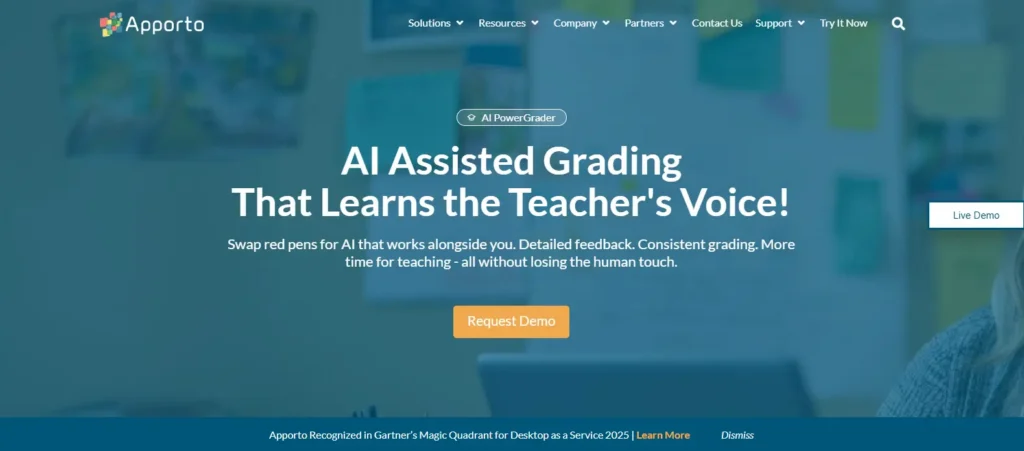
Apporto PowerGrader is an AI-assisted grading platform designed for higher education institutions that need to evaluate large volumes of student writing efficiently. Instead of replacing instructors, it supports the grading process by generating personalized feedback, applying custom rubrics, and streamlining repetitive tasks. This allows educators to focus more on teaching while maintaining consistent grading standards.
The platform stands out for delivering detailed feedback that goes beyond grammar and spelling. It evaluates essays against instructor-defined criteria and provides actionable suggestions to help students strengthen their writing. Because instructors review and approve AI-generated feedback before grades are finalized, PowerGrader supports academic integrity while keeping educators in control.
PowerGrader also integrates with leading learning management systems, making it easier to manage assignments, review submissions, and return feedback from one place. Its scalable assessment capabilities make it a practical choice for colleges and universities handling large classes.
Highlights
- AI-assisted grading with instructor oversight
- Detailed, personalized feedback for student essays
- Supports custom rubrics for flexible assessment
- LMS integration with Canvas, Blackboard, Moodle, and D2L Brightspace
- Scalable for large higher education courses
- Built-in academic integrity support
Best For
Higher education institutions looking for scalable AI grading with personalized feedback, custom rubrics, and seamless LMS integration.
Limitations
Primarily designed for colleges and universities.
Pricing
Custom pricing based on institutional requirements. Contact Apporto for a tailored quote.
2. CoGrader
Overview
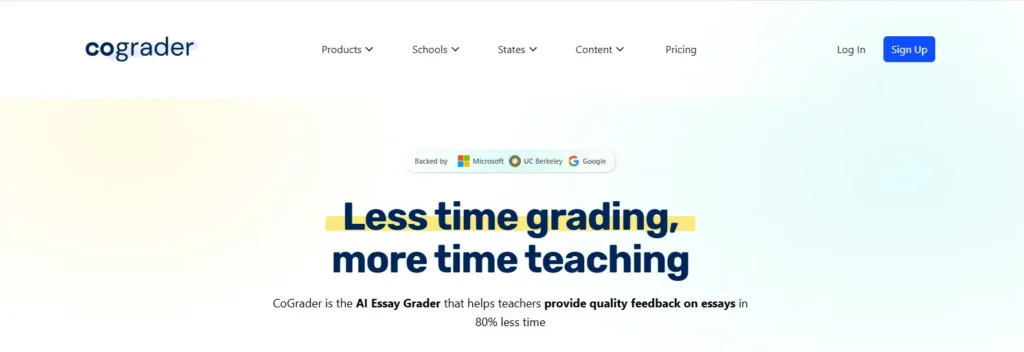
CoGrader is an AI-powered essay grading platform built for K-12 educators who want to provide faster, more meaningful feedback without increasing their workload. Its biggest advantage is its seamless Google Classroom integration, allowing teachers to import student submissions, review writing assignments, and return feedback without switching between multiple tools. The platform has been adopted by over 1,000 schools across all 50 states, making it a well-established choice for classroom assessment.
CoGrader focuses on generating actionable feedback rather than simply assigning scores. Teachers can create custom rubrics, review AI-generated comments, and edit feedback before returning assignments. This human-in-the-loop approach helps maintain grading quality while significantly reducing repetitive work. According to the company, CoGrader helps teachers save up to 80% of grading time, making it especially valuable during busy grading periods.
Beyond Google Classroom, CoGrader also supports LMS compatibility through file import and export, making it easier to fit into existing classroom workflows. While it excels at essay evaluation and writing feedback, its academic integrity features are less comprehensive than platforms built around plagiarism detection.
Highlights
- Direct Google Classroom integration
- AI-generated, actionable feedback for student writing
- Supports custom rubrics for consistent grading
- Used in over 1,000 schools across all 50 states
- Saves teachers up to 80% of grading time
- LMS-compatible through file import and export
Best For
K-12 teachers who want to grade essays faster while delivering detailed, personalized feedback through Google Classroom.
Limitations
Limited plagiarism and academic integrity features. Better suited for K-12 than higher education.
Pricing
Free tier available. Paid plans unlock additional features and classroom management capabilities.
3. Gradescope
Overview
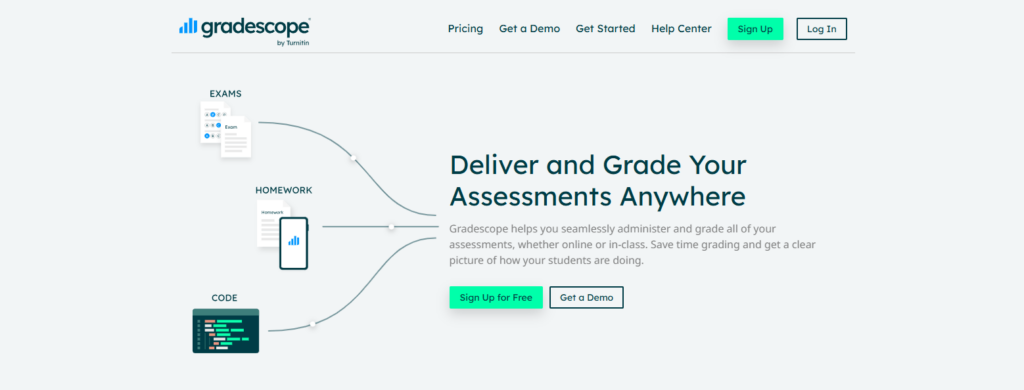
Gradescope is a popular assessment platform designed to help educators manage large volumes of assignments with greater efficiency. Widely used in higher education, it simplifies grading workflows by organizing student submissions and supporting rubric-based grading across multiple assignment types, including essays. Its AI-assisted grouping feature automatically clusters similar responses, allowing instructors to grade comparable answers together instead of reviewing every submission individually.
The platform is particularly effective for courses with high enrollment, where consistency and speed are essential. Instructors can build reusable rubrics, apply them across assignments, and update scores or feedback for multiple responses at once. This standardized approach helps maintain fair assessment practices while reducing repetitive grading tasks. Because of these capabilities, Gradescope is ideal for handling large volumes of student writing without sacrificing grading quality.
Gradescope also integrates with major learning management systems, making it easy to import assignments, sync grades, and manage coursework from existing teaching platforms. Although its AI features focus more on grading efficiency than personalized writing feedback, it remains a strong option for institutions looking to streamline assessment at scale.
Highlights
- AI-assisted grouping speeds up grading
- Rubric-based grading for consistent assessment
- Designed for managing large numbers of student submissions
- Seamless LMS integration with Canvas, Blackboard, and Moodle
- Reusable rubrics for faster grading workflows
- Well suited for higher education environments
Best For
Colleges and universities that need an efficient way to grade large classes while maintaining consistent assessment standards.
Limitations
Offers limited personalized writing feedback compared to dedicated AI essay graders. Advanced features are geared primarily toward institutional users.
Pricing
Institution-based pricing with custom licensing for colleges, universities, and educational organizations.
4. Turnitin
Overview
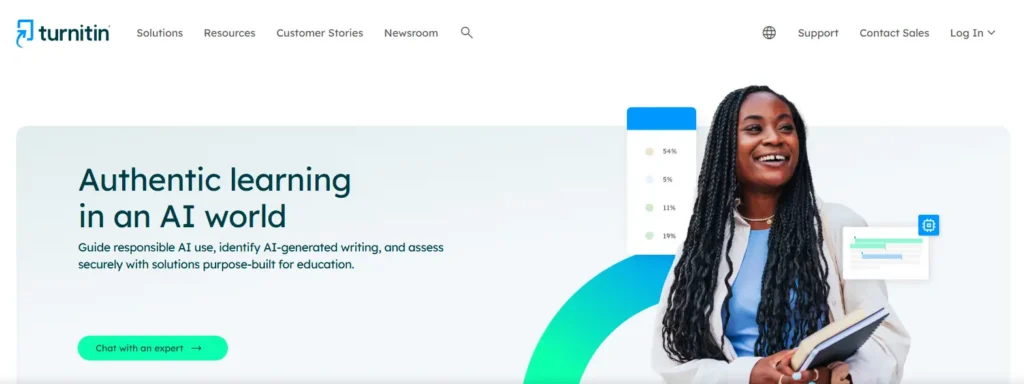
Turnitin is one of the most recognized platforms for maintaining academic integrity and evaluating written assignments. While it is best known for plagiarism checking and originality reports, it also includes tools that help instructors deliver meaningful feedback on student writing. Its Feedback Studio enables educators to review essays, apply rubric grading, and provide comments that guide students through the revision process.
A key strength of Turnitin is its detailed feedback annotations, which allow instructors to leave inline comments, reusable QuickMarks, and rubric-based evaluations directly within a student’s paper. This makes it easier to explain writing issues, highlight strengths, and encourage writing improvement while maintaining consistent grading standards across an entire class.
Turnitin integrates with major learning management systems, allowing instructors to collect assignments, check originality, and return feedback without leaving their existing classroom environment. Although it offers AI-assisted writing insights and powerful assessment tools, it is not designed for student self-service grading. Instead, it focuses on supporting instructors with originality checking, structured feedback, and fair evaluation.
Highlights
- Industry-leading plagiarism checking and originality reports
- Detailed feedback annotations and inline comments
- Rubric grading for consistent assessment
- Strong focus on academic integrity
- LMS compatibility with major learning platforms
- AI-assisted writing insights to support instructor feedback
Best For
Schools, colleges, and universities that prioritize academic integrity, originality checking, and structured instructor feedback.
Limitations
Not intended for students to independently grade or review their own essays. Writing feedback is instructor-led rather than fully AI-generated.
Pricing
Custom pricing based on institutional size, licensing requirements, and selected Turnitin products.
5. EnlightenAI
Overview
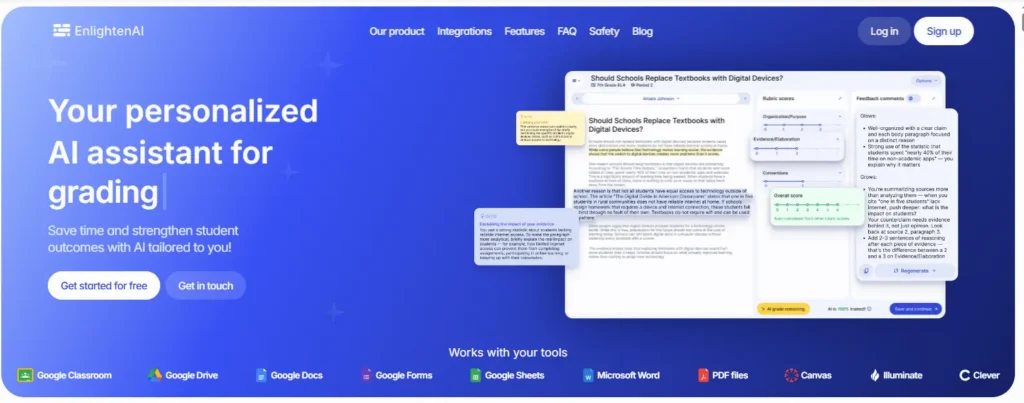
EnlightenAI is an AI-powered writing assessment platform that helps educators provide faster, more personalized feedback on student essays. Instead of focusing solely on assigning grades, it analyzes writing quality and generates suggestions that help students strengthen their ideas, organization, and overall communication. This makes it a useful tool for supporting writing improvement throughout the learning process rather than only at the end of an assignment.
Using advanced AI models, EnlightenAI evaluates essays and provides detailed feedback on areas that need attention. Its personalized suggestions can help students identify weaknesses in structure, clarity, and argument development while encouraging meaningful revisions. Because feedback is generated quickly, instructors can return assessments sooner and give students more opportunities to improve before final submission.
The platform also supports flexible assessment workflows and can integrate with existing learning environments, making it easier for educators to incorporate AI-assisted essay grading into their teaching. While it offers valuable writing insights, it places greater emphasis on formative feedback than on academic integrity or plagiarism detection.
Highlights
- AI-powered feedback tailored to individual essays
- Personalized suggestions to improve student writing
- Detailed feedback on structure, clarity, and organization
- Supports faster essay grading and assessment
- Built on advanced AI models for writing analysis
- Helps educators provide timely, consistent feedback
Best For
Educators who want AI-assisted writing feedback that helps students revise and improve their essays throughout the writing process.
Limitations
Limited plagiarism detection and academic integrity features. LMS integrations may not be as extensive as some established competitors.
Pricing
Contact EnlightenAI for custom pricing based on your institution’s size and implementation needs.
6. Class Companion
Overview
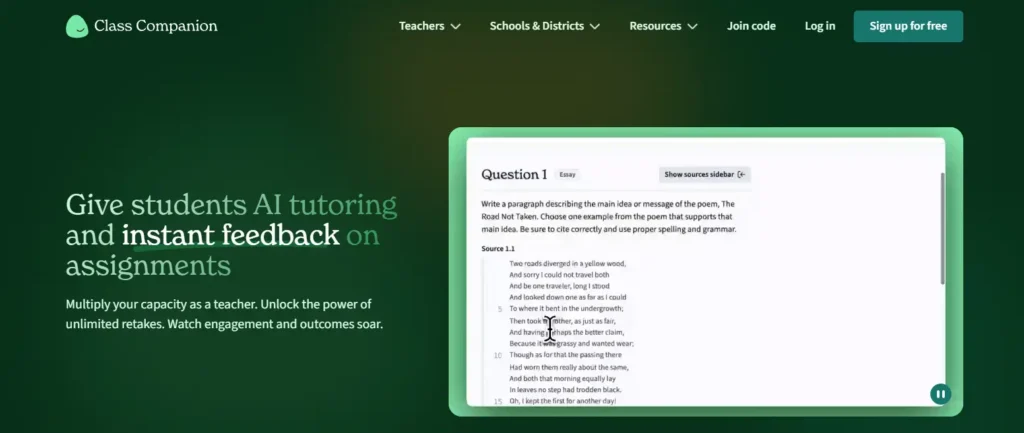
Class Companion is an AI-powered learning platform that helps teachers provide immediate feedback on writing assignments while keeping students engaged throughout the learning process. Rather than waiting until an assignment is submitted, students receive AI feedback as they write, giving them opportunities to revise and improve before turning in their work. This makes the platform particularly effective for formative assessment, where continuous improvement is the primary goal.
The platform is designed to fit naturally into everyday classroom workflows. Teachers can create assignments, monitor student progress, and review AI-generated feedback from a single dashboard. Its integration with Google Classroom makes distributing assignments and managing submissions straightforward, reducing administrative work and allowing educators to focus more on instruction.
Class Companion also encourages active learning by giving students guidance instead of simply providing answers. Teachers remain in control of grading and can review student work alongside AI-generated suggestions to ensure feedback aligns with classroom expectations. While it is an excellent tool for ongoing writing support, it is less focused on plagiarism detection or large-scale institutional assessment than some other platforms.
Highlights
- AI feedback delivered during the writing process
- Strong support for formative assessment
- Google Classroom integration for streamlined classroom workflows
- Easy assignment creation and management
- Helps teachers monitor student progress in real time
- Encourages students to revise before final submission
Best For
K-12 teachers looking to improve student writing through formative assessment and real-time AI feedback.
Limitations
Limited academic integrity and plagiarism detection features. Better suited for classroom learning than large-scale institutional grading.
Pricing
Free plan available for educators, with premium plans offering additional features and expanded classroom capabilities.
7. Automark
Overview
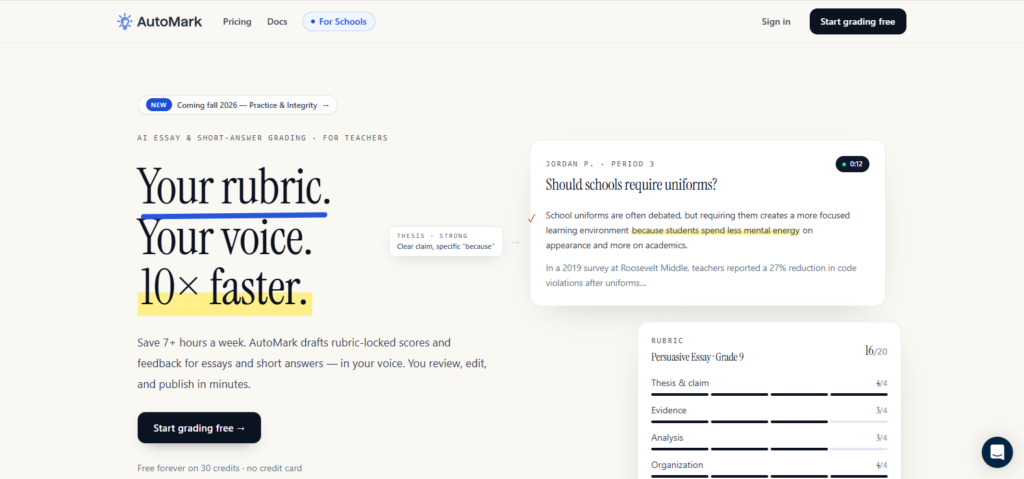
Automark is an automated essay grading platform designed to help educators evaluate written assignments more efficiently while maintaining consistent assessment standards. It uses AI to score essays against predefined criteria, making it easier to assess large numbers of submissions without manually reviewing every response from scratch. For educators managing frequent writing assignments, Automark can significantly reduce repetitive grading tasks.
A key strength of the platform is its support for rubric scoring. Instructors can create custom rubrics that align with their course objectives, ensuring essays are evaluated using consistent criteria across every assignment. This structured approach improves grading consistency and provides students with clear feedback on how their work was assessed. Rather than focusing only on final scores, Automark also generates comments that highlight areas where student writing can be strengthened.
Automark is best suited for educators who want to standardize assessment while reducing administrative workload. Although its AI-generated feedback helps streamline the grading process, instructors should still review results to ensure comments reflect the context and expectations of each assignment. This combination of automation and human oversight leads to more reliable evaluations.
Highlights
- Automated essay grading for faster assessment
- Rubric scoring with support for custom rubrics
- Consistent evaluation across student submissions
- AI-generated feedback to support writing improvement
- Reduces repetitive grading tasks
- Flexible assessment for different assignment types
Best For
Educators seeking an automated grading solution with rubric-based assessment and consistent feedback for student writing.
Limitations
Feedback may require instructor review for nuanced writing assignments. Academic integrity and plagiarism features are more limited than specialized platforms.
Pricing
Custom pricing based on institutional requirements and deployment needs.
Which EssayGrader Alternative Is Right for You?

Choosing the right EssayGrader alternative depends on how you teach, the number of writing assignments you manage, and the type of feedback you want students to receive.
Some platforms focus on saving time through AI grading, while others prioritize personalized writing support, plagiarism checking, or large-scale assessment. Before making a decision, consider which features will have the biggest impact on your classroom and long-term teaching goals.
Do You Need AI Essay Grading or More Personalized Feedback?
Not every essay grader is built for the same purpose. If your primary goal is reducing the time spent evaluating writing assignments, AI grading can automate repetitive tasks and make the grading process more efficient.
However, if you want to help students become stronger writers, personalized feedback should be your priority. Detailed comments, rubric-based assessment, and actionable suggestions provide greater value than simply assigning a score.
Different instructional goals require different platforms, so think about whether your focus is faster assessment or deeper learning. The best tools combine AI grading with instructor oversight because feedback quality matters more than grading speed alone, especially when evaluating complex student work.
Which Features Should Teachers and Schools Prioritize?
Teachers and schools should look beyond basic grading tools and evaluate how each platform supports long-term assessment goals. Features like custom rubrics allow greater flexibility across different assignments and writing levels, while detailed reports, comments, and scores make it easier to monitor student progress.
AI detection and plagiarism checking are equally important for maintaining academic integrity, particularly in secondary and higher education. Advanced analytics can also reveal learning trends that help educators adjust instruction over time.
Custom rubrics improve flexibility by aligning grading with course objectives, while academic integrity tools strengthen assessment. Detailed reports support instructional decisions by identifying areas where students need additional guidance.
How Important Are Google Classroom, LMS Integration, and Pricing?
A grading platform should fit naturally into your existing teaching environment. Google Classroom integration simplifies grading workflows by allowing teachers to distribute assignments, review submissions, and return feedback without switching between multiple systems.
Strong LMS integration and broad LMS compatibility also improve accessibility for students and reduce administrative work for educators. Easy implementation increases adoption because teachers can continue using familiar classroom tools.
Pricing is another important consideration. Free tiers suit individual educators or small classrooms, while premium plans often provide institution-wide features, expanded support, and greater long-term value for schools and universities managing larger numbers of users.
Which EssayGrader Alternative Offers the Best Long-Term Value?
The best platform depends on your instructional priorities. If you need scalable AI-assisted grading for colleges or universities, Apporto PowerGrader offers the strongest combination of personalized feedback, LMS integration, and academic integrity support.
CoGrader is an excellent choice for educators who rely on Google Classroom, while Gradescope excels at grading high-volume classes efficiently. Turnitin remains the leading option for originality checking and academic integrity.
Class Companion is ideal for formative assessment with real-time AI feedback, EnlightenAI focuses on personalized writing improvement, and Automark provides reliable automated grading with rubric-based scoring. Matching the platform to your teaching goals will deliver greater value than choosing based on features or pricing alone.
Final Thoughts
The best EssayGrader alternative depends on your teaching goals. CoGrader is a strong choice for K-12 educators using Google Classroom, Gradescope excels at grading large classes, Turnitin leads in academic integrity and originality checking, Class Companion supports formative learning, EnlightenAI focuses on personalized writing feedback, and Automark simplifies automated rubric-based assessment.
For colleges and universities, Apporto PowerGrader stands out as the most complete solution. It combines AI-assisted grading, personalized feedback, scalable assessment, academic integrity support, and seamless LMS integration to help instructors grade efficiently while maintaining high academic standards.
If you’re looking for a platform that balances automation with meaningful instructor oversight, Apporto PowerGrader is well worth exploring for your institution.
Frequently Asked Questions (FAQs)
1. What are the best EssayGrader alternatives in 2026?
Some of the best EssayGrader alternatives in 2026 include Apporto PowerGrader, CoGrader, Gradescope, Turnitin, EnlightenAI, Class Companion, and Automark. Each platform serves different needs, from AI-assisted grading and personalized feedback to plagiarism checking and large-scale assessment.
2. Which EssayGrader alternative is best for AI essay grading?
Apporto PowerGrader is one of the strongest options for AI essay grading because it combines AI-assisted assessment with personalized feedback, custom rubrics, scalable grading, and instructor oversight. It helps educators save time while maintaining consistent and high-quality evaluations.
3. Which platform is best for higher education?
For colleges and universities, Apporto PowerGrader is the best choice. It offers scalable assessment, seamless LMS integration, custom rubrics, academic integrity support, and AI-assisted grading features designed to handle large classes without compromising feedback quality.
4. Can EssayGrader alternatives integrate with Google Classroom or other LMS platforms?
Yes. Many EssayGrader alternatives support Google Classroom or other learning management systems. For example, CoGrader integrates directly with Google Classroom, while platforms like Apporto PowerGrader, Gradescope, and Turnitin support popular LMS platforms such as Canvas, Blackboard, and Moodle.
5. Are there free EssayGrader alternatives for teachers?
Yes. Platforms like CoGrader and Class Companion offer free tiers that allow teachers to explore AI-powered grading and writing feedback. Paid plans typically unlock additional features, larger usage limits, advanced analytics, and broader classroom management capabilities.
6. Do AI essay graders detect plagiarism?
Some AI essay graders include plagiarism checking, while others focus only on writing evaluation. Turnitin is the leading platform for originality reports and academic integrity, whereas many AI grading tools prioritize feedback, rubric-based assessment, and writing improvement over plagiarism detection.
7. How does AI-assisted feedback improve student writing?
AI-assisted feedback provides students with timely, specific suggestions on organization, clarity, grammar, and argument development. When combined with instructor review, this feedback helps students revise more effectively, strengthen their writing skills, and better understand assessment expectations.
8. What should you look for when choosing an EssayGrader alternative?
Choose a platform based on your teaching goals, class size, and workflow. Consider AI feedback quality, custom rubrics, LMS integration, academic integrity features, ease of use, scalability, and pricing to ensure the solution supports both educators and students effectively.
