

What Are the Best ELI Review Alternatives?
Apporto PowerGrader is one of the best ELI Review alternatives for higher education, combining AI-assisted grading, personalized feedback, and seamless LMS integration. Other leading options include Harmonize Peer Review, Peerceptiv, and Turnitin Feedback Studio, each supporting peer review, collaborative learning, or writing assessment workflows.
Writing is rarely a one-and-done process. Students improve when they receive thoughtful feedback, reflect on it, and apply those insights to stronger revisions. That is why peer review has become a valuable part of teaching, helping learners develop critical thinking, collaboration, and communication skills alongside better writing. Still, many educators now expect more than structured peer feedback.
Features like AI-assisted assessment, instructor analytics, collaborative workflows, and seamless LMS integration have become equally important for creating an efficient and engaging learning experience.
In this blog post, you’ll discover the best ELI Review alternatives, compare their strengths, and learn which platform offers the right combination of peer assessment, instructor workflows, feedback quality, scalability, and overall value for your classroom or institution.
How Did We Tested These ELI Review Alternatives?

A university running writing-intensive courses may prioritize detailed revision workflows and instructor oversight, while a K-12 school may focus on collaborative learning, ease of use, and timely feedback.
Some educators want anonymous peer review to encourage more honest responses, while others are looking for AI-assisted grading, deeper instructor analytics, or seamless LMS integration to simplify course management.
For this guide, each platform was evaluated on the features that have the greatest impact on teaching and learning. That includes the quality of peer assessment, support for the writing process, feedback effectiveness, reporting capabilities, scalability, and how well each solution fits into existing instructional workflows.
Rather than focusing on feature lists alone, the goal was to identify platforms that genuinely help educators save time while giving students more opportunities to learn, revise, and improve.
How Well Does the Platform Improve Peer Feedback and the Writing Process?
Effective peer review should do more than collect comments. It should strengthen the writing process by helping students review each other’s work using clear criteria and meaningful peer assessment. Structured peer feedback improves learning outcomes because it encourages reflection before revision begins.
Revision plans become far more valuable when feedback is specific and actionable. Anonymous peer review also encourages honest participation, allowing students to focus on improving ideas instead of worrying about personal bias. Combined with collaborative writing and timely feedback, these features create a more engaging learning process.
Which Features Help Teachers Manage Peer Review More Effectively?
The best platforms also reduce administrative work for instructors. Instructor analytics simplify progress tracking by showing how the entire class is performing and where additional support may be needed.
Well-designed rubrics improve review consistency, giving every reviewer clear criteria for evaluating assignments. Detailed comments, scores, and reports help teachers evaluate submissions more efficiently while making feedback easier for students to understand.
Together, these features create a more organized review process and support better instructional decisions throughout the course.
Which Platform Delivers the Best Overall Value?
Value extends beyond subscription cost. The strongest platforms combine reliable support, accessibility, and practical tools that improve learning without adding unnecessary complexity. LMS integration with systems like Canvas and Google Docs reduces administrative work by keeping assignments, feedback, and collaboration in one workflow.
Ease of adoption also matters, especially for institutions introducing new technology across multiple courses. Platforms backed by educational research and designed for long-term use often provide greater value because they continue supporting both instructors and students as teaching needs evolve.
Quick Comparison of the Best ELI Review Alternatives
Every peer review platform takes a slightly different approach to improving writing and assessment. Some emphasize collaborative learning and structured peer feedback, while others focus on AI-assisted grading, originality checking, or instructor analytics.
The best choice depends on your instructional goals, feedback workflow, and the level of automation you need. The comparison below highlights the key differences between the leading ELI Review alternatives, making it easier to identify the platform that best supports your students, instructors, and institution.
| Platform | Best For | AI Features | Peer Review | LMS Integration | Pricing |
|---|---|---|---|---|---|
| Apporto PowerGrader | AI-assisted grading and higher education assessment | AI grading, AI-generated feedback, academic integrity support | Instructor-led feedback with limited peer review | Canvas, Blackboard, Moodle, D2L Brightspace, and other major LMSs | Custom pricing |
| Harmonize Peer Review | Discussion-based learning and structured peer review | Basic AI capabilities | Anonymous peer review, discussion-based collaboration, customizable review workflows | Canvas, Blackboard, Moodle, D2L Brightspace | Custom quote |
| Peerceptiv | Research-backed peer assessment and writing improvement | Machine learning for review reliability and assessment analytics | Anonymous peer review, peer assessment, self-assessment, calibrated reviews | Canvas, Blackboard, Moodle, D2L Brightspace | Custom quote |
| Turnitin Feedback Studio | Grading, originality checking, and writing feedback | AI-assisted writing insights, grading assistance, originality detection | Instructor feedback with peer review support through LMS workflows | Canvas, Blackboard, Moodle, Google Classroom, Microsoft Teams, and other major LMSs | Custom quote |
Eli Review Alternatives (A Complete Overview)
1. Apporto PowerGrader
Overview
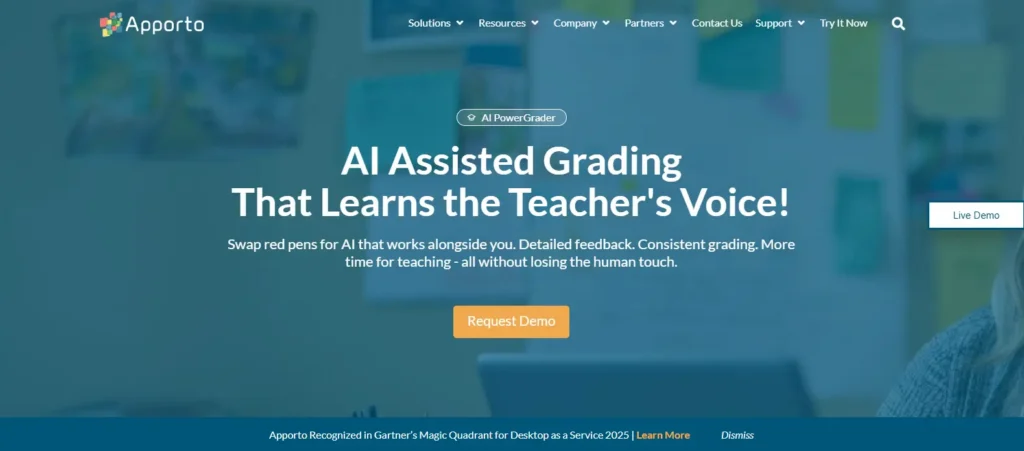
Apporto PowerGrader is an AI-powered assessment platform built to help higher education institutions modernize grading without sacrificing quality or consistency. While ELI Review centers on peer feedback and revision, PowerGrader focuses on instructor-led evaluation by automating repetitive grading tasks and delivering personalized feedback at scale. This makes it particularly valuable for courses with large enrollments, where providing detailed comments for every submission can quickly become time-consuming.
The platform combines AI-assisted grading with instructor oversight, allowing educators to review, refine, and approve AI-generated evaluations before they are shared with students. Rather than replacing instructors, it helps them spend less time on routine assessment and more time supporting student learning. PowerGrader also integrates with major learning management systems, making assignment distribution, grading, and feedback part of an existing academic workflow. With scalable assessment capabilities and academic integrity safeguards, it is well suited for colleges and universities seeking a more efficient approach to writing assessment.
Highlights
- AI-assisted grading accelerates writing assessment while maintaining instructor control.
- Generates personalized feedback that helps students improve future submissions.
- Supports scalable assessment for large classes and multi-section courses.
- Integrates with major LMS platforms, including Canvas, Blackboard, Moodle, and D2L Brightspace.
- Reduces grading time without compromising assessment quality.
- Includes academic integrity features to support fair and consistent evaluation.
- Designed specifically for higher education teaching environments.
Best For:
Colleges and universities looking for AI-assisted grading, personalized instructor feedback, scalable assessment workflows, and seamless LMS integration.
Limitations:
Peer review capabilities are not the platform’s primary focus, making it less suitable for courses centered on student-to-student feedback.
Pricing:
Apporto PowerGrader offers custom pricing based on your institution’s size, deployment requirements, and assessment needs. Contact the sales team for a personalized quote and implementation details.
2. Harmonize Peer Review
Overview
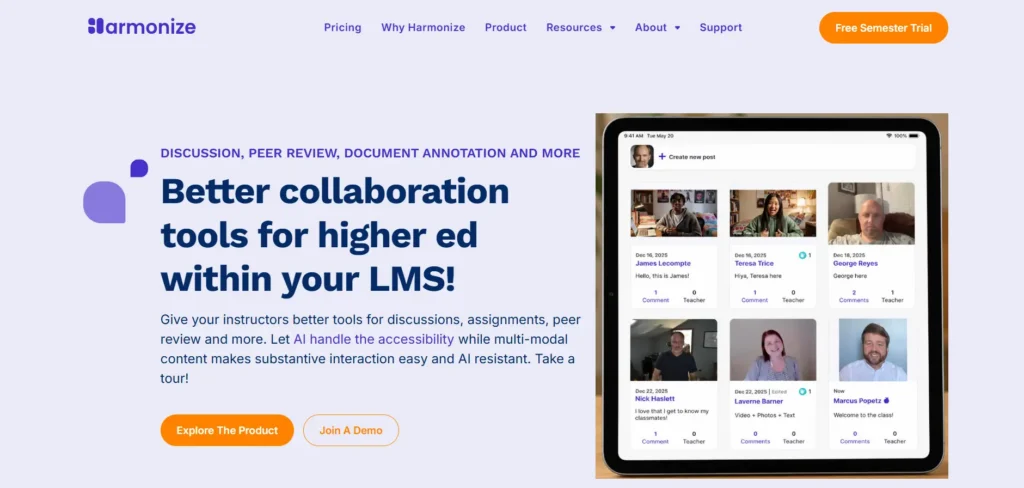
Harmonize Peer Review is designed to make peer review activities more engaging by combining structured feedback with discussion-based learning. Instead of treating peer assessment as a standalone assignment, the platform encourages students to exchange ideas, respond thoughtfully to classmates, and participate in ongoing academic conversations. This collaborative approach helps transform feedback into an active part of the learning process rather than a final step after an assignment is submitted.
The platform supports anonymous peer review, allowing students to evaluate work more objectively while reducing the hesitation that sometimes comes with reviewing classmates. Instructors can create customized review workflows, define evaluation criteria, and moderate discussions to ensure feedback remains constructive and aligned with course objectives. Because students interact throughout the review cycle, participation often extends beyond simple comments and encourages deeper reflection on both their own writing and the work of others.
Harmonize also integrates with major learning management systems, allowing instructors to manage assignments without introducing separate workflows. Combined with instructor moderation and collaborative discussion tools, it provides an effective environment for writing-intensive courses where peer interaction plays a central role.
Highlights
- Supports structured peer review activities with guided evaluation workflows.
- Encourages discussion-based learning that extends beyond written comments.
- Anonymous peer review promotes honest and unbiased feedback.
- Instructor moderation helps maintain constructive classroom discussions.
- Improves student participation through collaborative learning activities.
- Customizable review criteria support different assignment types.
- Integrates with major LMS platforms for streamlined course management.
Best For:
Educators who want to combine peer review, collaborative learning, and structured classroom discussions in one platform.
Limitations:
AI-assisted grading and automated writing evaluation are limited compared to AI-focused assessment platforms.
Pricing:
Harmonize Peer Review uses institution-based pricing rather than public plans. Schools and universities can request a custom quote based on enrollment, course volume, and implementation requirements.
3. Peerceptiv
Overview
Peerceptiv is a research-backed peer assessment platform developed to improve both the quality and reliability of student feedback. Unlike traditional peer review systems, it uses machine-learning review reliability models to evaluate the quality of peer assessments, encouraging students to provide more thoughtful and accurate feedback. This data-driven approach has made Peerceptiv a popular choice for institutions that want structured peer assessment without placing the entire evaluation process on instructors.
Built on more than 12 years of research, Peerceptiv emphasizes continuous improvement throughout the revision workflow. Students participate in anonymous peer review, evaluate classmates’ work using established criteria, and often complete self-assessments before revising their own submissions. These repeated review cycles strengthen critical thinking while helping students understand how high-quality writing develops over time.
The platform also provides instructor analytics that highlight participation levels, review quality, and overall class performance. These insights allow instructors to identify students who may need additional support while reducing the time spent monitoring peer review activities manually. Combined with its research-backed methodology and machine-learning reliability, Peerceptiv delivers a well-rounded solution for institutions committed to evidence-based peer assessment.
Highlights
- Supports structured peer assessment with anonymous peer review.
- Uses machine-learning review reliability to improve feedback quality.
- Backed by more than 12 years of educational research.
- Includes instructor analytics for monitoring participation and performance.
- Encourages multiple revision cycles to strengthen writing skills.
- Supports self-assessment alongside peer evaluation.
- Integrates with major learning management systems.
Best For:
Colleges and universities seeking a research-backed peer assessment platform with advanced analytics and reliable review workflows.
Limitations:
AI-assisted grading is limited because the platform focuses primarily on peer evaluation rather than automated instructor assessment.
Pricing:
Peerceptiv provides custom pricing for educational institutions. Licensing costs vary depending on the number of students, courses, and the level of implementation and support required.
4. Turnitin Feedback Studio
Overview
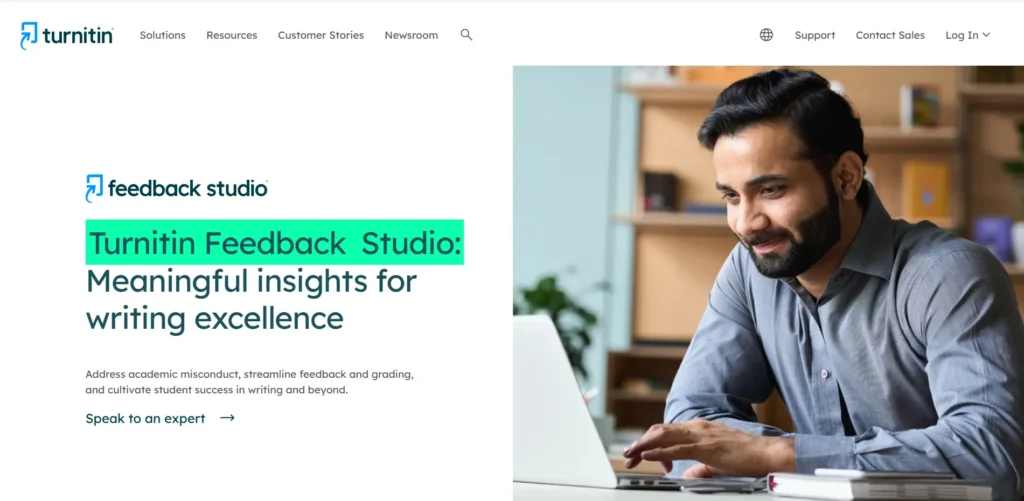
Turnitin Feedback Studio is one of the most widely adopted platforms for writing assessment, combining originality checking with instructor feedback and grading tools. While it is best known for plagiarism detection, the platform also helps educators evaluate student writing through rubric grading, inline comments, and structured feedback. This combination makes it a practical solution for institutions that want to strengthen academic integrity while maintaining consistent assessment standards.
Instructors can annotate assignments directly, apply customizable rubrics, and provide detailed comments that guide writing improvement across multiple drafts. Originality reports help identify potential citation issues, allowing students to revise their work before final submission and develop stronger academic writing habits. These features support learning by encouraging revision instead of treating assessment as a one-time event.
Turnitin Feedback Studio also integrates with major learning management systems, enabling educators to manage submissions, grading, and feedback from within existing course environments. Although peer review is available through connected workflows, the platform’s primary strength lies in instructor-led evaluation, originality checking, and comprehensive writing assessment.
Highlights
- Combines originality checking with comprehensive grading tools.
- Supports plagiarism detection to promote academic integrity.
- Enables rubric grading with detailed instructor feedback.
- Provides inline comments that encourage writing improvement.
- Generates originality reports to support proper citation practices.
- Integrates with major LMS platforms, including Canvas and Moodle.
- Simplifies assignment submission and grading within existing workflows.
Best For:
Institutions that prioritize originality checking, instructor feedback, rubric grading, and consistent writing assessment.
Limitations:
Peer review functionality is not as comprehensive as platforms specifically designed for collaborative peer assessment.
Pricing:
Turnitin Feedback Studio does not publicly list its pricing. Institutions can request a customized quote based on their enrollment size, licensing needs, and selected features.
Which ELI Review Alternative Is Right for You?

Choosing the right ELI Review alternative starts with understanding what you want to improve. Some platforms focus on collaborative peer learning, while others prioritize AI-assisted assessment, instructor efficiency, or academic integrity.
The best solution should align with your teaching objectives, simplify classroom workflows, and help students produce stronger work through meaningful feedback. The following considerations can help you narrow down the right platform for your classroom or institution.
Do You Need Better Peer Review or AI-Assisted Assessment?
Your choice should begin with your instructional priorities. If your courses rely on peer review, collaborative learning, and multiple rounds of revision, look for a platform that supports anonymous peer review, structured peer assessment, and guided feedback. These features encourage students to evaluate each other’s work objectively while strengthening the overall writing process.
On the other hand, if reducing grading time is your primary goal, AI grading offers a different advantage. AI-assisted assessment helps instructors evaluate assignments more efficiently while still delivering detailed feedback to students. These platforms are particularly valuable for higher education courses with large enrollments.
Different teaching goals require different platforms. AI grading and peer review solve different challenges, and neither replaces the other completely. Ultimately, feedback quality should guide your decision because meaningful, actionable feedback has the greatest impact on student learning and revision.
Which Features Should Educators Prioritize?
The best assessment platform should make life easier for both instructors and students. Start by looking for customizable rubrics that create consistent grading standards and help reviewers provide focused, meaningful comments. Anonymous reviews can also improve participation by encouraging more objective evaluations without personal bias.
Instructor analytics are equally important because they provide real-time progress tracking across assignments, making it easier to identify students who may need additional support. Detailed reports, reviewer activity, scores, and revision plans help teachers monitor classroom performance and evaluate learning outcomes more efficiently.
LMS integration is another essential feature. A platform that connects with your existing learning management system reduces administrative work by keeping assignments, grading, and feedback within one familiar workflow.
How Important Are LMS Integration, Pricing, and Ease of Use?
A feature-rich platform only delivers value if educators actually use it. LMS integration improves workflow by connecting assignments, grading, and feedback with systems such as Canvas and Google Classroom. This reduces duplicate work and creates a smoother experience for both instructors and students.
Ease of implementation is just as important. Platforms that are simple to set up and require minimal training typically achieve higher adoption across departments and institutions. Strong customer support also helps ensure a successful rollout.
Pricing should be evaluated alongside long-term value. Free tools can work well for individual teachers or small classrooms, while premium platforms often provide the scalability, advanced features, administrative controls, and support that larger institutions require. The right balance depends on your budget and instructional needs.
Which ELI Review Alternative Offers the Best Long-Term Value?
Each platform serves a different purpose, so the best long-term investment depends on your teaching strategy. If your priority is AI-assisted assessment, Apporto PowerGrader stands out with AI-powered grading, personalized feedback, scalable assessment, and seamless LMS integration. For collaborative discussion and structured peer review, Harmonize Peer Review is a strong choice.
If research-backed peer assessment is your focus, Peerceptiv offers machine-learning reliability, instructor analytics, and well-established revision workflows backed by years of educational research. Meanwhile, Turnitin Feedback Studio remains a leading writing feedback platform for originality checking, rubric grading, instructor feedback, and plagiarism detection.
The right fit is the one that supports your instructional goals today while continuing to deliver value as your courses, students, and assessment needs grow.
Final Thoughts
The best ELI Review alternative depends on your instructional priorities. Harmonize Peer Review is a strong choice for collaborative learning and structured peer discussions, while Peerceptiv excels in research-backed peer assessment with reliable review workflows.
Turnitin Feedback Studio remains a leading solution for writing feedback, originality checking, and consistent grading.
Schools, universities, and individual instructors often have different assessment needs, making it important to choose a platform that aligns with your teaching goals.
For higher education, Apporto PowerGrader stands out as the strongest overall solution. It combines AI-assisted grading, personalized feedback, scalable assessment, academic integrity features, and seamless LMS integration to streamline instructor workflows while improving learning outcomes.
If you’re ready to modernize writing assessment, explore Apporto PowerGrader and see how it can support your institution.
Frequently Asked Questions (FAQs)
1. What are the best ELI Review alternatives in 2026?
Some of the best ELI Review alternatives in 2026 include Apporto PowerGrader, Harmonize Peer Review, Peerceptiv, and Turnitin Feedback Studio. Each platform offers distinct strengths, ranging from AI-assisted assessment and peer review to collaborative learning, originality checking, and instructor feedback.
2. Which ELI Review alternative is best for peer review?
Peerceptiv and Harmonize Peer Review are among the strongest options for peer review. Both support structured feedback, collaborative learning, and anonymous peer review, helping students evaluate classmates’ work while developing stronger writing and critical thinking skills.
3. Which platform is best for anonymous peer review?
Harmonize Peer Review and Peerceptiv both provide robust anonymous peer review capabilities. These features encourage more honest, unbiased feedback and create a comfortable environment where students can focus on improving work rather than worrying about personal relationships.
4. Which ELI Review alternative is best for higher education?
Apporto PowerGrader is the best choice for higher education institutions. It combines AI-assisted grading, personalized feedback, scalable assessment workflows, academic integrity features, and LMS integration to help instructors manage large classes more efficiently.
5. Can ELI Review alternatives integrate with Canvas or other LMS platforms?
Yes. Most leading ELI Review alternatives integrate with popular learning management systems, including Canvas, Blackboard, Moodle, and other LMS platforms. These integrations simplify assignment management, grading, feedback delivery, and student access within existing course workflows.
6. Do ELI Review alternatives support collaborative writing?
Yes. Platforms such as Harmonize Peer Review and Peerceptiv encourage collaborative writing through structured peer review, discussion-based learning, and revision workflows. These features help students refine their writing by learning from both instructor and peer feedback.
7. How does peer feedback improve student learning?
Peer feedback encourages students to evaluate ideas critically, identify strengths and weaknesses, and apply suggestions during revision. This process strengthens writing skills, improves critical thinking, promotes collaboration, and helps students develop a deeper understanding of assessment criteria.
8. What should you look for when choosing an ELI Review alternative?
Choose a platform that aligns with your instructional goals and workflow. Consider features such as peer review, AI-assisted assessment, customizable rubrics, instructor analytics, LMS integration, scalability, reporting, ease of use, and the quality of feedback it supports.
