

What Is AI Proctoring & How Does It Works?
AI proctoring uses artificial intelligence, computer vision, and audio analysis to monitor online exams, verify identity, and flag anything that looks off. On its own, that’s just detection. What actually makes it useful is pairing it with a human proctor who can look at what got flagged and decide what it means, which is the approach that Apporto is built around, based on years of experience working in HigherEd.
Princeton just walked back 133 years of trusting students on their word alone. Starting July 1, 2026, faculty voted to put instructors back in the exam room, not because students suddenly got worse, but because AI made it too easy to cheat without anyone noticing. That’s one end of the spectrum.
On the other end, roughly 160,000 students sat for Mexico’s UNAM entrance exam remotely this year, the first time it had ever been offered that way, leaning heavily on a lockdown browser and AI webcam monitoring to keep things honest. It did not go well. Top scores nearly quintupled compared to previous years. The numbers were so implausible that UNAM ordered 58,000 students back into a classroom to retake the whole thing, this time with a person actually watching.
Two universities, two opposite instincts. One decided AI couldn’t be trusted to watch alone, so it brought humans back in. The other leaned almost entirely on AI and got burned for it. Neither extreme is the answer, and you don’t have to pick one. That middle ground, AI that extends what a proctor can see without ever making the call alone, is exactly where a tool like Apporto ExamSpace is built to sit.
What is AI Proctoring?
AI proctoring uses artificial intelligence, typically computer vision paired with audio analysis, to monitor online exams without requiring a person to watch every session live. Instead of a human proctor sitting in a room or on a video call, AI systems review exam sessions in real time or shortly after, checking for the kind of behavior that suggests unauthorized help is nearby.
It is not one piece of software doing one job. It is a layer of monitoring built into the exam experience itself, running quietly in the background while you work through the test.
How Does AI Proctoring Work?
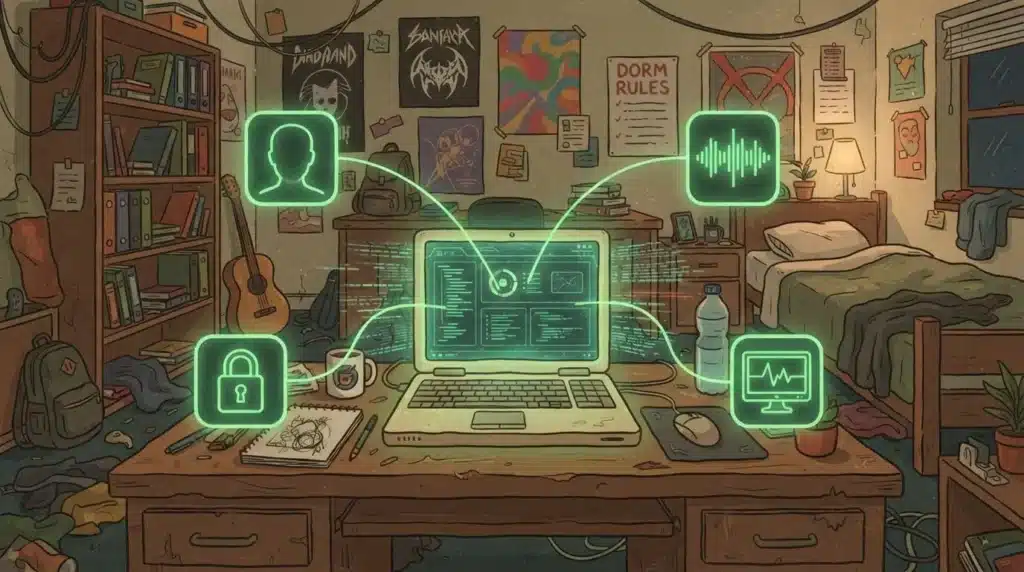
A proctor, human or AI, needs to do three things during an exam: confirm who you are, notice anything unusual, and decide what that means. AI handles the first two at a scale no single person could manage alone. Facial recognition confirms your identity before the exam begins, usually by comparing a live photo against an ID or a stored reference image. From there, several tools run simultaneously, feeding what they notice back to a proctor rather than acting on it themselves.
Here is what a typical AI proctoring setup actually monitors:
- Facial recognition and live photo comparison for identity verification before the exam begins
- Computer vision tracking gaze shifts, head movement, and unauthorized materials in the exam environment
- Audio analysis and voice detection flagging unexpected sounds or conversation
- Browser locking, which prevents test takers from opening new tabs or applications during the exam
- Machine learning models analyzing multiple data streams simultaneously to flag suspicious behavior in real time
None of these tools work in isolation, and none of them are built to make the final call either. A single gaze shift means very little on its own. What differentiats and makes our proctoring system powerful is not that it notices the pattern across video, audio, and browser activity, what makes it matter is that it then hands that pattern to a Proctor who decides what it means.
What Are the Different Types of AI Proctoring?
Not every AI proctoring setup looks the same, and after what happened at UNAM, the differences matter more than most people realize when they hear the term for the first time.
| Type | How it works | Best for |
|---|---|---|
| Live proctoring | Human supervisors monitor in real time with AI assistance flagging anomalies | High-stakes exams needing immediate human judgment |
| Recorded proctoring | Sessions are captured and reviewed later using AI analysis | High-volume testing windows, certification programs |
| Fully automated proctoring | AI systems handle monitoring end to end with no live human involvement | Lower-stakes assessments only, this is the setup that failed at UNAM when used for a high-stakes exam |
| Hybrid proctoring | Combines AI detection with human review of flagged moments | Emerging industry standard, balances scale and judgment |
Hybrid proctoring is the one worth paying attention to. It is quickly becoming the default, not because AI alone isn’t capable, but because pairing it with a human catches what AI alone misses. UNAM found that out the hard way, and it comes up again later in this piece.
How Accurate Is AI Proctoring Compared to Human Proctors?

Scale is where AI genuinely outperforms a single human proctor, and the numbers are not close.
| Metric | AI proctoring | Human proctoring |
|---|---|---|
| Candidates monitored at once | Thousands of exam sessions simultaneously | 10-30 candidates at once |
| Detection accuracy | 90-95% | 75-85% |
| Facial recognition accuracy | 99.5% in controlled conditions | Not applicable |
| Cost per exam | $5-15 | $20-40 |
| Cheating reduction vs. unsupervised tests | Up to 96% | Varies |
A human proctor gets tired. A human proctor blinks, glances away, loses focus during hour three of a testing block. AI does not have that problem, which is a large part of why detection accuracy and cost both land in AI’s favor here. But being accurate at flagging something suspicious is not the same as being accurate about what actually happened, and that gap is exactly what tripped up UNAM. The AI flagged plenty. What it couldn’t do was tell the university, on its own, whether the results were trustworthy. That took a commission of human experts and 58,000 retakes to sort out
But accuracy on paper and accuracy that actually protects learning are two different questions, and this is where the story gets more complicated than a comparison table can show.
Does AI Proctoring Actually Improve Exam Integrity?
At Apporto our research came back to these two numbers, because the whole story lives in the space between them. Non-proctored performance on AI-susceptible problems rose 85%. Proctored performance on the same problems fell 25%.
Researchers from UC Irvine and McGraw Hill analyzed 3.2 million real learning interactions on a math platform, spanning a decade, and found that after ChatGPT’s release, students spent noticeably less time on problems that could be typed straight into a chatbot. When those same students were tested under proctored conditions, with AI simply unavailable, their odds of answering correctly fell substantially.
That single fact should reframe how you think about the purpose of proctoring. For years, AI in education has been treated as an integrity question. Did the student cheat? Can detection tools catch them? That framing assumes a discrete event, one moment where a specific student crossed a specific line.
But what this data actually shows is not a cheating event. It is a slow, population-wide drift in how students allocate mental effort, and no detector was built to catch something that gradual. When a non-proctored grade can rise while the underlying knowledge falls, the grade stops measuring what everyone assumes it measures.
What Is Cognitive Surrender and Why Does It Matter?
Researchers have a name for the mechanism behind this gap: cognitive surrender. Students have not become more efficient learners. They have learned to route around the cognitive effort that actually builds durable knowledge, because artificial intelligence is sitting right there to do it for them.
The problem is that the effort was never the obstacle to learning in the first place. The effort was the learning. Think about physical training for a moment. If a machine lifts the weights for you, your numbers on paper look excellent.
The point of lifting and learning is the strain which creates friction and drives improvement. We need to focus on the antithesis of Cognitive Surrender. For students, growth comes from Cognitive Friction, and that friction is exactly what got outsourced. You end up with the record, minus the muscle that was supposed to come with it.
That is cognitive surrender in a single image, and it is why human oversight matters even when AI systems are technically accurate at flagging behavior. Accuracy at spotting a rule violation and contextual understanding of what a student actually knows are not the same skill.
What Are the Benefits of AI Proctoring for Institutions?

None of this means AI proctoring is the wrong tool. It means the case for it needs to rest on the right benefits, not just the promise of catching cheaters.
- Can monitor thousands of exam sessions simultaneously, unlike human proctors capped at 10-30
- Enables consistent monitoring standards across every test session, reducing human error and inconsistency
- Lets certification bodies and higher education institutions offer exams anytime rather than scheduling around proctor availability
- Reduces costs associated with physical proctors and testing centers
For certification providers running thousands of exams a year, that scale advantage alone can be the difference between offering flexible testing windows and forcing every candidate into a handful of scheduled slots.
What Are the Concerns and Limitations of AI Proctoring?
The scale that makes AI proctoring appealing is also where its limitations show up most clearly.
- AI systems can misinterpret normal behavior, like excessive gaze shifts, as suspicious, causing false positives
- Algorithmic bias in facial analysis can disproportionately affect individuals with darker skin tones
- Privacy concerns arise from continuous video and audio monitoring and the data collection involved
- Technical barriers, like poor internet access, can disadvantage some students regardless of their actual performance
- Organizations deploying AI proctoring must comply with regulations like GDPR for data processing
A student glancing away to think through a problem is not automatically cheating. A dog barking in the next room is not a confession. Treating an ambiguous signal as an institutional verdict does not reduce risk. It just moves that risk from the exam itself into an appeals process nobody wanted to deal with in the first place.
Why Does AI Proctoring Still Need Human Oversight?
A flag is not a verdict. That distinction matters more than almost anything else in this conversation. AI proctoring is genuinely useful at surfacing moments worth a second look, but deciding what those moments mean still requires a human being who understands context.
This is exactly why hybrid proctoring, AI detection paired with human review, is becoming the industry standard rather than staying a niche option. The technology controls what it can control and records what occurred. People interpret what that record actually means.
How Can Institutions Balance Security and Student Privacy in AI Proctoring?
Balancing security with privacy is not a box to check once during procurement. It is an ongoing responsibility. Ethical AI proctoring starts with transparency, telling students clearly what is being monitored and why, rather than letting a vague privacy policy do that job.
End-to-end encryption should protect exam data in transit and at rest, since biometric and behavioral data is sensitive by nature. And institutions should run regular equity audits, checking whether the system is flagging certain groups of students more often than others, before that bias quietly shapes outcomes nobody intended.
What Alternatives Exist to Traditional AI Proctoring?
More surveillance is not always the answer, and the research actually supports stepping back from that instinct. Assessments that are AI-resistant by design, requiring visual interpretation, multi-step manipulation, or context-specific reasoning, are far harder to hand off to a chatbot in the first place.
These were never built as anti-cheating features. They were built as good pedagogy, and the integrity benefit turned out to be a side effect. Educational institutions experimenting with project-based assessments are finding the same thing: when the task itself resists shortcutting, you need less monitoring to trust the result.
How Does Apporto Approach AI Proctoring Differently?

At Apporto, the starting question is not how to lock a student down. That framing already assumes the wrong relationship between institution and student. The better question is how to build a testing environment where students can use approved resources, institutions can restrict what should not be available, and faculty still retain enough visibility to trust the process.
That question shapes three connected pieces. ExamSpace secures the exam itself, governing the full assessment workspace at the infrastructure level rather than locking a single browser tab, so the exam can include the real tools a course actually teaches with.
CoTutor protects the productive effort that happens during practice, long before the exam, using faculty-defined guardrails so AI supports thinking instead of quietly replacing it. TrustEd makes the learning process visible, surfacing writing timelines and revision patterns as context for a professor rather than handing down an automated accusation. Together, these three pieces treat AI proctoring as one part of a larger assessment lifecycle, not a single gate at the end of it.
Conclusion
The real question was never whether students are using AI. That question is already settled. The real question is whether your assessments are measuring the student or measuring the tool. AI proctoring, used well, is one part of the answer, but only one part. Securing the exam matters. Protecting effort during practice matters just as much.
Making the learning process visible enough for a professor to actually teach into the gap matters most of all. If you are auditing your institution’s assessment strategy this year, that is the place to start. Schedule a walkthrough of how ExamSpace, CoTutor, and TrustEd work together across the full assessment lifecycle.
Frequently Asked Questions(FAQs)
1. How does AI proctoring work?
AI proctoring combines facial recognition, computer vision, and audio analysis to verify identity and monitor exam sessions for suspicious behavior, often supported by browser locking that restricts other applications during the test.
2. Is AI proctoring more accurate than human proctors?
At flagging behavior, yes, studies put AI in the 90-95% range versus 75-85% for a single human proctor. But flagging isn’t the same as judging. AI can tell you something looks off. Deciding what it means, and what to do about it, still takes a person, which is exactly where UNAM’s fully automated approach fell short.
3. What are the main concerns with AI proctoring?
False positives, algorithmic bias in facial recognition, privacy around continuous monitoring, and technical barriers like unreliable internet access are the most commonly documented concerns.
4. Does AI proctoring comply with privacy regulations like GDPR?
It can, but compliance depends on the specific platform and institution. Organizations deploying AI proctoring are responsible for how exam data is collected, stored, and processed under regulations like GDPR.
5. What is hybrid proctoring and why is it becoming standard?
Hybrid proctoring combines AI detection with human review of flagged moments. It is becoming the industry standard because it keeps the scale advantages of AI while ensuring a person, not an algorithm alone, makes the final call.
