

What Is a Rubric for Assessment?
A rubric for assessment is a scoring guide that evaluates student work using defined criteria, performance levels, and descriptions of achievement. It helps educators grade consistently, provide specific feedback, and measure learning outcomes. Students can also use rubrics to understand expectations, assess their progress, and improve assignments before submission.
Two instructors can grade the same assignment and come back with different scores. One might care more about research quality, while the other focuses on writing and organization. For students, that’s frustrating. What exactly did they get wrong?
When assessment criteria aren’t clear, grading becomes harder to explain, and students are left guessing about what’s expected. That’s where rubrics come in. A rubric gives educators a clear scoring guide, helps make grading more consistent, and shows students where they can improve.
They’re useful for everything from research papers and essays to oral presentations and practical projects. In this blog post, you’ll learn what a rubric for assessment is, how it works, and how to create one that makes grading clearer and more useful.
What Is a Rubric for Assessment?
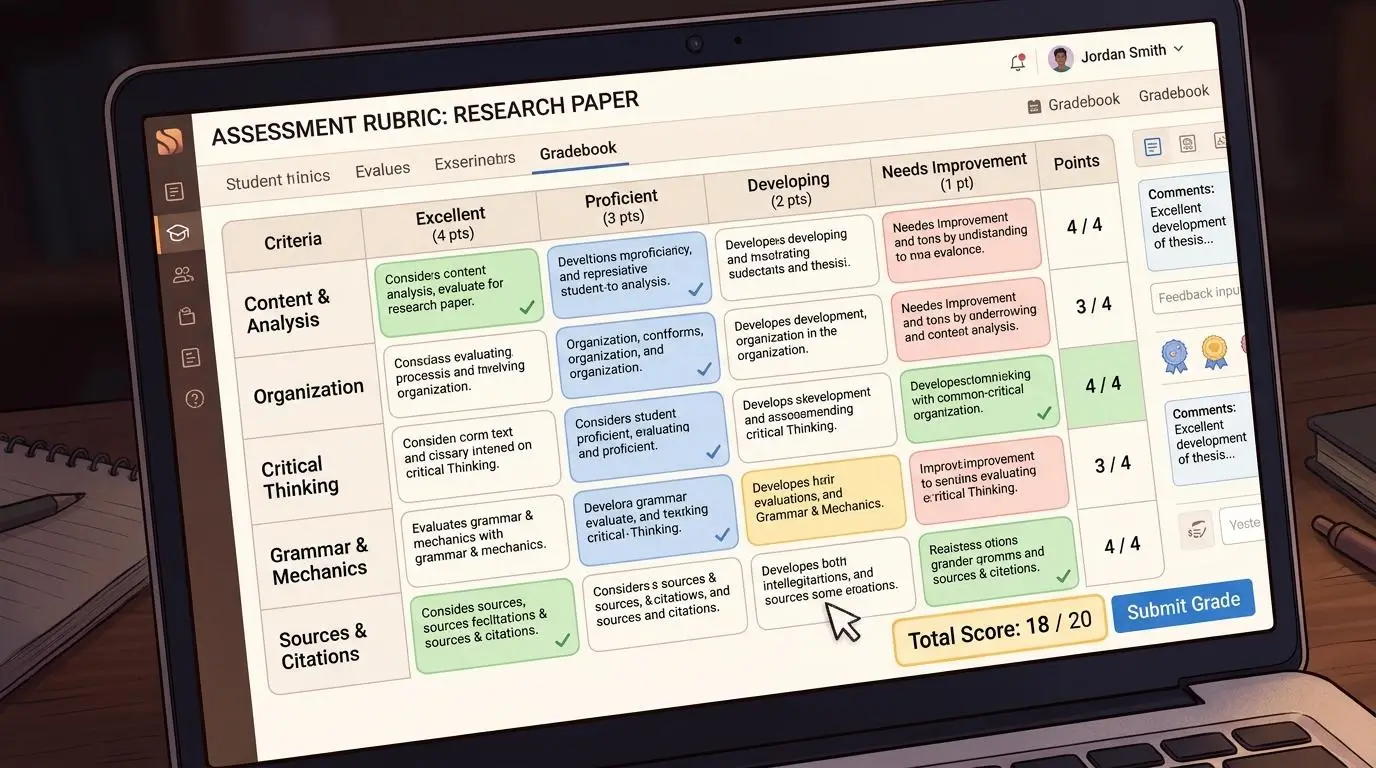
A rubric for assessment is a scoring guide that shows how student work will be graded. It breaks an assignment into specific criteria, explains different performance levels, and describes what students need to achieve at each level. This gives educators a consistent way to assess work while making expectations easier for students to understand.
But there’s more to a rubric than numbers on a grading sheet. Students can use it before starting an assignment, check their progress along the way, and understand their feedback once the work is graded.
What Is the Main Purpose of an Assessment Rubric?
The main purpose of an assessment rubric is to make grading expectations clear and consistent. Instead of judging assignments based on general impressions, educators have defined criteria to work with.
Students know what quality work looks like and where they need to improve. Rubrics also help teachers spot learning gaps, adjust their teaching approach, and provide feedback that explains more than a final score ever could.
How Is a Rubric Different From a Grading Checklist?
A grading checklist tells you whether something is included. A rubric tells you how well it’s done. Take an essay, for example. A checklist might confirm that the student included an argument.
A rubric looks closer. Is the argument clear? Does the evidence support it? Does the reasoning make sense? That extra detail helps educators assess quality and gives students something useful to work on.
What Are the Main Components of an Assessment Rubric?

Every good assessment rubric has three basic parts: assessment criteria, performance levels, and descriptors.
Each has a specific job. Together, they show students what’s expected, how their work will be evaluated, and what different levels of achievement look like. Here’s how they work.
What Are Assessment Criteria?
Assessment criteria are the skills, knowledge, or qualities you’re looking for in student work. For a research paper, that might mean accuracy, critical thinking, organization, and the quality of supporting evidence.
For an oral presentation, communication skills might matter more. The important thing is choosing criteria that reflect the assignment’s learning objectives, rather than grading things that don’t really matter.
What Are Performance Levels and Rating Scales?
Performance levels show how well a student has met each criterion. You’ll often see labels such as Excellent, Proficient, Developing, and Beginning.
These form a rating scale, helping educators distinguish strong work from work that needs improvement. Some rubrics use numerical scores, others use descriptive labels, and many combine both.
What Are Rubric Descriptors?
Descriptors explain what each performance level actually means. Simply calling work “Good” doesn’t tell students much. A useful descriptor explains what they’ve achieved. For example:
| Component | Example |
|---|---|
| Criterion | Research Quality |
| Performance Level | Proficient |
| Descriptor | Uses relevant sources with generally accurate supporting evidence |
That extra detail makes grading clearer and gives students a better idea of how to improve.
What Are the Different Types of Assessment Rubrics?

Not every assignment needs the same grading approach. A research paper might need detailed scores for several criteria, while a short classroom activity could be assessed with one overall rating.
It comes down to what you’re evaluating and how much feedback students need. Here are the main types of assessment rubrics and when to use them.
What Is an Analytical Rubric?
An analytical rubric scores each assessment criterion separately. For example, an essay might receive individual marks for research quality, argument, organization, and writing clarity. This makes analytical rubrics particularly useful for complex assignments where students need detailed feedback.
Instead of seeing just one final grade, students can identify what they did well and where they lost marks. That makes it easier to understand what needs improving.
What Is a Holistic Rubric?
A holistic rubric looks at the overall quality of an assignment and gives it a single score or performance rating. Educators consider the work as a whole rather than grading every criterion individually.
This approach can make marking quicker when a broad evaluation is enough. The trade-off? Students may not get much detail about their particular strengths or weaknesses.
What Is the Difference Between Generic and Task-Specific Rubrics?
A generic rubric uses assessment criteria that work across several similar tasks. For example, you could use the same presentation rubric to assess different topics, focusing on content, organization, and delivery.
Task-specific rubrics are designed for one particular assignment. A science project, for instance, might require criteria covering experimental methods, data accuracy, and conclusions. Generic rubrics are convenient to reuse. Task-specific rubrics offer more focused guidance.
What Is a Weighted Rubric, and When Should You Use One?
A weighted rubric gives some criteria more importance than others. In a research paper, analysis and evidence might count more toward the final grade than spelling or formatting.
That way, the scoring reflects what matters most. Here’s how the different types compare:
| Rubric Type | Main Feature | Best Used For |
|---|---|---|
| Analytical | Scores criteria separately | Detailed assignments |
| Holistic | Gives one overall score | Overall performance |
| Generic | Uses reusable criteria | Similar tasks |
| Task-Specific | Uses assignment-specific criteria | Unique projects |
| Weighted | Gives criteria different weights | Unequal grading priorities |
A rubric can also combine approaches. For example, an analytical rubric may use weighted criteria to calculate the final grade.
What Does a Good Assessment Rubric Look Like?

A good assessment rubric takes the guesswork out of grading. It tells students what matters, how their work will be scored, and what separates excellent performance from work that still needs improvement.
An analytical rubric makes this particularly clear because each part of the assignment gets its own score.
What Is an Example of an Analytical Rubric for an Essay?
Take a university essay. Instead of giving one overall grade, the instructor can assess four areas: argument, research, organization, and writing clarity. Here’s what a simple grading rubric might look like:
| Assessment Criteria | Excellent (4) | Proficient (3) | Developing (2) | Beginning (1) |
|---|---|---|---|---|
| Argument & Critical Thinking | Strong argument with thoughtful analysis | Clear argument with relevant reasoning | Partially developed argument | Argument unclear or missing |
| Research & Evidence | Strong evidence from credible sources | Mostly relevant evidence | Limited supporting evidence | Little reliable evidence |
| Organization | Logical structure and smooth flow | Clear structure with minor issues | Some organizational weaknesses | Difficult to follow |
| Writing & Clarity | Precise writing with very few errors | Clear writing with occasional errors | Errors sometimes affect clarity | Frequent errors affect understanding |
Each criterion receives between 1 and 4 points. With four equally weighted criteria, the highest possible score is 16 points. Say a student earns 4 for argument, 3 for research, 3 for organization, and 2 for writing. That’s 12 out of 16, or 75%.
It’s a straightforward example, though. You can adjust the criteria, scores, and weights to suit your essay prompt and learning objectives.
How Can Students Use a Sample Rubric Before Submitting Work?
Students can get plenty of value from a rubric before their assignment is graded. They can check whether their argument is convincing, their evidence is strong enough, and their writing meets expectations.
If something’s missing, there’s still time to fix it. Sharing the rubric early makes self-assessment easier and gives students a clearer idea of what they’re working toward.
How Do You Create an Effective Assessment Rubric Step by Step?

Creating a good assessment rubric starts with one question: What should students actually learn from this assignment?
Once that’s clear, you can build assessment criteria around those learning objectives and decide how different levels of performance should be measured. Here’s a practical way to create your own rubric:
1. Identify Learning Objectives: Decide what students need to demonstrate. That could be research skills, critical thinking, problem-solving, or written communication.
2. Choose the Rubric Type: Pick an analytical, holistic, or task-specific rubric based on the assignment and how much feedback you want to provide.
3. Define Assessment Criteria: Focus on the skills and qualities that matter most. Avoid adding criteria simply to make the rubric look detailed.
4. Set Performance Levels: Choose a rating scale, usually three to five levels, that clearly separates different standards of achievement.
5. Write Clear Descriptors: Explain what performance looks like at each level. “Uses credible sources to support arguments” tells students far more than “Good research.”
6. Assign Points or Weights: Decide how much each criterion contributes to the grade. Important learning objectives should generally carry more weight.
7. Test the Rubric: Try it on sample assignments. Check whether the descriptions make sense and whether different graders reach similar conclusions.
8. Share and Refine: Give students the rubric before they start. After grading, review what worked and make adjustments where needed.
How Many Performance Levels Should a Rubric Have?
Three to five performance levels are usually a good starting point. Too few levels can make it hard to distinguish different standards of work. Too many may slow grading and confuse students. Keep the scale detailed enough to be useful, but simple enough to apply consistently.
Should Students Help Develop Assessment Rubrics?
Yes, students can benefit from having a say in how assessment criteria are explained. You could ask them to review descriptors or discuss what quality work should include.
This can encourage self-assessment and greater ownership of learning. Just make sure the final rubric still reflects the course’s learning objectives.
What Are the Main Benefits of Using Rubrics for Assessment?

A well-designed rubric can make grading easier for educators and a lot less confusing for students. Everyone knows what’s expected, how assignments will be assessed, and what good work should look like.
But rubrics offer more than a clearer grading process. Here are seven benefits worth knowing:
- Clear Expectations: Students understand what they need to achieve before they begin, rather than guessing what the instructor wants.
- Consistent Grading: Shared criteria help instructors evaluate assignments using the same standards.
- Better Feedback: Students can see what they did well and where there’s room for improvement.
- Less Grading Time: Clear performance descriptors can reduce repetitive decisions and make marking more manageable.
- Student Accountability: Learners can check their own work against the rubric before submitting it.
- Identifying Learning Gaps: Educators can spot areas where students struggle and adjust their teaching accordingly.
- Easier Communication: Grades become simpler to explain when they’re tied to specific criteria.
Of course, a rubric is only as useful as the thought behind it. Vague descriptions can leave students just as confused as before, and educators still need to use their judgment.
When done well, rubrics help promote student learning, encourage better feedback, and make assessment fairer for everyone involved.
How Can Rubrics Improve Student Learning and Self-Assessment?

Rubrics give students a clearer picture of how they’re doing, even before their assignments are graded.
Instead of waiting for feedback, they can check their progress, spot weak areas, and make improvements while there’s still time. It’s a simple way to encourage students to take more responsibility for their learning.
How Can Students Use Rubrics for Self-Assessment?
Students can use a rubric to review their own work before handing it in. An essay might have a clear argument but lack strong supporting evidence. A rubric helps students notice those gaps.
By comparing their work with the performance descriptions, they can see what needs fixing. This encourages critical thinking and helps students become more confident in judging their own work.
How Can Rubrics Support Peer Assessment?
Rubrics make peer assessment more useful by giving students clear criteria to follow. Instead of saying a classmate’s work is simply “good,” they can explain what works and what needs improvement.
Reviewing others’ assignments can also help students recognize weaknesses in their own work. Clear guidance and instructor oversight keep the feedback fair and constructive.
How Do Rubrics Support Formative and Summative Assessment?

Rubrics are useful at different points in the learning process, not only when it’s time to assign grades. They work for both formative assessment, which helps students improve as they learn, and summative assessment, which evaluates what they’ve achieved.
How Are Rubrics Used for Formative Assessment?
Formative assessment focuses on how students are progressing before their final work is submitted. With a rubric, educators can review drafts, practice assignments, or presentations and point out what needs attention.
Students get a chance to act on that feedback, strengthen weak areas, and improve their work before it’s graded. That’s where timely feedback can make a real difference.
How Are Rubrics Used for Summative Assessment?
Summative assessment looks at what students have achieved after completing an assignment, project, or course. Rubrics help educators evaluate the finished work against clear criteria and assign grades more consistently. Here’s the difference:
| Assessment Type | When Used | Rubric Purpose |
|---|---|---|
| Formative | During learning | Help students improve |
| Summative | After completion | Evaluate achievement |
The same rubric can serve both purposes, keeping expectations clear from start to finish.
Can Assessment Rubrics Save Grading Time for Instructors?

Yes, a well-designed rubric can take some of the repetitive work out of grading. Instead of deciding what deserves full marks every time, instructors have clear criteria and performance descriptions to guide them.
That can make marking assignments quicker and feedback easier to prepare. Of course, creating a good rubric takes time upfront. But once it’s ready, you can reuse or adapt it for similar assignments.
Tools like Apporto PowerGrader can help further by preparing rubric-based draft scores and feedback for faculty review.
How Can Teaching Assistants Use Rubrics for Consistent Grading?
When several teaching assistants grade assignments for the same course, differences in marking can creep in. A shared rubric helps everyone work from the same standards.
Instructors can also provide sample assignments, discuss scoring decisions, and compare results during moderation meetings. Rubrics won’t remove every difference in judgment, but regular discussions and faculty oversight can keep grading fair and feedback consistent.
How Can Rubrics Make Grading More Fair and Consistent?
Two instructors can read the same assignment and notice different things. One might focus on research quality, while another pays closer attention to writing and structure.
A clear grading rubric helps keep those differences in check. It gives educators shared assessment criteria, making grading decisions easier to explain. Of course, some personal judgment will always be involved.
How Do Rubrics Reduce Subjectivity in Assessment?
Rubrics encourage instructors to look at specific qualities rather than rely on general impressions. Instead of simply calling an essay “good,” you can evaluate its argument, supporting evidence, and organization separately.
Clear performance descriptors also make it easier to explain why certain marks were awarded. Students get useful feedback, and grading decisions become easier to justify.
Can Different Instructors Use the Same Rubric Consistently?
Yes, shared rubrics can help instructors and teaching assistants grade more consistently across the same course. But using the same rubric doesn’t guarantee identical scores.
Before marking, educators can grade sample assignments, compare results, and discuss differences. This practice, called grading calibration, helps everyone interpret the criteria more consistently and make fairer decisions.
What Are the Most Common Mistakes When Creating Assessment Rubrics?
A rubric is supposed to make grading easier. But when it’s poorly designed, it can create more confusion than it solves.
Students may struggle to understand what’s expected, while instructors spend extra time figuring out how to apply the criteria.
Here are eight common mistakes worth avoiding:
- Vague Descriptors: Using words like “Excellent” or “Poor” without explaining what they actually mean.
- Too Many Criteria: Adding unnecessary details that make the rubric difficult to follow.
- Unclear Performance Levels: Creating rating categories that are hard to tell apart.
- Poor Weighting: Giving minor details more marks than important learning outcomes.
- Misaligned Criteria: Assessing things that don’t connect to the assignment’s objectives.
- Late Distribution: Sharing the rubric after students have already finished their work.
- Skipping Testing: Not checking whether different graders interpret the criteria consistently.
- No Updates: Reusing rubrics even when they clearly aren’t working.
Keep things practical. A good rubric should make expectations clearer and grading more manageable, not add another layer of complexity.
How Can Educators Adapt Rubrics for Different Assignments?
Different assignments test different skills, so using the same assessment criteria for everything doesn’t always work.
A research essay might focus on evidence and critical thinking, while an oral presentation needs more attention to communication and delivery. Here’s how the criteria can vary:
| Assignment Type | Possible Assessment Criteria |
|---|---|
| Research Essay | Argument, evidence, analysis, organization |
| Oral Presentation | Content knowledge, clarity, delivery, audience engagement |
| Science Project | Methods, accuracy, analysis, conclusions |
| Class Participation | Preparation, contributions, engagement |
| Creative Assignment | Originality, creative thinking, execution |
| Information Literacy Task | Source evaluation, research strategy, evidence use |
A generic rubric can be handy when you’re grading similar assignments. For more specialized projects, a task-specific rubric usually makes expectations clearer. In higher education and science teacher education, adapting rubrics helps you assess the skills students are actually expected to develop.
How Can Apporto PowerGrader Support Rubric-Based Assessment?
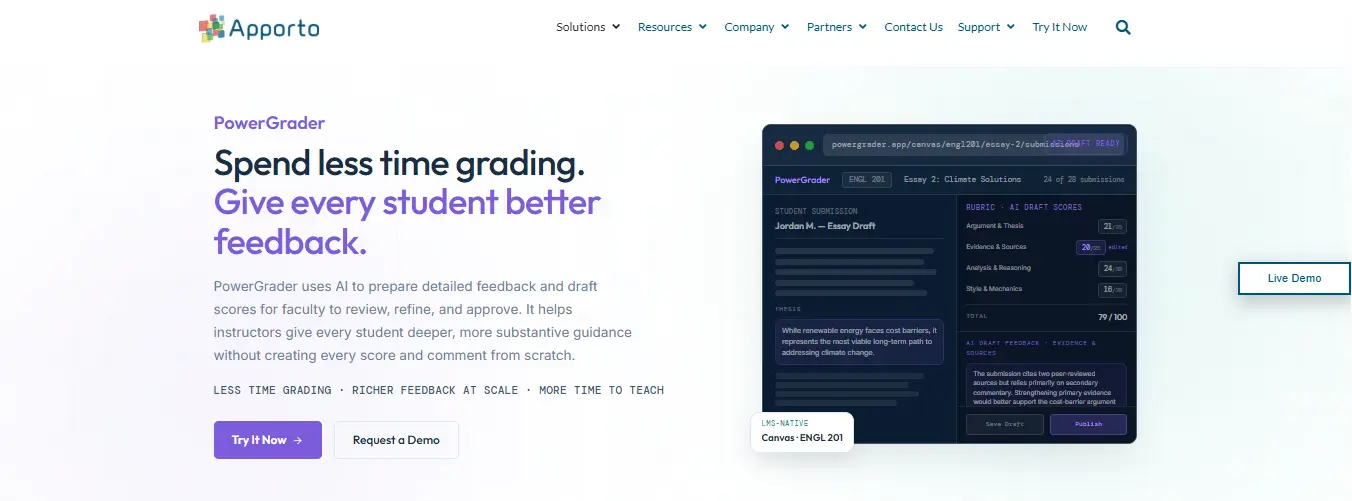
Apporto PowerGrader helps educators grade assignments using AI while keeping their own rubrics and grading standards in place. It looks at assignment instructions, assessment criteria, and student submissions to prepare draft scores and feedback.
The useful part? Instructors don’t have to start every evaluation from scratch. They can review the suggestions, make changes, and approve the final grades themselves.
How Does PowerGrader Use Assessment Rubrics for Grading?
PowerGrader follows a straightforward process:
- Import Assignments: Pulls instructions, rubrics, and submissions from supported learning management systems.
- Prepare Draft Scores: Evaluates student work against the rubric criteria.
- Review Suggestions: Lets instructors adjust scores and comments where needed.
- Return Grades: Sends approved grades and feedback back to the LMS.
The instructor’s rubric remains the foundation for grading.
How Can PowerGrader Help Educators Provide More Detailed Feedback?
Writing personalized feedback for every assignment takes time, particularly in large classes. PowerGrader prepares comments based on individual rubric criteria and evidence from student submissions.
Educators can review those suggestions, add their own observations, and make the feedback more useful. This can reduce repetitive grading work while leaving final decisions with faculty.
Final Thoughts
A good rubric makes grading clearer for everyone. Students know what’s expected, and educators have a consistent way to assess their work.
It also makes feedback more useful. Instead of wondering why they lost marks, students can see what needs improvement and work on those areas. For instructors, that means fewer unclear grading decisions and more time to focus on teaching.
Apporto PowerGrader can help further by preparing rubric-based scores and feedback for faculty review. Want to make grading more manageable? Explore Apporto PowerGrader and see how it can support your assessment process.
Frequently Asked Questions (FAQs)
1. What Is a Rubric for Assessment in Simple Terms?
A rubric is a scoring guide that shows how an assignment will be graded. It explains what matters, how performance is measured, and what students need to do to earn better marks.
2. What Are the Three Main Parts of a Rubric?
A rubric has three main parts: criteria, performance levels, and descriptors. Criteria show what’s being assessed, performance levels indicate achievement, and descriptors explain what the different levels actually look like.
3. What Is the Difference Between Analytical and Holistic Rubrics?
An analytical rubric scores each part of an assignment separately, giving students more detailed feedback. A holistic rubric looks at the work as a whole and provides one overall score.
4. How Many Levels Should an Assessment Rubric Have?
Most rubrics work well with three to five performance levels. That’s usually enough to distinguish strong work from weaker submissions without making grading unnecessarily complicated or confusing for students.
5. Can Rubrics Be Used for Both Formative and Summative Assessment?
Yes, rubrics work for both. During learning, they help students understand what needs improvement. After an assignment is completed, they provide clear criteria for grading the finished work.
6. Do Rubrics Help Teachers Save Grading Time?
Yes, a well-designed rubric can make grading quicker by giving teachers clear criteria to follow. Creating one takes some effort initially, but reusing it can save time on future assignments.
