

How Is AI Used in Higher Education?
Using AI in higher education helps personalize learning, streamline administrative tasks, and support teaching through tutoring, grading, and feedback tools. When paired with clear policies and faculty oversight, platforms like Apporto enable responsible AI adoption while protecting academic integrity, student privacy, and meaningful learning outcomes.
Every new learning tool seems to trigger the same institutional reaction. First concern, then resistance, then policy, then adoption.
Using AI in higher education is the newest version of an old argument: does the tool weaken the learner, or does it open a better conversation with knowledge.
The scale of adoption already suggests the argument is behind the reality. 86% of students use AI in their studies, and most institutions are still working out what “using it well” should actually mean.
What Does Using AI in Higher Education Actually Look Like Today?
Using AI in higher education now spans a wide range of AI tools, from AI tutoring assistants and grading support to admissions automation and adaptive learning platforms. It is not one product category.
It is a growing set of AI systems and AI platforms, each doing a different job inside the institution, from the classroom to the registrar’s office.
The scale is no longer in question. As per studies, 93% of educators expect AI’s integration to deepen over the next decade, and 61% of faculty have already used AI in teaching in some form. Generative AI, in particular, has moved faster into daily academic work than most institutions have built policy for.
The question higher education institutions now face is not whether to adopt these tools. It is how to adopt them without weakening the learning they exist to support.
Why Do Higher Education Institutions Keep Misreading New Learning Tools?

Higher education has been here before, at least emotionally. Writing was once treated as a threat to memory. Books were treated with suspicion. Calculators were going to weaken math. Computers were going to distract students. The internet was going to destroy research because students could just look things up. Now it is artificial intelligence, and the concern is not unreasonable.
In Plato’s Phaedrus, writing is criticized because it may produce reminding instead of remembering, and the appearance of wisdom instead of real understanding. Replace “writing” with artificial intelligence and you have a fair summary of most faculty meetings on this topic today.
A new tool arrives. It changes access to knowledge. Institutions worry students will stop developing the underlying skill. Some of that worry is valid. Some of it is fear dressed up as rigor. The pattern has repeated with enough consistency that it is worth laying out plainly.
Table: The tool panic cycle
| Tool | Institutional fear | What eventually changed |
|---|---|---|
| Writing | Students will stop remembering | Knowledge became more durable and transferable |
| Books | Students will rely on others’ thinking | Reading became central to scholarship |
| Calculators | Students will stop learning math | Math education shifted toward concepts and applications |
| Computers | Students will be distracted or dependent | Digital work became basic academic infrastructure |
| Internet | Students will stop researching properly | Information literacy became more important |
| Artificial intelligence | Students will outsource thinking | AI literacy, process visibility, and better assessment design become necessary |
That last row is where the work is now. Artificial intelligence differs from the internet because it does not just give access to information.
It can transform information into output. It can summarize, explain, draft, revise, solve, simulate, and coach. That makes it more powerful, and more disruptive to teaching and learning practices, than a search bar ever was.
Does Using AI in Higher Education Weaken Critical Thinking?
This is the part of the argument that deserves a real answer, not a dismissal. Many students express genuine concern about AI undermining their critical thinking skills, and the data backs that concern up in part. 53% of students worry about AI’s accuracy and reliability, which is a fair worry given how confidently AI systems can present incorrect information as fact.
But danger is not the same as destiny. A student who uses AI to get a direct answer without engaging the reasoning behind it is not learning much.
A student who uses AI to compare explanations, challenge assumptions, and work through complex concepts step by step may be learning more deeply than they would have alone. The tool does not decide the outcome. The way it gets used does.
What Is the Real Divide in How Students Use AI?
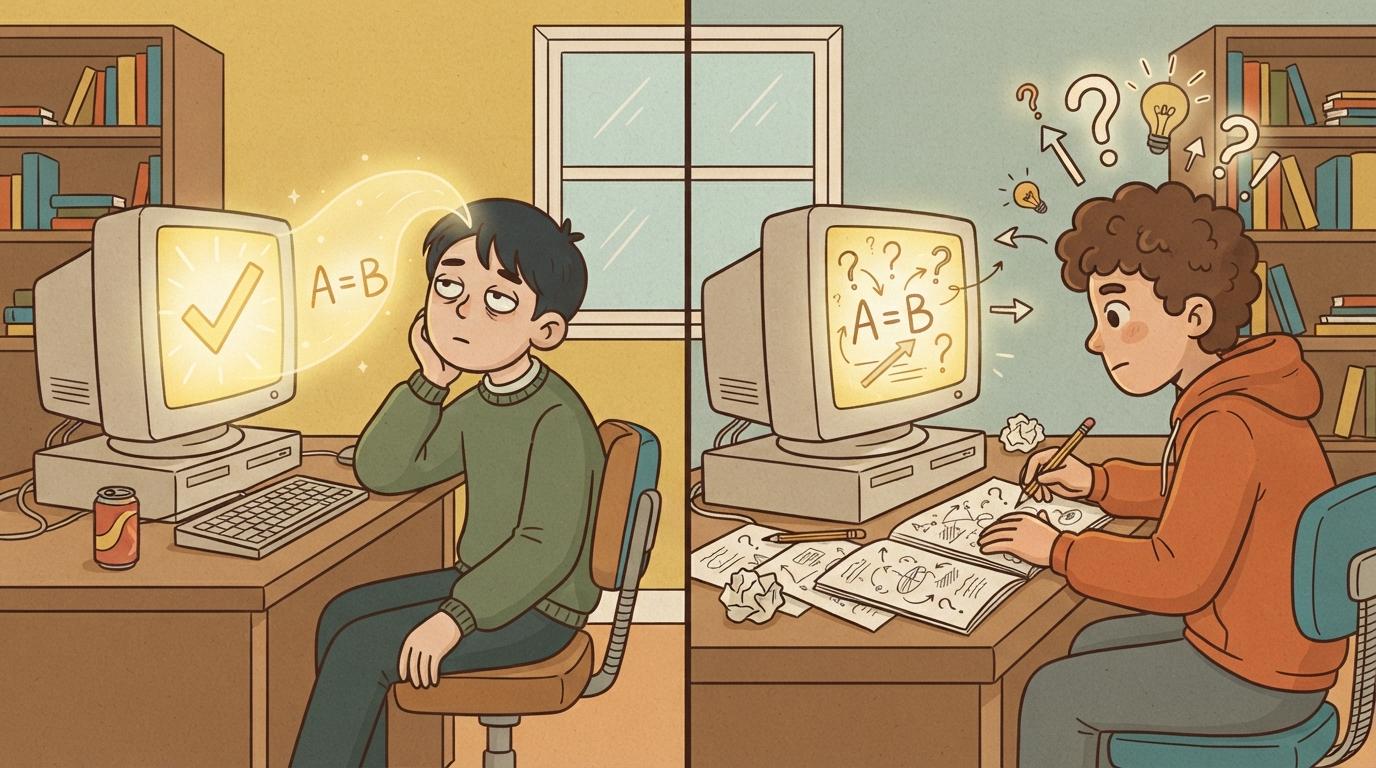
The real divide is not AI access. It is AI use quality. The institutions that succeed with AI will not be the ones that simply allow or ban it. That framing is too shallow to be useful, and it ignores how differently the same tool can function depending on the student behind it.
Two ways students use AI:
- Answer-machine use — asking AI for a direct answer without engaging the reasoning behind it, which limits learning and can erode academic outcomes over time
- Extend-thinking use — using AI to compare explanations, test assumptions, practice retrieval, and revise reasoning at the student’s own pace, which supports student engagement rather than replacing it
If the AI tool sits outside the learning environment, faculty lose visibility, students get inconsistent guidance, and academic integrity offices get pulled in only after something has already gone wrong.
If AI sits inside the learning workflow, the institution can define boundaries, align AI behavior to course goals, and support students without pretending every use case is the same.
How Can Higher Education Institutions Integrate AI Into Teaching and Learning Practices?
This is where more nuance is needed. AI used during practice is not the same as AI used during a final exam. AI used for brainstorming is not the same as AI writing the final submission.
AI used to explain a concept is not the same as AI completing the work. Those distinctions matter, and a blanket “use AI responsibly” policy is not a workflow. It does not tell the student what is allowed, tell the faculty member how the tool behaves, or give administrators anything they can actually govern.
Table: AI role by learning context
| Learning context | AI role | Product design need |
|---|---|---|
| Practice | Explain, coach, quiz, give hints | Encourage effort before answers |
| Brainstorming | Suggest angles, ask questions | Support exploration, not final output |
| Final exam | Minimal or no assistance | Protect independent performance |
Faculty use of AI already reflects this unevenness in practice. Roughly 22% of instructors currently use generative AI tools directly in their coursework, often through general-purpose platforms like Microsoft Copilot rather than anything designed specifically for the classroom. That gap, between general AI use and course-aligned AI use, is exactly what clear guidelines and better product design are meant to close.
A chemistry course, a writing course, a nursing simulation, and a business case analysis all need different AI behavior, and sometimes the rules change by assignment within the same course.
What Are the Ethical Concerns of Using AI in Higher Education?

Ethical concerns are not an abstract worry attached to AI adoption. They show up consistently in how students and faculty describe their own hesitation, and the numbers are specific enough to act on.
What the data shows:
- 55% of students believe AI could negatively impact academic integrity
- 49% of faculty are concerned about bias in AI models
- 59% of faculty worry about data security and privacy
- 29% of faculty are concerned specifically about AI’s impact on academic integrity
- AI systems may embed biases that affect decision-making in higher education, which is part of why balancing AI use with human oversight is essential to maintaining ethical standards
None of this means institutions should avoid AI. It means student data, privacy, and integrity need to be treated as design requirements from the start, not questions to answer after a tool is already in wide use.
Is AI Detection the Right Way to Protect Academic Integrity?
A lot of institutions initially reached for AI detection as the answer. That is understandable, but detection-only strategies rest on a weak foundation.
OpenAI retired its own AI text classifier in 2023 because of its low accuracy rate, while noting ongoing work on better provenance techniques. AI tools can also generate misleading or inaccurate information themselves, which should make any institution cautious about treating a detection score as a final judgment on a student’s work.
This does not mean authorship questions should be ignored. It means the evidence model needs to mature. The more useful question is not “does this look AI-written.”
It is what the assignment policy allowed, what support the student received, what changed between draft and submission, and whether the student can explain their own reasoning. That is a richer and fairer way to evaluate academic work, and it is closer to how real learning gets assessed in the first place.
How Is AI Enabling Personalized Learning in Higher Education?

Personalized learning is where AI’s upside is most concrete. Adaptive learning platforms can customize educational content to an individual student’s needs rather than delivering the same material at the same pace to everyone in a course.
What personalized AI support looks like:
- Adaptive learning platforms customize educational content to individual student needs and varying levels of prior knowledge
- AI enables students to learn at their own pace and in a way suited to their learning styles
- AI can enhance accessibility for students with disabilities, supporting a wider range of learners than traditional formats allow
- AI can improve academic advising by recommending courses and monitoring individual student progress over time
- Predictive analytics can help identify at-risk students earlier, giving advisors real time insights that support academic success before a student falls too far behind
These are not hypothetical capabilities. They are the personalized learning experiences institutions are already piloting, and the ones most likely to move the needle on student success at scale.
How Are Higher Education Institutions Using AI to Automate Administrative Tasks?
Separate from teaching and learning, AI is quietly reshaping institutional operations. Much of this work is unglamorous, but it saves time and improves efficiency in ways that free up staff for higher-value work.
Common administrative use cases:
- AI-powered chatbots providing 24/7 support for routine administrative inquiries
- Automating admissions and enrollment processes, including application screening, to reduce manual effort
- Drafting emails, creating presentations, and checking grammar as part of everyday academic work
- Automating grading for nearly 100% of multiple-choice exams
- Streamlining financial management and scheduling as part of broader administrative workflows
82% of institutions plan to use AI in college admissions within the next year, which signals this is no longer an experimental use case. It is becoming standard institutional infrastructure, the same way digital work became basic infrastructure after computers arrived on campus.
What Do Higher Education Leaders Need to Know Before Adopting AI?
Higher education leaders and higher education professionals evaluating AI adoption need to treat it as a strategic planning question, not just a procurement decision.
Faculty and students both require training for AI integration to work well in practice, and implementation requires real investment in infrastructure and personnel, not just a licensing agreement.
The stakes justify that investment. The AI education market is expected to exceed $20 billion by 2027, and institutions that treat curriculum design and professional development as afterthoughts will likely fall behind peers that build AI literacy into faculty development from the start.
How Should Higher Education Use AI Responsibly Going Forward?

The better question is not whether AI weakens the learner. It is whether institutions are designing the learning environment well enough for AI to strengthen the learner instead.
That means clear guidelines for community members across the institution, not just students. It means faculty guardrails that function as product-level controls, not policy documents sitting on a website. It means assessment redesigned around what AI has changed, rather than assessment defended as if nothing has changed at all.
This is where Apporto’s AI in higher education approach becomes more than a collection of AI features.
CoTutor can support learning inside faculty-defined boundaries.
PowerGrader can strengthen feedback loops and rubric alignment so grading becomes part of the learning process rather than the end of it.
TrustEd can help institutions understand authorship and process without relying on a single, unreliable detection score.
ExamSpace can protect the moments where independent performance genuinely matters.
Together, they reflect a simple premise: responsible use of AI in higher education is a design problem before it is a policy problem. If your institution is still working through what that looks like in practice, talk to Apporto’s team about how the AI suite fits your existing workflows.
Conclusion
Books did not end thought. The internet did not end learning. Calculators did not end math. They changed what had to be taught, what had to be measured, and what kind of judgment mattered most. AI is doing the same thing, just faster.
The tool is already here, used by the overwhelming majority of students and a growing share of faculty. The work now is teaching students how to think with it, not pretending institutions can hide from it.
If your institution is still working out what that should look like in practice, Apporto’s AI suite was built around exactly this problem.
Frequently asked questions (FAQs)
1. What does it mean to use AI responsibly in higher education?
It means AI is deployed inside clear, faculty-defined guardrails rather than left as an unmanaged external tool, with visibility into how students are actually using it and assessment designed to account for that use.
2. Does using AI in higher education weaken critical thinking?
It depends on how the tool is used. AI used to shortcut to an answer weakens engagement with the material, while AI used to test reasoning, get feedback, and revise thinking can strengthen it.
3.What are the biggest ethical concerns with AI in higher education?
The most common concerns are data privacy, academic integrity, and bias in AI systems, with a majority of faculty citing data security and roughly half citing bias as active worries.
4. Is AI detection reliable for protecting academic integrity?
Not on its own. Detection tools, including OpenAI’s own classifier, have shown low accuracy, which is why process visibility and richer evidence of student reasoning are becoming the more durable approach.
5. How many students and faculty currently use AI in higher education?
86% of students report using AI in their studies, and 61% of faculty have used AI in teaching, with adoption expected to keep expanding over the next two years.
