

What Is the Difference Between Apporto CoTutor and Knewton?
Apporto CoTutor is designed for higher education, offering in-context AI tutoring, instructor-guided learning, and LMS integration to support real coursework. Knewton specializes in adaptive learning that personalizes educational content. The right platform depends on whether you prioritize course-specific guidance or adaptive curriculum delivery.
Artificial intelligence is changing how students learn, and universities are paying close attention. Traditional, one-size-fits-all instruction is giving way to learning experiences that adapt to individual needs, helping students make progress at a pace that matches their understanding.
This evolution has fueled the rise of adaptive learning platforms and AI tutors that provide timely academic support. Knewton and Apporto CoTutor both embrace personalized learning, but they solve different challenges. Knewton uses adaptive technology to tailor educational content, while Apporto CoTutor delivers in-context AI tutoring that supports critical thinking within real coursework.
In this blog, you’ll learn how these platforms compare across personalization, student support, learning analytics, higher education workflows, and long-term educational value, helping you choose the solution that best fits your institution’s goals.
What Are Knewton and Apporto CoTutor, and How Do They Differ?

Artificial intelligence has introduced new ways to personalize learning, but not every platform is built with the same objective. Knewton and Apporto CoTutor both use AI to improve education, yet they take a fundamentally different approach to helping students and faculty achieve better outcomes.
Knewton is an adaptive learning platform that uses AI and predictive analytics to tailor educational content for individual learners. As students interact with lessons, the system analyzes their performance and adjusts the curriculum based on strengths, weaknesses, and demonstrated mastery.
This adaptive learning model is designed to help learners progress at their own pace, making it particularly useful for foundational subjects and skill development across universities, colleges, and other educational settings.
Apporto CoTutor is designed specifically for higher education, where learning often depends on course context rather than generalized content. Instead of continuously adapting a curriculum, it provides in-context AI tutoring that supports students while they work through assignments, lecture materials, and technical coursework. The platform encourages guided reasoning and keeps assistance aligned with instructor expectations, allowing faculty to reinforce learning without replacing independent thinking.
The key distinction lies in their educational goals. Knewton focuses on adaptive learning technology that personalizes curriculum delivery, while Apporto CoTutor emphasizes contextual tutoring that strengthens critical thinking within real university courses. Both are valuable examples of modern educational technology, but they solve different learning challenges.
Platform Overview Comparison
| Feature | Apporto CoTutor | Knewton |
|---|---|---|
| Primary purpose | In-context AI tutoring for higher education | Adaptive learning platform that personalizes educational content |
| Best for | Course-specific academic support and technical learning | Personalized learning and adaptive curriculum delivery |
| Target users | Universities, colleges, faculty, and students | Schools, colleges, publishers, and individual learners |
| Education level | Primarily higher education | K-12 and higher education learning environments |
| AI functionality | Context-aware tutoring, guided reasoning, personalized academic assistance | Predictive analytics, adaptive learning, and personalized content recommendations |
| Learning philosophy | Contextual tutoring that promotes critical thinking and instructor-guided learning | Adaptive learning that adjusts content and pacing based on student performance |
How Does Each Platform Personalize Learning for Individual Students?

Personalized learning has become one of the biggest advantages of AI in education. Instead of delivering identical lessons to every student, modern platforms analyze performance, identify learning needs, and adapt instruction to improve student success. Knewton and Apporto CoTutor both personalize learning, but they use different methods to achieve that goal.
Knewton relies on predictive analytics and an adaptive learning engine to tailor educational content for individual students. As learners complete activities, the platform collects more data about their strengths, weaknesses, and progress. It then adjusts the curriculum, recommends targeted resources, and allows students to learn at their own pace. This adaptive approach helps reinforce difficult concepts while keeping advanced learners moving forward.
Apporto CoTutor personalizes learning through in-context assistance rather than adapting the curriculum itself. It provides guidance within the context of a student’s actual coursework, particularly in technical subjects, helping learners apply concepts to real assignments.
Through guided inquiry, personalized support, and instructor-aligned responses, the platform encourages deeper understanding instead of simply delivering answers. This contextual approach makes learning more relevant while reinforcing course objectives.
Personalized Learning Features
Apporto CoTutor
- In-context AI assistance aligned with current coursework.
- Guided reasoning that promotes deeper understanding.
- Course context that keeps support relevant to instructor expectations.
- Designed for technical subjects and complex academic work.
- Personalized support without replacing independent thinking.
Knewton
- Predictive analytics that adapt learning based on student performance.
- Adaptive learning engine that continuously refines instruction.
- Personalized curriculum tailored to student strengths and weaknesses.
- Individualized pacing that lets students progress at their own speed.
- Data-driven recommendations that target learning gaps and improve outcomes.
Which Platform Better Improves Student Success and Classroom Learning?

Improving student success requires more than delivering personalized content. Students benefit most when AI supports meaningful learning, reinforces difficult concepts, and complements the work of instructors. Both Knewton and Apporto CoTutor contribute to better classroom experiences, but they focus on different parts of the educational process.
Knewton improves learning through automated learning and adaptive technology. It analyzes student performance, adjusts instructional content, and allows learners to move through material at a pace that matches their understanding. This personalized approach helps students strengthen weak areas before advancing, making it particularly valuable for foundational courses where mastery builds over time. Faculty can use these insights to monitor progress and provide additional support when needed.
Apporto CoTutor takes a more interactive approach by providing personalized tutoring within the context of actual university courses. Rather than adapting the curriculum, it encourages guided inquiry, helping students think through problems while remaining aligned with instructor expectations.
This model strengthens classroom support by keeping AI connected to course materials, assignments, and faculty guidance. The result is a learning experience that encourages critical thinking while promoting superior learning outcomes through active participation instead of passive answer retrieval.
Student Learning Comparison
| Learning Area | Apporto CoTutor | Knewton |
|---|---|---|
| Student support | In-context academic guidance tailored to course activities | Adaptive learning that personalizes educational content |
| Classroom learning | Supports classroom instruction through course-specific AI tutoring | Reinforces classroom learning with adaptive curriculum and automated practice |
| Faculty involvement | Strong faculty involvement through instructor-guided learning and course alignment | Faculty monitor progress using adaptive learning insights and performance data |
| Personalized tutoring | Context-aware tutoring with guided reasoning and personalized support | Personalized learning paths driven by predictive analytics and adaptive technology |
| Student success | Promotes deeper understanding, critical thinking, and application of concepts | Improves mastery through individualized pacing and adaptive instruction |
| Best fit | Universities seeking interactive AI tutoring integrated with teaching | Institutions focused on adaptive learning, personalized curriculum, and foundational skill development |
Which Platform Better Develops Critical Thinking Instead of Memorization?

The most effective AI learning platforms do more than help students remember facts. They encourage critical thinking, strengthen conceptual understanding, and teach learners how to solve problems independently. While both Knewton and Apporto CoTutor support academic growth, they approach this goal through different learning models.
Apporto CoTutor is built around guided reasoning. Instead of delivering complete solutions, it provides hints instead of answers, prompting students to analyze information, connect ideas, and work toward their own conclusions. This approach reflects modern learning science, where scaffolding gradually builds confidence while preserving independent thinking.
By keeping every interaction tied to course materials and instructor expectations, CoTutor reinforces concept mastery without encouraging shortcut learning. The result is an AI experience that complements the role of the teacher and strengthens learning inside and outside the classroom.
Knewton develops understanding through adaptive learning rather than conversational guidance. Its AI analyzes student performance, identifies weak areas, and adjusts future lessons to reinforce difficult concepts. Students receive additional practice where they need it most, allowing them to build mastery before progressing to more advanced material. This adaptive model improves retention and supports long-term learning, although its primary focus is personalized content delivery rather than guided dialogue.
If your priority is developing reasoning skills and independent problem-solving, Apporto CoTutor offers the stronger approach. If your goal is helping students master concepts through adaptive instruction and repeated practice, Knewton provides an effective, research-backed learning experience.
Which Platform Offers Better Learning Analytics, Data Mining, and Adaptive Intelligence?

Learning analytics have become one of the biggest advantages of AI in education. Rather than simply recording grades, modern platforms analyze student performance, identify learning patterns, and generate actionable insights that help educators improve outcomes. Both Knewton and Apporto CoTutor use AI and technology to support learning, but they focus on different types of intelligence.
Knewton is built around adaptive learning and predictive analytics. Using data mining and continuous analysis of learner interactions, the platform gathers more data about how students perform over time. It identifies student indicators, recognizes strengths and weaknesses, and adjusts instructional content accordingly. This research-driven approach produces personalized learning recommendations, helping students master concepts before moving to more advanced material. Its adaptive engine is supported by extensive research on personalized learning and continuously refines educational content based on demonstrated mastery.
Apporto CoTutor approaches analytics from a course-centered perspective. Rather than adapting an entire curriculum, it analyzes student interactions within the context of actual coursework to provide meaningful performance insights for instructors.
Faculty can better understand where students struggle, identify opportunities to strengthen knowledge mastery, and intervene with targeted support before learning gaps widen. These contextual learning analytics make AI assistance more relevant to individual courses while preserving instructor oversight and academic integrity.
Both platforms provide valuable insights, but they serve different educational priorities. Knewton excels in adaptive intelligence and curriculum personalization driven by predictive analytics. Apporto CoTutor focuses on contextual analytics that help faculty improve learning outcomes inside higher education courses.
Analytics Comparison
| Analytics Feature | Apporto CoTutor | Knewton |
|---|---|---|
| Learning analytics | Contextual analytics based on course interactions and student engagement | Comprehensive learning analytics driven by adaptive learning technology |
| Predictive analytics | Uses course performance patterns to support timely instructor intervention | Advanced predictive analytics that personalize learning paths and anticipate learning needs |
| Adaptive learning | Provides contextual guidance instead of adapting the full curriculum | Continuously adapts educational content based on student performance and demonstrated mastery |
| Student performance | Delivers performance insights that help faculty identify learning gaps and improve support | Tracks student performance using data mining, adaptive indicators, and personalized recommendations |
| Faculty insights | Gives instructors actionable insights into course progress, engagement, and areas requiring intervention | Provides educators with analytics on mastery, progress, and adaptive learning outcomes |
| Best fit | Higher education institutions seeking contextual learning analytics and instructor-guided support | Institutions prioritizing adaptive intelligence, research-backed personalization, and individualized learning pathways |
Which Platform Fits Better Into University Technology and Faculty Workflows?

Technology should simplify teaching, not complicate it. For universities, the right AI platform must integrate smoothly into existing academic environments while giving students and faculty reliable access to learning resources. Knewton and Apporto CoTutor both support higher education, but they fit into institutional workflows in different ways.
Apporto CoTutor is designed around the modern university technology ecosystem. As a browser-based study guide, it works within cloud-based learning environments and integrates with virtual desktop infrastructure, allowing students to access course resources from virtually any device.
Universities can authenticate users through Single Sign-On, simplifying secure access for both students and faculty. The platform also supports up to three monitors, making it easier for learners to view course materials, coding environments, and AI assistance simultaneously.
Students can use file upload/download capabilities to manage assignments, while the built-in App Store provides access to available applications and cloud desktops. Integrated Help tutorials further reduce onboarding time, making institutional deployment straightforward across multiple departments and campuses.
Knewton takes a different approach. Its strength lies in embedding adaptive learning into digital course materials rather than providing a complete technology workspace. Students access personalized educational content through publisher platforms and learning environments where Knewton’s adaptive engine adjusts lessons based on performance.
This model supports personalized instruction but offers fewer workflow features related to desktop access, application management, or institutional computing resources.
For universities, colleges, and other educational institutions looking to combine AI tutoring with a flexible technology platform, Apporto CoTutor provides a broader solution that extends beyond learning support and into everyday academic workflows.
Workflow Comparison
| Workflow Feature | Apporto CoTutor | Knewton |
|---|---|---|
| Browser access | Browser-based study guide with secure online access from virtually any device | Accessed through partner learning platforms and digital course materials |
| Cloud desktops | Supports cloud desktops, virtual desktop integration, and multi-monitor environments | Does not provide a cloud desktop environment, focuses on adaptive educational content |
| File management | Supports file upload/download, application access, and cloud-based assignment workflows | Primarily manages learning content rather than document or application workflows |
| Faculty workflow | Supports institutional deployment, Single Sign-On, App Store access, and integrated faculty workflows | Helps instructors personalize learning through adaptive course content and analytics |
| Campus deployment | Designed for scalable deployment across universities and colleges with centralized access and support | Integrated through publisher and institutional learning ecosystems |
| Best fit | Higher education institutions seeking AI tutoring with a complete cloud-based academic workspace | Institutions focused on adaptive learning and personalized curriculum delivery |
Which Platform Provides Better Long-Term Value for Universities?

Long-term value depends on more than upfront cost. Universities need a platform that scales with institutional growth, supports evolving teaching practices, and delivers measurable educational outcomes over time. Both Knewton and Apporto CoTutor represent meaningful investments in AI-powered technology, but they create value in different ways.
Knewton offers long-term benefits through its adaptive learning engine and strong publisher ecosystem. Its research-backed personalization helps institutions deliver customized educational content at scale, making it a practical choice for programs focused on foundational learning and broad curriculum delivery.
Apporto CoTutor is designed for educational institutions seeking institution-wide AI tutoring that integrates directly into university workflows. Its emphasis on institutional scalability, guided learning, and technical education supports sustainable university deployment while reducing barriers to adoption. By combining contextual AI assistance with faculty oversight, it also strengthens future readiness as higher education continues to adopt AI responsibly.
For universities evaluating long-term ROI, Apporto CoTutor delivers greater value when the goal is scalable, course-specific learning support, while Knewton remains a strong option for adaptive curriculum personalization backed by significant research investment.
Why Is Apporto CoTutor the Better Choice for Higher Education?
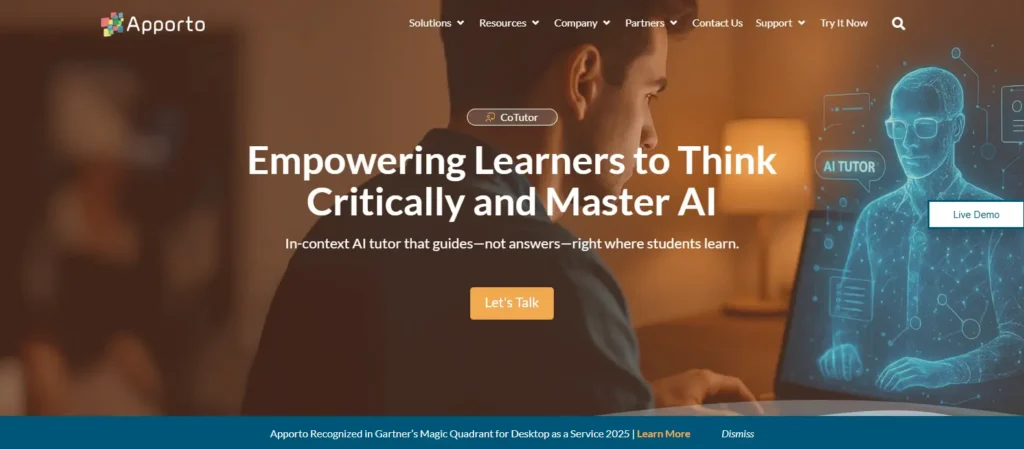
Higher education requires an AI tutor that complements teaching rather than replacing it. Apporto CoTutor is purpose-built for university learning, providing in-context assistance that aligns with course materials and instructor expectations.
Through guided inquiry, it encourages critical thinking instead of delivering direct answers, helping students develop lasting understanding, especially in technical subjects. Its focus on personalized learning, faculty-guided support, and integration with institutional learning management environments creates a more relevant academic experience.
This balanced approach strengthens student success while giving faculty confidence that AI is supporting meaningful learning and academic integrity. Try Apporto CoTutor
Frequently Asked Questions (FAQs)
1. Is Apporto CoTutor better than Knewton?
It depends on your goals. Apporto CoTutor is better for higher education institutions that need course-specific AI tutoring, faculty-guided learning, and in-context academic support. Knewton is stronger for adaptive learning, automatically personalizing educational content based on each student’s progress and performance.
2. What is the biggest difference between Knewton and Apporto CoTutor?
Knewton focuses on adaptive learning by adjusting educational content according to student strengths, weaknesses, and mastery. Apporto CoTutor provides in-context AI tutoring that supports real coursework, encourages critical thinking, and aligns guidance with instructor expectations and university learning objectives.
3. Which platform is better for adaptive learning?
Knewton is the better choice for adaptive learning. Its predictive analytics and adaptive learning engine continuously personalize lessons, pacing, and recommendations based on student performance, helping learners master concepts before progressing to more advanced material.
4. Can Apporto CoTutor support technical and STEM subjects?
Yes. Apporto CoTutor is designed to support technical and STEM subjects by providing contextual AI assistance during assignments and problem-solving. Instead of giving direct answers, it encourages guided reasoning that helps students develop stronger analytical and critical thinking skills.
5. How does Knewton personalize educational content?
Knewton personalizes educational content through predictive analytics and adaptive learning technology. It analyzes student performance, identifies strengths and weaknesses, and continuously adjusts lessons, pacing, and recommendations to create an individualized learning experience for every student.
6. Does Apporto CoTutor give students direct answers?
No. Apporto CoTutor is designed to guide students instead of providing direct answers. Through hints, guided inquiry, and contextual support, it encourages independent thinking, reinforces course concepts, and helps maintain academic integrity throughout the learning process.
7. Which platform is better for universities?
For most universities, Apporto CoTutor is the stronger choice. Its higher education focus, faculty-guided tutoring, contextual learning support, and integration into institutional workflows make it well suited for course-specific instruction and scalable AI-assisted learning across campus.
8. How do Knewton and Apporto CoTutor improve student success?
Both platforms improve student success in different ways. Knewton uses adaptive learning to personalize educational content and reinforce mastery, while Apporto CoTutor supports students through in-context guidance, personalized learning, and critical thinking aligned with faculty-defined course objectives.
