

Is AI Grading FERPA Compliant?
Yes, AI grading can be FERPA compliant when schools obtain valid consent or meet an applicable FERPA exception, maintain appropriate control over student records, and restrict unauthorized data use. Schools should verify vendor agreements, security measures, data retention policies, and AI model training practices before adopting grading tools.
AI grading tools are making their way into more classrooms, promising to take some of the repetitive work off teachers’ plates. Faster evaluations and ready-made feedback sound useful, but what happens to student information once it’s uploaded to an outside platform?
That raises an important question: Is AI grading FERPA compliant?
Yes, AI grading can comply with FERPA, but there’s a catch. Your school needs a valid reason to share student records, and the vendor must handle that information according to the law’s requirements. Simply choosing a tool built for education doesn’t guarantee compliance. Student privacy deserves the same attention as grading efficiency.
In this blog, you’ll learn what makes AI grading FERPA compliant and how schools can protect student privacy while using these tools.
Is AI Grading FERPA Compliant?
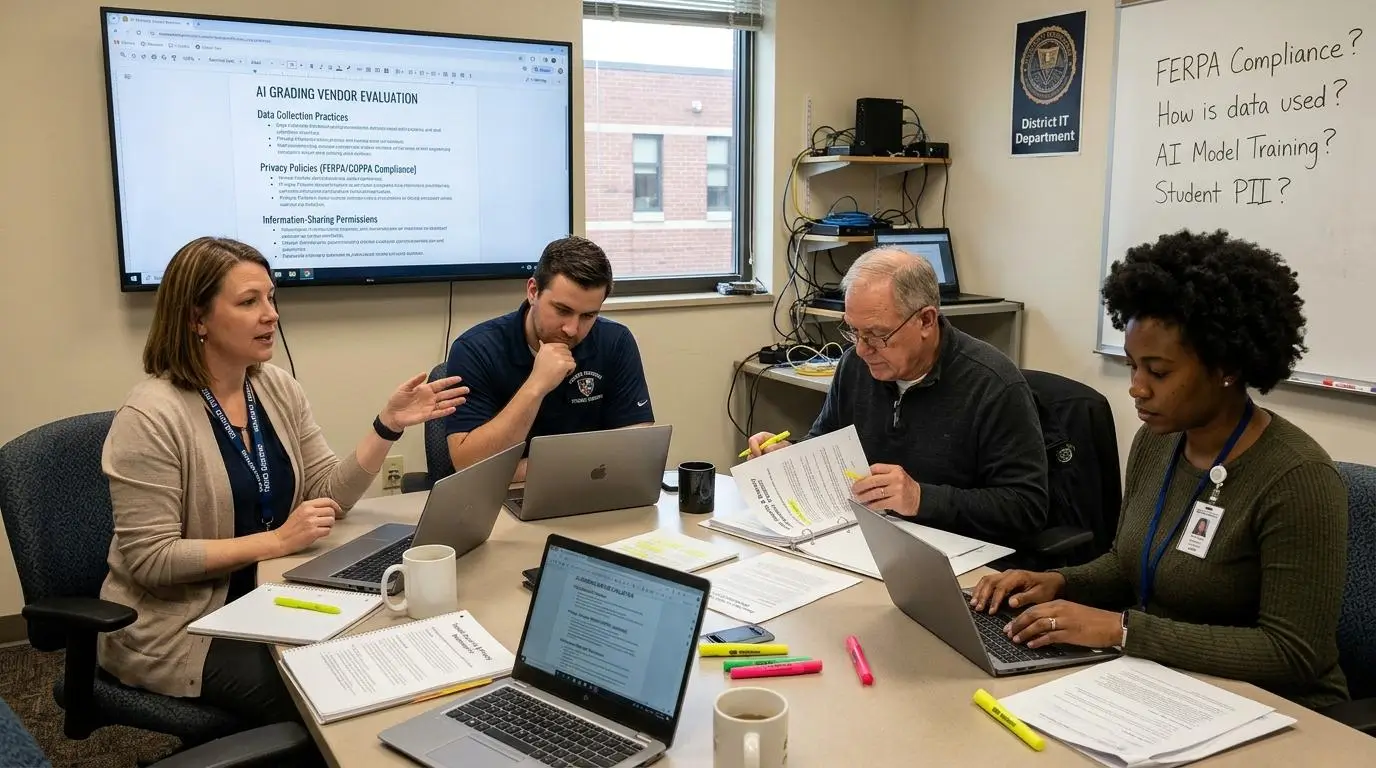
AI grading can be FERPA compliant, but using a tool designed for schools doesn’t automatically make it compliant. FERPA protects student education records and sets rules for when schools can share personally identifiable information with outside providers.
The law doesn’t have separate requirements written specifically for AI grading. The same FERPA regulations that govern other educational technologies apply when AI tools receive protected student records. So, before your school adopts an AI grading platform, you need to know what information it collects, why it’s needed, and what happens to that data afterward.
When Is AI Grading Allowed Under FERPA?
AI grading is permitted when student information is shared under a valid legal basis and the provider follows the applicable privacy requirements.
Here’s how different situations compare:
| AI Grading Situation | FERPA Consideration |
|---|---|
| Approved tool meeting a valid FERPA exception | May be used without individual consent |
| Sharing identifiable records without consent or an exception | May violate FERPA |
| Vendor using records for unauthorized purposes | Raises compliance concerns |
| Processing properly de-identified information | Different privacy considerations may apply |
Don’t take a vendor’s compliance claims at face value. What matters is how the platform actually uses and protects student information.
What Is FERPA, and How Does It Apply to AI Grading?

The Family Educational Rights and Privacy Act (FERPA) is a U.S. federal law that has protected student education records since 1974. It applies to schools, colleges, and other educational institutions receiving funds under applicable U.S. Department of Education programs.
Simply put, FERPA sets boundaries around who can access student records, when schools can share them, and what rights students and parents have over that information. These rules also matter when schools use AI grading tools, particularly when assignments, grades, or identifiable student details are sent to an outside provider.
What Rights Do Parents and Eligible Students Have Under FERPA?
FERPA gives parents and eligible students several rights concerning their education records:
- Access Rights: You can inspect and review relevant education records.
- Amendment Rights: You can request corrections to records believed to be inaccurate or misleading.
- Privacy Protections: You generally have the right to consent before personally identifiable information is disclosed, unless an exception applies.
- Complaint Rights: You can report potential FERPA violations to the U.S. Department of Education.
One important detail: these rights generally transfer to students when they turn 18 or enroll in a postsecondary institution, even if they’re younger than 18.
Does FERPA Have Special Rules for Generative AI?
No, FERPA doesn’t have separate rules specifically written for generative AI or automated grading. Instead, existing privacy requirements apply when AI tools receive protected information from education records.
Schools can also introduce their own policies for AI-generated scores, grading fairness, teacher oversight, and data security. Those requirements may go further than what FERPA specifically demands.
What Student Information Is Protected When You Use AI Grading Tools?
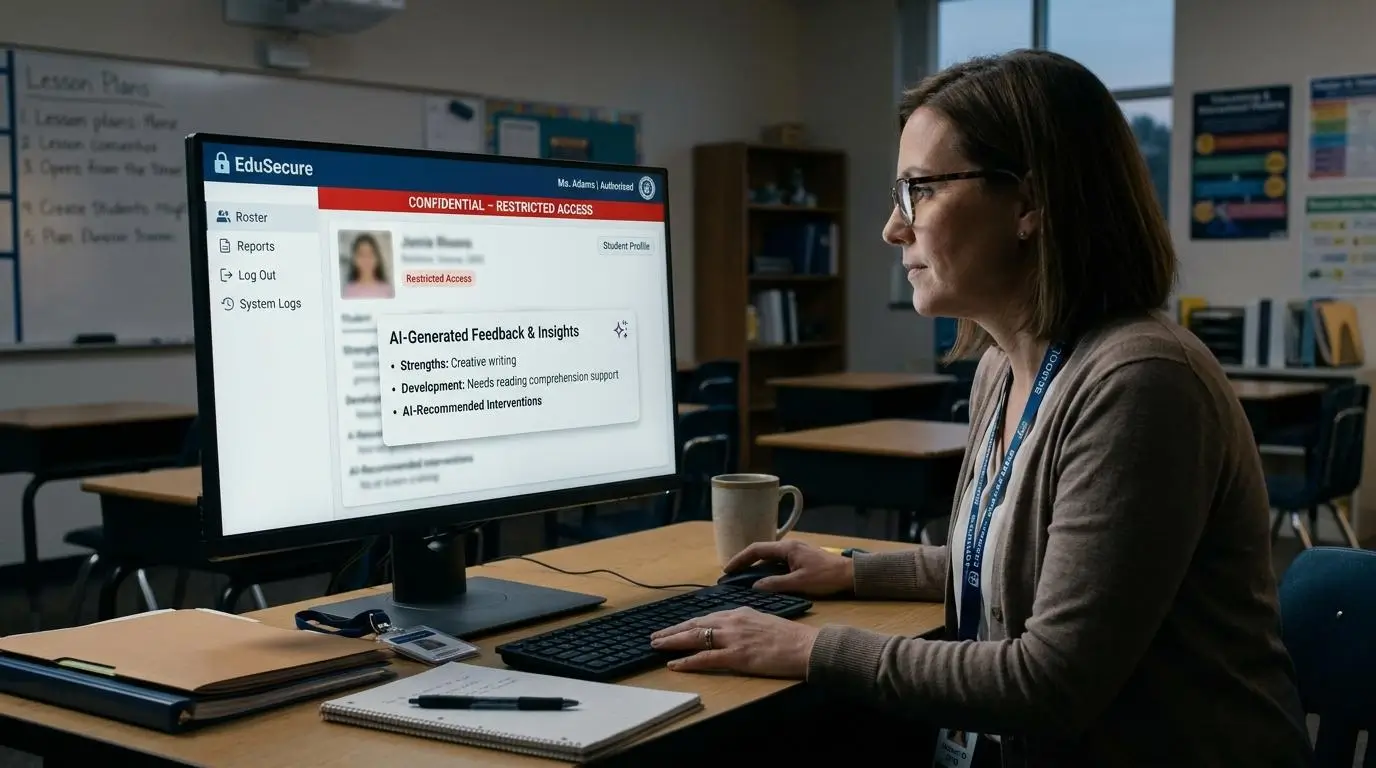
Under FERPA, education records generally include information directly related to a student and maintained by a school or someone acting on its behalf. That covers more than you might expect. Grades, submitted assignments, and written feedback can all fall under FERPA’s protection when they’re connected to an identifiable student.
And a student’s name isn’t the only thing that matters. Personally identifiable information (PII) can include student ID numbers, contact details, or even combinations of details that make it possible to identify someone.
Do Student Essays, Grades, and AI-Generated Feedback Count as Education Records?
Yes, these materials can qualify as protected education records, depending on how they’re maintained and connected to individual students. Examples include:
- Student Submissions: Essays, exams, and completed assignments.
- Grades and Scores: Assessment results linked to a student.
- Identifying Information: Names, student IDs, and other personal details.
- Individual Feedback: Teacher comments or AI-generated evaluations kept in student records.
- Combined Details: Information that could identify someone when considered together.
The format doesn’t really matter. A PDF, Google Doc, or digital gradebook can contain protected information.
Can You Upload Student Work to ChatGPT or Another AI Tool?
Uploading identifiable student work to an unapproved AI tool can raise FERPA concerns. For instance, copying an essay from a Google Doc into a personal ChatGPT account may expose protected information to an outside provider.
Before doing that, check your school’s policies and approved tools. And remember, removing a student’s name doesn’t necessarily make the work anonymous. Other details in the assignment might still identify them.
How Does the FERPA School Official Exception Apply to AI Grading Vendors?

Schools sometimes need outside technology providers to handle tasks that would otherwise fall to their own staff. FERPA allows certain arrangements through what’s called the school official exception.
Under this exception, schools can share protected student education records with qualifying vendors without obtaining individual consent, provided specific conditions are met.
But simply offering educational software doesn’t make a vendor a school official under FERPA. Your institution needs to verify that the provider meets the requirements before sharing student information.
What Conditions Must an AI Vendor Meet Under the School Official Exception?
For an external AI grading provider to qualify, four conditions matter:
- Perform an Institutional Function: The vendor must provide a service the school would otherwise perform through its own employees, such as grading support.
- Remain Under Institutional Control: Your school must maintain direct control over how the vendor uses and maintains student education records.
- Follow Use and Redisclosure Restrictions: The provider must follow FERPA’s limits on using or sharing protected information.
- Meet Legitimate Educational Interest Criteria: The arrangement must satisfy the criteria outlined in the school’s annual FERPA notification.
There’s also a practical consideration. Only share the student information the tool actually needs. A grading platform shouldn’t receive unrelated records simply because it has the ability to process them.
What Does Legitimate Educational Interest Mean for AI Grading?
Legitimate educational interest means access to student information is necessary for an authorized educational responsibility. For an AI grading vendor, that could involve reviewing assignments or preparing rubric-based feedback for instructors.
Here’s where the distinction matters:
| Permitted Educational Purpose | Potential Privacy Concern |
|---|---|
| Processing assignments for grading | Using student work for unrelated advertising |
| Preparing rubric-based feedback | Reusing submissions for unrelated product development |
| Returning scores to authorized teachers | Sharing grades with unauthorized individuals |
Schools must retain direct control over how student records are used and maintained. A vendor’s access should remain tied to its authorized educational purpose, with clear limits on other uses.
Do Schools Need Parental Consent Before Using AI Grading Software?
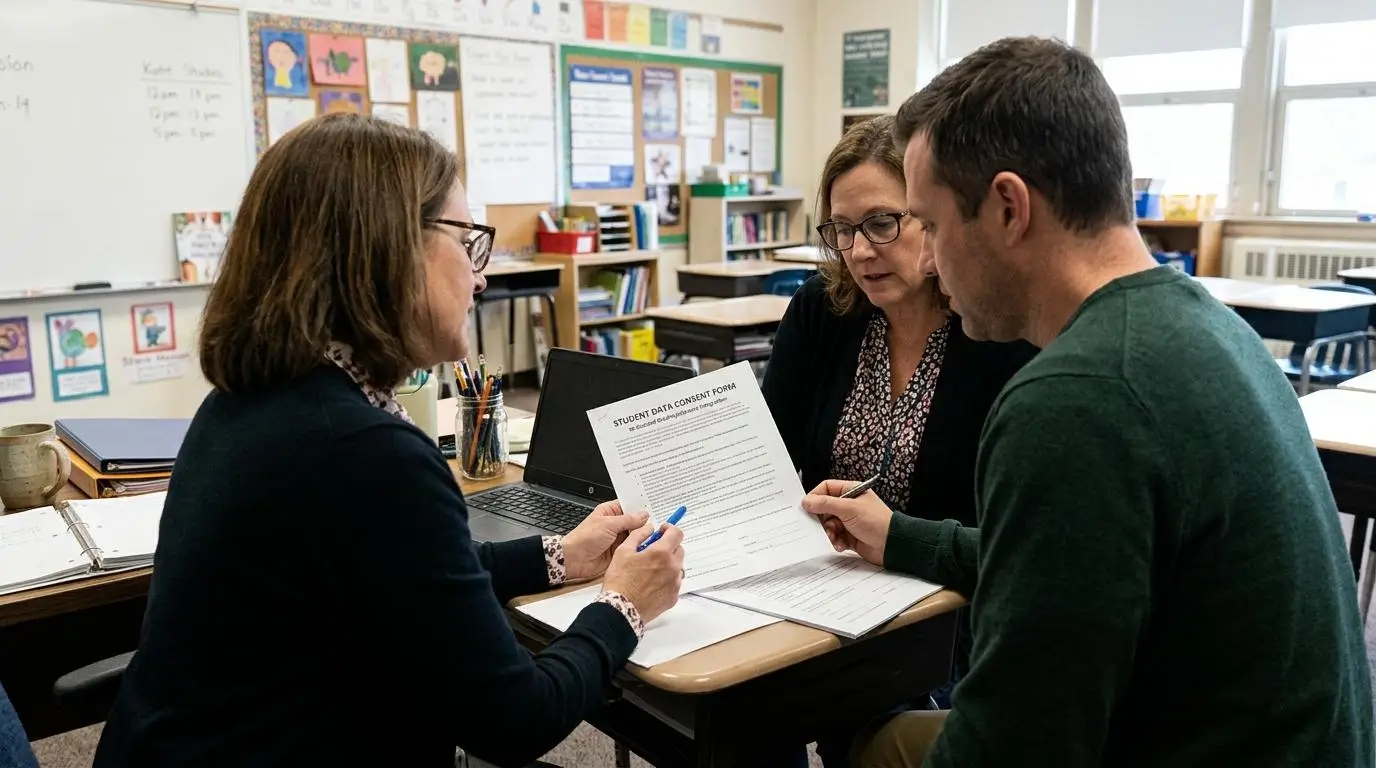
FERPA generally requires written consent from parents or eligible students before schools share personally identifiable information from education records. But there are exceptions, and they matter when you’re considering AI grading software.
For example, the school official exception may allow your institution to share student records with an AI grading vendor without individual consent, provided the vendor meets FERPA’s conditions.
That doesn’t mean every school-approved tool qualifies automatically. Also, sending a classroom notice or accepting a vendor’s terms of service won’t replace written FERPA consent when the law requires it.
When Is Consent Required, and When Can an Exception Apply?
The answer depends on what student information you’re sharing and whether a valid exception applies.
| Situation | General FERPA Approach |
|---|---|
| Sharing protected records without an applicable exception | Written consent is generally required |
| Sharing with a vendor that qualifies under the school official exception | May be allowed without individual consent |
| Sharing properly de-identified information | FERPA’s restrictions on disclosing identifiable information may not apply |
| Disclosing designated directory information | Notice and opt-out requirements apply |
One thing to remember: directory information doesn’t automatically include private grades or student assignments. Your school must also consider applicable state privacy laws and institutional policies, which may require additional protections.
What Should Schools Look for in an AI Grading Data Processing Agreement?

Before sharing student records with an AI grading vendor, your school needs clear answers about how that information will be handled. A data processing agreement (DPA) puts those responsibilities in writing. It explains what data the provider can collect, how it’s used, who can access it, and what happens when the service ends.
FERPA doesn’t always require a written agreement under the school official exception. Still, the U.S. Department of Education strongly recommends one to help schools maintain control over protected records.
And don’t take a vendor’s FERPA compliance badge as sufficient evidence. The actual contract matters.
What Should an AI Grading Vendor Agreement Include?
A good agreement should leave little room for confusion about the vendor’s responsibilities.
Look for these provisions:
- Permitted Use: Restrict student data to the agreed educational purpose.
- Data Ownership and Control: Make clear that your institution retains authority over its records.
- Access Restrictions: Identify which vendor employees and subcontractors can access information.
- Security Requirements: Explain how student records are protected.
- Retention and Deletion: Specify what happens to stored information when the contract ends.
- Incident Handling: Establish procedures for reporting security incidents.
- Subprocessors: Identify other providers that may handle student data.
- Verification: Allow schools to request security evidence or appropriate audits.
Some provisions directly support FERPA’s requirements for institutional control and restricted data use. Others provide additional protection through clearer contractual obligations.
Can AI Vendors Use Student Records to Train Their Models?
AI vendors cannot freely use student records for unrelated model training when those records are shared under FERPA’s school official exception. There’s a difference between processing an essay to prepare feedback and keeping that essay to train a commercial AI model.
| Data Use | Recommended Institutional Position |
|---|---|
| Processing assignments for authorized grading | Allow within the approved purpose |
| Training models for unrelated commercial purposes | Prohibit unless separately lawful and authorized |
| Keeping student records indefinitely | Establish retention and deletion limits |
| Using properly de-identified information | Verify de-identification and applicable restrictions |
Your agreement should clearly address student submissions, prompts, AI-generated feedback, model training, and further disclosure. The important question is whether the vendor uses student information only for purposes your institution has lawfully authorized.
What Security and Privacy Measures Should FERPA-Compliant AI Grading Tools Have?

A privacy policy alone won’t keep student information safe. Schools also need to understand what security measures an AI grading platform uses to prevent unauthorized access and protect sensitive records.
FERPA sets rules for protecting education records and limiting their disclosure. While the law doesn’t prescribe every technical safeguard, measures such as encryption, access controls, and secure deletion can help schools meet their privacy responsibilities.
Which Security Controls Matter Most for AI Grading?
Before approving a tool, check how student information is protected while it’s being processed, stored, and shared.
Look for these safeguards:
- Role-Based Access: Limit student records to authorized teachers and staff.
- Authentication: Require secure sign-ins to prevent unauthorized access.
- Encryption: Protect data while it’s stored and transferred.
- Audit Logs: Track who accesses information and when.
- Retention Limits: Avoid storing student data longer than necessary.
- Secure Deletion: Remove records safely when they’re no longer needed.
- Vendor Oversight: Review security documentation and reported incidents.
Security certifications can help you assess a vendor, but they aren’t proof of FERPA compliance on their own.
How Do Data Minimization and Access Controls Protect Students?
Data minimization means sharing only the information required for a specific purpose. An AI grading tool, for instance, may need a student’s assignment and the grading rubric. It doesn’t necessarily need their home address, attendance records, or unrelated personal details.
Access matters just as much. Teachers, administrators, and vendors should only be able to view records relevant to their authorized responsibilities. Less unnecessary data means fewer opportunities for sensitive information to be exposed.
What Should Schools Check Before Approving an AI Grading Tool?
Before giving a platform access to student records, review its actual data handling practices.
| Review Question | What to Verify |
|---|---|
| Is the tool approved? | Institutional authorization and privacy review |
| What student data is collected? | Files, identifiers, and prompts |
| Who can access records? | User permissions and vendor personnel |
| Is data used for AI training? | Contract terms and platform settings |
| How long is information stored? | Retention and deletion policies |
| Can the school review security practices? | Audit provisions and vendor documentation |
And approval shouldn’t be the end of the process. Review vendor practices periodically, particularly when software features, contracts, or data policies change.
How Can Teachers Build a FERPA-Conscious AI Grading Workflow?
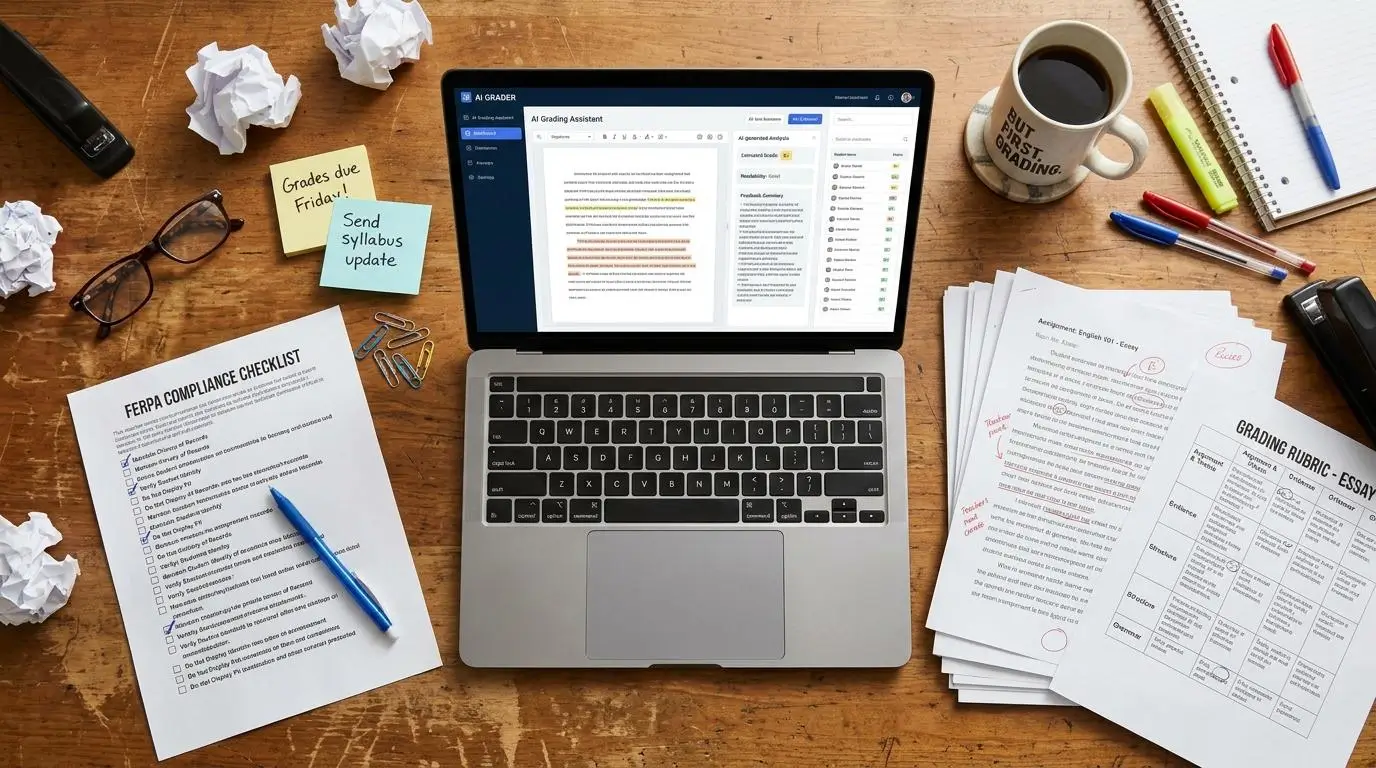
Even an approved AI grading tool can create privacy risks if it isn’t used properly. Uploading more student information than necessary, sharing grades through the wrong platform, or overlooking access settings can expose protected records.
A clear AI grading workflow helps you avoid those problems. Schools should establish a process that explains which tools teachers can use, what information they’re allowed to share, and how AI-generated evaluations should be reviewed.
That way, privacy protection becomes part of everyday grading practices, rather than something you only think about when a problem comes up.
What Steps Should You Follow Before Using AI to Grade Student Work?
Before uploading student assignments, follow these steps:
- Confirm Tool Approval: Make sure your school has authorized the AI grading platform.
- Check Data Requirements: Identify which assignments, student details, and records the tool needs.
- Verify Disclosure Permissions: Confirm that valid consent or a FERPA exception permits sharing the information.
- Limit Shared Data: Upload only what’s necessary for the grading task.
- Use Approved Systems: Keep submissions, scores, and feedback within authorized platforms.
- Review AI Output: Check suggested grades for errors, unusual interpretations, and potential bias.
- Approve Final Grades: Correct mistakes and return results through approved channels.
One important distinction: human review can improve grading accuracy, but it doesn’t guarantee FERPA compliance. Your school still needs proper authorization, privacy safeguards, and control over student information. Both responsibilities deserve attention.
What Common FERPA Mistakes Should Schools Avoid With AI Grading?

Having a privacy policy doesn’t necessarily mean student information is safe. Schools can still run into FERPA compliance problems when teachers use AI tools without understanding where student data goes or how it’s handled.
Some mistakes are easy to overlook:
- Trusting compliance labels: A vendor’s FERPA compliant claim isn’t enough. Check its actual data handling practices.
- Using unapproved AI tools: Always confirm school authorization before uploading student records.
- Removing names only: An essay may still contain details that identify the student.
- Ignoring model-training policies: Student work could be stored or reused for purposes your school hasn’t authorized.
- Overlooking third parties: Other companies may process sensitive information behind the main platform.
- Sharing grades too widely: Keep scores and individual feedback accessible only to authorized users.
- Skipping contract reviews: Check what happens to student data during and after the agreement.
- Confusing accuracy with privacy: Even perfectly accurate AI-generated grades don’t prove that the tool handles data lawfully.
Schools should also give teachers clear guidance on approved tools, privacy requirements, and when to ask for additional review.
How Can Schools Choose AI Grading Tools Without Compromising Student Privacy?

A faster grading process sounds appealing, but speed shouldn’t be the deciding factor when choosing an AI grading tool.BBefore adopting one, your school needs to know what happens to student information after it’s uploaded. That means checking the vendor’s privacy policy, data processing agreement, security measures, and whether student work is used to train AI models.
A compliance claim is worth examining, but it shouldn’t be taken as proof.
Do FERPA Compliance Claims Prove That an AI Tool Is Safe?
No, claiming FERPA compliance doesn’t automatically make an AI tool safe. According to AI Educator Tools, 38 of 138 tools in its directory declared FERPA compliance in October 2026. Of those, 16 reported collecting no student data. By November 4, the number of declarations had dropped to 30.
These were self-reported claims, not independent compliance audits.
| Vendor Claim | What Schools Should Check |
|---|---|
| FERPA compliant | Contracts, legal requirements, and actual data practices |
| No student data collected | Whether prompts, assignments, or metadata are processed |
| Secure AI grading | Access controls, retention policies, and security documentation |
Apporto PowerGrader is another option to explore for rubric-based AI grading with instructor oversight. Before adopting it, review its privacy and security arrangements against your school’s requirements.
Final Thoughts
AI grading can comply with FERPA, but only when schools have a valid basis for sharing student records and proper safeguards to protect them. A vendor’s privacy badge isn’t enough. You need clear agreements, controlled access, responsible data handling, and regular checks to make sure student information stays protected.
Before adopting any AI grading tool, speak with your school’s privacy or IT team about its requirements.
Looking to make grading more efficient without giving up instructor control? Explore Apporto PowerGrader and discuss your institution’s grading, security, and privacy needs with the team.
Frequently Asked Questions (FAQs)
1. Is AI Grading Automatically FERPA Compliant?
No, AI grading tools aren’t automatically FERPA compliant just because they’re built for schools. What matters is how student records are shared, stored, and used. Your institution must also make sure the vendor’s practices meet the relevant FERPA requirements.
2. Can Teachers Upload Student Essays to ChatGPT?
Teachers can upload student essays to ChatGPT only when doing so complies with FERPA and their school’s policies. Sharing identifiable work through an unapproved account can create privacy concerns. Removing names may not be enough, since other details could still identify students.
3. Does FERPA Prohibit AI Companies From Training Models on Student Data?
FERPA restricts how vendors use student records received under its disclosure exceptions. A company generally can’t use those records for unrelated model training without appropriate legal authorization. Check your vendor agreement for clear terms covering AI training, data retention, and permitted uses.
4. Does FERPA Require Parental Consent for Every AI Grading Tool?
No, schools don’t always need parental consent to use AI grading software. Certain FERPA exceptions allow student records to be shared without individual permission. Your institution must still satisfy the exception’s conditions and follow any additional state privacy laws or school policies.
