

What Is Automated Essay Scoring and How Does It Work?
Automated essay scoring (AES) uses natural language processing, machine learning, and AI to evaluate essays based on grammar, vocabulary, organization, and grading criteria. Apporto PowerGrader streamlines essay assessment through rubric-based scoring and feedback, while maintaining instructor oversight to assess complex reasoning, creativity, and grading accuracy.
Grading student essays takes a lot of time. And when you’ve got dozens, sometimes hundreds, of responses to review, keeping scores consistent while giving students useful feedback isn’t always easy.
That’s where automated essay scoring (AES) comes in. Using technologies like machine learning and natural language processing, these systems analyze student writing and assign scores based on learned patterns and grading criteria.
It sounds convenient. But there’s a bigger question worth asking. Can software really recognize a strong argument, understand original ideas, or judge how well a student has thought through a complex topic?
Speed alone doesn’t answer that. This guide takes a closer look at how automated essay scoring works, how much you can trust its results, and what you should consider before bringing it into your grading process.
What Is Automated Essay Scoring, and Why Is It Used in Education?

Automated essay scoring (AES) uses computer-based systems to evaluate written essays and assign scores based on established grading criteria. Depending on the system, it may follow predefined rules or learn scoring patterns from essays that human graders have already assessed.
Rather than reading every submission yourself, you can use AES to examine writing features such as grammar, vocabulary, organization, and how closely an essay addresses the topic.
It’s particularly useful when you’re dealing with a large volume of student work and want to keep grading consistent. One thing worth understanding, though, is the difference between automated scoring and automated writing feedback.
Scoring gives you a numerical result. Feedback explains what students did well and where their writing could improve. Some systems offer both, but providing feedback doesn’t necessarily mean the software decides the final grade.
How Is Automated Essay Scoring Different From Traditional Essay Grading?
The biggest difference is how the work gets evaluated and how much human judgment goes into the final score.
| Assessment Aspect | Human Grading | Automated Essay Scoring |
|---|---|---|
| Grading Speed | Takes time to review each essay | Can process essays much faster |
| Consistency | Scores may differ between graders | Applies learned scoring patterns consistently |
| Understanding | Can recognize context and subtle meaning | Depends on what the model can interpret |
| Feedback | Can be detailed and personal | May be standardized or AI-generated |
| Oversight | Depends on instructor judgment | May still need human review |
Neither method works perfectly for every assignment. What makes sense depends on the writing skills you’re assessing, how important the grades are, and how much individual judgment the work calls for.
How Does Automated Essay Scoring Work?

Automated essay scoring uses computer models to examine student writing and predict how well an essay meets the grading standards. The process depends on the technology, but systems trained on human-graded essays generally work through five steps:
- Collect Training Data: Gather essays that human raters have already scored using a clear set of grading criteria.
- Prepare the Essays: Process the text so the system can examine words, sentences, and writing patterns.
- Analyze Writing Features: Look at grammar, vocabulary, organization, topic relevance, and other details that may influence the score.
- Predict a Score: Use patterns learned during training to estimate how the essay would be graded.
- Review the Results: Check the predicted score, generate feedback if supported, and flag uncertain cases for human review.
Of course, not every AES system follows this exact process. Some rely on fixed scoring rules, while newer AI models can examine broader language patterns.
What Role Do Training Data and Human Scores Play?
Training data is what helps supervised AES models learn how essays should be scored. During training, the system examines essays that have already received human scores. It looks for connections between writing characteristics and the grades assigned by human raters.
But the quality of those examples matters. You need dependable human ratings, clear grading standards, and essays representing different writing abilities. Testing the model on separate essays also helps reveal how well it handles unfamiliar work. If the original ratings contain mistakes or bias, the system can end up learning those patterns too.
What Writing Features Does an AES System Analyze?
AES systems can look at several parts of student writing, including:
- Grammar: Errors in sentence construction, punctuation, and language mechanics.
- Sentence Structure: How sentences are formed, their length, and their complexity.
- Vocabulary: Word choice, average word length, and lexical diversity, which simply means the variety of words used.
- Organization: How paragraphs are arranged and how ideas connect.
- Topic Relevance: How well the essay addresses the assigned question.
These details can tell you quite a bit about an essay. But there’s a limit. Measuring writing features doesn’t necessarily mean the system understands how strong a student’s argument really is.
What Technologies Power Automated Essay Scoring Systems?

Not every automated essay scoring system works the same way. Some look at specific writing features, such as grammar and vocabulary. Others use more advanced technology to identify patterns in how students develop and express their ideas.
Four technologies play an important role: natural language processing, machine learning, neural networks, and large language models.
How Do Natural Language Processing and Machine Learning Evaluate Essays?
Natural language processing (NLP) helps computers examine written language, including grammar, sentence structure, and word choice.
One technique, called part-of-speech tagging, identifies how words function in a sentence, such as nouns, verbs, and adjectives. NLP can also help detect grammatical patterns and extract features used in essay scoring.
Machine learning works a little differently. Instead of following only fixed grading rules, these models learn from essays that human graders have already scored. By studying the connection between writing characteristics and human scores, the system learns patterns it can use to predict grades for new submissions.
How Do Traditional Models, Neural Networks, and LLMs Differ?
There are several ways to build an automated essay scoring system, and each comes with its own strengths and limitations.
Here’s a comparison:
| Technology | How It Works | Main Consideration |
|---|---|---|
| Feature-Based Machine Learning | Predicts scores using measurable writing characteristics | Relies on selected features and training data |
| Neural Networks | Learns more complex patterns from written text | May need substantial training data |
| Large Language Models (LLMs) | Evaluates essays using language capabilities and grading instructions | Results depend on the task and model setup |
Earlier neural approaches included recurrent neural networks (RNNs) and long short-term memory (LSTM) models, which were developed to process sequences of text. Some models also use several processing layers to recognize increasingly complex patterns.
What Is Latent Semantic Analysis in Essay Scoring?
Latent Semantic Analysis (LSA) examines how words appear together across documents to identify patterns related to meaning. Earlier AES systems used this technique to compare essay content with reference material. It’s one method of analyzing content, though modern systems often use other approaches.
What Criteria Can Automated Essay Scoring Systems Evaluate?

Automated essay scoring systems can assess several parts of student writing, including grammar, vocabulary, organization, and how well an essay stays on topic. But some things are easier for software to judge than others.
Grammar mistakes and sentence patterns are relatively straightforward to identify. Understanding an original argument or evaluating deeper reasoning? That’s a different challenge.
Can AES Evaluate Grammar, Vocabulary, and Writing Mechanics?
Yes. AES systems can examine grammatical errors, spelling, punctuation, sentence structure, and vocabulary choices. Some also assess language fluency, looking at how smoothly sentences read and whether ideas connect clearly.
You might come across measurements like average word length and lexical diversity, which simply means how many different words a student uses throughout an essay. These details can tell you something about writing style.
But here’s the thing. Using longer words or more varied vocabulary doesn’t automatically make an essay better. Clear explanations, relevant ideas, and good reasoning matter just as much.
Can AI Evaluate Essay Content, Organization, and Critical Thinking?
AI can examine how an essay is organized, whether it addresses the assigned topic, and how clearly its ideas connect. Some systems can also identify supporting evidence and check whether important parts of the assignment have been addressed.
Evaluating critical thinking, though, is where things get harder. A student might write a beautifully structured essay with impressive vocabulary, yet the actual argument could be weak.
Original interpretations, complex reasoning, and subject-specific knowledge aren’t always easy for automated systems to judge accurately. That’s why instructor review still matters, particularly when an assignment requires students to demonstrate deeper understanding.
What Does an Automated Essay Scoring Rubric Look Like?
An automated essay scoring rubric breaks an assignment into specific grading areas, with points assigned according to their importance. Here’s what a 100-point essay rubric could look like:
| Grading Criterion | Maximum Points |
|---|---|
| Content and Relevance | 25 |
| Organization and Coherence | 20 |
| Evidence and Critical Thinking | 25 |
| Grammar and Mechanics | 15 |
| Vocabulary and Style | 15 |
| Total | 100 |
This is an example of how you might organize your grading criteria. It doesn’t mean every AES system can assess each area equally well. Choose criteria that reflect your learning objectives, and make sure the scoring tool can evaluate them reliably.
What Are the Main Benefits of Automated Essay Scoring?

The biggest appeal of automated essay scoring is simple. It can take some of the workload out of grading student essays. When you’re dealing with a large number of submissions, these systems can help speed up assessment, keep scoring more consistent, and deliver feedback sooner.
Of course, how useful those benefits are depends on the system’s accuracy and how you use it.
How Does Automated Essay Scoring Save Teachers Time?
Grading essays by hand is labor-intensive, particularly when you’ve got a large class or hundreds of responses waiting to be reviewed.You have to read each essay, check it against the rubric, assign points, and write comments. That adds up quickly.
Automated scoring can handle some of these repetitive tasks much faster. It’s particularly helpful in higher education, standardized testing, and online courses where submission volumes can be high. That leaves you with more time to focus on teaching, reviewing difficult essays, and giving students the individual attention they need.
How Can Automated Scoring Improve Grading Consistency?
Even experienced instructors can disagree on an essay’s score. One grader might give an essay 8 points, while another awards 7, despite using the same rubric.
Automated scoring systems can help reduce these differences by applying the same learned scoring patterns under consistent conditions. But there’s something worth remembering. A system can be consistent and still get things wrong. That’s why you need to compare automated results with reliable human assessments before trusting the scores.
Can Immediate Feedback Help Students Improve Their Writing?
Yes. Getting feedback soon after completing an essay gives students a chance to review mistakes and improve their work while the ideas are still fresh. This is especially useful for formative assessment, where students can revise their writing before receiving a final grade.
Depending on the tool, feedback might cover:
- Grammar and Clarity: Flagging language mistakes or sentences that are difficult to follow.
- Organization: Pointing out paragraphs that need better structure or clearer connections.
- Vocabulary: Highlighting repetitive words or choices that don’t quite fit.
- Argument Development: Suggesting where claims need stronger evidence or clearer explanations.
Quick feedback is useful, but only if students can understand it and put it into practice.
Where Is Automated Essay Scoring Used in Education?

Automated essay scoring is used across schools, universities, standardized testing programs, and online learning platforms. How it’s used depends on the type of assessment. Some institutions rely on it to handle large volumes of written responses, while others use it to give students quicker feedback on their writing.
How Is AES Used in Standardized Testing?
Grading thousands of essays manually takes a lot of time, even with experienced human graders. That’s why automated scoring has become useful in large-scale testing, where consistent evaluation and efficient processing are important.
One well-known example is ETS’s e-rater, an automated essay-scoring engine that uses natural language processing to analyze writing and produce scores. Some testing programs also combine automated scores with human evaluations. This gives them another way to check results rather than relying entirely on software.
How Can Teachers Use AES for Formative and Summative Assessment?
Automated scoring can support two common types of assessment:
- Formative Assessment: Feedback students receive while they’re still learning. They can use it to spot mistakes, improve their drafts, and practice writing skills before submitting the final version.
- Summative Assessment: Grading that measures student achievement at the end of an assignment, unit, or course.
For formative work, quick feedback can be particularly helpful because students have time to act on it. Summative grading needs more care. When scores affect final grades or important academic decisions, human review helps catch mistakes and questionable assessments.
Can Automated Scoring Be Used for Short Answers and Constructed Responses?
Yes. Automated systems can also evaluate short answers and constructed responses, where students explain ideas in their own words instead of choosing from preset options. These answers often test specific knowledge, explanations, or problem-solving skills.
A scoring model might check whether students included relevant concepts and demonstrated the reasoning the question requires. But there’s a catch. A system that grades full essays accurately won’t necessarily perform as well on shorter answers.
Each response type needs suitable grading criteria, training examples, and testing to make sure the scores are dependable.
How Accurate Is Automated Essay Scoring Compared With Human Graders?

Automated essay scoring accuracy isn’t the same across every system. It depends on the model, essay topic, grading rubric, training data, and how the results are tested. Researchers usually check accuracy by comparing automated scores with grades assigned by trained human raters.
Some systems perform well on familiar writing tasks. Others have trouble with complex arguments or writing styles they haven’t encountered before. So, how can you tell whether an automated score is actually dependable?
How Do Researchers Measure Agreement Between AES and Human Scores?
Researchers use several measures to see how closely automated scores match human evaluations:
- Exact Agreement: How often both assign exactly the same score.
- Adjacent Agreement: How often the scores differ by an acceptable amount, usually one point.
- Quadratic Weighted Kappa (QWK): Measures agreement while giving bigger scoring differences a heavier penalty.
- Mean Squared Error: Shows the average squared difference between predicted and reference scores.
- Cohen’s Kappa: Measures agreement while accounting for matches that could happen by chance.
QWK is commonly used in AES research. It was also used to evaluate entries in the Hewlett Foundation’s Automated Student Assessment Prize (ASAP) competition.
What Makes an Automated Essay Score Reliable?
A reliable AES system should produce scores that closely agree with qualified human graders across the writing tasks it’s designed to assess. To check this, researchers test models on essays they haven’t seen during training.
But there’s another detail worth considering. Scoring a new essay on a familiar topic is different from handling an entirely unfamiliar prompt. A model might do well on one and struggle with the other.
That’s why independent testing matters. You need consistent results across relevant assignments, supported by clear grading standards and dependable human evaluations.
What Are the Limitations and Fairness Risks of Automated Essay Scoring?

Automated essay scoring can make grading easier, but there are some important limitations to keep in mind. The main concerns are how well these systems understand complex writing, how fairly they assess different students, and whether their scores can be trusted for important academic decisions.
Why Can Automated Systems Struggle With Complex Arguments?
An essay can sound impressive without actually making a strong argument. That’s something automated scoring systems don’t always pick up on.
AI models may have trouble recognizing original ideas, subtle meanings, cultural references, or arguments that take an unexpected but perfectly valid direction. There’s also the risk of confusing fluent writing with good reasoning. An essay might read smoothly and use sophisticated language while offering little evidence to support its claims.
Even advanced models can misinterpret subject-specific knowledge or overlook weaknesses in an argument. A confident-looking score doesn’t necessarily mean the system understood what the student was trying to say.
Can Students Manipulate Automated Essay Scores?
Yes, some scoring systems can be influenced by writing features that don’t necessarily reflect genuine understanding. Essay length, complicated vocabulary, and repeated topic-related words are a few examples.
If a model places too much importance on these features, students may receive higher scores without demonstrating stronger reasoning or better knowledge. That’s a problem worth testing for. A good essay should earn its score through clear thinking and meaningful content, not simply by using longer sentences or more impressive words.
Can Automated Essay Scoring Be Biased Against Certain Students?
Yes. AES systems can produce different levels of scoring accuracy across student groups, particularly when the training data doesn’t represent everyone equally.
Some areas of concern include:
- English Language Learners: Differences in grammar and language patterns may influence automated scores.
- Socioeconomic Backgrounds: Students may have different educational experiences and exposure to academic writing conventions.
- Writing Styles: Unusual but effective ways of expressing ideas might not match the patterns a model has learned.
- Demographic Differences: Scoring errors may vary across groups studied in fairness research.
Bias can also come from the human ratings used to train the system. To investigate this, researchers compare scoring errors and outcomes across student populations.
One approach, called equalized odds, looks at whether certain error-related rates are comparable between groups. It’s useful, but fairness involves more than any single measurement.
What Are the Most Important Risks Educators Should Monitor?
Before using automated scores for important assessments, consider these potential risks:
| Risk | Why It Matters |
|---|---|
| Training-Data Bias | Can carry unfair patterns from previous human ratings into new scores |
| Weak Contextual Understanding | May miss reasonable arguments or subtle meanings |
| Overreliance on Writing Mechanics | Can reward essay length or vocabulary instead of strong ideas |
| Limited Generalization | May struggle with unfamiliar topics or assignment formats |
| Lack of Transparency | Makes it harder to understand or explain grading decisions |
| Student Data Privacy | Requires proper handling and protection of submitted work |
Research suggests that scoring accuracy and fairness can differ across AES models and student populations. So, a high overall accuracy score doesn’t tell you everything.
You also need to check how the system performs for different groups of students, particularly before using it to make decisions that affect their academic progress.
How Does Automated Essay Scoring Provide Feedback to Students?

Automated essay scoring and automated writing feedback often go hand in hand, but they do different jobs. Essay scoring gives students a numerical result. Writing feedback explains what worked, what didn’t, and where there’s room for improvement.
Some AES systems offer both, providing scores alongside comments about grammar, organization, clarity, and other parts of an essay. For students, that extra detail can make a grade much more useful, particularly when they’re working on another draft.
What Types of Feedback Can AES Systems Generate?
Depending on the system, you can provide diagnostic feedback that points students toward specific writing problems.
Here’s what that might look like:
| Writing Area | Example of Automated Feedback |
|---|---|
| Grammar | Flags subject-verb agreement mistakes |
| Organization | Identifies paragraphs that need clearer connections |
| Vocabulary | Points out repetitive or awkward word choices |
| Coherence | Highlights passages that don’t seem to fit the main argument |
| Argument Support | Suggests where claims might need more evidence |
Grammar and vocabulary mistakes are usually easier for software to spot. Coherence and argument support are harder to judge. They require a better understanding of what the student is trying to communicate, and automated suggestions aren’t always right.
Does Immediate Feedback Improve Student Writing?
Quick feedback can make a difference, particularly when students still have time to revise their work. Instead of waiting several days for comments, they can review possible mistakes, make changes, and practice the skills they’re struggling with.
That’s one reason automated feedback can be useful for formative assessment, where improvement matters more than the final score. But speed isn’t everything. Feedback needs to be accurate, clear, and relevant. If students can’t understand a suggestion or figure out how to apply it, getting it instantly won’t help much.
Why Is Human Feedback Still Important?
Software can point out writing problems, but it doesn’t always grasp the idea a student is trying to express. As an instructor, you can recognize original thinking, question weak reasoning, and offer advice that fits the assignment. That kind of feedback matters, especially when students need help building stronger arguments rather than fixing a few grammar mistakes.
How Are Large Language Models Changing Automated Essay Scoring?

Large language models (LLMs) are opening up new possibilities for automated essay scoring, particularly when it comes to understanding written responses and explaining grades.
Older scoring systems often rely on measurable writing features or patterns learned from previously graded essays. LLMs can examine broader context, follow detailed rubrics, and generate explanations alongside suggested scores.
That’s appealing when you’ve got a large number of essays to review and want to provide more meaningful feedback. But there’s one thing worth remembering. A detailed explanation can sound convincing even when the score itself isn’t quite right.
How Do LLMs Compare With Traditional Machine Learning Models?
Traditional machine learning models learn scoring patterns from human-graded essays, often using features like grammar, vocabulary, and organization. Neural networks can pick up more complex relationships within the text.
LLMs offer another option. You can give the model an essay, a rubric, and grading instructions without having to train a separate model for that particular assignment.
Two approaches are commonly used:
- Zero-Shot Scoring: The model grades an essay using your instructions and rubric, without seeing previously scored examples for that task.
- Few-Shot Scoring: You provide a handful of scored examples to help the model understand your grading expectations.
Both methods offer flexibility, but neither guarantees scores that match expert human evaluations.
Are LLMs More Accurate at Essay Scoring?
Not always. Research findings vary, and there’s no single model that performs best on every essay-scoring task. A 2025 study comparing traditional machine learning with neural network approaches found similar overall accuracy, although other scoring measures differed.
Research on LLMs has also shown promising results, alongside concerns about inconsistent predictions and disagreement with human graders. Unusually high or low scores can be particularly difficult. Computing costs and fairness also deserve attention.
For educators, the question is fairly simple: can the model grade your students’ essays reliably, using the standards you’ve actually set?
How Can Educators Use Automated Essay Scoring Responsibly?

Using automated essay scoring responsibly means knowing what the technology does well and where it still needs a human eye. Before bringing an AES system into your grading process, you need clear assessment goals, reliable scoring criteria, and a way to check the results.
And don’t assume that a tool that handles one type of essay well will perform equally well on another. Testing accuracy and fairness beforehand can help you avoid problems once real student grades are involved.
What Should You Check Before Using an AES System?
Before using automated scores for grading, make sure the system actually fits the work your students are doing.
Here’s a practical checklist:
- Define Your Assessment Goals: Decide which writing skills you want to evaluate, such as grammar, organization, or argument development.
- Prepare a Clear Rubric: Set specific criteria and explain what different performance levels should look like.
- Test Scoring Accuracy: Compare automated results with essays independently assessed by qualified human graders.
- Check for Fairness: Look for scoring differences across relevant student groups.
- Review Feedback Quality: Make sure the comments are accurate, understandable, and genuinely useful.
- Protect Student Data: Check where submissions are stored, who can access them, and how long they’re retained.
- Plan for Human Review: Decide which essays need an instructor to take a closer look.
Use essays similar to your actual assignments when testing. That’ll give you a more realistic picture of the system’s performance.
When Should Human Graders Review Automated Essay Scores?
Some submissions deserve closer attention, regardless of how confident the automated score appears. Human review is particularly important for:
- High-Stakes Assessments: Exams or assignments that significantly affect academic results.
- Unusual Scores: Essays receiving unexpectedly high or low marks.
- Unfamiliar Writing: Responses that differ from the examples used during training.
- Scoring Disagreements: Cases where automated results don’t match human evaluations.
- Complex Reasoning: Essays with original ideas or unconventional arguments.
- Student Appeals: Grades that students question or formally challenge.
These checks help you catch questionable scores before they become final decisions.
How Can You Combine Automated Scoring With Human Judgment?
A sensible approach is human-in-the-loop grading. The software helps with assessment, but you keep control of the final decision.You can use AES to suggest scores, prepare feedback, or flag essays that need more attention.
Then review the results, correct anything that doesn’t look right, and approve the grades yourself. It’s also worth comparing automated scores with human ratings from time to time. Keep a record of significant changes, particularly when they affect important academic outcomes.
How Can Apporto PowerGrader Support AI-Assisted Essay Grading?
Grading essays involves a fair amount of work beyond reading the submission and assigning a mark. You need to check how well students meet the rubric, evaluate their arguments, and write feedback that helps them improve. With dozens of essays waiting for review, all of that can take hours.
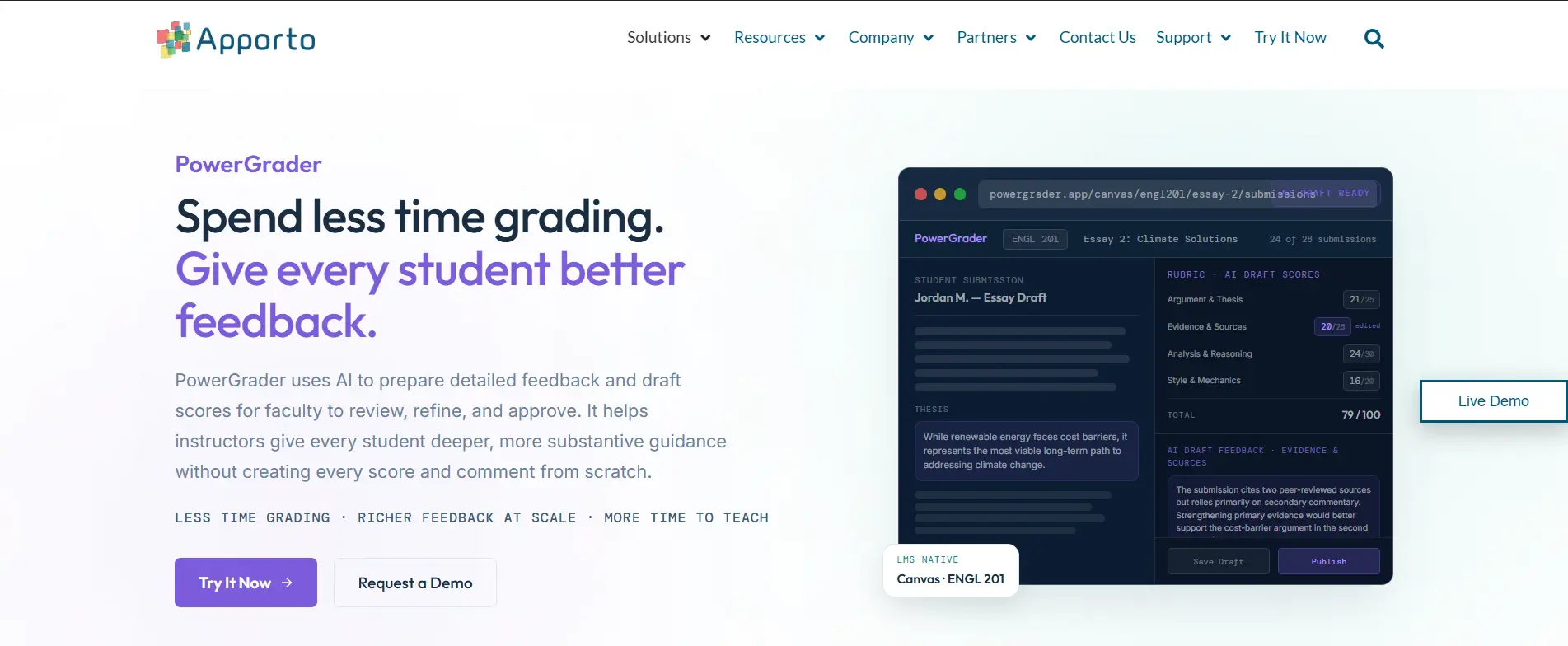
Apporto PowerGrader can help take some of that work off your plate. This AI-assisted grading platform uses instructor-defined rubrics to prepare suggested scores and feedback, giving you a starting point instead of having to assess every detail from scratch.
The important part? You still make the final call. AI-generated suggestions need checking, particularly when students present complex arguments, demonstrate critical thinking, or apply subject-specific knowledge.
How Does PowerGrader Help Instructors Review Essay Assignments?
PowerGrader supports rubric-based assessment while keeping you involved throughout the grading process. Here’s how it works:
- Prepare Your Rubric: Set the grading criteria, point values, and expectations students need to meet.
- Access Student Submissions: Work with assignments through PowerGrader’s supported learning management system (LMS) integrations.
- Get Scoring Suggestions: Receive AI-generated draft scores and feedback based on your rubric.
- Review and Adjust: Look through the suggested grades, check the comments, and correct anything that needs attention.
- Approve Final Grades: Review the completed assessment before grades are finalized.
This approach can reduce repetitive grading work while leaving important academic decisions in your hands. Want to see how it could fit into your grading process? Explore Apporto PowerGrader and its AI-assisted assessment features.
What Does the Future Hold for Automated Essay Scoring?
Automated essay scoring is still evolving, with researchers developing more advanced AI models and looking for better ways to assess student writing. Accuracy is a big part of that work. But researchers are also paying closer attention to whether scores are fair, easy to explain, and dependable across different writing tasks.
For educators, these improvements could make automated grading more useful. Still, newer technology doesn’t automatically mean better assessment.
How Are Researchers Improving AES Accuracy and Fairness?
One challenge researchers are working on is helping AES systems score essays on topics they haven’t encountered during training. A model might perform well on familiar prompts, but can it handle a completely different assignment with the same accuracy?
Researchers are also exploring ways to explain scoring decisions more clearly and assess specific writing skills, including organization, argument development, and language quality. Fairness matters, too. Testing models across different student groups helps reveal scoring differences that might otherwise go unnoticed.
The Hewlett Foundation’s Automated Student Assessment Prize (ASAP) contributed to AES development by making essay-scoring data and a competition benchmark available to researchers. The goal is to develop scoring systems that educators can properly test, understand, and trust.
Will Automated Essay Scoring Replace Human Teachers?
Automated essay scoring is unlikely to replace everything teachers bring to writing assessment. Software can analyze essays, suggest grades, and identify areas for improvement. But understanding how a student thinks, recognizing their progress, and helping them develop stronger arguments requires more than a numerical score.
You still need human judgment for complex reasoning, individual learning needs, and important grading decisions. In the end, the real value of automated scoring will depend on how much it helps students learn, not simply how quickly it processes their essays.
Final Thoughts
Automated essay scoring can take some of the pressure off grading, especially when you’ve got a large number of essays to review. It can speed up assessment, help keep scores consistent, and give students feedback while there’s still time to improve their writing.
But there are limits. Complex arguments, original thinking, and fairness aren’t always easy for software to judge accurately. That’s where your judgment matters. Before using AES, look at your current grading process. Which tasks take the most time? Where could automation genuinely make things easier?
Start with a clear rubric, test the scores, and review the results carefully. For additional support, explore Apporto PowerGrader and its AI-assisted rubric-based grading features.
Frequently Asked Questions (FAQs)
1. What Is Automated Essay Scoring?
Automated essay scoring (AES) uses computer software to evaluate written essays and assign scores. Depending on the system, it looks at writing features, follows grading criteria, or learns from essays that human graders have already assessed.
2. How Accurate Is Automated Essay Scoring?
Automated essay scoring can produce results that closely match human grades, but accuracy isn’t guaranteed. It depends on the model, essay topic, grading rubric, and training data, along with how thoroughly the system has been tested.
3. Can AI Grade Essays Better Than Human Teachers?
AI can grade essays faster and apply scoring rules more consistently, but that doesn’t mean it’s always better than human teachers. Instructors are generally better equipped to recognize original ideas, interpret subtle arguments, and understand the reasoning behind student writing.
4. What Are the Disadvantages of Automated Essay Scoring?
Automated essay scoring can struggle with complex arguments, unfamiliar writing styles, and cultural references. There’s also the risk of bias in training data or giving too much weight to essay length and vocabulary instead of meaningful content.
5. Can Automated Essay Scoring Provide Feedback to Students?
Yes. Many AES systems can provide feedback on grammar, vocabulary, organization, and writing clarity. Some also suggest ways to strengthen arguments. Still, instructor review helps ensure the feedback is accurate and addresses what students actually need to improve.
