

Is Apporto PowerGrader Better Than Smodin?
Apporto PowerGrader is the better choice for AI-assisted grading, combining rubric-based assessment, personalized AI feedback, LMS integration, and instructor oversight for consistent evaluation. While Smodin excels at AI writing, rewriting, and plagiarism detection, PowerGrader is purpose-built to streamline grading workflows in higher education.
Not every AI platform belongs in the same conversation. Some are built to help you evaluate student work with greater accuracy, while others focus on generating, rewriting, or analyzing written content. That distinction matters, yet it’s often overlooked when comparing educational AI tools.
Apporto PowerGrader and Smodin may both use artificial intelligence, but they are designed to solve different challenges. PowerGrader streamlines AI-assisted grading with rubric-based evaluation, while Smodin supports academic writing, AI detection, plagiarism checking, and content creation. Understanding where each platform excels is the key to making the right choice.
In this blog, you’ll learn how Apporto PowerGrader and Smodin compare across features, AI capabilities, grading quality, pricing, integrations, and overall value, helping you determine which platform best fits your educational or academic needs.
What Are Apporto PowerGrader and Smodin, and How Do They Differ?

Although Apporto PowerGrader and Smodin both use artificial intelligence, they serve very different roles in education. Understanding that distinction is the first step toward choosing the right platform for your needs.
Apporto PowerGrader is an AI-assisted grading platform built specifically for educators. Its primary purpose is to help instructors evaluate assignments more efficiently using dynamic rubrics, personalized feedback, and AI that adapts to an instructor’s grading style over time. Rather than replacing academic judgment, it automates repetitive grading tasks while keeping instructors in complete control of final evaluations. The platform also integrates with major Learning Management Systems, making it a natural fit for existing academic workflows.
Smodin, by comparison, is an all-in-one suite of AI writing tools designed primarily for students, researchers, and writers. It helps users draft content, rewrite text, generate citations, improve grammar, and check for plagiarism. Beyond content creation, Smodin includes AI detection capabilities that analyze whether text appears AI generated, making it useful for reviewing written work before submission. Its workflow centers on creating and refining content rather than evaluating it against academic rubrics.
The biggest difference comes down to purpose. PowerGrader helps educators assess student work with consistency and efficiency, while Smodin helps users produce, revise, and analyze written content. Although both platforms rely on AI, their core capabilities, target users, and academic workflows are fundamentally different.
Platform Overview
| Feature | Apporto PowerGrader | Smodin |
|---|---|---|
| Primary purpose | AI-assisted grading and rubric-based assessment | AI writing, rewriting, plagiarism checking, and AI detection |
| Best for | Educators grading essays and text-based assignments | Students, researchers, writers, and content creators |
| Target users | Schools, colleges, universities, and instructors | Students, educators, researchers, and general writers |
| AI functionality | AI-assisted grading, dynamic rubrics, personalized feedback | AI writing, rewriting, grammar improvement, citations, AI detection |
| Primary workflow | Assignment evaluation and instructor feedback | Content creation, revision, and text analysis |
| Learning Management System integration | Integrates with major LMS platforms such as Canvas and Blackboard | No native LMS-focused grading workflow |
| AI writing capabilities | Limited, focused on grading feedback rather than content generation | Comprehensive AI writing and editing tools |
| AI detection capabilities | Not designed as an AI detection platform | Built-in AI detection with detailed text analysis reports |
How Does Each Platform Use AI to Improve Academic Work?
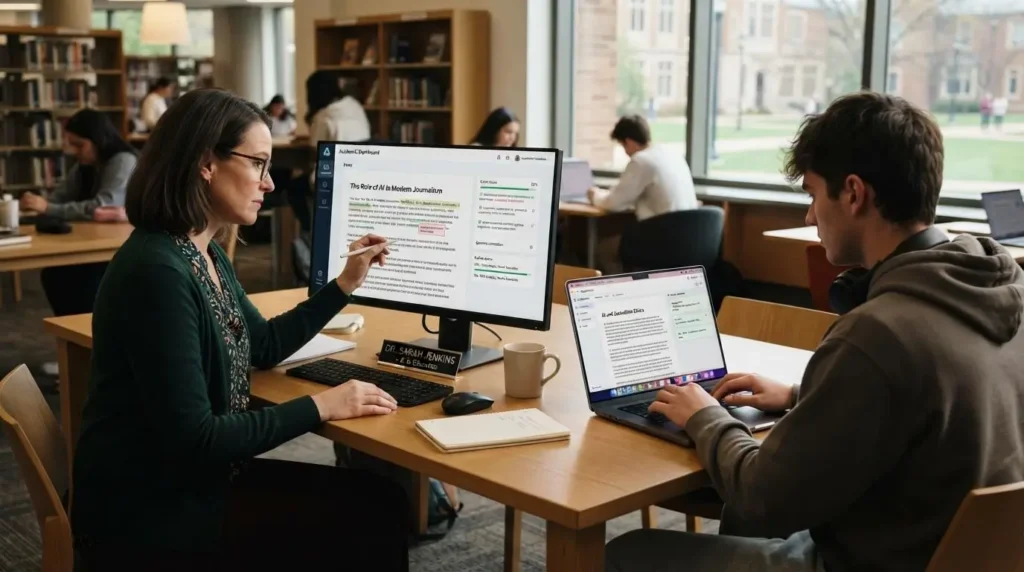
Artificial intelligence can improve academic work in different ways, depending on the problem you’re trying to solve. Apporto PowerGrader uses AI to simplify the grading process, while Smodin applies AI to help create and refine written content. Although both platforms reduce repetitive tasks, they support different educational outcomes.
Apporto PowerGrader combines AI-assisted grading with dynamic rubrics to evaluate assignments consistently and generate personalized feedback. Its machine learning capabilities adapt to an instructor’s grading style over time, producing rubric aligned feedback that reflects established assessment standards. Instead of replacing educators, the platform preserves the human touch by keeping instructors responsible for reviewing and approving final grades. This approach improves faculty efficiency without compromising academic quality.
Smodin focuses on the writing process. It uses AI to assist with draft generation, rewriting, grammar improvement, and citation creation, helping users produce clearer, more polished human written content. Rather than evaluating assignments, it supports students and writers throughout the content creation process, making writing faster and more accessible.
Main AI Strengths
Apporto PowerGrader
- AI-assisted grading for essays and text-based assignments.
- Dynamic rubrics that promote consistent evaluation.
- Learns an instructor’s grading style through machine learning.
- Generates personalized, rubric aligned feedback for every submission.
- Improves faculty efficiency by automating repetitive grading tasks.
Smodin
- AI writing assistance for academic and general writing tasks.
- Draft generation to accelerate content creation.
- Grammar improvement for clearer, more polished writing.
- AI-powered rewriting to enhance readability and structure.
- Citation generation to support academic writing and research.
Which Platform Produces Better Quality Results?

The quality of an AI tool depends on what you expect it to produce. If your goal is consistent grading and meaningful academic feedback, Apporto PowerGrader delivers higher-quality results by evaluating student work against instructor-defined rubrics. If your focus is creating or refining written content, Smodin provides a broad set of writing features that help improve drafts, grammar, and readability.
Apporto PowerGrader generates personalized feedback based on dynamic rubrics and adapts to an instructor’s grading style over time. This results in more consistent evaluations while preserving the instructor’s judgment. Instead of producing AI generated content, it analyzes student submissions and provides rubric-based recommendations that maintain academic standards and reduce grading errors.
Smodin approaches quality from a different angle. Its AI is designed to generate, rewrite, and improve text with more natural sentence structure and clearer wording. It can produce human like text for a variety of writing tasks, but the final output still benefits from human review to verify meaning, originality, and factual accuracy. Like most AI writing tools, the quality of the content generated depends heavily on the prompt and subsequent editing.
Output Quality Comparison
| Quality Area | Apporto PowerGrader | Smodin |
|---|---|---|
| Personalized results | Personalized grading and feedback based on instructor-defined rubrics | Generates customized writing based on user prompts |
| Rubric alignment | Strong rubric-based evaluation for consistent grading | Not designed for rubric-aligned assessment |
| Human-like output | Produces natural, personalized instructor feedback | Generates human-like text for academic and general writing |
| Writing quality | Focuses on improving the quality of grading feedback rather than writing content | Assists with drafting, rewriting, grammar improvement, and content refinement |
| Originality | Evaluates student work without generating new academic content | Helps create original drafts, but users should verify originality and accuracy before submission |
| Best fit | Educators seeking consistent, rubric-aligned assessment and high-quality feedback | Students and writers looking to create, revise, and improve written content |
Which Platform Offers Better AI Detection and Academic Integrity Support?

If protecting academic integrity is your priority, it is important to understand that Apporto PowerGrader and Smodin address different parts of the educational process. PowerGrader is built to help instructors assess assignments fairly and consistently, while Smodin includes dedicated AI detection and plagiarism tools for reviewing written content.
Smodin functions as an AI content detector that analyzes AI generated text and produces detection reports in approximately 2.6 seconds. According to the company, its AI detection model achieves 91% accuracy for identifying AI-generated content and 96.8% accuracy in multilingual testing.
It also integrates plagiarism checking with Google Scholar, giving users another way to review originality before submitting academic work. While some users look for ways to bypass AI detection or bypass AI detectors, these tools are intended to promote responsible writing and transparency rather than circumvent institutional policies.
Apporto PowerGrader takes a different approach. Instead of identifying AI-generated submissions, it focuses on instructor assessment through rubric-based evaluation and personalized feedback. This supports consistent grading while leaving academic judgment in the hands of educators, including situations where a professor reading an assignment needs clear, structured evaluation rather than automated AI detection.
AI Detection Comparison
| Feature | Apporto PowerGrader | Smodin |
|---|---|---|
| AI detection | Not a core feature | Detects AI-generated content with reported 91% accuracy |
| AI content detector | Not designed for AI content detection | Dedicated AI content detector with detailed analysis |
| Plagiarism checking | Not a built-in feature | Includes plagiarism checking with Google Scholar integration |
| Academic integrity | Supports fair, rubric-based instructor assessment | Supports originality checks through AI detection and plagiarism analysis |
| Detection reports | Focuses on grading insights rather than detection reports | Generates detailed AI detection and text analysis reports in about 2.6 seconds |
| Best fit | Educators seeking consistent assessment and instructor-controlled grading | Students, writers, and institutions reviewing AI-generated text and originality |
Which Platform Supports More Writing and Assessment Features?

The number of features a platform offers only matters if those features align with your workflow. Apporto PowerGrader and Smodin include AI capabilities, but they are built for different purposes. PowerGrader concentrates on assignment grading, while Smodin provides a broader collection of writing tools for creating and refining content.
Apporto PowerGrader is designed to evaluate essays and other text-based assignments using AI-assisted grading and dynamic rubrics. Instead of generating content, it helps educators deliver consistent, personalized feedback while reducing manual grading effort. This focused approach makes it especially valuable for institutions that prioritize accurate assessment over content generation.
Smodin offers more features for the writing process. It combines AI writing, AI rewriting, grammar improvement, citation generation, plagiarism checking, and text analysis into a single platform. It also supports file uploads in .doc, .pdf, and .xls formats, allowing users to analyze or revise existing documents.
From drafting articles and completing academic writing tasks to restructuring text for better readability, Smodin functions as an all-in-one writing assistant. Compared with many other AI tools, its broad feature set appeals to students, researchers, and writers who need help producing and refining content.
Ultimately, these platforms complement different academic workflows. If your priority is evaluating student submissions, PowerGrader offers the stronger assessment solution. If you need one platform for multiple writing-related tasks, Smodin provides a wider range of content creation and editing features.
Feature Comparison
| Feature | Apporto PowerGrader | Smodin |
|---|---|---|
| Essays | AI-assisted grading and rubric-based evaluation | Supports essay drafting, editing, and text analysis |
| Text-based assignments | Designed for grading written assignments with personalized feedback | Assists with creating, revising, and improving written content |
| AI writing | Not a primary capability | Generates content for academic and general writing tasks |
| Rewriting | Focuses on grading feedback rather than rewriting | AI-powered rewriting to improve clarity and sentence flow |
| Citation generator | Not a core feature | Generates citations for academic writing |
| Grammar improvement | Supports clearer instructor feedback | Grammar correction and writing enhancement tools |
| File uploads | Assignment submissions through supported educational workflows | Supports .doc, .pdf, and .xls file uploads for text analysis |
| Rubric grading | Dynamic rubrics with personalized, instructor-aligned assessment | Not designed for rubric-based grading |
| Best fit | Educators seeking efficient AI-assisted assignment grading and consistent assessment | Students, researchers, and writers looking for a comprehensive AI writing platform |
Which Platform Saves More Time and Improves Productivity?

One of the biggest reasons educators and students adopt AI is to save time without compromising quality. Apporto PowerGrader and Smodin both improve productivity, but they do so in very different ways. The better choice depends on where you spend the most effort in your academic workflow.
Apporto PowerGrader focuses on reducing instructor workload by automating repetitive grading responsibilities. Its AI automation evaluates assignments against dynamic rubrics, generates personalized feedback, and completes the initial grading pass while keeping instructors in control of every final decision. Instead of replacing academic judgment, it removes repetitive tasks that consume valuable hours, allowing you to provide consistent feedback with faster grading and greater efficiency.
Smodin improves productivity earlier in the writing process. It helps users generate drafts, rewrite passages, correct grammar, create citations, and refine academic content in less time. Rather than grading assignments, it supports faster writing by reducing the time required to organize ideas and polish documents before submission.
Both platforms offer meaningful productivity gains, but they serve different audiences. If your priority is evaluating student work more efficiently while maintaining instructor oversight, Apporto PowerGrader delivers the greater advantage. If your goal is accelerating drafting, editing, and revising written content, Smodin provides a practical collection of writing tools that simplify content creation.
Which Platform Fits Better Into Your Educational Workflow?

A platform becomes more valuable when it fits naturally into the way you already teach, grade, or manage assignments. While both Apporto PowerGrader and Smodin support academic work, their workflows are designed for different users and institutional needs.
Apporto PowerGrader is built for educational environments where grading, feedback, and course management are part of a connected ecosystem. It integrates with major Learning Management System platforms, including Canvas and Blackboard, allowing instructors to manage assignments without leaving their existing environment.
This seamless integration simplifies the faculty workflow, keeps student data centralized, and improves assignment management across courses. For colleges and universities, the platform’s scalability and straightforward implementation make institutional adoption easier while maintaining consistent grading practices.
Smodin, on the other hand, functions primarily as a standalone AI writing platform. Users create, edit, analyze, and improve content directly within the application rather than through an LMS. This approach works well for individual students and writers, but it is not designed to manage institution-wide grading workflows or integrate deeply into classroom management systems.
If your priority is improving teaching operations across departments, Apporto PowerGrader provides a more connected workflow. If you simply need AI assistance for writing and editing, Smodin offers a flexible standalone solution without requiring a broader educational infrastructure.
Workflow Comparison
| Workflow Feature | Apporto PowerGrader | Smodin |
|---|---|---|
| LMS integration | Integrates with major Learning Management Systems | Functions primarily as a standalone writing platform |
| Canvas | Native integration with Canvas | No native Canvas integration |
| Blackboard | Supports Blackboard integration | No native Blackboard integration |
| Assignment workflow | Streamlines assignment grading, feedback, and instructor review within the LMS | Supports content creation and editing outside institutional grading workflows |
| Student data | Keeps grading records and student data within institutional systems | Focuses on document creation rather than student data management |
| Implementation | Designed for institutional adoption with scalable deployment and implementation support | Quick individual setup with minimal onboarding, but limited institutional integration |
| Best fit | Schools and higher education institutions seeking scalable AI-assisted grading and streamlined faculty workflows | Students, researchers, and writers looking for an independent AI writing assistant |
Which Platform Offers Better Pricing and Long-Term Value?

Pricing is only one part of the decision. You should also consider scalability, available features, and the long-term value each platform delivers. Because Apporto PowerGrader and Smodin serve different audiences, their pricing models reflect different priorities.
Apporto PowerGrader is offered through enterprise licensing with institutional pricing tailored to schools, colleges, and universities. Instead of fixed monthly subscriptions, pricing is based on organizational requirements, deployment size, and implementation needs. This model supports long-term scalability and delivers stronger ROI for institutions looking to improve grading efficiency across multiple courses and departments.
Smodin uses a subscription-based model with three paid plans. The Basic plan starts at $12 per month, the Productive plan costs $24 per month, and the Ultimate plan is priced at $63 per month. Users can also choose annual plans for additional savings. While Smodin includes a free version, it is extremely limited, allowing only 3 writing credits per week. The platform does not offer a free trial, and several premium features, including higher usage limits and advanced writing capabilities, require a paid subscription.
If you are comparing long-term value, PowerGrader is the stronger investment for educational institutions, while Smodin offers flexible pricing for individuals who need AI writing assistance.
Pricing Comparison
| Pricing Area | Apporto PowerGrader | Smodin |
|---|---|---|
| Pricing model | Enterprise licensing with customized institutional pricing | Monthly and annual subscription plans |
| Public pricing | Custom quote required | Basic: $12/month, Productive: $24/month, Ultimate: $63/month |
| Free version | No public free version | Available, but limited to 3 writing credits per week |
| Free trial | Contact sales for demonstrations or evaluation options | No free trial |
| Paid plans | Enterprise plans based on institutional requirements | Three paid plans with additional premium features and higher usage limits |
| Enterprise licensing | Designed for schools, colleges, and universities with scalable deployment | Individual and team subscriptions, not enterprise-focused licensing |
| Best fit | Educational institutions seeking scalable AI-assisted grading with strong long-term ROI | Students, researchers, and writers looking for affordable AI writing tools |
Why Is Apporto PowerGrader the Better Choice for AI-Assisted Assignment Grading?
If your goal is to improve grading quality while reducing manual effort, Apporto PowerGrader stands out as the better solution. It combines AI-assisted grading with rubric aligned feedback to help educators evaluate essays and other text-based assignments faster without sacrificing consistency.
The platform generates personalized feedback, learns from instructor grading patterns, and keeps every final decision under instructor control. Its integration with major Learning Management System platforms also simplifies grading workflows, improves faculty efficiency, and supports seamless adoption across higher education institutions.
Rather than replacing academic judgment, PowerGrader enhances it with AI that works alongside instructors, making assessment more efficient, consistent, and scalable. Try Apporto PowerGrader
Frequently Asked Questions (FAQs)
1. Is Apporto PowerGrader better than Smodin?
It depends on your intended use. Apporto PowerGrader is the better choice for AI-assisted assignment grading, rubric-based evaluation, and instructor feedback. Smodin is designed for AI writing, rewriting, plagiarism checking, and AI detection rather than grading student work.
2. What is the biggest difference between Apporto PowerGrader and Smodin?
The biggest difference is their purpose. Apporto PowerGrader helps educators assess assignments using AI-assisted grading and dynamic rubrics, while Smodin helps students and writers create, edit, rewrite, and analyze written content with a variety of AI writing tools.
3. Which platform is better for AI-assisted grading?
Apporto PowerGrader is the stronger platform for AI-assisted grading. It evaluates essays and text-based assignments using dynamic rubrics, generates personalized, rubric-aligned feedback, and keeps instructors in control of final grades, making it well suited for educational institutions.
4. Is Smodin good for AI writing and academic writing?
Yes. Smodin is designed to support academic writing through AI-powered drafting, rewriting, grammar improvement, citation generation, and text analysis. It helps users produce and refine written content more efficiently, although human review remains important before submission.
5. Does Smodin include AI detection and plagiarism checking?
Yes. Smodin includes AI detection and plagiarism checking as part of its feature set. It analyzes AI-generated text, provides detailed detection reports, and integrates plagiarism checking with Google Scholar to help users review originality and academic integrity.
6. Can Apporto PowerGrader grade essays and text-based assignments?
Yes. Apporto PowerGrader is specifically built to evaluate essays and other text-based assignments. It combines AI-assisted grading with dynamic rubrics and personalized feedback, helping educators grade more consistently while maintaining complete instructor oversight.
7. Do both platforms support Learning Management Systems?
No. Apporto PowerGrader integrates with major Learning Management Systems, including Canvas and Blackboard, making it suitable for institutional grading workflows. Smodin primarily operates as a standalone AI writing platform and does not provide the same level of LMS integration.
8. Which platform is the better choice for schools, colleges, and universities?
For institutions focused on efficient grading and consistent assessment, Apporto PowerGrader is the stronger choice. Schools seeking an integrated AI grading solution will benefit from its LMS compatibility and instructor-centered workflow, while Smodin is better suited for individual writing and content improvement.
