

What Is an AI Tutor and How Does It Work?
An AI tutor uses artificial intelligence to provide personalized explanations, guided practice, and feedback based on students’ learning needs. Apporto CoTutor supports course-specific learning through Socratic questioning, structured hints, and assignment-aware guidance. It helps students understand difficult concepts, complete assignments independently, and develop critical thinking and problem-solving skills.
Some concepts take more than one explanation to sink in. Students might understand a lesson in class, then get stuck on the same topic while doing homework or preparing for an exam. And when that happens outside classroom hours, getting help isn’t always easy.
That’s where an AI tutor can be useful. These tools can explain difficult concepts, ask follow-up questions, and guide students through problems at their own pace. They also offer personalized support across different subjects, making it easier to revisit lessons whenever questions come up.
Of course, getting an answer quickly doesn’t mean you’ve understood it. In this blog post, you’ll learn how AI tutors work, where they can support student learning, and what universities should consider before introducing them into their courses.
What Is an AI Tutor, and How Does It Help Students Learn?

An AI tutor is a learning tool powered by artificial intelligence that helps students understand topics, practice skills, and work through questions. It can explain tricky concepts, offer hints, and provide feedback based on what a student needs help with, making studying more flexible.
You’ll find these tools in schools, universities, and online courses. Some are designed specifically for teaching, while others are everyday AI chatbots that students use to make sense of their coursework.
How Is an AI Tutor Different From a Regular AI Chatbot?
A regular AI chatbot usually gives you a response based on whatever you type. Ask it about a formula, and it’ll explain it. Ask another question, and it’ll move on. A dedicated AI tutor can take things further. Some track your learning progress, adjust question difficulty, and use course materials to guide you through problems.
Rather than handing over answers straightaway, they may encourage you to work things out yourself. Of course, features vary between platforms.
Who Can Benefit From AI Tutoring?
AI tutoring can be useful at almost any stage of learning. School students can revisit lessons they found confusing. University students can tackle tougher subjects and prepare for exams.
Language learners can practice grammar and vocabulary, while adults can explore professional skills or unfamiliar topics. Having extra help available when you’re stuck, and being able to learn at your own pace, is a big part of its appeal.
How Does an AI Tutor Work Step by Step?

An AI tutor works a bit like a conversation that builds as you go. You ask a question, get an explanation, and can keep digging until the concept starts to make sense.
Some tutors also remember your progress and adjust their guidance based on how you’re doing. Here’s how the process typically works:
1. Identify the Learning Goal: Start with a subject, homework problem, or skill you want to improve.
2. Check Your Starting Level: The tutor may ask a few questions or look at previous results to understand what you already know.
3. Analyze Your Question: AI examines your request and any available course materials to figure out what you’re asking.
4. Offer an Explanation or Hint: Difficult concepts get broken into smaller steps, with examples or hints to help you move forward.
5. Ask Follow-Up Questions: Instead of giving everything away, the tutor may ask questions that encourage you to work through the problem.
6. Provide Feedback: It checks your responses, highlights mistakes, and explains where your reasoning went wrong.
7. Adjust the Next Activity: Some platforms recommend easier exercises or more challenging lessons based on your progress.
What Technology Allows AI Tutors to Understand Student Questions?
Behind the conversation are technologies like generative AI, large language models, and natural language processing, which help software interpret questions and produce explanations.
Some tutors use multiple AI models or draw on approved learning materials for additional context. Apporto CoTutor, for instance, can consider course instructions, rubrics, and faculty expectations when helping students with assignments.
How Does an AI Tutor Personalize Learning for Each Student?

No two students learn at exactly the same pace. One might pick up a new concept after a single explanation, while another needs a few examples before things click. That’s where personalized learning becomes useful.
An AI tutor can adjust explanations, practice questions, and activities based on what you understand and where you’re getting stuck. The aim is to make studying feel less like following a fixed lesson plan and more like learning at your own pace.
How Does an AI Tutor Adapt to Your Knowledge and Learning Pace?
AI tutors can look at your answers, previous mistakes, and progress to work out what you might need next. Struggling with algebra? The tutor may return to basic equations before introducing something harder.
Once you’re getting the answers right and showing a clearer understanding, it can introduce more challenging exercises. Some platforms adapt in real time. Others use quiz results or progress reports to recommend the next lesson. It depends on how the system is designed.
Can AI Create a Custom Learning Pathway for Your Goals?
A custom learning pathway is a series of lessons, exercises, and assessments organized around a particular goal. Some AI tutors can build these plans using your current knowledge, grade level, and the skills you want to develop. They may also adjust how information is presented. Still, a preferred learning style doesn’t guarantee better results. What matters is whether you’re actually understanding the material and improving.
How Does Progress Tracking Help Students Improve?
Progress tracking shows where you’re doing well and which topics still need work. Quiz scores, completed lessons, and repeated mistakes can help an AI tutor recommend additional practice. Teachers can use that information too, giving students more focused guidance as they continue learning.
What Are the Main Benefits of AI Tutoring for Students?

Having someone explain a difficult topic when you’re stuck can make studying a lot easier. That’s one of the biggest draws of AI tutoring. Students can ask questions, revisit lessons, and get extra practice outside classroom hours. How useful that help turns out to be depends on the platform and how students use it.
How Does 24/7 AI Tutoring Help Students Study Independently?
Sometimes a question doesn’t come up until you’re halfway through your homework, long after class has ended. With an AI tutor, you can ask for an explanation, try practice questions, or go over a confusing concept without waiting for office hours. Many platforms work on computers and smartphones, so getting help is fairly convenient. And if something still doesn’t make sense? You can ask again.
Why Do Students Find AI Tutors Easier to Ask Questions?
Nobody enjoys asking the same question five times in front of a class. AI tutors give students space to admit they’re confused, request simpler explanations, and revisit topics without feeling embarrassed. That can make asking questions easier, although software can’t offer the personal encouragement a good teacher brings.
What Learning Benefits Can AI Tutors Provide?
Depending on the platform, students can get:
- Immediate Feedback: Catch mistakes during practice.
- Personalized Explanations: Get help suited to their understanding.
- Flexible Study Times: Learn outside regular classes.
- Repeated Practice: Revisit tricky topics.
- Multilingual Support: Study in supported languages.
- Independent Learning: Think through problems before seeing answers.
Used thoughtfully, these tools can help students become more active, confident learners.
What Subjects Can You Learn With an AI Tutor?
AI tutors can help with quite a few subjects, from mathematics and science to programming, languages, and professional skills. Some platforms specialize in one area. Others cover a broader range of topics, letting you move between subjects as needed.
Of course, the quality of the explanations can vary. A tool that’s good at explaining basic algebra might struggle with advanced research or complicated technical questions. Here’s where AI tutoring can come in handy:
| Subject | How an AI Tutor Can Help |
|---|---|
| Mathematics | Work through formulas, calculations, and problem-solving steps |
| Science | Explain concepts in biology, chemistry, and physics |
| English and Writing | Improve grammar, reading comprehension, and essay planning |
| Programming | Understand code, spot errors, and learn debugging techniques |
| History | Explore historical events, timelines, and different viewpoints |
| Languages | Practice vocabulary, grammar, and conversations |
| Business and Economics | Understand financial concepts, economic theories, and management principles |
| Professional Skills | Develop technical, communication, and workplace skills |
| Test Preparation | Practice questions and revisit difficult topics |
Can AI Tutors Help With University-Level Courses?
Yes, AI tutors can help students work through university coursework, technical subjects, and research-related concepts. But there’s a difference between explaining a topic and understanding what your professor expects. A general AI chatbot may know the subject without knowing your course requirements.
Apporto CoTutor can draw on course materials, assignment instructions, and faculty expectations to provide more relevant guidance. That added context is useful, though students should still verify important information.
How Can an AI Tutor Help With Homework and Difficult Assignments?

Getting stuck on homework happens. Maybe the instructions aren’t clear, a formula looks unfamiliar, or you understand the topic but can’t quite figure out how to start.
An AI tutor can help you untangle those problems with explanations, hints, and step-by-step guidance. The idea is to understand what you’re doing, rather than simply collect answers for submission.
Can an AI Tutor Explain Homework Problems Step by Step?
Yes, AI tutors can walk you through mathematics, science questions, coding exercises, and written assignments without overwhelming you with information. Take an algebra equation. Instead of solving it immediately, the tutor might ask, “What should you do first to isolate the variable?”
You try that step, get feedback, and move on. It’s a more manageable way to tackle difficult questions, and you’re still doing the thinking.
How Can Students Use AI Homework Help Without Copying Answers?
Try the assignment yourself first. Even a rough attempt gives you something to work with. If you hit a wall, ask the AI tutor for a hint, a simpler explanation, or help understanding where your reasoning went wrong.
You could also practice with a similar question before returning to your homework. Apporto CoTutor offers an attempt-first mode, allowing instructors to require students to try a problem before receiving further guidance.
Can AI Tutors Help Students Improve Their Written Assignments?
AI tutors can help organize essay outlines, develop arguments, explain grammar mistakes, and review early drafts. They can also point out where your writing needs stronger evidence or clearer reasoning. The aim is to help you become a better writer while keeping the actual work your own.
How Does the Socratic Method Make AI Tutoring More Effective?

The Socratic method is a teaching approach that helps students reach conclusions by answering carefully chosen questions. Rather than giving you the solution straightaway, an AI tutor can encourage you to think through a problem and understand why an answer works. It’s a useful way to build reasoning and problem-solving skills instead of memorizing solutions.
What Is the Socratic Method in AI Tutoring?
In AI tutoring, the Socratic method means using questions to guide students toward an answer. The tutor might offer a small hint, ask you to explain your thinking, or break a complicated problem into simpler parts.
Say you’re solving an equation. Instead of doing the calculation for you, it might ask, “Which operation would help isolate the variable?” Your response determines what comes next. You stay involved in the problem rather than watching the AI solve it.
Why Are Hints and Follow-Up Questions Better Than Giving Every Answer?
Figuring something out yourself takes effort. Sometimes, that’s exactly what helps the lesson stick. Educators call this productive struggle. Students try, make mistakes, receive guidance, and gradually build understanding.
A well-timed hint can help you move forward without spoiling the whole problem. Of course, endless questions aren’t helpful either. When someone is genuinely stuck, a clearer explanation may be more useful.
How Can AI Tutors Encourage Critical Thinking?
AI tutors can ask you to justify an answer, compare different approaches, or reconsider an assumption. Apporto CoTutor supports this through faculty-configured Socratic questions, structured hints, and attempt-first guidance.
The OECD’s 2026 education research also emphasizes the importance of thoughtful teaching methods when using generative AI. Better reasoning is the goal, not getting answers faster.
How Can AI Tutors Help Students Prepare for Tests and Exams?

Exam preparation can get messy when you’ve got several subjects to cover and no clear idea where to start. AI tutors can help organize your revision, create practice questions, and show you which topics need more attention. Instead of going over everything repeatedly, you can spend more time on the areas you’re struggling with.
How Do AI Tutors Generate Practice Tests, Quizzes, and Flashcards?
Many AI tutoring tools can turn your notes, lessons, and course materials into revision activities.
Depending on the platform, you can create:
- Practice Tests: Questions based on specific topics and difficulty levels.
- Short Quizzes: Quick checks to see what you’ve understood.
- Flashcards: Handy prompts for remembering formulas, definitions, and important facts.
- Answer Explanations: Feedback explaining why a response is correct or incorrect.
- Topic Reviews: Short summaries of key concepts from your study materials.
One thing to watch out for: AI can occasionally generate incorrect questions or answers. Check important details against your course materials.
Can an AI Tutor Identify Weak Areas Before an Exam?
Some AI tutors can examine your quiz results, previous answers, and learning progress to spot recurring mistakes. Keep getting questions about chemical reactions wrong? The tutor might suggest revisiting that topic before moving on.
More advanced platforms can also adjust question difficulty as your understanding improves. That makes revision more focused.
How Can Personalized Study Plans Improve Exam Preparation?
A personalized study plan organizes revision around your exam dates, available time, and weaker topics. AI tutors can recommend practice tests, lessons, and review sessions based on your progress. Just keep the plan realistic. Cramming everything into one evening rarely helps much.
How Does AI Tutoring Compare With Human Tutors?
A good human tutor brings more than subject knowledge. They can tell when you’re confused, explain things differently, and give you a little encouragement when a topic feels impossible.
AI tutors have their own advantages. They’re available on demand, can explain the same concept several ways, and let you practice without booking a session. Here’s how the two compare:
| Learning Factor | AI Tutor | Human Tutor |
|---|---|---|
| Availability | Often available anytime | Usually requires scheduling |
| Personalized Help | Adapts using learning data | Adjusts through experience and observation |
| Feedback | Can respond immediately | Offers personal, contextual feedback |
| Emotional Support | Limited emotional understanding | Provides genuine encouragement |
| Subject Accuracy | Can make factual mistakes | Depends on the tutor’s expertise |
| Critical Thinking | Uses hints and guided questions | Can explore reasoning more deeply |
| Cost | Free and paid plans available | Usually charges per session |
| Learning Accountability | Depends on platform features | Can provide regular follow-ups |
| Large-Scale Support | Helps many students at once | Limited by tutor availability |
So, which is better? For quick explanations, extra practice, and everyday homework questions, AI tutors can be quite useful. Human tutors bring personal attention and encouragement that’s harder for software to match.
Stanford’s August 2026 evidence brief also notes that research on AI-led tutoring is still developing compared with established human-led programs. Combining both approaches can give students a good balance of flexibility and personal guidance.
How Can Teachers Use AI Tutors in the Classroom?

In a classroom full of students, keeping everyone on the same page isn’t easy. Some pick things up quickly. Others need more time, a different explanation, or extra practice. AI tutors can help teachers manage those differences by offering additional guidance while they focus on teaching and supporting students.
How Can AI Tutors Support Different Learning Levels in One Class?
Students rarely learn at exactly the same pace. One student might still be working through the basics, while another is ready to tackle harder questions. AI tutors can adjust explanations, provide extra examples, and suggest practice activities based on individual progress.
That gives students room to learn at their own pace without changing the class’s overall learning goals. Accessibility matters here, too. Any tool you introduce should work with approved accommodations and assistive technologies.
Can AI Tutors Help Teachers Create Lessons and Practice Materials?
AI tools can help you put together draft lesson plans, worksheets, quizzes, vocabulary activities, and practice exercises. You can also ask for simpler explanations of difficult topics or questions suited to different grade levels.
But don’t skip the review. AI-generated materials can contain mistakes or miss important curriculum requirements. Check the facts, difficulty level, and learning objectives before bringing them into class.
How Can Teachers Control the Amount of AI Help Students Receive?
Too much help can make learning a little too easy. Teachers need to decide when students should receive hints, explanations, or direct answers. Apporto CoTutor lets faculty set assistance levels for courses and assignments, keeping AI guidance aligned with learning goals. Students get support, but they’re still expected to do their own thinking.
How Can Universities Use AI Tutors to Support Student Learning?

Supporting students across large university classes can be tough. Some need extra help with coursework, others get stuck after lectures, and online learners don’t always have easy access to their professors. AI tutors can help bridge those gaps with explanations, guided practice, and personalized support when students need it.
Why Is Course-Specific AI Tutoring Useful in Higher Education?
University assignments often come with particular readings, grading rubrics, and instructions that students need to follow. A general AI chatbot might explain a topic perfectly well but miss what the professor actually expects.
Course-aware AI tutors can work with approved learning materials and assignment instructions, making their guidance more relevant. They might explain a tricky concept from a lecture or help students understand what a rubric is asking for. That extra context helps, although AI-generated information still needs checking.
How Can AI Tutors Support Students Outside Classroom Hours?
Questions have a habit of appearing when office hours are already over. An AI tutor can help students revisit difficult lessons, practice concepts, or make sense of assignment instructions without waiting for the next class. That’s particularly useful for online learners and students with busy schedules. Of course, some questions still need a professor’s input.
How Can Universities Maintain Consistent AI Tutoring Policies?
Universities need clear rules about approved AI tools, academic integrity, student privacy, and acceptable assistance. Apporto CoTutor offers institutionally managed access, LMS-connected course context, and faculty-controlled guidance. These features help universities provide additional academic support while keeping educators involved in how AI is used.
What Does Research Say About the Effectiveness of AI Tutoring?

AI tutors can explain difficult topics, answer questions, and give students feedback almost instantly. Sounds useful, but does that actually lead to better learning? Research shows some promising results. Still, the benefits depend on the subject, students’ age, and how the tutoring system is designed and used.
Can AI Tutoring Improve Academic Performance?
A 2025 systematic review published in npj Science of Learning examined 28 studies involving 4,597 K–12 students. The findings were generally encouraging. AI-powered tutoring showed positive effects on learning and academic performance.
However, the benefits were smaller when researchers compared these tools with non-intelligent tutoring systems. So there’s reason for optimism, but the evidence doesn’t suggest that every AI chatbot will automatically help students earn better grades.
Why Does Human Support Still Matter When Students Use AI Tutors?
Giving students access to an AI tutor doesn’t mean they’ll use it regularly. A 2026 study involving elementary-school students found that human support increased engagement with an AI literacy tutoring platform by 71–80%.
Yet overall usage remained low, and students didn’t show improvements in reading achievement. That tells you something important. Getting students to use a learning tool and helping them actually learn are different challenges.
What Makes an AI Tutor Educationally Effective?
Good AI tutoring needs meaningful practice, thoughtful questions, accurate feedback, and teacher involvement. Students should have room to make mistakes, work through problems, and build understanding. Fancy technology alone won’t do the teaching.
What Are the Biggest Limitations and Risks of AI Tutoring?

AI tutors can make studying more convenient, but they have their shortcomings. And when students start relying on them for homework or difficult coursework, those limitations matter. Here are some risks worth keeping in mind:
- Incorrect Information: AI can sound confident while giving explanations that are factually wrong.
- Over-Reliance: Too much dependence on AI may weaken independent problem-solving and critical thinking skills.
- Instant Answer Dependence: Getting solutions straightaway can discourage students from figuring things out themselves.
- Limited Context: General AI chatbots may miss important course instructions or assignment requirements.
- Academic Integrity: Submitting AI-generated work without permission can violate university rules.
- Student Privacy: Uploading assignments or personal details to unapproved platforms can put sensitive information at risk.
- Unequal Access: Paid subscriptions, poor internet connections, and limited device access can leave some students behind.
- Motivation and Engagement: Studying independently can be difficult without encouragement from a teacher or tutor.
- Limited Emotional Understanding: AI can’t provide the genuine empathy and personal support that human educators offer.
These concerns have some research behind them. A 2025 study published in PNAS found that unrestricted AI assistance helped high-school mathematics students during practice but hurt their performance when they later worked without it. Guided tutoring safeguards largely reduced that problem.
The takeaway is fairly simple. Check AI-generated information, encourage students to work through problems themselves, and keep teachers involved. AI should help students learn, not do all the thinking for them.
What Features Should You Look for in an AI Tutor?
A long list of features might look impressive, but it doesn’t tell you much about how well an AI tutor actually teaches. What matters is whether students can understand difficult concepts, practice independently, and get useful guidance when they’re stuck. Accuracy, privacy, and ease of use deserve attention, too. Here’s what to look for:
| Feature | What to Evaluate |
|---|---|
| Personalized Learning | Adjusts explanations and difficulty to student needs |
| Guided Questioning | Encourages students to reason through answers |
| Subject Coverage | Supports relevant courses and academic topics |
| Course Context | Uses approved materials and assignment instructions |
| Homework Help | Provides hints, explanations, and feedback |
| Practice Tests and Quizzes | Creates questions for revision and self-assessment |
| Progress Tracking | Shows improvements and recurring difficulties |
| Feedback Quality | Gives clear, accurate, and useful explanations |
| Teacher Controls | Lets educators decide how much help AI provides |
| Multilingual Support | Explains topics in supported languages |
| Accessibility | Works with assistive technologies and different devices |
| Privacy and Security | Protects student information |
| Integration | Connects with existing educational platforms |
| Pricing | Clearly outlines free plans and additional costs |
Should You Choose a Free AI Tutor or a Paid Platform?
Free AI tutors can be handy for occasional homework questions, quick explanations, and extra practice. The catch? Some limit usage or keep certain features behind a subscription. Paid platforms may include personalized lessons, progress tracking, and more advanced learning tools.
Universities have additional requirements, including faculty controls, privacy safeguards, and course integrations. Before paying, try the tutor with actual learning tasks. A bigger price tag doesn’t necessarily mean better teaching.
How Does Apporto CoTutor Help Students Learn Without Giving Away Answers?
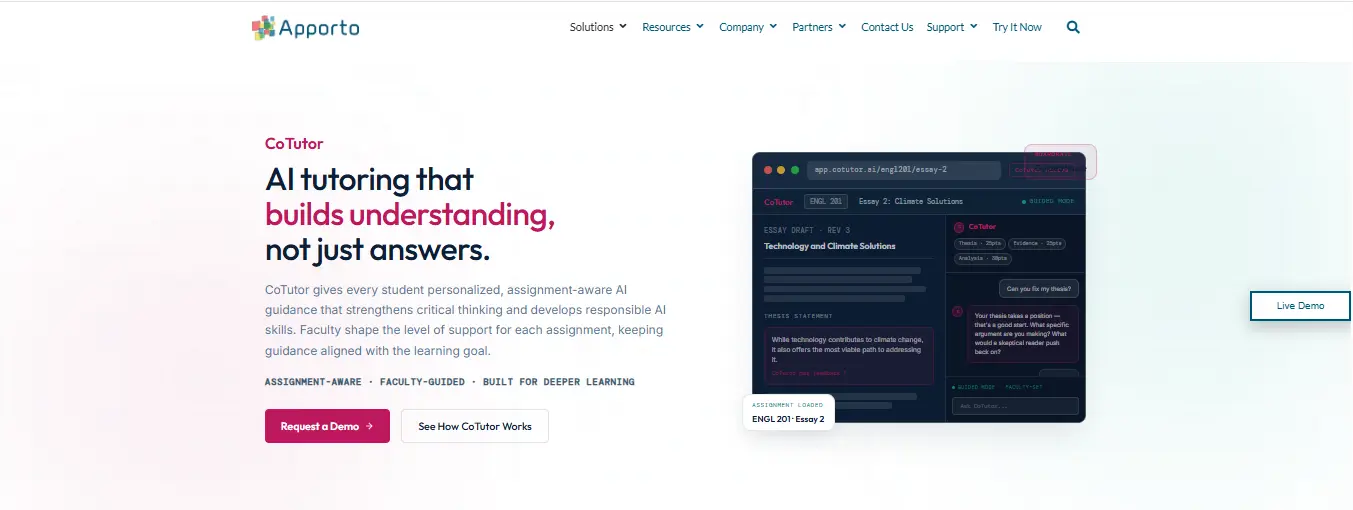
Apporto CoTutor helps students work through assignments without doing all the thinking for them. Unlike a general AI chatbot, it can draw on course materials, grading rubrics, and instructor expectations to provide guidance that fits what students are actually studying.
The idea is simple: help students understand the work, rather than hand them a finished answer.
How Does CoTutor Guide Students Through Assignments?
CoTutor offers several features that encourage students to stay involved in their learning:
- Course-Aware Guidance: Uses relevant course materials, instructions, and rubrics.
- Socratic Questions: Asks questions that get students thinking.
- Structured Hints: Breaks tricky problems into smaller steps.
- Attempt-First Mode: Lets faculty require an initial attempt before offering help.
- Pre-Submission Feedback: Gives students guidance based on assignment expectations.
- In-Tool Support: Provides assistance within supported academic applications.
Why Is CoTutor Useful for Faculty and Higher Education Institutions?
Teachers need a say in how much assistance students receive. CoTutor lets faculty configure support for different courses and assignments, while LMS connections keep guidance tied to coursework.
Universities can manage access centrally, too. Apporto also describes student-data safeguards, which institutions should review against their privacy requirements. Students get help when they’re stuck, while educators keep control over how that help is delivered.
How Can Schools and Universities Introduce AI Tutoring Responsibly?
Introducing AI tutoring into a school or university takes some planning. You need to consider what students actually need, how teachers will use the technology, and whether it fits your existing courses.
Privacy, accessibility, and academic integrity matter too. Before rolling out an AI tutor across your institution, test it with real coursework and see how students respond. Here are six steps to follow:
1. Define Learning Goals: Identify where students need extra explanations, guided practice, or help understanding assignments.
2. Choose Suitable Tools: Compare AI tutors based on accuracy, guided questioning, accessibility, privacy protections, and integration with existing platforms.
3. Set Assistance Rules: Decide when students can receive hints, examples, detailed explanations, or direct answers.
4. Run a Pilot: Test the platform with selected courses and student groups before introducing it more widely.
5. Train Educators and Students: Explain acceptable AI use, how to verify information, and why independent thinking still matters.
6. Monitor Learning Outcomes: Review student feedback, engagement, assessment results, and progress over time.
Remember, high usage doesn’t necessarily mean better learning. The real measure of success is whether AI tutoring helps students understand concepts, build skills, and become more confident independent learners.
Final Thoughts
AI tutors can make studying easier by offering personalized support, clearer explanations, and guided practice when students need a little extra help. Still, getting a quick answer doesn’t mean the lesson has sunk in. Students learn more when they’re encouraged to ask questions, work through problems, and think for themselves.
Accuracy, privacy, and academic integrity matter too. And good teachers? They remain essential. Apporto CoTutor helps bring these pieces together by providing assignment-aware guidance while letting faculty decide how much assistance students receive.
For universities, that means giving students extra support without making them dependent on ready-made solutions. Looking to bring responsible AI tutoring into your institution? Explore Apporto CoTutor and see how it can support student learning.
Frequently Asked Questions (FAQs)
1. What Is an AI Tutor?
An AI tutor is a learning tool that uses artificial intelligence to explain concepts, ask questions, and provide feedback. It helps students work through difficult topics and practice at their own pace.
2. Can an AI Tutor Help With Homework?
Yes, AI tutors can help with homework by explaining confusing instructions, breaking problems into smaller steps, and pointing out mistakes. They’re especially useful when you need a hint rather than a ready-made answer.
3. Are AI Tutors Better Than Human Tutors?
AI tutors are handy for quick explanations, flexible study times, and extra practice. Human tutors offer personal encouragement and deeper academic guidance. Neither is perfect, and using both can give students more complete support.
4. Can AI Tutors Help You Prepare for Exams?
Yes, AI tutors can create quizzes, flashcards, practice tests, and revision plans. Some can even identify topics you’re struggling with. Just remember to check generated questions and answers against your course materials.
5. Are AI Tutors Free to Use?
Some AI tutors offer free plans for basic homework help, explanations, and practice questions. More advanced features, higher usage limits, and personalized learning tools may cost extra. University-managed platforms often have separate pricing.
